
Toyota Corona 3rd generation (T40/50)
 |
|
|
Sales period |
September 1964 to January 1970 |
|
body type |
2 door hardtop |
|
Drive system |
rear wheel drive |
|
engine |
2R type 1,490cc OHV |
|
transmission |
2-speed AT / 3-speed MT |
|
Wheelbase |
2,420mm |
|
full length |
4,110mm |
|
Width |
1,550mm |
|
Height |
1,420mm |
|
vehicle weight |
945kg |
|
breaks |
4 wheel drum |
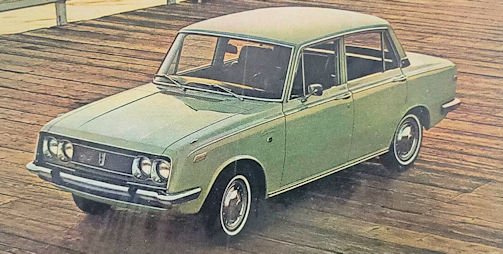
The third generation of the Toyopet / Toyota Corona was launched in September 1964 and replaced the T20. Meanwhile, a relentless fight between Datsun and Toyota sparked supremacy in the domestic market. This was fought on both sides mostly by the way of the press and went in the end as a BC war in the history.
September 1964 -Full model change. Taking advantage of the lessons learned so far, it was developed with the aim of creating a high-performance, high-quality car that can be used in overseas markets. The engine was the 2R type (1,490cc, 70 horsepower), which was an improved version of the R type engine, which had a reputation for durability and ease of use. The newly designed suspension reduces vibration and noise. In order to maintain ride comfort, comfort and equipment on a par with medium-sized cars, the overall length and width were increased by 60mm, and the interior width was increased by 40mm compared to the previous model. It featured a slanted front nose design called the "Arrow Line". As soon as the announcement was made, the "100,000 km continuous high-speed driving public test" was conducted on the newly opened Meishin Expressway . It ran a complete 100,000 km in 58 days, and its high-speed
performance and durability made it stand out from its predecessor, making its popularity soar.
PERFORMANCE 1500cc
ENGINE 1500 90.92 cu in, 1.490 cu cm
FUEL CONSUMPTION 32.1 m/imp gal, 26.7 m/US gal, 8.8 1 x 100 km
Max speed 87 mph, 140.1 km/h
max power (SAE):74hp at 5.000 rpm
max torque (SAE):86 1b ft. 11.8 kg m at 2,600 rpm
specific power: 49.7 hp/l
max speeds: 26 mph,41.9 km/h in 1st gear; 59 mph, 95 km/h in 2nd gear; 87 mph, 140.1 km/h in 3rd gear
power-weight ratio: 28.2 lb/hp, 12.8 kg/hp
acceleration: standing 1/4 mile 19.8 sec, 0—50 mph (0-80 km/h) 12.4 sec
In January 1965 , in the fierce sales competition with the Datsun Bluebird , the so-called "BC War," it surpassed the Bluebird in terms of sales for the first time, achieving the number one spot in domestic sales. After that, it continued to be overtaken for a while, but from around the end of 1965, it solidified its No. 1 position. The Corona continued to lead until 1968, when it was handed over to the Corolla . The original body variation was a 4-door sedan And from this generation, it was a 2/4 door van that was unified under the name of Corona (from this generation, the back door of the van became the back door of the hatchback, and it became a 3/5 door van) and a single/double pickup. Also, the rear number plate on the van pickup model was moved back to the center of the bumper. The steering gear was changed from a worm and sector roller to a recirculating ball (ball nut), the standard engine mainly for taxis was changed from a 1,200cc 2P type to a 1,350cc 3P type, and the Toyoglide became fully automatic. Things are mentioned. It is about 60kg lighter than the old Corona, and along with the improved engine, it achieves high performance, maximum speed (140km/h), and acceleration performance (SS1/4 mile 19.7 seconds).
In April 1965, Toyota completed the model series for the sports model Corona 1600S (T60). This got a Toyota 4R engine with a displacement of 1587 cc and two carburettors. The new engine had a power of 90 hp.In July, Toyota will once again expand its model range. With the Corona RT / 40 and the Corona RT / 50 , the company upgraded the Corona model series back to a superclass model.A market development was attempted with the Corona in November 1965 in Europe. All Corona model versions were also offered here in Europe. However, the planned sales volume was not reached because the vehicles were very difficult to sell and Toyota was still one of the unknown brands within Europe.
PERFORMANCE 1600 S Coupé
ENGINE CAPACITY 96.84 cu in, 1,587 cu cm
FUEL CONSUMPTION 37.6 ml imp gal, 31.4 m/US gal, 7.5 1 X 100 km
MAX SPEED 99 mph, 159.4 km/h
max power (SAE): 95 hp at 5,800 rpm
max torque (SAE): 95 1b ft, 13.1 kg m at4,200 rpm
max engine rpm: 5,800
specific power: 59.9 hp/l
max speeds: 28 mph, 45 km/h in 1st gear; 49 mph, 78.9 km/hin 2nd gear; 74 mph, 119.1 km/h in 3rd gear; 99 mph, 159.4 km/h in 4th gear
power-weight ratio: 22.7 lb/hp, 10.3 kg/hp
acceleration: standing 1/4 mile 18.5 sec, 0—50 mph (O —80 km/h) 9.6 sec
Another challenge for the Group was the introduction of international standards for the automotive market and new legal decrees in various countries. Thus, a standardization of models within the group was sought. Since almost everything was consistent in the Corona models, one could exploit the model as a project trial. And indeed Toyota succeeded in the Corona as the first model series to work out a uniform structure and adapt the vehicle to all new issued standards and bills. Thus it was now also possible to export the Corona to Africa and South America.
April 1965 Added "1600S" to compete with Bluebird, which enriched sporty models such as SS and SSS, with a 4R engine (OHV 1,587cc, SU twin carburetor, 90 horsepower), Corona's first front wheel disc brake , A 4-speed floor shift was adopted, and a tachometer and fully reclining bucket seats were adopted for the interior . In July of the same year, a 2-door hardtop (T50 series) with a pillarless structure was added for the first time in a Japanese car.In November, a 5-door hatchback sedan was added, which was also the first Japanese car . was the first to adopt the 5-door, which had started to appear. The hardtop was well received as a pioneer of the specialty cars that followed, but the 5-door sedan was not popular and sold only in small numbers. However, Toyota revived it in the 6th generation, and since then it has continued to make efforts to make this body form take root in Japan. Although it was exported to Europe and the United States as the Toyota Corona , it was well received outside of Japan, and the number of T40 series exports increased rapidly to 8,734 units in 1964, 23,096 units in 1965, and 60,864 units in 1966. In October, 80,058 units were set, setting a new record for exports of a single Japanese car model, and with the success of the T40 series, Toyota gained the top position in exports as well.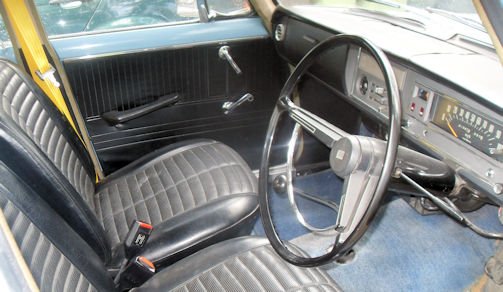
June 1966 -Mid-term model after minor changes. The horn ring has been changed and the front grill has a grid pattern.
June 1967 brought the Corona family again a facelift. The bumpers were replaced, as well as made small modification to the mold. Furthermore, Toyota now established the sister model Toyopet / Toyota Corona Mark II . The outdated Toyota 2P engine was replaced shortly afterwards by the new 3P engine with a capacity of 1350 cc. February 1967 - Production begins at Steel Brothers' Motor Assemblies in Christchurch , New Zealand .
June 1967 - Minor change. The front mask has been changed again, and the bumper position has been raised (in compliance with US safety standards). Due to the detail change of the front mask and rear later, the orange color of the rear lamp was omitted and the rear blinker and brake lamp/ tail lamp were integrated (combined use) (the design of the van pickup model was changed while remaining a combination type). For the hardtop, the reversing lights, which were independent in the previous and mid-term models, are integrated with the combination lights. September 1967 - When Toyota Motor Corporation achieved monthly production of 80,000 units, 30,000 of them were the 40 series Corona . In 1966, 252,492 units of the T40 series were produced, including vans, which is far behind the VW Beetle (1,295,834 units) in terms of the production scale of a single model, but Ford Cortina 's 243,384 units. It was second place, surpassing It was also knocked down by Shinshin Motors in South Korea (currently GM Korea ) . August 1967 - As a derivative model, " Toyota 1600GT " equipped with a DOHC 1,600cc engine using a 2-door hardtop body appeared.
April 1968 - The "Golden Series" appeared, equipped with the Corona's first SOHC 1,600cc ("7R" single carburetor, 85PS / "7R-B" SU twin carburetor, 100ps) engine, which was released in 9 of the same year. It was the advance introduction of the engine for the Corona Mark II, which will appear in January as a high-end model .
September 1968 - With the release of the Corona Mark II, the normal Corona was reorganized into a sedan (standard deluxe) with a 2R-type 1,500cc engine and a van only, and the 5-door sedan was abolished. There was also a significant price reduction. Hardtops, 1600s, and single/double pickups moved to the Mark II series.
VARIATIONS AND OPTIONAL ACCESSORIES
4-speed mechanical gearbox fully synchronized (1 3.673, Il 2.114, Ill 1.403, IV 1) central gear lever
Toyoglide automatic gearbox, hydraulic torque convertor and planetary gears with 2 ratios (I 1.820, II 1, rev 1.820)
3.700 axle ratio. 4.111 axle ratio; servo brake; heavy-duty battery.
The production volume of the third generation is 578,534 .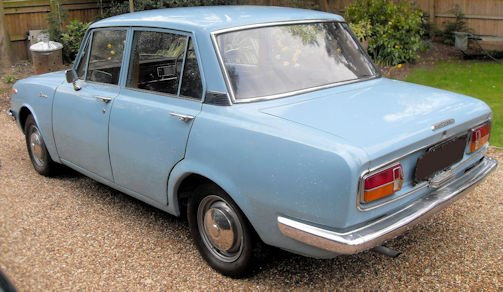
Related
Technical
-
DIMENSIONS AND WEIGHT
wheel base: 95.28 in. 2,420 mm
front track: 50in, 1,270 mm
rear track: 50 in. 1.270 mm
overall length: 162.05 in, 4,116 mm
overall width: 61-02 in, 1,550 mm
overall height: 55.91 in, 1,420 mm
ground clearance:7.09 in, 180 mm
dry weight: 2,084 1b, 945 kg
distribution of weight: 57.6% front axle,42.4% rear axleTRANSMISSION
1500
driving wheels: rear
clutch: single dry plate
gearbox: mechanical; gears: 3 + reverse
gearbox ratios: I 3.337,II 1.653, III 1, rev 4,449
gear lever: steering column
final drive: hypoid bevel
axle ratio: 4.110.1600 S Coupé
gearbox: mechanical; gears: 4 + reverse; synchromesh gears: l, Il, Ill, IV;
gearbox ratios: 1 3.673,Il 2.114, Ill 1.403, IV 1, rev 4.183
gear lever: central
final drive: hypoid bevel
axle ratio: 3.700.CHASSIS
integral
front suspension: independent. wishbones, longitudinal torsion bars, anti-roll bar. telescopic dampers
rear suspension: rigid axle, semi-elliptic leafsprings, coil springs, telescopic dampers.STEERING
worm and roller.
turning circle (between walls): 34 ft. 10.4 mBRAKES
1500 drum. 2 front leading shoes lining area: total 132.40 sq in, 854 sq cm.
1600 Sport front disc, rear drum
lining area: front 15.80 sq in, 101.91 sq cm, rear 48.70 sq in, 314.11 sq cm, total 64.50 sq in, 416.02 sq cm.ELECTRICAL EQUIPMENT
voltage: 12 V
battery: 40 Ah
dynamo: 360 W
ignition distributor: Nippon Denso
headlamps: 4ENGINE 1500
front. 4 stroke
cylinders: 4, in line
bore and stroke: 3.07 x 3.07 in, 78 x 78mm
engine capacity; 90.92 cu in, 1,490 cu cm
compression ratio: 8
cylinder block: cast iron
cylinder head: cast iron
crankshaft bearings: 3
valves: 2 per cylinder, overhead, push-rods and rockers
camshafts:1, side
lubrication: rotary pump. filter on by-pass
carburation: I Aisan downdraught twin barrel carburettor
fuel feed: mechanical pump
cooling system: waterENGINE 1600 S Coupé
front, 4 stroke
cylinders: 4, vertical, in line
bore and stroke: 3.17 x 3.07in, 80.5 x 78 mm
engine capacity: 96.84 cu in, 1,587 cu cm
compression ratio:9.2
cylinder block: cast iron
cylinder head: cast iron
crankshaft bearings: 3
valves: 2 per cylinder, over-head, in line, push-rods and rockers
camshafts: 1, side
lubrication: rotary pump,filter on by-pass
lubricating system capacity: 6.15 imp pt, 7.40 US pt, 3.5 1
carburation: 2 Aisan type SIJ horizontal carburettors
fuel feed: mechanical pump
cooling system: water© Motor car History
Service
-
1500cc
fuel: 95-100 oct petrol
engine sump oil: 5.46 imp pt, 6.55 US pt, 3.1 1, SAE 20 (winter) 30 (summer), change every 1,900 miles, 3,000km
lubricating system capacity:6.16 imp pt, 7.40 US pt. 3.51
gearbox oil: 3.17 imp pt, 3.81 US pt, 1.8 1, SAE 90, change every 11,200 miles 18,000 km
final drive oil: 1.76 imp pt, 2.11 US pt, 1 1, SAE 90, change every 11,200 miles, 18,000 km
steering box oil: 0.50 imp pt, 0.63 uS pt, 0.3 1, SAE 90
cooling system capacity: 12.60 imp pt. 15.22 US pt. 7.2 1.
greasing: 13 points
tappet clearances: inlet 0.008 in, 0.20 mm, exhaust 0.014 in, 0.35 mm
tyre pressure (medium load): front 23 psi, 1.6 atm, rear 20 psi, 1.4 atm.
tyres: 5.60 x 13
fuel tank capacity: 9.9 imp gal, 11.9 US gal, 45 1.
carrying capacity:882 1b,400 kg1600 S
fuel: 100 oct petrol
engine sump oil: 6.15 imp pt, 7.40 US pt, 3.5 1, SAE 20 (winter) 30 (summer), change every 3,000 miles, 4,800km
gearbox oil: 3 imp pt, 3.59 1-uS pt, 1.7 1, SAE 90, change every 20,000 miles,32,200 km
final drive oil: 1.75 imp pt, 2.11 US pt, 1 1, SAE 90, change every 20,000miles, 32,200 km
greasing: every 6,000 miles, 9,700 km, 12 points
cooling system capacity: 13.75 imp pt, 16.49 US pt, 7.8 1.
tappet clearances: inlet 0.008 in, 0.20 mm, exhaust 0.014 in, 0.35 mm
valve timing: inlet opens 26° before tdc and closes 66° after bdc, exhaust opens 66° before bdc and closes 26° after tdc
normal tyre pressure: front 23 psi, 1.6 atm, rear 21 psi, 1.5 atm.
coupe carrying capacity: 706 1b, 320 kg;
-Note: More Specifications and Repair Manuals available for registered users-
© Motor car History
