
Renault 4CV
 |
|
| Mark | Renault |
|---|---|
| Years of production | 1947 to 1961 |
| Production | 1,105,547 copies |
| Class | Motor Car |
| Assembly plant(s) | Billancourt, Flins |
| Fuel | Petrol |
| Engine(s) | Billancourt 760cc 747cc |
| Engine position | Rear |
| Maximum power | SAE - 18 to 35 hp |
| Gearbox | 3 gears |
| Unloaded weight | 610 kg |
| Bodywork | Hatchback |
| Brakes | Drum brakes |
| Length | 3663mm |
| Lenght | 1430mm |
| Height | 1450mm |
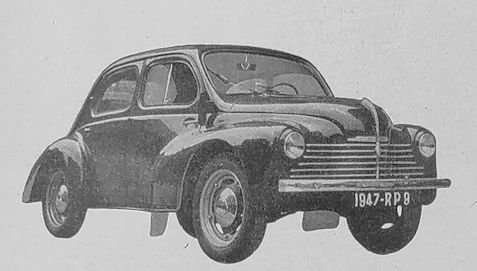
The Renault 4CV , from the French manufacturer Renault , is a car designed during the ending reign of Louis Renault and under the responsibility of two talented engineers, Fernand Picard and Charles-Edmond Serre. It is first presented in following the development of three prototypes , two of them secretly during the Occupation. It's a small car, but it's particularly spacious for its era and its exterior dimensions.
The Renault 4CV symbolizes the return of peace and prosperity because it is the first car accessible to the greatest number of people . The 4CV was the best-selling car in France until 1955 . It is the first French to reach a production of one million copies .
Production begins and will be mainly carried out in Billancourt , but part will also be done at the Flins factory ( Seine et Oise ). It will last from 1947 to 1961 , from year of release of the final 1,105,547 and copys . Along with the Dauphine , the 4CV was, for nearly fifteen years, the main model marketed by Renault . The Renault 4CV was designed in near-secret, in full secrecy, during the Second World War , at a time when French companies in the occupied zone were under German control . Two Renault executives, Serre and Picard, opposed to collaboration with the occupier and who would later join the Resistance , in to Obegin designing this popular small car in anticipation of post-war .
Charles-Edmond Serre, 58, is one of Louis Renault's early companions; an industrial designer, he became a director of the company and director of studies and research . Fernand Picard, one of his main assistants, joined the car manufacturer in 1935 and was then the director of the design office .Fernand Picard works with a very restricted group of collaborators . Known under the code name "106 E", the prototype was only completed after two years, in . Its general structure could suggest that its designers were inspired by the Volkswagen Beetle , particularly for its rounded front , but this hypothesis is not always accepted and even seems surprising. Indeed, in 1946 , Marcel Paul , Communist Minister of Industrial Production invited Ferdinand Porsche , at that time a prisoner in France , to give his opinion on the future Renault 4CV. Nevertheless, Pierre Lefaucheux is furious with this initiative and very quickly expresses his dissatisfaction to the Prime Minister :“I agreed to submit a file to Professor Porsche concerning the 4CV, we are currently carrying out the tools. We will of course study with the greatest attention the remarks which could be made but it is understood that we will remain the only judges of the advisability of following or not following its possible suggestions” . The Minister insisted, nine meetings will take place, but the intervention will have no influence on the 4CV. “We estimate that the 4CV can be launched in series within a year ,” Porsche told the minister's representatives.
Made of aluminum, this prototype has only two doors and its style is rather unattractive. Miraculously escaping a bombardment aimed at the Renault factories, the prototype made its first laps on, around Meudon. With a displacement of 760 cc , it reaches 84 km/h . Two events accelerated the evolution of the model: the Liberation and the arrest of Louis Renault for acts of collaboration and, subsequently, the appointment of Pierre Lefaucheux at the head of the National Board of Renault factories as temporary administrator in and CEO in . This one seizes the interest of the project and imposes to improve the model. Very soon after taking the helm of Renault, Pierre Lefaucheux carried out a few tests on a Renault 4CV prototype. He is therefore convinced to resume the design of this model, while making some modifications. He then decided to replace the two-door with a four-door version, having had difficulty due to his tall stature entering the rear of the prototype . Lefaucheux has no particular affection for the automobile in general. .
It is therefore in that the third and last prototype, close to the production version, is born. Unlike the two previous ones, this prototype is equipped with four doors, thus orienting the vehicle towards the family category . In 1946, the engineers realized that the height of the headlights was not legal. However, the machine tools are already manufactured. This is how Fernand Picard managed to get the National Automobile Commission to propose changing the height of the headlights to 550 mm .
The production of the Renault 4CV did not start until the summer of 1947 , due to the damage suffered by the industries during the war and the delays necessary for the restoration of the machines, in the form of a series of 300 copies intended for the dealers who will thus ensure the promotion of the car . The 4CV becomes the only new post-war Renault model (the Juvaquatre station wagon continues to be produced). The first production 4CV comes down from the assembly lines on Île Seguin on . The 4CV was a success : daily production was 15 vehicles in 1948 to reach 375 units in 1950, an impressive number for the time.The 4CV evolved over the years: the most striking changes were, on the 1954 models , the abandonment of the six-bar "mustache" on the front face, in favor of a simpler one with three bars , then the adoption, together with the Dauphine and a few years before the end of production, of wheels with solid rims instead of the previous wheels with removable star rims.
Its main technical characteristics are a " Billancourt engine " placed in a rear overhang with three levels, of 760 cm 3 (for the first models), then 747 cm 3 from , four-cylinder, overhead valves and side camshaft , developing 17 then 21 hp ; a three-speed manual gearbox , with non-synchronised 1st.The radiator , located between the engine and the rear bench seat, although weakly supplied by the two air vents located at the bottom and in front of the rear fenders, cools the engine sufficiently, to the point that a curtain controlled from the interior makes it possible to limit cooling , which is excessive in winter. In this same season, it was on the other hand difficult to heat the uninsulated cabin, the windows were adorned with fog from the first cold snap. However, hot air vents were provided at the base of the windscreen and, from 1958, the 4CV was equipped, like the Dauphine, with an excellent Sofica heater which definitively solved the problem .
From the 1956 models, a Ferlec brand electromagnetic clutch was offered , which would be used on the Dauphine . Presented at the 1954 Paris Motor Show , the Ferlec automatic clutch, studied and developed by Ferodo , was offered in the catalog the following year. However, series production will only take place in and concerns approximately three hundred vehicles per month. This device can be fitted to all models, as an option only. The removal of the clutch pedal from a small production car marks an important step in the practical evolution of the automobile. The tightening of the friction disc between the two plates is carried out thanks to the action of an electromagnet powered by the dynamo. The clutch pedal is removed in favor of a switch, placed under the gear lever, which automatically controls the clutch. An inverter button, placed on the underside of the dashboard support, allows you to connect the clutch to the battery to take advantage of the engine brake during a prolonged descent or to immobilize the car on a slope. Externally, the signature " Ferlec automatic clutch " appears on the rear cover.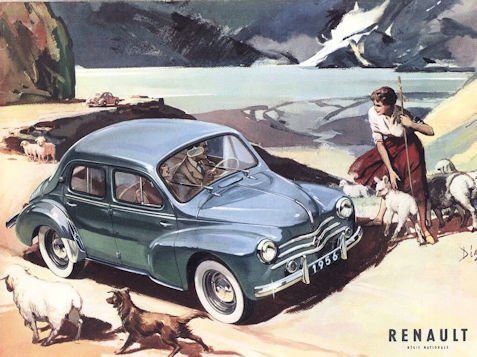
Related
Technical
-
Layout: rear-engine
rear-driveBody Construction:
steel unibody.ENGINE (760 cc)
Inline, overhead-valve four-cylinder.
Cast-iron block and aluminum head (removable cylinder sleeves).
Displacement: 46.3 cid (760 cc).
Bore & Stroke: 2.16 x 3.15 ln. (55 x 80 mm).
Compression Ratio: 6.7:1.
Brake Horsepower: 19 at 4000 rpm.
Torque: 32.6 lbs.-ft. at 1500 rpm.
Three main bearings.
Solid valve lifters.
One inverted carburetor.
6-volt electrical system.CHASSIS:
Wheelbase: 83 in.
Overall Length: 141.5 in.
Height: 56 in.
Width: 56 in
Front Tread: 47 in
Rear Tread: 47 in.
Standard Tires: 5.00x15.
Transmission
three-speed manual (floor lever).
Standard Final Drive Ratio: 4.3:1
Steering: rack and pinionSuspension
(front): independent with coil springs.
Suspension (rear): independent with swing axles and coil springs.Brakes:
Lockheed hydraulic,
front/rear drum.Note:
All engines and full specifications available for registered users© Motor car History
