
Hungary
Via (Villamos Autógyár Részvény Társaság)
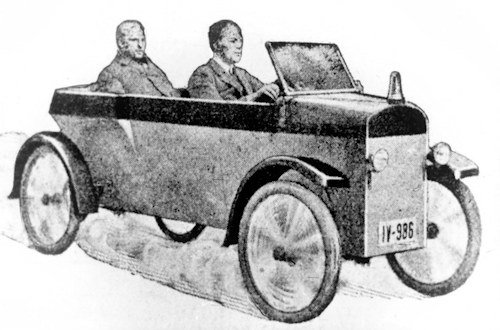
Villamos Autógyár Részvény Társaság was a Hungarian manufacturer of automobiles in the 1920s. The brand name was Via.
History
The company from Budapest began in 1921 with the production of small electric automobiles. The model offered was a two-seater electric cyclecar type small car with the simple body made from wood. capable of a 50 km range on a single charge with around 2 horsepower. The seats were also arranged in tandem one behind the other. The design maximum speed was specified at 35-40 km / h.
In 1923 the vehicle production was stopped after only a few copies built.
MÁVAG History (Magyar Királyi Államvasutak Gépgyára)
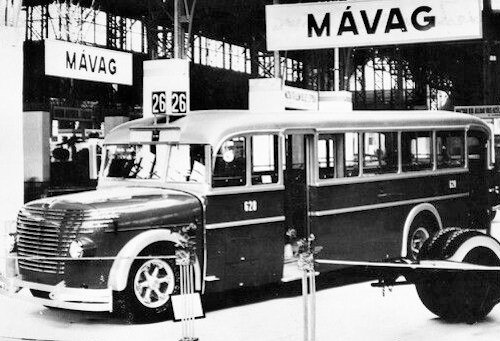
Magyar Királyi Államvasutak Gépgyára, short MÁVAG was a Hungarian locomotive and wagon factory owned by the Kingdom of Hungary that built Commercial vehicles and Cars. After the Second World War MÁVAG was nationalized and the addition "Királyi" (Royal) was deleted from the company name.
History
The factory was located in the 8th district of Budapest, adjacent to the streets Kőbányai, Hungária, Vajda Péter and Orczy. It was next to Ganz & Cie the most famous Hungarian machine factory in the 19th century. MÁVAG became known above all for its steam locomotives produced from 1873 onwards. For the millennium of Hungary in 1896 MÁVAG delivered the 1000th locomotive to the Hungarian state railway MÁV. Engineers of the company played a decisive role in the development of electrical engineering. Károly Zipernowsky, Miksa Dériand Ottó Titusz Bláthy brought the transformer to series maturity in 1885. Kálmán Kandó introduced the railway operation with three-phase current in 1900/1902 they also supplied parts for the postal parcel delivery vehicle completed in 1905. After 1924 MÁVAG built the famous locomotives of the MÁV class 424.
In the interwar period after the First World War: the assembly of Austro-Fiat licensed trucks previously manufactured by Ganz-Fiat continued. In 1925, an agreement was made with MAG, according to which the trucks and their engines would be manufactured jointly. MÁVAG produced trucks, trolleybuses, buses and automobiles MÄVAG produced the chassis and raw material for the engines, while MAG performed the task of assembling the engine. Later In 1926, they bought the license to manufacture commercial vehicle chassis made by the German Neue Automobil-Gesellschaft (N.A.G). Four truck types chassis began to be produced four-ton and six-ton bus chassis, three-ton and five-ton trucks all with a six-cylinder engine. Mercedes-Benz also produce commercial vehicles in the 1920s at the Benz plant in Gaggenau. In 1927, Mercedes-Benz's had a new range of trucks MÄVAG purchased the license for the range with new MÄVAG-Mercedes buses. MÄVAG-Mercedes commercial vehicles continued into the 1930s to this end, 1936 Ford acquired a license for the production of the Ford Eifel and in 1939 the Ford V8 according to industrial protection laws, rental cars could only be purchased from a domestic manufacturer -
however, there was no domestic car factory. The MÄVAG-Ford collaboration lasted until the Second World War. During the Second World War In 1938, MÄVAG was commissioned by the military to produce a prototype of an all-terrain truck, tanks and other war material were made. These included the licensed production of the Italian Reggiane Re.2000, as well as their MÁVAG own development Hejja II.
After the war, MÄVAG resumed car production of essentially the pre-war earlier Mercedes Benz models.
Fejes Lemezmotor és Gépgyár

Fejes was a Hungarian manufacturer of automobiles in the 1920s.
History
Jenő Fejes had worked for MAG with the design of aircraft engines. In 1922 he founded the company Fejes Lemezmotor és Gépgyár in Budapest at a former military warehouse building for the production of automobiles the self-produced cars came to production in around 1923. The model was equipped with a four-cylinder engine with 1244 cc capacity equipped and a four-seat body. Several vehicles with different superstructures were produced for the Post Office. In 1928 replacing heavy cast and pressed parts with a light quality plate construction gave the low curb weight chassis built with the principles of modern light machine construction as were other parts
giving durability and reliability in theory at least. while the electrical equipment the and gauges wheel brakes were bought from abroad. the cars proved unreliable and by 1929 production was stopped.
Puli HÓDGÉP

Puli was a Hungarian micro car brand from the 1980s and 1990s.
History
The first in 1986 Hódmezővásárhely based agricultural machinery and automobile manufacturers Hódmezővásárhelyi Mezőgazdasági és Szolgáltató Gépgyártó Vállalat (agricultural machinery manufacturers and service providers), short HODGEP, was marketed.
HÓDGÉP built from 1974 various agricultural machinery, including tillage machines, tractors, combine harvesters, and finally from 1987, also micro-cars.
In the mid-1980s, the import-export company "Techno Impex", which made deals between countries like Hungary and the West, turned to HÓDGÉP with the proposal to build a small city car. The leaders at HÓDGÉP gladly took up the proposal, because the Hungarian economy was suffering from currency shortage at that time, and they saw it as a chance to open up new markets for themselves. After the oil crisis in the late 1970s were microcars in high demand, especially in countries like France and Italy.
So, in 1986 the first designs for the new small car were made. It was first called "Hungi" and "Pouli"; later it became "Puli". In 1987 the first mobile prototypes were available.
The Puli is 2460 mm long and was assembled from parts of Skoda, Lada and Polski Fiat, which were then available in the country. The car is powered by a diesel engine that delivers 6.4 hp (4.0 kW). In the spring of 1988, when the decisive ramp-up of series production took place, an attempt was made to eliminate systematically existing quality problems. Was in the first prototype still a Yanmar diesel engine installed with 273 cubic centimetres, so this was later replaced by a diesel from Lombardini . The body is made of fiberglass reinforced plastic, mainly was intended for export to France, where this category of automobiles is license-free.
At the beginning of 1991, an electric car model was created under the name Fridez Pinguin 4. It came about through the acquisition of early Puli stocks with subsequent conversion to electric cars. The limited small series production of the Penguin 4 is due to the business activity of the Swiss solar and electric car builder Bruno Fridez. However, this project did not last long because the manufactured products did not meet the quality expectations of that time.
At that time, economic change in Hungary HÓDGÉP was privatized. As part of this privatization was established in early 1991, the Puli Jármű és Gépgyártó Kft (Puli vehicle and engine manufacturing Ltd.) was founded, whose Managing Director Alexander Pikali was. Since Pikali was dissatisfied with the business situation, as far as the Puli was concerned, he decided to break with Hardy and Fridez and go their own way. The manufactured by the newly established company puli 2 E . A complete overhaul of the entire powertrain. It is a construction, in which a 7.4 kW electric motor (more precisely: a direct current machine in series connection) with downstream reduction gearbox with differential and 10 lead-acid batteries of 6 volts were installed. The resulting Puli reaches a range of 30-100 km and a maximum speed of 60-70 km / h. On the chassis, the body styles "convertible", "hatchback" and "Transporter".
Borrowings on the debit side weighed heavily on the company in relation to the generated revenues, when lenders realized in 1992 that things were not going so smoothly, they sought bankruptcy protection. But at the end of 1996, lenders liquidation eventually prevails.
In 2006, the Puli came back under the new owner Henrik Harasta . Harasta owns the trademarks Puli and Wartburg.
Alma Automotive manufacturer
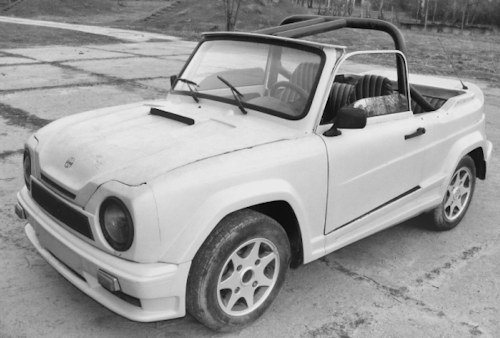
Alma was a Hungarian car brand from the 1990s. The brand name was Alma .
History
A Hungarian sculptor manufactured a vehicle in 1990 and named it Papillon. Imre Pápa, head of Pápa & Pápa Kft , Biharkeresztes , which produced canned goods, acquired the rights a few years later. 1995 began the production of automobiles.
The model was based on a Trabant. For the drive was provided by a small motor from the Fiat 127 or the Fiat Panda. The engine power was 45 hp. The body consisted of plastic open body. A roll bar provided some security. The build quality vehicle is described as bad.
1996, the production ended. Overall, emerged only a few copies.

