
Switzerland
- Details
- Parent Category: History
- Category: Switzerland
- Hits: 40
MBM automobiles History
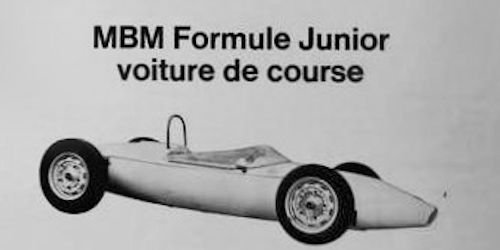
MBM was a Swiss automobile manufacturer, which produced in the early 1960s in small numbers racing cars and also road sports cars.
History
The company, led by Peter Monteverdi , is the forerunner of the sports car manufacturer Automobile Monteverdi , which from 1967 built coupes, sedans and SUVs of the upper class for about one and a half decades.
Peter Monteverdi owned in Binningen in the Swiss canton of Basel-Landschaft, a company that developed in the 1960s from a repair shop for trucks to a thriving commercial operation with representations of various European sports car brands. Monteverdi was temporarily licensee for Ferrari , Lancia , Bentley , Jensen and BMW.
In the 1950s he participated as a racing driver in various events. At the same time he began to develop his own racing cars and to have them manufactured in his factory, which he marketed under the name MBM. Initially, Monteverdi also considered marketing it under the name MBM; at the end of 1967. Shortly before the start of production, the brand name was then switched to Monteverdi . The production of automobiles ended in the early 1980s.
The focus of the company was on the production of racing sports cars. According to Monteverdi, MBM produced a total of 18 vehicles of different specifications from 1960 to 1962
The first race cars bearing the MBM name were vehicles for Formula Junior . In 1960 and 1961, following a prototype called "Bamosa", four different models, technically related and named types A, B, C and D, appeared.The prototype Bamosa contained an indication of the temporary contribution from the Swiss racecar constructors Sauter . After initial plans Kurt Sauters company was to supply the bodies for the designed by Peter Monteverdi racing car.
The car built at Monteverdi had a lattice frame and used various mass-produced components: The front suspension was about taken over by Volkswagen , the steering came from a Renault 4CV . Sauter formed a body made of aluminum with an Mantzel tuned three-cylinder engine DKW, which made 65 hp.t.
During the year 1960, Peter Monteverdi designed a racing car in Formula 1 configuration. This was basically a slightly enlarged Formula Junior car, in which a four-cylinder boxer engine of the Porsche 718 (RSK) had been installed. Since Porsche had refused to supply an engine, Monteverdi bought a complete car from Porsche, took out the engine and installed it in his own vehicle.In a race at the Hockenheimring in October 1961, which took place in the run-up to the Grand Prix of Germany , Monteverdi crashed. The car was badly damaged.
MBM Turismo Sports car
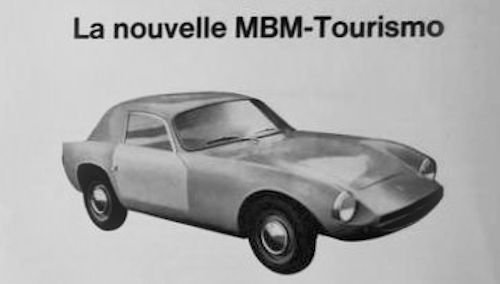
Before the founding of Automobile Monteverdi in 1967, Peter Monteverdi produced very few road sports cars. The first designed by him was a coupe based on the Ferrari 750 Monza , which had a fixed roof and gullwing doors . The car was just as unique as the 1960 MBM Sport. The MBM Sport was a Barchetta with a tubular frame and an engine from OSCA.Monteverdi had bigger ambitions with the 1962 presented MBM Turismo. It was a small closed 2 seat coupe with tubular frame and a plastic body. The drive was a Ford Anglia engine, which made 85 hp. The maximum speed is said to have been 118 mph, 190 km/h
PERFORMANCE: MBM Turismo
- Engine capacity: 60.95 cu in, 996.6 cu cm;
- Fuel consumption: 29.7 m/imp gal, 24.7 m/US gal, 9.5 1x 100 km
- Max speed: 118 mph, 190 km/h
- max power (SAE): 85 hp at 7000 rpm
- max numberof engine rpm: 7500
- specific power: 85.3 hp/l
- power-weight ratio: 13 1b/ hp.5.9 kg hp
- Details
- Parent Category: History
- Category: Switzerland
- Hits: 21
Twike AG
Gelterkinden in Switzerland from 1995 on
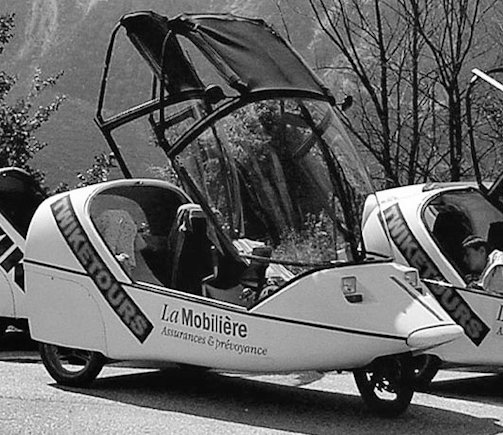
The Twike is a three-wheeled light electric vehicle for two people at first built in Gelterkinden in Switzerland.
History
The Twike emerged from a study by students, including ETH Zurich. Originally it was designed as a pure bike. In 1986, it won a prize for ergonomics during the Vancouver World Expo on the occasion of the Innovative Vehicle Design Competition (IVDC) and first prize in the category of everyday vehicles during the Human Powered Vehicle World Championships The original producer of the Twike, the Twike AG based in Gelterkinden in Switzerland, and the company S-Lem merged in 1999 to Swiss LEM based in Hochdorf (Switzerland). Swiss LEM went bankrupt in the summer of 2002. The Twike today called Twike 3, was bought by the German FINE Mobile GmbH, which now continues to produce the Twike in Rosenthal. The Swiss LEM development called Twike. Me did not go into production.
Since 1995, the Twike 3 has been approved for road traffic. In the meantime, just over 1,000 vehicles have been sold, with around 450 each delivered to Switzerland and Germany (as of February 2013). The other vehicles spread to other countries like the Netherlands, Korea, China, Denmark, Austria, Great Britain, Australia, Belgium, Norway, Italy, Spain, France, Morocco and the United States. To develop a successor model since 2009, the Twike 4 was developed and tested as a prototype. As a successor model since 2015, the Twike 5 is developed; it can be reserved as a priority by participating in fundraising. Subordinated are non-binding reservations without down payment.
For the propulsion of the TWIKE 3 as provides three-phase - electric motor with a rated output of 3 kW (peak power of 7 kW, with "Racing Software" and 25 A driving current up to 8 kW) and optionally a pedal drive for driver and passenger. Thus, the Twike reaches a speed of 85 km / h in the plane. The Twike is made of an aluminium tube frame, which is covered with a plastic cover (Luran S).
The powertrain of the under development Twike 5 will come due to license classes in a version up to 15 kW and possibly also in a version with more than 15 kW on the market. With the drive up to 15 kW and three batteries, speeds of up to 190 km / h are achieved. Driving supports a pedal generator (300 watts, standard driver side, option on the passenger side) and optionally a roof solar panel.
The Twike is steered by a joystick between the two drivers, with which at the same time acceleration and braking is carried out. A recuperation brake feeds power back into the batteries when braking. The entry is made possible by the opening of the hood, which is supported by a gas spring. The hood carries the laminated glass or a lighter Plexiglas and the removable convertible or Targa top.
The energy is stored since the model year 2008 in Li-ion batteries with a nominal voltage of 353 volts. Currently (2014) the manufacturer offers rechargeable batteries with 9.0 Ah (two to seven of them are selectable). The smallest equipment, with only one 9-Ah battery offers a range of 40-80 km, at least 2 such batteries are recommended; the maximum equipment with 7 x 9 Ah batteries offers a range of> 500 km. These 7 modules weigh a total of 133 kg. The full traction current of 25A is only reached from 4 modules. 3 modules offer only 20A and 1-2 modules only 16A - the latter is not enough for steep mountain rides.
Before that, NiCd batteries with a rated voltage of 336 volts and a capacity of 3 to 5 Ah per battery pack were used, in which 280 round cells each were installed. The NiCd version has a maximum of two battery packs with a total of 6 to 10 Ah, which at 10 Ah allows a range of max. 50-70 km corresponds.
As an alternative, on the occasion of the Twike Challenge 05 in 2005, the Black Sea NiMH batteries were tested with capacity doubled compared to the nickel-cadmium batteries (18 Ah). Stages up to 130 km without charge were reached with these cells. FINE Mobile, delivers these because of technical problems (too short life) with the cells since mid-2007, but no longer. The range is - depending on the battery - between 40 and 500 km with a consumption of about 4 to 8 kWh / 100 km. This corresponds to 14.4 28.8 megajoules / 100-man economical gasoline car with a fuel consumption of 5 Liters of gasoline or 4.33 L diesel / 100 km (x 32.5 MJ / L gasoline or 37.4 MJ / L diesel =) corresponding to 162 MJ / 100 km thus consumes well 5.5 to 11 times as much energy. Such low energy consumption is due to the much higher efficiency of the electric drive, the aerodynamically favourable shape with a small cross-sectional area and the lightweight construction (aluminium, plastic). The moderate maximum speed and the (depending on the height profile of the route) brake energy recovery have a favourable effect on consumption.
- Details
- Parent Category: History
- Category: Switzerland
- Hits: 25
Diavolino ZBR Automobile AG Zurich; Switzerland from 1984 to 1986

Diavolino is a former Swiss car manufacturer that existed in the 1980s
Marcel Oswald presented the public in 1984 a successor to the 1980 Lawil S3 ; an almost identical buggy with the name Diavolino which should target the younger generation. Only the front was revised, which now resembles the current jeep country vehicles.
Production and assembly of the body parts took over the Romay AG in Oberkulm / Aargau . Sales were handled by ZBR Automobile AG . As an engine, the obsolete engines of the Lawil S3 were taken. In addition to the revision of the front also contributed to the rapid success of the new model, that the vehicle was allowed to be driven in Switzerland from the age of 16 years. The basic price of the Diavolino was 7380 SFr . With the rapid success, the company looked to overseas markets and hoped there, the necessary sales. Accordingly, BAROQ SA was founded with a workforce of ten. But because of the US Current standards had to be used for the officially smallest convertible in the world new engines. Finally, four-stroke gasoline engines were used.
In 1986, the financial situation of the companies deteriorated due to the collapsing sales figures. In the same year the production of Diavolino was abandoned.
- Details
- Parent Category: History
- Category: Switzerland
- Hits: 35
Enzmann Automobiles Schupfheim; Switzerland 1956 to 1967
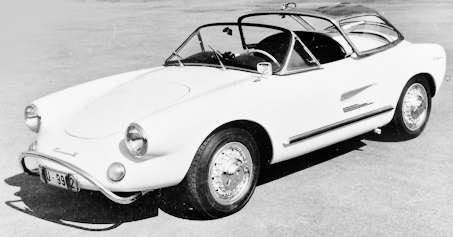
The Enzmann also called the Enzmann 506 is a sports car constructed by the Swiss Emil Enzmann , which was built from 1956 to 1968. The brand name Enzmann has been continued since 2001 by the son-in-law of Emil Enzmann. The company is currently based in Bischofszell as Gossweiler + Schreiber .
History
In 1953, the Swiss country doctor and hobby designer Dr. med. Emil Enzmann an open sports car, inspired by the Porsche 550 Spyder . The body was a monoblock type made of fiberglass-reinforced plastic ,then was bolted to a VW chassis . To reduce weight, the installation of doors was omitted, which also simplified the body structure.
ENGINE CAPACITY: 79.20 cu in, 1295 cu cm; SEATS: 2; MAX SPEED: 99.4 mph, 160 km/h; PRICE: 10,600 francs.
In 1956, the Enzmann-Spider was presented in Lausanne at the Comptoir Suisse . In 1957, the International Motor Show followed in Frankfurt, where he also received the suffix 506 , the number of the trade fair stand. There were three variants:
- Spider - with a small racing disc and open
- Cabriolet - with Karmann disc and folding roof
- Hardtop - with fixed folding or parallel sliding roof
It was made from 1956 to 1968. The main cause for the production to stop was ultimately the procurement of new chassis , which was torpedoed by VW. VW saw in Enzmann a competitor to the VW Karmann Ghia . Thus, the veto of AMAG , the Swiss VW and Porsche importer, meant the end for the Enzmann production. The alternative would have been to buy new VW Beetle, unscrew their bodies and convert them to men . This would have been far too expensive and Enzmann would have thrown out of the race in the competition - a circumstance that brought the end to other Beetle converters, such as the company Rometsch .Finally, about 100 vehicles have been built.
Karl Enzmann and Werner Schreiber, son and son-in-law of the company founder, nowadays produce faithful new editions. Since the launch of the new edition in 2001, air-cooled boxer engines with two-liter displacement and a twin carburetor from the Volkswagen Beetle have been used there . The power is rated at 110 hp .
PERFORMANCE:
- max power (DIN): 45 hp at 4600 rpm
- max torque (DIN).70 1b ft, 9.7 kgm at 2800 rpm
- max number of engine rpm: 5200
- specific power: 347 hp/l
- power-weight ratio: 26.0 lb/hp, 11.8 kg/hp
- useful load: 353 1b, 160 kg
- acceleration: 0—50 mph (0 —80 km/h) 9 sec
- speed in top at 1000 rpm: 20.2 mph, 32.5 km/h.
- max speed in 1st gear: 31.1 mph, 50 km/h
- max speed in 2nd gear: 56 mph, 90 km/h
- max speed in 3rd gear: 85.1 mph, 137 km/h
- max speed in 4th gear: 99.4 mph, 160 km/h
VARIATIONS AND OPTIONAL ACCESSORIES:
Engine capacity 72.90 cu in, 1290 cu cm, bore and stroke 3.03 x 2.52 in, 77 x 64 mm, MAG low pressure compressor, compression ratio 6.6 : 1, max power 42 hp at 3400 rpm; 506 Super 1300
Hardtop, overall height 42.52 in, 1080 mm, dry weight 1323 1b, 600 kg.
- Details
- Parent Category: History
- Category: Switzerland
- Hits: 31
Orca Sports Cars Ltd
Breitenbach SO, Canton of Solothurn, Switzerland
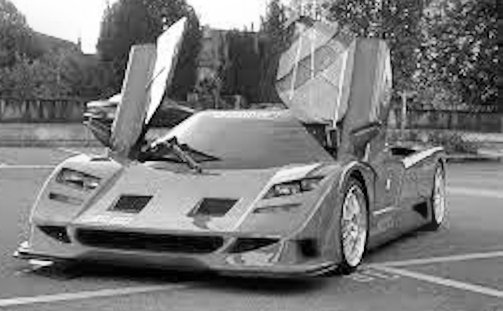
Orca Sports Cars Ltd. was a sports car manufacturer from Switzerland.
History
René Beck, who previously headed Orca Engineering in Liechtenstein, founded the company on 9 May 2005 in Breitenbach SO in the canton of Solothurn. This continued the production of sports car while retaining the brand name Orca continued. The company manufactured the Orca 113 platform. They came in three versions, of which a total of seven copies were made. The company was dissolved on May 7, 2010. René Beck had on 6 July 2006 Beck Engineering & composites in Muri bei Bern founded and tried there, the production and marketing as Beck continued.
This platform should be the basis for 198 vehicles in three variants. In the end, however, only seven vehicles were produced in the two companies: three C 113 (coupe), two R 113 (roadster) and two SC 7 (coupe)
The C 113 was a coupe and the first concept vehicle on the Orca 113 platform. The maximum speed is specified at 360 km / h. However, 113 (acceleration 0-100 km / h in under 3 seconds) was the C proved as the fourth fastest car in the world.
- Acceleration 0-100 km / h in less than 3 seconds
- Acceleration 0-200 km / h in 8.5 seconds
- Acceleration 0-300 km / h in 15 seconds
- Top speed: about 360 km / h
R 113
The R 113 was the Roadster version of C 113. Before setting the Orca-113 platform, the R 113 was the fastest road-going vehicle in the world (acceleration 0-100 km / h in less than 2.5 seconds). It was powered by the same twin-turbo Audi V8 engine as the Beck LM 800.
- Acceleration 0-100 km / h in under 2.5 seconds
- Acceleration 0-200 km / h in 6.5 seconds
- Acceleration 0-300 km / h in 12.8 seconds
- Top speed: about 410 km / h
SC 7
The SC 7 would have been by far the most exclusive model from Orca. Little is known about this concept car as well: its weight was 850 kg and it was powered by an Audi twin-turbo V12 engine. The top speed was over 400 km / h. From the beginning, only seven copies of this super sports car were planned, but actually only two. [3]
- Acceleration 0-100 km / h in less than 2.7 seconds
- Top speed: about 400 km / h
The Orca C 113 was a super sports car. The project was started in 1987 by Orca Engineering from Schaan in Liechtenstein under the direction of René Beck. In 2001, the first prototype of the Orca received the street approval. After a few presentations at car shows such as the Geneva Motor Show, a small series was decided, but it was delayed due to a lack of investors. Later, the series production began. Orca Sports Cars from Breitenbach SO from Switzerland under the same management continued production in 2005.
The orca was radically designed to sporty standards. Among other things, the goal was to build a super sports car that was easy to drive due to its low weight. Due to its height and its compact design, the centre of gravity of the car was pleasantly deep. The Orca C 113 had a body made of carbon and Kevlar, which weighed only about 35 kg. The flat profile of the body allowed for efficient aerodynamics. The chassis made of magnesium, titanium and aluminium offered high safety and rigidity despite a low weight of about 200 kg.
The 4.2-liter V8 engine of the car came from the Audi S6 and was fundamentally revised by the Audi tuner MTM engines Technik Mayer. The engine, with the help of two turbochargers and a charge air cooling charged 478 kW (650 hp) at 5400 rpm. The maximum torque of 900 Nm was at 4200 revolutions per minute. The power of the car was passed through a semi-sequential 7-speed gearbox and a limited slip differential on the rear wheels.
Performance
- Acceleration 0-100 km / h: less than 3 s
- Acceleration 0-200 km / h: 8.5 s
- Acceleration 0-300 km / h: 15 s
- Maximum speed: approx. 360 km / h
Successor was the Beck LM 800 of Beck Engineering & Composites from Muri near Bern in Switzerland, also under the direction of René Beck. However, there were only two prototypes left.

