
Austria
KTM AG History
Mattighofen Austria Since 1992
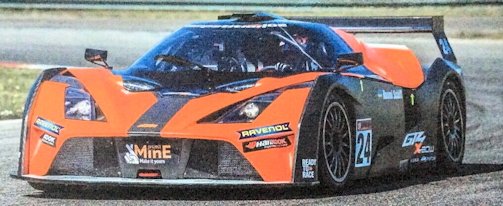
The KTM AG (formerly KTM Power Sports AG) is an international Austrian motorcycle and sports car manufacturer.
History
In the industry, KTM first made a name for itself with its all-terrain motorcycles (enduro and motocross), but has also been producing sporty street motorcycles for a number of years in a similarly large number. The company is since 2012 the largest motorcycle manufacturer in Europe and is considered a world leader in the field of Motorcycles cross.
In 1934, Hans Trunenpolz founded a locksmith and car repair shop in Mattighofen. In the early 1950s the first time appeared the letters on KTM, the first for K raftfahrzeuge T runkenpolz M attighofen stood for since entering the partner Ernst Kronreif in 1955 K ronreif T runkenpolz M attighofen . 1954 began the mass production of motorcycles. In 1980, the company was renamed KTM Motor-Fahrzeugbau KG and reached in the mid-80s, a turnover of over 50 million euros.
After the company came under strong economic pressure in the late 1980s, it was split up and sold in 1992. The motorcycle division was re-founded as KTM-Sportmotorcycles GmbH . The company initially specialized in the development and production of sporty off-road motorcycles. In 1994, the first street motorcycle was introduced with the 620 Duke. Since then, this segment has become increasingly important; Today, as many road and off-road models are sold
After the turnover had exceeded the threshold of one billion schillings until the mid-nineties, a larger plant was needed, which was opened in September 1999 in Mattighofen. This was followed in 2001 by a new spare parts warehouse, a new development centre in 2003 and a new administration building in 2004. In Munderfing, a new engine plant went into operation in 2002
The ownership of KTM has been subject to multiple restructuring since 1991. After KTM Motor-Fahrzeugbau KG became the property of the creditor banks in 1991, the company was sold in January 1992 for 55 million schillings (about 4 million euros) and re-established as KTM-Sport motorcycles GmbH.
In December 2004, Cross Holding bought back all shares in the KTM Group, with the exception of those of the Hofer Privatstiftung. The Cross Holding now owned 89.2% of the shares and thus for the first time since 1999, the majority in the company. It declared the motorsport and All-Terrain Vehicles (ATV) to the new core business of Cross Holding and moved all other types of holdings - all except KTM - to their unlisted parent company Cross Industries AG. On July 7, 2005, the listed since 2003 Cross Holding called itself finally in KTM Power Sports AG. After the shares of Hofer Private Foundation had bought was on 1 December 2006, the KTM Group GmbH and transferred its 99.79 percent stake in KTM Sport motorcycle GmbH to KTM Power Sports AG.
In order to gain a foothold in the ATV market, KTM Power Sports subsequently sought out an investor with experience in this area and found it in 2005 in the US company Polaris Industries, which took over 24.9%. In 2006 KTM achieved sales of 84,000 motorcycles for the first time over 500 million euros in sales. In 2007, Polaris' share in KTM decreased to less than 5%. Meanwhile, Indian automaker Bajaj Auto increased its share to over 14.6%, reaching over 20% in the spring of 2008, and targeting the 25% barrier of cutoff.
On April 20, 2012, the company name of KTM Power Sports AG was changed to "KTM AG" at the Annual General Meeting. The reason for this is the focus on the KTM brand - the designation KTM AG has been valid since May 4, 2012 with entry in the commercial register.
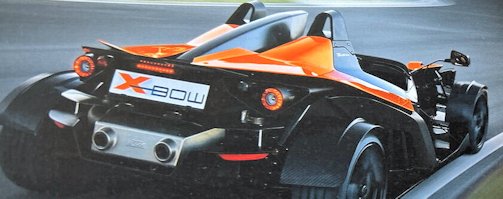
- KTM X-Bow (supercar, 1984 cc, R4 mid-engine from Audi, since 2008) - The first car from KTM was developed in 2006 in cooperation with the designers of Kiska GmbH. The series production takes place since 2008 in its own production plant in Graz. It is the world's first production vehicle with a monocoque made entirely of carbon fibre composite material. The X-Bow is the first car of the Austrian motorcycle manufacturer KTM. It was presented in early 2007 in the form of drawings and on March 8 at the Geneva Motor Show.
In close cooperation with the largest Austrian design bureau Kiska, which has been working for KTM since 1994, the idea was born in 2006 to bring a vehicle together with motorcycles onto the European market that reflects the shapes and characteristics of KTM and true to its motto "Ready to Race" should become a purist high performance sports car.
From the first ideas, a vehicle was developed with the help of the formula vehicle manufacturer Dallara, which should implement the motto of KTM thanks to modern materials such as carbon fibre reinforced plastic. At the first presentation of the designs in Geneva in 2007, there was great interest, which led KTM to decide to mass-produce the vehicle.
After another year of development, in March 2008 the construction of our own production plant in Graz began. In June 2008, the production of the first vehicles of KTM started, in August 2008, the first KTM X-BOW was delivered. In order to show the close connection with the development of the X-BOW with Dallara, the first 100 vehicles Dallara Edition were baptized and received a particularly high-quality equipment.
During the development, the entry into professional motorsport began in the spring of 2008, and the KTM X-BOW used by Reiter Engineering was able to achieve very good results right from the start. The German junior pilot Christopher Haase won the "Sports Light" class of the GT4 European Cup already in the first season of 2008, and in 2009 the Austrian Augustin Eder repeated this success. In turn, the experience gained from motorsport was incorporated into the development of series production. In addition, the KTM X-BOW "Race" was used to build a customer racing car and sell it around 25 times.
In 2009, KTM presented new models at the Geneva Motor Show: the base vehicle "Street", the "Clubsport" for the regular visit of the racetrack, as well as the "ROC", a special edition limited to 30 pieces, which contained extensive equipment and designed in the style of the Race of Champions, where the KTM X-BOW has been used every year since 2008.
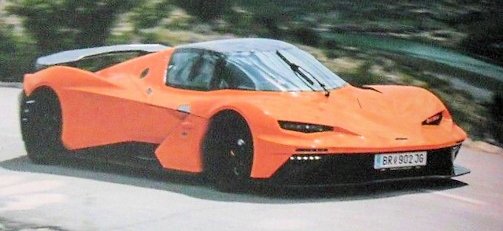
The series production of the KTM X-BOW was temporarily suspended in summer 2009 due to the difficult economic situation. In 2010, the production was changed to "order-related individual production”, at the same time, the Upper Austrian manufacturer launched the "KTM X-BOW BATTLE" one-make series, which is exclusively for KTM X-BOW owners.
In 2011, the model range was extended by an "R" model powered by a variant of Audi's 2.0 TFSI engine delivering 220 kW (300 hp). In 2013, KTM exhibited again at the Geneva Motor Show and presented the KTM X-BOW GT. The model makes 285 hp and has for the first time a windscreen.
GT4
» Low running costs
» Low wear & tear on long distance races
» Unique safety (carbon fibre monocoque)
» FIA approved sportscar rollcage
» 6 speed sequential racing gearbox (HOLINGER)
» Paddle shifting on the steering wheel
» Racing ABS (BOSCH)
» 139.000,- EUR (+ VAT)
full flat underfloor with rear diffuser Double wishbone front and rear suspension,
anti-roll-bar, 3-way adjustable shocks, machined aluminium uprights
In 2017, another body variant was launched on the market with the X-Bow GT4. It is a coupe designed for racing class GT4. The drive here is also a 2.0 TFSI engine from Audi which provides up to 360 hp. The dry weight is 975 kg.
The vehicle is elaborately constructed mainly from components of racing cars. Therefore, the base model price is $ 69,967 excluding taxes (prices in different countries vary depending on export cost and local tax). It has a monocoque made of carbon fibre reinforced plastic, suspension and damper elements of WP suspension - front inside - a removable steering wheel, Brembo, as well as an aerodynamic complete covering of the floor with integrated diffuser. The built-in in front of the rear axle 2.0 Liter four-cylinder engine of the Audi provides 221 kW (300 hp), has direct (TFSI) and a turbocharger. He drives the rear wheels. There is also the Street version with an output of 177 kW (240 hp). On request, a racing version with up to 265 kW (360 hp) is also available. The X-Bow accelerates from 0 to 100 km / h in 3.9 s and reaches a top speed of 220 km / h or 231 km / h. The performance of this roadster is due to a curb weight of only 790 kg. The X-Bow has neither electronic driving aids such as anti-lock braking system (ABS), traction control (ASR) or Electronic Stability Program (ESP), nor comfort components such as air conditioning, radio, etc. on board, but only a steering wheel, a digital display, a manually switched six-speed Gearbox and the driver adjustable pedals. Moreover, there is no obligation to drive the car with a helmet, since the 7 cm high windshield is sufficient to suspend the statutory helmet duty, but it is recommended in their own interest.
The X-Bow complies with all EU guidelines for small series homologation in order to be admitted to road traffic. This directive is being implemented in all EU member states. The Switzerland joins the EU directive. In many countries outside the European Union, the X-Bow is also homologated, but in some countries, it is only intended for use on racetracks.
U-Wagen-Werke
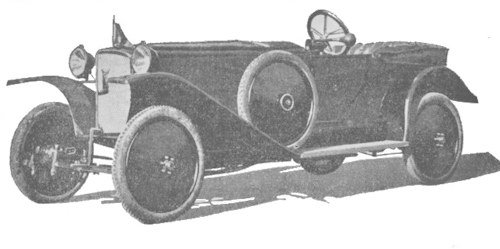
The U-Wagen-Werke Ing Umann was a manufacturer of automobiles from Vienna, Austria. The brand name was U-Wagen.
History
The company from Vienna began in 1919 under the direction of engineer Umann with the production of automobiles.
The company produced small cars. With the two-seat prototypes U 1 a was two-cylinder engine with 489 cc capacity its Soden transmission was developed by Carl Alfred Graf von Soden-Frauenhofen, director of ZF. The empty weight was 360 kg. In production model 7/18 PS provided a four-cylinder engine with 760 cc Displacement. The most common body shape was that of a two-seater roadster. 1920, the model 7/18 PS U 2 the motor had 1100cc. The body could accommodate two or four people.
The company was dissolved in 1923 after low production numbers.
Baja (N. von Jakabffy GmbH)

Baja was a car brand from Austria in the 1920s. The brand name was Baja.
History
The company N. von Jakabffy GmbH started in 1920 with the production of automobiles the designer was Max Bartsch. in 1921, first built as Ing. Max Bartsch & Frank man and later Baja Cyclecar Co. As of 1922, the sales and the successful export by the Baja Cyclecar Vertriebs GmbH. In 1924, took over Amender Werke AG production. All companies were based in Vienna. Baja stood for Ba rtsch & Ja kabffy.
The vehicles built were cycle cars that featured the absence of a chassis. The body made of plywood offered space for one or two people. The vehicles were also used in car races such as the Riederberg race. The empty weight was 250 kg. First, a provided air-cooled single-cylinder engine from Hiero with 460 cc displacement and 3.5 hp power for the drive. As of February 1922, there was a water-cooled single-cylinder engine with 602 cc capacity. In addition, a was two-cylinder engine with 790 cc capacity offered. The engine was mounted in the rear, driving via a chain to the right rear wheel. The transmission had three gears.
By 1925 the production ended.
ESA (Egon Seilnacht) History

Egon Seilnacht, machine and racing car manufacturer was a manufacturer of automobiles from Austria-Hungary, later Atzgersdorf, Vienna Austria. The brand name was ESA.
History
Egon Seilnacht founded the company in February 1917 at Atzgersdorf near Vienna and started producing automobiles. Overall, emerged more than 240 vehicles. Between 1917 and 1919 Seilnacht produced some copies of a cycle car. One of these vehicles in 1920 won the first Baden Cyclecar race.
1920 appeared the models 3/8 hp with four-cylinder engine and 16 hp with six-cylinder engine. Both engine types had SV valve control. These vehicles were offered as two and three-seater. One of these vehicles was on the 1920 Olympia Motor Show in London won the beauty contest. A total of about 200 originated four-cylinder models and 40 six-cylinder models.
1926, production ended when the company went bankrupt.
Fuchs (Inzersdorfer Industriewerke Hans Fuchs AG)
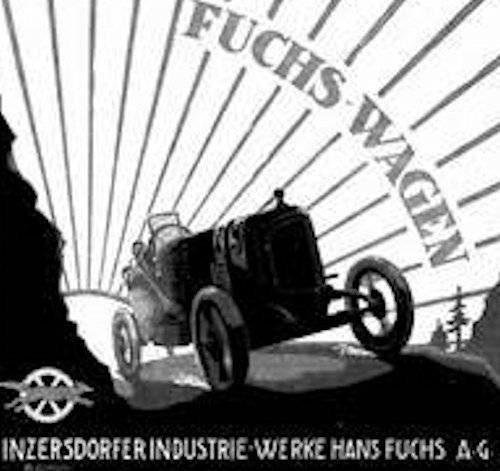
The Inzersdorfer Industriewerke Hans Fuchs AG was a manufacturer of automobiles from Vienna, Austria. The brand name was Fuchs.
History
The company was founded in 1920. The aim was the production of engines, bodywork, radiators, machinery and metal products. in 1922 started the production of automobiles. 1925, automobile production ended.
The small car model 5/15 hp came with a four-cylinder engine with 1180 cc capacity and 15 PS output. The open bodies could accommodate two to three people. From 1924 the engine power was increased to 20 hp. In the same year also began the production of delivery vans with 600 kg payload.
By 1926, the company was dissolved.

