
Argentina
Autoar (Automotores Argentinos SA)
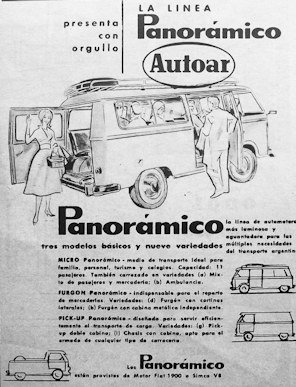
Automotores Argentinos SA was an Argentine manufacturer of automobiles. the brand name was Autoar.
History
The company was based in Tigre near Buenos Aires. The production of automobiles began in around 1950 with also commercial vehicles made. The brand name was among others Autoar. Initially Fiat vehicles were produced under license. By 1959, there was an agreement with the NSU Motorenwerke, followed in 1960 the licensed production of the NSU Prinz This had a two cylinder, four-stroke engine with 75 mm bore, 66 mm stroke, 583 cc and 30 hp power. The vehicles were at a wheelbase of 2000 mm 3145 mm long, 1420 mm wide and 1350 mm high. The empty weight was given as 506 kg. From NSU Prinz total vehicles 2432 made. By 1961, now with its own brand name for passenger cars from the sedan as the brand Autoar and the derived vans and pick-ups about 1,500 vehicles developed.
From 1950 commercial vehicles. With a 2199 cc 65hp displacement engine was from the US Willys Jeep . in 1951 was followed by a two-door sedan and cabriolet version with the same engine. Later, a Simca-Vedette of 2351 cc and 85hp in the 1950s, the sedan was discontinued and instead, on this basis, a combi and a pick-up available for the combi, a four-cylinder engine from Fiat with 70 hp 1900 cc capacity was fitted.
Between 1958 and 1962 there was with the panorámico a minibus, a pick-up and a van in front-wheel design. The panorámico created 597 minibuses, 372 pick-ups and 103 vans, in total, so 1072 vehicles.
By In 1962 the automobile production ended.
Borgward (Dinborg Argentine Industries Automotive S.A.C.I.F)
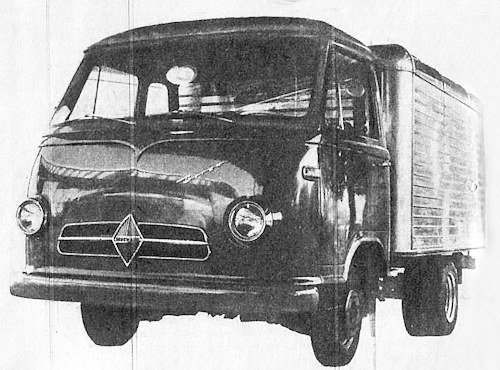
Dinborg Argentine Industries Automotive S.A.C.I.F was an Argentine manufacturer of automobiles. The brand name is Borgward.
History
The state enterprise DINFIA that the Graciela produced, and Borg Ward founded on 1 December 1958, the Joint Undertaking in Córdoba, Argentina. In 1960, they started with the production of automobiles as Borgward.
Dinborg made the chassis and bodies and glass with also the related engines, transmissions while other chassis parts like the independent rear suspension came from Germany. The car model was the Borgward Isabella as a two-door sedan. A water-cooled four-cylinder engine with a 75 mm bore, 84.5 mm stroke 1493 cc displacement and 60 hp power drove the vehicles. The vehicles with 260 cm wheelbase were 440 cm long, 176 cm wide and 150 cm high.
In addition, there was the van Borgward B 611 with various body types. This had a water-cooled four-cylinder D4M Borg Ward diesel engine with 78 mm bore, 92 mm stroke, 1758 cc and 42 hp also petrol variant four-cylinder in-line with a displacement of 1,490cc. The vehicles were 520 cm long, 210 cm wide and 218 cm high with a wheelbase of 260 cm. Between 1960 and 1962 1296 were built.
By 1962 The end of Borg Ward led to the end of the Argentine production, around 3000 vans and cars in total were created. IKA (Industrias Kaiser Argentina SA) took over with their own version.
Zamba (Ergo diseño) History

Ergo diseño was an Argentine manufacturer of kit type automobiles from the 1990s. The brand name was Zamba.
History
The company from Buenos Aires began in 1990 with the production of kit and built automobiles based on the Citroën 2 CV.
The model was based on the monocoque chassis of the Citroën 2 CV. The car was a two-door 2 seat convertible. The body was made entirely of fiberglass reinforced plastic (GRP), with an added roll bar then bolted directly to the chassis with six screws. The open body with suicide opening type doors the front headlights were integrated into the wide fenders as a one-piece front end, as well as the front turn signals in the bumper. The original 2CV air-cooled two-cylinder piston engine powered vehicles.
Some kits were sold to to France but by 1996 ended the production.
Koller EKIS History
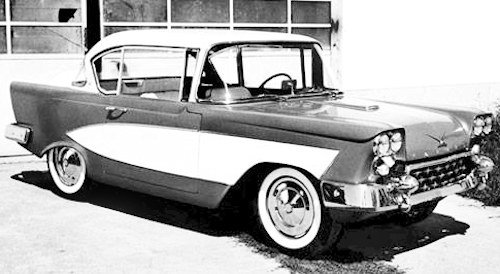
EKIS (Establecimientos Koller Industrias Santafesinas S A.) was an Argentine manufacturer of automobiles from the 1950s.The brand name was Koller.
History
Alberto José Koller and José Héller had already founded Koller y Héller SRL in 1944 for the manufacture of furniture and also construction of trailers. 1958 they founded Establecimientos Koller Industrias Santafesinas S A. Or in short EKIS. The seat was in Carcarañá in the province of Santa Fe. The development of an automobile began. The first prototype was in 1959 in Rosario, and later in Buenos Aires issued. By 1960, announced the mass production. Financial problems prevented mass production. Total produced was only two complete vehicles.
The only model was a fiberglass two-door sedan with a chassis made of steel tubular pipe. A striking the two-tone painted body, the front double headlights, the two were panoramic windows. The spare wheel was standing at the rear behind the trunk assembled in the 50s American style.
The car was from wheel drive, gearbox was a four-speed with reverse, a three cylinder two-stroke engine with 70 mm bore, 78 mm piston stroke and 901 cc capacity made 37 hp. This came from the Wartburg 311 of the automotive plant Eisenach. The vehicle had a wheelbase of 209 cm and a track width of 105 cm (front) and 109 cm (rear). It was 380 cm long, 144.5 cm wide and 127 cm high the front suspension was independent with coil springs and hydraulic shock absorbers. The rear suspension was rigid axle with longitudinal semi-elliptical springs and hydraulic shock absorbers. The empty weight was with 750 kg and Brakes were hydraulically operated with four-wheel drums on 13-inch wheels and the white wall tires.
Andino (Automotores 9 de Julio SA)

Automotores 9 de Julio SA was an Argentine manufacturer of automobiles . The brand name was Andino.
History
The company from Buenos Aires began in 1967 under the direction of Luis MG Varela with the production of automobiles that was manufactured by a dealer from the IKA-Renault brand. 1978 ended production. Total originated about 100 vehicles.
On offer were fiberglass sports cars as Andino coupes design by Luis Varela at first as the Renault GT Initially they were to be made of aluminium. The sheet metal base formed a central tube frame chassis 1.60 meters long. All components were from French parts. Independent suspension with Renault Gordini chassis . A four-cylinder engine of Renault Gordini was mounted in the rear The weight distribution was 60% rear and 40% front. The first version was from 1968 to 1970 in the range. It was based on the Renault Dauphine. The four-cylinder engine with 845 cc capacity made 80 hp at 6,800 rpm. The second version from the period from 1976 to 1978 had a Renault 12 engine with 1397 cc.As Varela Renault there was a coupe from 1970 to 1971 with the four-cylinder engine from Renault with 845 cc. Between 1977 and 1980 there was the Varela Berlinetta as a coupe. The choice was the engine of the Fiat 600 with 767 cc and the Fiat 128 with 1116 cc.
Performance: 845cc
- max power (SAE) 80 hp at 6,800 rpm
- max torque (SAE) 57 1b ft, 7.9 kg m at 5,800 rpm;
- specific power 94.7 hp/l
- Fuel consumption 33.2 m/imp gal, 27.7 m/IJS gal, 8.5 1 x 100 km.
- Max speeds (l) 26.1 mph, 42 km/h, (II) 43.5 mph, 70 km/h, (III) 74.6 mph, 120 km/h, (IV) 108.7 mph, 175 km/h.
With rear wheel drive and 4-speed mechanical gearbox, with synchronized, on 2nd,3rd and 4th and gearbox ratios 1st 3.610, 2nd 2.250, 3rd 1.480, 4th 1.030 and revese 3.080 the gear lever was located in a central position. At the rear a hypoid bevel final drive with 4.375 axle ratio.For the suspension this was independent at the front with wishbones, coil springs, anti-roll bar and telescopic dampers the rear was alsoindependent fitted with , swinging semi-axles, trailing radius arms, coil springs, and telescopic dampers.For the steering Rack-and-pinion .And brakes fitted Disc brakes with a diameter 10.28 in, 261 mm. The electrical system was 12 V with 55 Ah battery and 560 W alternator

