
• Home
  • Makes
  • History
  • Maintenance
    • Engines By Make
    • Engine Components
    • Electrical & electronic
    • Gearbox & Drivetrain
    • Induction & Exhaust
    • Suspension Types
    • Tyres wheels Brakes
    • Vehicle Body types
  • Trivia
  • Register
  • "log in"

Australia

JWF Fiberglass (1959-1969)

Details
Parent Category: Motor car History
Category: Australia

JWF Fiberglass Industries

 Australian Automotive manufacturer Brookvale, Australia From 1959 to 1969
 Australia From 1959 to 1969
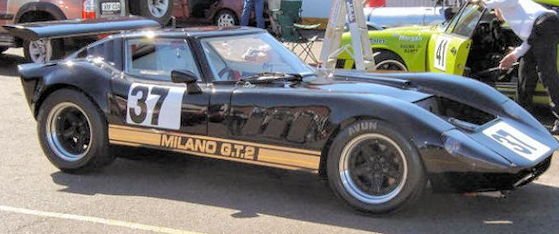
JWF Milano 750

JWF Fiberglass Industries was an Australian manufacturer of automobiles in the 1960s . 

 History

Ian Johnson, Jeff Williams and Grant Furzer founded the company in 1959 in Brookvale near Sydney . They started with the production of automobiles and kit cars . The brand name was JWF . In 1969 the production ended. 

The cars used mainly British MG,Morris and Austin parts but also ford and Holden engines.

The first model was the Milano 750 . The vehicle was based on the chassis of the Austin 7 . A little later there was the body in eight different lengths and widths for other chassis. Last run was the Milano GT . Some vehicles received a motor from Holden and were used between 1964 and 1967 in sports car racing.

JWF Fiberglass Industries

JWF Italia 

1960 came the Italia . was based on a chassis with 243 cm wheelbase . One version had a grid frame from Nota , a Holden engine and was only available as a complete vehicle. By1969 appeared the GT 2  for race and track  .


Devaux (2001-)

Details
Parent Category: Motor car History
Category: Australia

Devaux History

Australian car manufacturers from 2001

 Devaux History Australian car manufacturers from 2001


Devaux Coupe is an Australian car manufacturer based in Beaconsfield in the state of Victoria . The company was founded by industrial designer David J. Clash. Clash chose the company name Devaux after the maiden name of his mother. The company is unrelated to the vehicles of the American De Vaux from the 1930s.

With the work on the first and so far only vehicle model, the Devaux Coupé , Clash already began in the late 1980s - initially in a backyard workshop. With the increasing success of his design company, work on the vehicle also continued. In the early 2000s, the first prototype was completed, production started in 2001.

Model 

The only model is based on the design of those of the French coachbuilders of the 1930s. It is powered by a 4.0-liter V-6 engine of Ford or optionally by a 3.4-liter V-6 engine of Jaguar or later by a 361bhp 5.7-litre V8 alloy Chevrolet engine. With a purchase price of AU $ 168,000 , the Devaux Coupé belongs to the automotive luxury class .

Assembled on a mild-steel chassis frame with an internal glassfibre tub  over which a glassfibre body shell  gives the car a weight of just 1125kg. ,suspension is a fully-adjustable stainless steel double wishbone unit with coil-overs, and the rear live axle is located using 4 bar trailing arms and Panhard rod.

The wheelbase is 2794mm (9'2") long, with 1385mm (54½") front and rear track.

The overall length is 4800mm and width 1612mm. 

The vehicle is currently produced only as right-hand drive and not officially offered in the EU.

Devaux History Australian car manufacturers from 2001

Arcadipane (1977-1979)

Details
Parent Category: Motor car History
Category: Australia

Arcadipane

Arcadipane cars logo

Australian Automotive manufacturer West Heidelberg, Victoria Australia From 1977 to 1979

Peter Arcadipane, the man behind Ford's Concorde show van, the nose of which later became famous on the front of Mad Max's Interceptor.

Arcadipane van

Peter Arcadipane an automobile designer, joining GM Holden in 1968. After training experience in the USA, he developed a "super graphics" decal concept and brought the practice back to Australia. He later joined Ford Australia working with the Falcon. He left Ford to design independently and developed the initial "Mad Max" Interceptor vehicle. He continues to design for European and Asian firms.

Peter Arcadipane


Car Models

Bobcat  

Arcadipane bobcat car oz

Imitator  

Arcadipane Imitator car oz

Mystere  

Arcadipane Mystere car oz

Simple, economical maintenance, availability of spare parts from all Holden dealers and low price
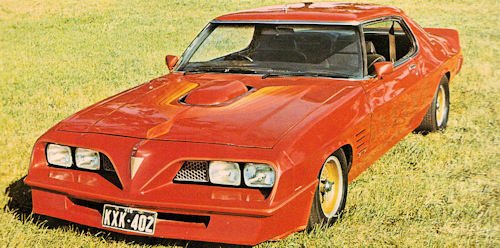
distinguish this sports coupé completely restyled around the original Tornana Hatchback. The tail has been sectioned and shortened by 14 in and the front has a new nose-cone and aerodynamical wind-dam.

Engine & performance:

Position: front
Type: Holden V8
Capacity: 5.0-liter
Power: 216 Nm @ 4800 rpm

Dimensions:

Length: 4200 mm
Width: 1900 mm
Height: 1200 mm
Wheelbase: 2586 mm
Weight: 1213 kg

Taipan  

Arcadipane Taipan car oz

Corsa Specialised Vehicles

Details
Parent Category: Motor car History
Category: Australia

Corsa Specialised Vehicles 

From 1994

Corsa Specialised Vehicles


Corsa Specialised Vehicles (CSV) is a small-scale automaker established in 1994 that is based in Mildura, Victoria, Australia. Its range consists of V8-engined high performance cars based on those produced by Holden.

Since its founder, Peter Dichiera (engine builder and 1970s drag racer, nicknamed "Mildura Maverick"), decided that CSV would not simply build modified versions of existing Holden cars, in 1996 it obtained government approval under the Australian Design Rules (ADR) scheme thus becoming a "secondary manufacturer" in the same mold as large-scale rival, Holden Special Vehicles (HSV).

CSV's famed tuner reputation was established with the first vehicle built in 1994. Badged Corsa 220i ("corsa" meaning "race" in Italian) and based on a Holden VR Berlina, it featured in a test comparison published by a local automotive magazine following which, thanks to favourable results against rival HSV,CSV built a further two vehicles by special order and began exhibiting at Australian motorshows.

The full CSV range has included:

  • the Volanti (a phonetic adaptation of "volante" meaning "flying" in Italian), Strada (meaning "road" in Italian) and Veloce(meaning "fast" in Italian), based on the short wheelbase Holden Commodore (VR to VX series) sedan and wagon
  • the La Classe (meaning "the class" in Italian), based on the long wheelbase Holden Statesman/Caprice (VS and WH series) sedan
  • the Mondo (meaning "world" in Italian), based on the Holden Monaro (V2 series) coupé
  • the Bullet based on the Holden (VS to VU series) utility.

csv bullet pick up

The individual model designation of each vehicle is based on the engine output (in kilowatts). For example, in the case of the Mondo, it was offered as the GT305 (featuring a 5.7 L (350 cu in) LS1 producing 305 kW (409 hp), stainless steel high output headers, stainless steel exhaust, 19-inch alloy wheels and 245/35ZR19 tyres), a "Stage 2" GT350R (featuring a blueprinted version of the base engine) and a GT400R (instead powered by a 6.5 L (397 cu in) V8 engine).

Apart from high capacity and high output V8 engines, enhanced suspension and braking systems, CSV vehicles are characterised by upgraded interiors and full body kits (in particular, bonnet air vents, revised grilles and large decklid spoilers).

Over time, CSV has gained various high performance achievements in the local Australian industry that have included:

  • producing, in 2000, the fastest accelerating Australian production car from 0 to 400m (the CSV Veloce)
  • offering, in 2007, the first Holden Commodore-based performance car powered by a 7.0 L (427 cu in) LS7 V8 engine (the CSV GTS), in so doing beating rival HSV with its subsequent W427.

While still based in Mildura, CSV's expanded operations into Melbourne were terminated but also opened in Perth, Western Australia.

This CSV is not to be confused with HSV's Middle-Eastern export CSV badge, which stands for "Chevrolet Special Vehicles" instead.

 La Classe csv rear

Caldwell Vale (1907-1913)

Details
Parent Category: Motor car History
Category: Australia

Caldwell Vale Australian automobiles from 1907 to 1913

 Caldwell Vale trucks


The Caldwell Vale Truck & Bus Co. was an Australian automobile, bus, truck and tractor manufacturer from 1907 to 1913 in the Sydney suburb of Auburn NSW,. The company started in 1907 when Felix Caldwell and Norman Laurie Caldwell of South Australia filed for a patent covering "Improvements in and connected with driving and steering motor propelled vehicles". In short, the patent was for a four-wheel-drive system with four-wheel-steering.

They built forty petrol-engined commercials as load-carriers and heavy tractors. Power came from an 11-litre 4-cyl engine with separately cast cylinders via a 3-speed main gearbox and transfer to all four 1.5m diameter steel,shod wheels. It was a bonneted design. employing a unique power steering system. whereby the column engaged with one of the cone clutches connected by chain driven shaft to the front of the engine crankshaft. When the steering wheel was turned one of the clutches engaged with a worm connected to the steering drag link, thereby moving the wheels the appropriate direction.

Later they combined with Henry Vale of New South Wales and in 1910, the trio applied for a patent covering "Improved power steering gear for heavy motor driven road vehicles".

Few technical details have survived about the marque and roughly 40 examples of the vehicles appear to have been made. A touring car, it is known to have had four-wheel drive, a 30 hp six-cylinder engine and four-wheel steering.

The company also built a fair tractors.In 1912-1913, the company lost a court case to do with the performance guarantee of the trucks and was taken over by Purcell Engineering in 1916.

log on

Log in to Motor car

  • Forgot your password?
  • Forgot your username?

Welcome To Motor Car

On Motor Car
Engine makes Drivetrain
Induction exhaust Tyres Wheels Brakes
Engine Guide Maintenance Guide
Suspension Electrical
Understanding the Automobile

Veteran - Vintage - Classic - Modern  

 Luxury Cars  Bus Coach
Roadsters  Coupes
 Super Cars  Kit cars
 Cyclecars  Microcars
 Electric  Fibreglass

Enjoy all of Motor Car Here

1890s 1900s 1910s 1920s 1930s 1940s 1950s 1960s  1970s 1980s 1990s 2000s 2010s

  1. You are here:  
  2. Motor Car
  3. Motor car History
  4. Australia