
Trivia
The Monkeemobile

The Monkeemobile was a TV car of the 1960s.
History
To build the Monkeemobile as usual for the NBC TV show the turnaround time was short after a couple of sketches Dean Jeffries got the deal to build it, so soon started on disassembling and restyling the cars. With huge promotional opportunity Pontiac furnish two red 1966 GTO convertibles for Jeffries to work his magic on. Pontiac sent Jeffries two brand-new 1966 GTO convertibles to use.The Monkeemobile was the car that transported the fabricated rock-and-roll group The Monkees to all sorts of on-screen capers around Hollywood in the USA on the weekly television series starring Davy Jones, Peter Tork, Micky Dolenz and Michael Nesmith.
The original car that screamed 1960s Hollywood custom, and the Monkeemobile is One of Jeffries' most famous creations. The NBC show debuted 1966 a half-hour situation comedy that was a direct rip-off of the Beatles 1964 film A Hard Day’s Night trying to get the attention they had got that side of the pond and followed the madcap misadventures ridiculous situations of the made-up band.
The car was built by Dean Jeffries, a modern Pontiac GTO muscle car from that time with the look of a more traditional hot rod. In total they only built two Monkeemobiles multiple cars for TV and films was common place for different shots. Jeffries completed the first just 10 days and the second within 2 weeks. The styling is combination of the Model T Ford—type hot rod and a modern car. The entire concept of a Monkeemobile was the brainchild of George Toteff,president of Model Productions Corporation MPC. Toteff was looking for a customized car to tie in with the show that he could make and sell as a plastic model kits. At the time he was working with Dean Jeffries.

Both cars came equipped with a 389-cubic-inch engine and a two-speed automatic transmission.
Since the GTOs were convertibles, their chassis were already reinforced and stronger than the hardtop versions as is needed for most convertibles. Even though The Monkeemobile appears to be stretched. the wheelbase is still standard. Inside stock white Naugahyde bucket seats in the front and middle rows with custom fabricated wraparound rear bench that was positioned where the trunk once existed. giving the longer appearance along with 21 inches added to the front and 18 inches to the rear bodywork.
Some of the GTO convertibles features remained stock the windshield was cut and tilted with a chrome piece glued to the centre to give the illusion of a split windshield, along with changes also to the original GTO's grille and taillight along with the long Model T'style roof that was fixed and made from steel tubing covered in white vinyl and in candy-red paint work for the body. The rear end got exaggerated taillights, complete with a dragster parachute and quick- fill gas cap on top of the cut rear deck lid. For wheels the Monkeemobile came with a set of Cragar S/S chrome rims fitted with Goodyear Blue Streak racing tires. The Monkeemobile also came with a trailer that would unfold to form a stage.
One of the two 389-cubic-inch engines was installed a tri-carb carburettor while the other came fitted with a GMC 6-71 supercharger The hood was cut and dished with a hole along with modified transmission and 3:55 "Safe-T-track" rear ends to channel this power and make it easier to do wheelie additional weights were put in the back of the car. Jeffries lengthened the front wheel wells to allow the functional chrome side exhaust trumpets.
The TV show was cancelled after just 2 seasons (1966-1968) .One of the two cars was purchased by George Barris and later sold for $360,000. Not a bad price for a car that Jeffries originally built and in and out the door within two weeks.

Munster’s Koach
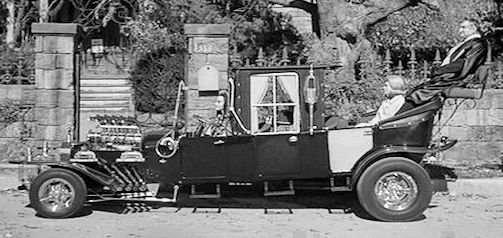
The Munster’s Koach was a Custom-Built car for the TV program the Munster’s in the 1960s
History
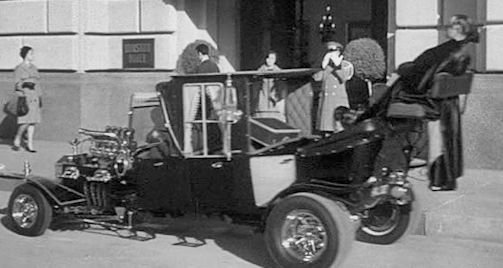
The Universal TV Producers called on the famous George Barris to build the unusual Vehicle for the well unusual family of Ghouls! the Munster’s with the normal little time to build given by the TV company, the engineers Les Tompkins and Bud Kuns complete the task in less than 30 days The needed appropriate transportation for the popular TV Family,this had to be of a size to accommodate the whole family.
To accommodate the Munster family Barris needed to fabricate a large enough chassis frame this was 113 inches with a 1927 Model T ford body of fiberglass from Owins Corning and Reynolds aluminium panel’s that need to be stretched into a larger six door touring type roadster style.
George Barris wife Shirley met with the actress who played Lilly Munster to plan the Colour Theme for the unusual car and was painted with 40 coats of hand-rubbed Black Spyder peal paint with gold leaf trim in keeping with the ghoulish theme That included the 'gravestone' radiator, casket door handles, and gas-lantern headlights with their spider-web glass. Ermins fur rugs along with red velvet diamond tufted coffin liner trim and no less than two French antique telephones run by an Auto light electrical system along with the Sony TV and Muntz stereo tape deck .
The Munster’s Koach featured Rader Chrome spoked rims and MT slicks Vertical steering a four on the floor transmission along with the dropped front axle and split radius rod for the right stance with swing pedals with hydraulic clutch and brake.
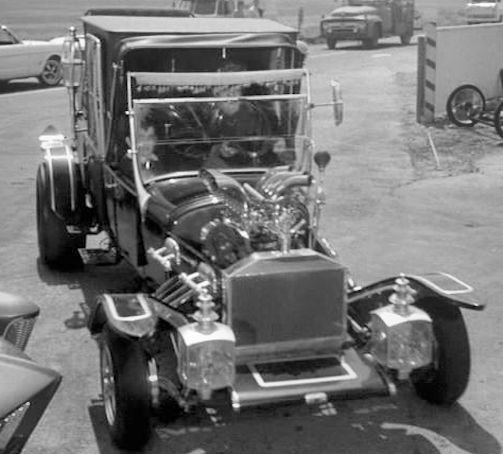
For performance desired by their larger-than-life Herman Munster. Ansen Automotive engineered a Ford Cobra Engine that was Bored and stroked with Jahns high-dome pistons and an Isky cam, also to give the looks and performance needed then fitted with M-T ram manifold and spotting no less than ten chrome carbs which fuel from an electric pump from Dupree with fuel economy only around 3 miles per gallon it’s a good job it ran on embalming fluid.
All these features meant the newly built Munster’s Koach Cost the TV company a large $18,000.00 price tag.
The Munster’s DRAG-U-LA Car
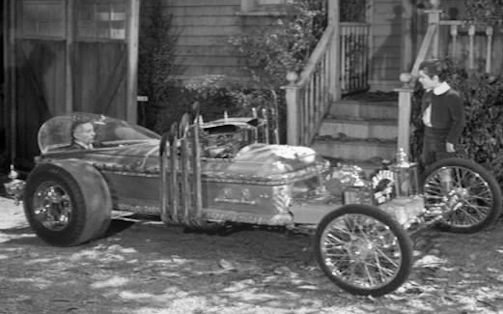
The DRAG-U-LA was a custom car built by George Barris for the TV Show the Munster’s in the 1960s.
History
Upon completion Of MUNSTER KOACH for the TV series from Universal the Munster’s, Kayro-vue productions again approaches George Barris at Kustom King in North Hollywood in California USA.After the studio, gave the go ahead Barris envisioned an even more unworldly creation along with the theme of the show.
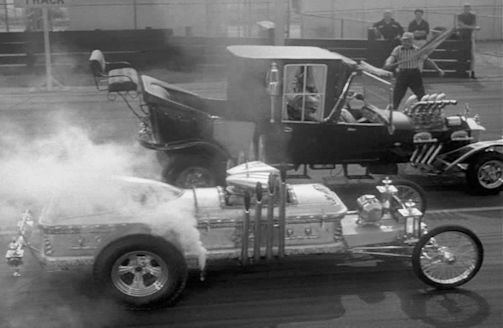
The DRAG-U-LA finished product appears on the TV program , and also stars in the movie "Munster’s Go Home “Grandpa used the Drag-U-La in a race against Hermann in the Coach,in true dragster style.For looks innkeeping with the show it was built like a coffin on wheels a single seat car with an actual Owends-Corning Fiberglass casket Barris extended the length by 3 ft The radiator was a miniature casket made in solid brass .The marble gravestone grille has the inscription: Born 1367, Died? the driver is covered under a clear plastic bubble top.Inside the casket is trimmed in an royal purple velvet and finished Italian gold leaf.
This was designed in normal dragster type fashion from the time with tube frame chassis The engine a 350 hp Ford Mustang V8 unit and uprated Dupree fuel pump for looks and power a dual 4-barrel carbs And performance MT Manifolds and small moon type fuel tank at the front with Autolite 12 volt electrics the front Lanterns are used for the headlight which can be removed for some high speed drag strip action with plenty of noise via the side exit straight Chromo organ exhaust stacks.
A four speed transmission directs the power to the rear wheels in conjunction specially made Reynolds aluminium 10" Rader and spoked front rims (wheels) fitted with 11" Firestone slick dragster type tyres. And the hub caps were decorated with solid silver spiders.
An AMT Corp kit car version also produced.
Batmobile Original Car (1966)
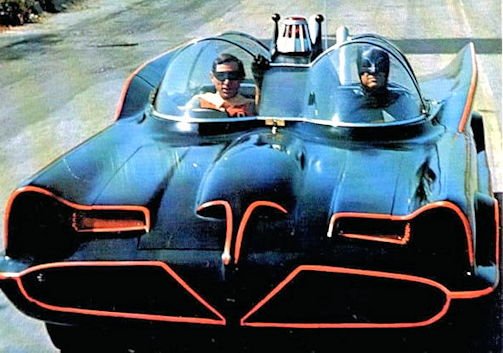
The iconic 1966 ABC TV series Batmobile "atomic batteries to power; turbines to speed".
The original car was in almost all 120 30-minute shows, made between 1966 and up to 1968 filmed at the 20th Century Fox Studios starring Adam West as Bruce Wayne AKA Batman and the infamous Burt Ward as Robin (Dick Grayson).
The basis for the car was the Lincoln Futura shark-like look,with its popular for the time large tailfins and hooded headlights the car was built in Italy in 1955 by Ghia, and Designed at Ford based as a concept show car. The Futura cost $250,000 to build .that year it was the centrepiece in the New York's Central Park after being driven to the event by Benson Ford. Henry Ford’s very own grandson on 3 May 1955.The concept car was later Repainted in red from its original light blue colour, the Futura also starred in the film it Started with A Kiss Debbie Reynolds and Glenn Ford in the 1959 MGM movie .
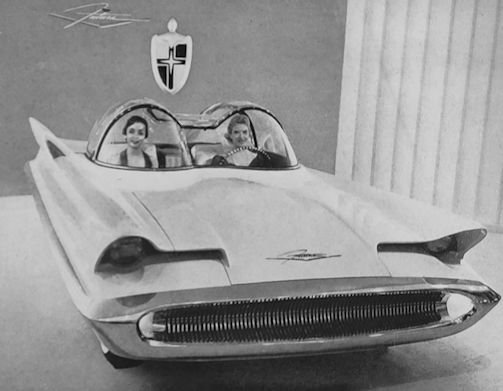
By the 1960s the car was acquired by Hollywood custom-car legend George Barris. Later by the summer of 1965 ABC asked Baris to
complete a special car for its TV incarnation of Batman a popular comic book hero from the original DC Comics strips. He was only given as little as three weeks to build, but the Futura car was half-way there already. He kept the basic chassis but was lengthened to 21 ft, and basic profile unaltered, but the whole of the body underwent a fibreglass re-styling by Owens-Corning fiberglass. while customising the front nose section to resemble a more bat-like appearance while the already twin-cockpit theme and individual plastic canopies over cockpits, were virtually unchanged from the original car and extended the trailing edges of the already large rear fins to give a more bat look so that Batman and Robin are now protected by 84 inch bulletproof Steel bat fins..
The previous concealed wheel arches of the Lincoln Futura were now opened up, with the cars colour now changed again to the black with fluorescent pinstriping we all know and love unique to the batmobile. The car has 40 coats of Acrylic black velvet glow bat fuzz from Metal flake Inc and outlined by is fluorescent pin stripes. decorative mouldings are extruded in Reynolds Aluminium satin finish.
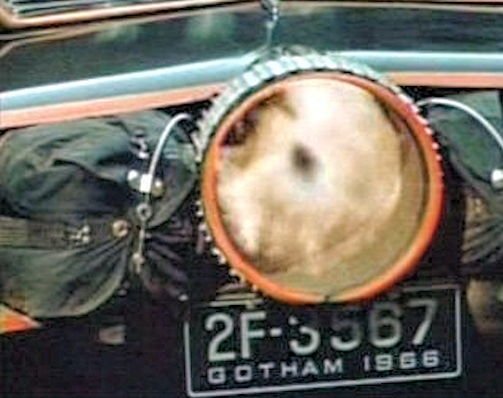
The saying for the Batmobile "atomic batteries to power; turbines to speed". Of course, was not so... the car had a Ford Thunderbird 428 cu V8 engine of the original still.
The special innovations by Baris Kustom City in North Hollywood,told in a launch checklist read out in the opening show by Batman's assistant Robin. As the series progressed other gadgets were incorporated along with the originals such as a Bat scope, revolving closed-circuit camera which consisted of a revolving camera with 360-degree vision (and in the 1960s). The matching Duel streamlined aircraft-type, Plexiglass bubble windshields and top section are also bullet proof. Twin body-contoured, air foam bucket seats of Scottish grain black naugahyde in horseshoe pleat & roll design fitted with shoulder harness and safety belts for Batman and Robin by Cummings & Sander Impact. Interior sound is provided by duo-stereophonic tape deck with speakers by MuntZ.
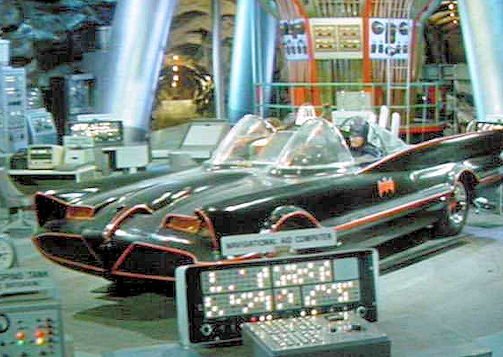
The center safty roll bar arch is equipped with flashing lights, twin parachute brakes to aid high speed-turns and for quick braking, The center consul incorporates the power accelerator T-arm and Bat fire extinguisher, along with a Ansen Posi shift with reflective T-arm has been mounted into the floor consul.The antenna reactor is co-ordinated with an electronic unit installed in trunk and relays messages, through a computer in Batcave. A Detect-a-Scope can locate Batman Robin at all times.
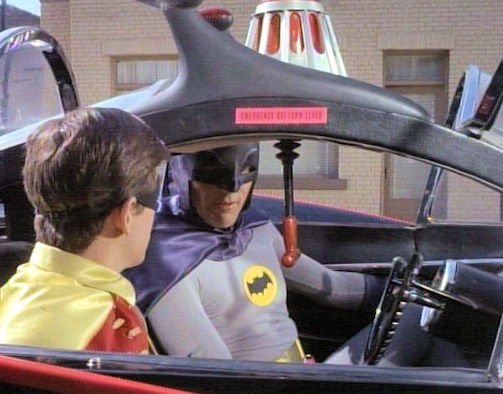
The front mouth are mounted within the grille cavity concealing a set of rockets.The rear upper panel has triple rocket tubes capable of shooting colored fite rockets at the touch or a trigger. It has its own miniature helicopter in the boot called a Whirlybat.a chain-slicer mounted in the nose at the point is a hydraulically operated steel chain and cable curter, smoke and nail spreaders to deter pursuers. Along with the Bateyeanti-theft device. The Bat eyes are dual 450 watt lasser beams headlighting behind reflective amber lenses. Hidden inside the bat ears are normal headlights for street driving and bullet proof Wheel wells guard Firestone tires that are mounted on 10" Rader wheels. and not forgetting the rear turbine exhaust tube, featuring air cooling fins.
The car still in protectve custody of George Barris. He built three replicas for promotional use, after taking moulds from the original Show demand meant five separate Batmobiles were produced altogether for the long running show , the original costing $75,000, with the other four, from moulds off the original car.
The original Batmobile made its final offcial TV appearance in 1979 in a special show entitled Legends of the Superheroes. The car was again covered in flocking material known as Bat Fuzz' but today it's in its shiny black paint once more, complete with the Batrnan logos on the doors.The 1965 original established the style for nearly all Batmobiles since the original George Barris design.
Specifications
- Wheelbase: 129 inch .
- overall length: 225 inch
- Height: 48 inch
- Weight: 3.000lbs
- Seats: 2
- Produced: 5
- Engine: Ford Thunderbird 428 cu V8
- Gadgets: many gadgets
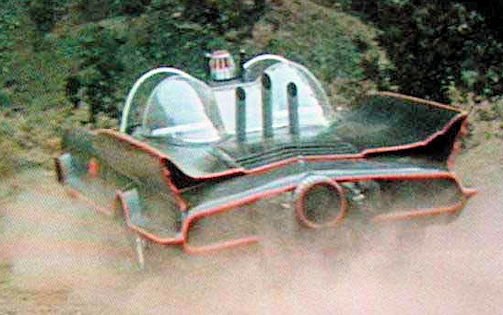
Walt Disney’s Herbie Volkswagen Beetle

Herbie a Volkswagen Beetle magically endowed with a soul of its own. The vehicle can drive itself, reaches impressive top speeds on the road, scares its opponents with a wheelie and really likes to drain oil on indecent people .Used in the original films from 1968 to 1980.
Members exclusive View and watch all the Herbie films
History
Walt Disney realized an idea for a comedy family film of a little VW.The first Love Bug was first leased in 1969 and was an instant success, with both-children and adults. Herbie built in 1963 with a soft top. In contrast to the current street model, the entire interior was kept in Gray because Gray caused fewer problems for the film recordings than white. Herbie’s license plate remained the same in all films: California OFP 857.The body is pearl white L87. Herbie's racing number is black 53 with a white background in a black circle producer of the first two films, Bill Walsh. He stated that at that time he had come across the number 53 very often and that his favourite baseball player
What we find are an innocent 1200 cc VW motor and Not believing that this little VW could be capable of such speeds. Yes, in reality, the powerful bug that was capable at least to seem wheelieing and wheel-spinning was actually powered by Porsche.
Briefly, in the first film the car belongs to a maid, but she returns it to the seller (Peter Thorndyke) due to mechanical problems. Seen Jim Douglas at the dealership, Herbie decides to follow him; Thorndyke, however, reports the man for theft and forces him to buy the Beetle. Thanks to Jim, Herbie begins a "career" as a racing car, achieving many successes; he also helps the owner court and then marry Carole Bennet. About 30 Beetles, ranging from 1966 to 1968 were required for the various Love Bug
stunts, which is a little confusing because the exterior of Herbie is very definitely pre-1967 model and with a keen eye you can see various different models used. much of the special modification work required was carried out at the VW Wolfsburg factory in Germany.
In the first of Herbie’s four adventures, he finds himself out on the race track his new owner, a small-time racing driver named Jim Douglas played by Dean Jones. As Herbie takes the chequered flag time and again, watch out for other rare cars along with Corvettes and Ferraris that fade into the distance as No. 53 goes hurtling past, Patrick Thorndyke.
Herbie's crazy antics include Herbie being driving unaided or this, a driver, hidden by lace curtains, sat right in the back of the car, his foot pedals being just behind the front seats, the rear bench seat having been removed. This enabled side and brief frontal shots to be taken with car appearing to drive by its self. the two-wheel stunt driving (both rear and side); to the car lurching around, tyres heading in all directions, apparently drunk on Irish coffee to Herbie splitting in half at the end of the final race, the rear section over-taking the front portion to win, leaving the front half to come third. also, with the aid of a fork-lift hydraulic system, and carb dioxide bottleand a host of electric motorswith separate 26 levers and buttons which, among other things, opened and shut all the doors and bonnet.

The hydraulic Herbie was also used in some of the other love Bug sequels. The Herbie Rides Again, Herbie Goes to Monte Carlo and Herbie Goes Bananas also featured new stunts, which demanded more special VWs to be constructed.Nobody is really sure how many Beetles were used throughout the Herbie series, although theoriginal now proudly stands in the VW factory.
in Herbie Rides Again from 1974

The story is set in San Francisco During filming Herbie switches from a 1963 model to a 1965 one: this can be seen from the windows, which are different in the 1965 model (they have larger quarters). The broken-down Beetle featured in the final scenes already appeared in the first film in the role of Herbie; the car still exists today and has been restored, however keeping the dents.
Herbie Goes to Monte Carlo 1977

Jim Douglas (Dean Jones) must participate in the imaginary race "Trans-France" (Trans-France Race), accompanied by the faithful mechanic Wheely Applegate (Don Knotts) and driving the irreplaceable Herbie beetle. The race takes place between Paris and Monte Carlo. Some scenes were filmed at the Circuit of Laguna Seca. Numerous vintage sports cars were used in the film; the four cars used by the main characters are: Volkswagen Beetle (Herbie): year 1963, white, red and blue stripes on the bonnet, black number 53 inside a circle, sunroof. Lancia Montecarlo powder blue, white and yellow stripes, dark number 7, retractable headlights (not existing in the real version). De Tomaso Pantera: black, white stripes, black number 66 in a white circle; there are also other specimens. Porsche 917: red, black and yellow stripes, yellow number 17 in a black square.
Herbie Goes Bananas 1980

In Puerto Vallarta, Mexico, two young men, Pete Stanczek and Davy Johns are looking for a mechanic to take the race car that Pete's uncle, Jim Douglas, gave him.


