
Tools
- Details
- Parent Category: Tech Guide
- Category: Tools
- Hits: 44
Panel beating spoon Types
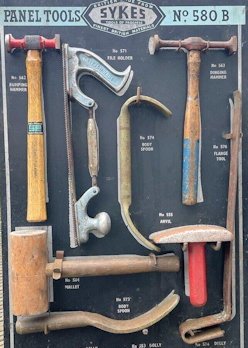
Panel beating spoon Spoon types and their applications.
Spoons are used for bumping and prying; they are also used in place of dollies when direct access to the rear of the panel is obstructed by the internal frame structure.
The choice of the spoon for a particular job will depend on the original contour of the metal, the amount of access, the proposed action (roughing or levelling) and the general shape and length of the spoon.
General-purpose spoon

The reshaping of the roof panel may be possible using a general-purpose spoon instead of the curved dolly.
The use of a backing piece prevents local damage prying upwards with a steady force, accompanied with external beating on any ridges that may be present, will restore the shape. Provided that a backing piece is employed, a certain amount of prying fore and aft may assist the work.
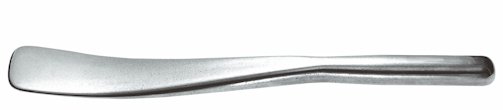
Heavy-duty pry spoon
This spoon can be used for separating outer panels from the inner frame structure when they have been damaged and squeezed together. The spoon can be driven between the plates prying sideways or up and down until the desired amount of separation is achieved. The blade can then be used as a dolly to dress out the outer panel and the inner structure, if required. The blade is reduced to a very thin section which can be used for opening door panel flanges or breaking spot-welded joints that have been previously drilled through the panel or section to be discarded.
High-crown spoon
The high-crown spoon with its broad working surface and high crown is an ideal tool as a dolly or as a spoon for work in confined areas such as headlamp housings and high-crown sections of the body.
Spring-beating spoon
This is a light pressed-steel spoon designed especially for spring-beating on ridges. The spoon is placed directly on the ridge and sharp blows with a beater are delivered to the back of the spoon, spreading the force over a large area. In this manner marking of the panel is prevented and the damage is corrected in many cases without injury to the paintwork. The intensity of the blows should be closely controlled so that the area is not forced down below its normal position. This spoon is not made for
prying or levering. Its surface as with other panel tools should be kept clean and highly polished. Any irregularities on the surface will
be reproduced on the panel in the reverse order.
- Details
- Parent Category: Tech Guide
- Category: Tools
- Hits: 30
Panel Bumping blades
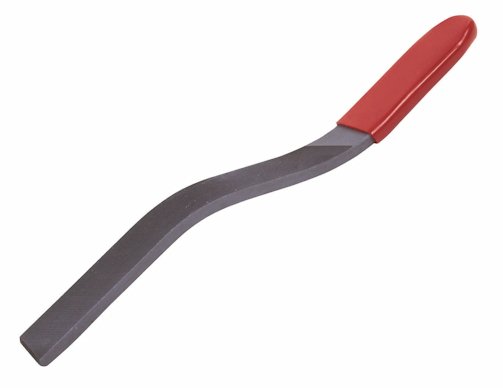
Here we discuss the use of Bumping blades what they are and can be used for.
Bumping blades are used in motor vehicle repair to remove slight dents some time hard to get at panels.
Bumping blades are Suitable for removing bumps, dents & flattening wavy surfaces, with or without the backing support of a dolly. For slight dents or a wavy panel, the use of a Bumping blade surfaces the need for dolly is not required; the bumping blade should be applied so that glancing blows are received by the panel.
The blade serrations hold the metal within the area of contact to avoid stretching.
Use should be limited to slight or moderate damage as this tool is not intended to take on the heavier role of the body spoon or beater and dolly.
Light use and work area with you experience this will indicate when to use the bumping blade and it should be tried out as a semi-finishing tool before the use of a body file
Advice. For best practice, first use on trial panel to get the feel for using it.
- Details
- Parent Category: Tech Guide
- Category: Tools
- Hits: 27
Pressure feed spray guns
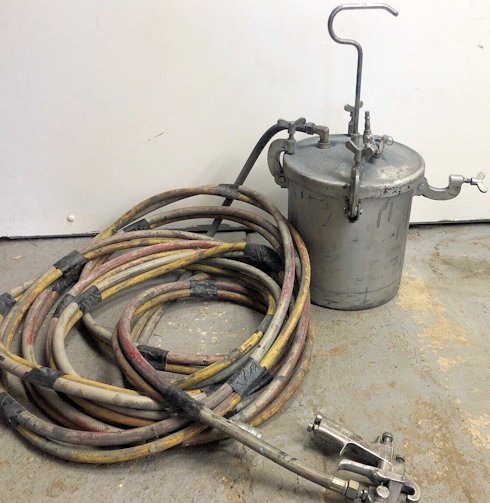
Pressure feed spray guns explained what they are used for and benefits for using them.
This is a spray gun to which the paint is forced by pressure from a tank, fluid cup or pump this type was once often used, but still used in various forms in some environments.
The gun is fitted with an air cap and fluid tip combination that does not siphon the paint and the fluid tip is generally flush with the air cap. A pressure feed gun is used when large amounts of the same colour material are being sprayed, when the material is too heavy to be siphoned from a cup or container by suction, when extra fast application is required, or when large amounts of work need to be done very quickly, particularly on large or commercial vehicles.
In all cases where large amounts of the same material have to be applied, the use of a pressure feed tank is recommended.
- A very large amount of work that can be done before filling is necessary, thus obviating the waste of time that would be entailed in constantly filling the smaller container.
- The spray gun may be turned to any angle to coat the work effectively.
- The material is fed to the gun in greater volume than any other method, particularly if heavy paints are used.
- Less air pressure is required to obtain speed of operation.
- Waste of paint and losses by evaporation are eliminated.
The principle of pressure feed is the application of low air pressure on the material in the tank so that it is forced through fluid hose to the spray
gun. Air pressure is controlled by an air regulator on the lid and a pressure gauge is provided. Pressure feed tanks are in many cases provided with a light insert container that greatly facilitates cleaning and change of material; some tanks can be mounted on a castor base, making removal from place to place an easy matter. The tanks are strongly constructed to avoid any risk of distortion under pressure and are usually galvanized inside and outside.
The lid is held on by clamps and is fitted with a gasket to prevent air leakage. There is a safety valve, an air release valve and at least one air and one fluid draw-off cock, but on the larger tanks there are two or three additional air and fluid cocks, so that the tank can be used by more than one operator. Provision is made for a hand-operated agitator to keep the material properly mixed and for large-capacity tanks it is advisable to have an agitator driven by a compressed air motor. The air motor ensures that the paint is kept at a constant consistency even during periods when the gun is not used.

- Details
- Parent Category: Tech Guide
- Category: Tools
- Hits: 29
Air Compressor regulators and filters
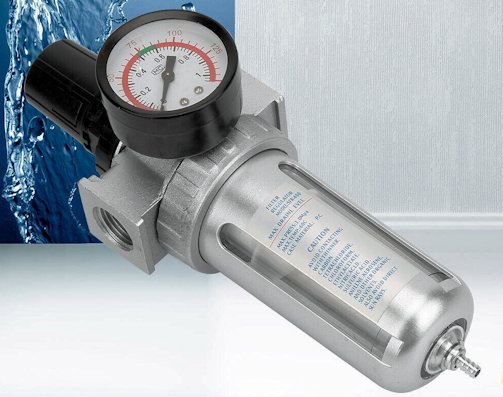
Here we look at Air Compressor regulators and filters what they are used for and types.
Air regulators must be of sufficient air flow capacity for the largest demand at the output and will be rated accordingly and fitted only where a regulated supply is required at spraying points.
Filters (or separators) must also be of the correct air flow rating and are normally integral with the transformer. A filter with drain cock must be incorporated after the regulator and must not be allowed to become clogged with oil or filled with water which condenses from the air passing through it.
Frequent draining is essential in conjunction with periodic cleaning or renewal of the filter as appropriate.
- Failure to maintain filters will result in refinish defects.
- To be efficient, They must not be installed adjacent to the compressor, or near heating appliances.
- Each final output from the regulator/filter unit should be fitted with a shut-off valve prior to the female hose coupling.
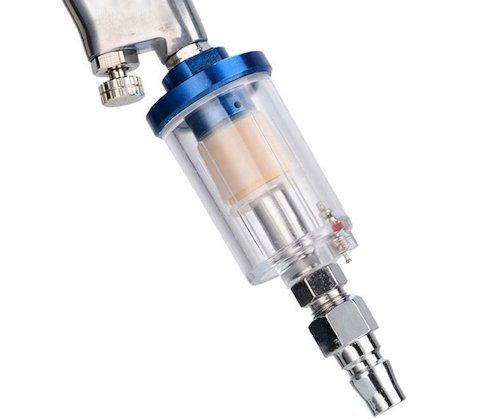
Small-capacity moisture filters are available for fitting directly onto the spray gun inlet tail (between the air hose coupling and the gun) but
these must never be regarded as or used as a substitute for main airline filter units.
- Details
- Parent Category: Tech Guide
- Category: Tools
- Hits: 39
Tools Air Compressor

Air Compressor How it works .Compressed air supply equipment explained, use and types for automotive use.
Guide
The compressor may be a screw, vane or reciprocating piston type. The piston main airline type is often used in the paint trade or for air tools in the general automotive repair shop and DIY home use, although very large and continuous air demands can be economically met with the modern screw and rotary types with reduced noise levels.
The compressor must be of sufficient capacity to cater for work loads. The output rating in cubic metres, litres or equivalent cubic feet, per minute, must be calculated on the basis of actual total air consumption when all equipment is in use.
Compressors may be rated according to piston displacement, displacement at a specified pressure, or free-air displacement at various speeds. The rating which equates to actual output is the free-air displacement at operating speed as this will depend on the volumetric efficiency, which is approximately 75 per cent of the piston displacement for single-stage compression and 85 per cent for two-stage.
For pressures under 5.95 bar (85 psi), single regulated air stage compression is normally used; when pressure requirements are higher, greater economy and efficiency is obtained with a two-stage compressor. With two-stage compression, less power is required; nevertheless, the drive motor power rating can be regarded as an approximate guide to actual air delivery The compressor pressure rating or working air pressure must be selected to maintain a minimum pressure which is equal to the highest-pressure requirement of any equipment in the range to be used. On larger-capacity compressors and when there is continuous air demand, it is advantageous to have an automatic unloader control mechanism which will allow the motor to idle without load when the required pressure is developed in the system and to reload the compressor when the air pressure drops. Auto-Matic start and stop facilities are normally fitted to small compressors for which the air demand is intermittent. Dual-control versions may be used when demands fluctuate.
These are fitted with automatic start/stop and load/unload controls with a time control to stop the compressor when a predetermined motor idling period (unloaded conditions) has elapsed. When there is a high usage of compressed air, as in large refinish premises, an effective cooling device is essential to reduce the temperature of the compressed air and to obtain maximum moisture separation from the air.
Compressors must be sited in a cold area with cold air intake as hot environments and inlet air will reduce efficiency.
- Weekly check
Compressor oil level, safety valves. - Monthly check
Intake filter, external cleanliness (to aid cooling), lubrication and cleanliness of electric motor, tightness of bolts, fittings, etc.
The compressor reservoir must be of sufficient capacity to eliminate air pressure fluctuations

