
Vehicle Body
- Details
- Parent Category: Tech Guide
- Category: Vehicle Body
- Hits: 31
Paint Settling problems
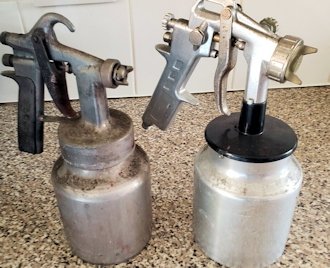
This section includes Paint Settling problems hard settling and caking.
All pigmented materials will settle. Many factors, such as type of pigment, formulation, fineness of grind, and viscosity will determine whether the pigments settle hard, soft, fast or slow.
To Repair All paint products should be stirred thoroughly each time before use. Materials which do not appear to be settled may actually contain a much higher concentration of pigment near the bottom of the container than near the top, and still be so soft that the settling cannot be detected. Thus an undercoat, if used without stirring, may give poor adhesion, hard flatting, etc. If firm or hard settling is present, the liquid portion should all be poured off into a separate clean container, and the settled
portion should be broken up and stirred thoroughly until completely smooth and free of lumps and visible particles. The liquid portion should then be poured back into the original container, very slowly at first, while continually stirring the material. After thinning, the material should be strained through a fine straining medium.
Prevention
Steps which can be taken by the paint dealer and the paint user to minimize settling are:
- Never store paint near heat. Keep in a cool place.
- Invert containers periodically.
- Use oldest stock first.
- Never store thinned paint.
- Never pour paint back into container of unthinned paint.
- Details
- Parent Category: Tech Guide
- Category: Vehicle Body
- Hits: 33
Vehicle Paint Colour is off-shade
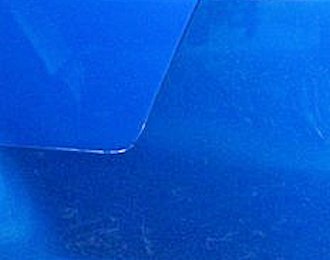
Vehicle Paint Colour looks different to original paint under normal or different light conditions.
Cause
1. Refinish colour not thoroughly stirred.
2. Original finishes faded or off colour due to weathering.
3. Original finishes do not match master standard supplied by motor company.
4. Wax coatings on the original finish are discoloured. This is a common condition on light colours.
5. Refinish colour not properly applied. This can be a result of poor or improper amount of thinner, wrong air pressure, spraying too wet or dry. These will greatly influence the final appearance of metallic colours in particular.
6. Insufficient number of coats.
7. Colour burned by hard wheel polishing.
8. Metamerism — colour match only under one type of light.
Prevention
1. Stir all colours thoroughly to incorporate all pigment.
2. Remove wax from adjacent sections with a wax and grease remover.
3. Light polishing of adjacent panels often helps to produce a colour match to newly painted section.
4. When applying metallics adjust spraying technique to effect colour match. Higher air pressure, greater distance between spray gun and panel, thin, dry coats give lighter shades. Lower air pressure and wetter coats give darker shades.
5. To prevent rings on spot jobs, overlap sufficiently on original finish. Use care to avoid cutting through when polishing.
6. A sure way to avoid colour mismatch is to spray a small metal panel with the materials to be used, and compare with the original finish before painting the job.
7. In severe cases, the new material should be tinted to match the old finish.
- Details
- Parent Category: Tech Guide
- Category: Vehicle Body
- Hits: 31
Paint Undercoat Primer
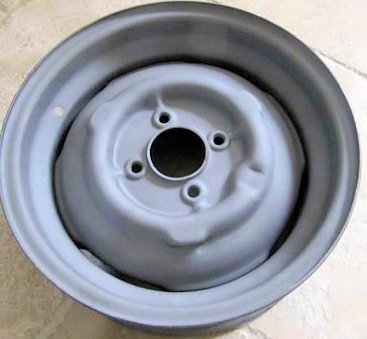
The Undercoat is a term used broadly to describe the coatings which can provide a base for the final coat It includes primers, primer colour coats.surfacers, fillers, stoppers and sealers.
A prirner is an undercoat designed to ensure that the paint system adheres well to the substrate, initially and in service. It is generally used over bare metal, although it can also be used over old finishes. As its main function is to establish a secure base for the paint system as a whole, a primer is most effective if applied in a relatively thin film. Primers are not formulated to fill scratches or to be flatted. For a very light rubbing down that should be carried out.
- Details
- Parent Category: Tech Guide
- Category: Vehicle Body
- Hits: 31
Paint Wrinkling problems
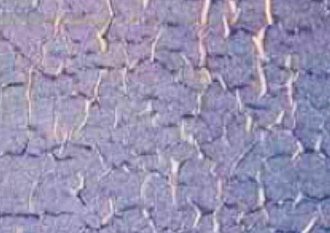
This section includes Paint Wrinkling problems crinkling and puckering. Any condition that produces a lifting tendency will often initiate or aggravate wrinkling: see lifting. To Repair the only recommended course of action is to remove the wrinkled film and repaint properly.
Cause
- Rapid drying of top surface while the underneath remains soft.
- Any condition that leads to thick films will tend to cause wrinkling
- Many conditions that produce slow drying tend to produce wrinkling: see drying.
- Spraying in hot sun, or exposing to sunshine before synthetic paint is thoroughly dry.
- Abnormally hot and humid weather.
Prevention
1. Avoid all conditions which may lead to runs, lifting, and slow drying.
2. At all costs avoid application of abnormally thick films.
3. If possible avoid spraying in abnormally hot humid weather.
4. Do not spray in hot sun, or run car into sunshine before it is completely dry.
5. Do not put water on freshly painted enamel job, especially if surface is warm.
- Details
- Parent Category: Tech Guide
- Category: Vehicle Body
- Hits: 31
Paint Bronzing Problems
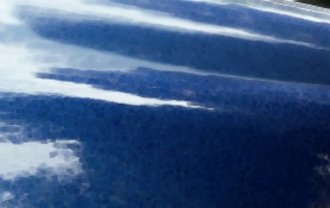
A not too common condition, seen more often in some dark blues, reds, maroons and rarely in other colours, having the appearance of a fine coloured chalk or bronze coloured film on the surface. Easily wiped off, the condition appears again in a short time. The painter has little or no control over this rather rare condition.
Cause
1. A peculiar combination of certain pigments and film-forming ingredients is responsible.
2. In a few cases, overheating of reds and maroons by hot spraying or wheel burning has been known to cause this condition.
Prevention
Repair
1. Light hand polishing with a mild liquid polish will remove the bronze. Frequent washing and light polishing will maintain good appearance.
2. Permanent elimination of the condition usually requires repainting.

