
Jaguar Engines
- Details
- Parent Category: Engines Makes
- Category: Jaguar Engines
- Hits: 247
Jaguar AJ126 3.0-liter V6 engine

The AJ126 is basically based on the Jaguar AJ133 V8. Due to the external similarity of the housing and cylinder heads both engines, d. H. Both the V6 and the V8 are manufactured on a production line, since only minor changes to the tools and processes are necessary. A relationship with engines from the house Ford does not exist. The AJ126 in the JLR Group replaces the previously used AJ-V6 with 60 ° cylinder angle.
The AJ126 has 2,995 cc capacity with a bore of 84.5 mm and a stroke of 89 mm. The cylinder angle is 90 °. The compression is 10.5: 1. All versions of the AJ126 are supercharged and differ in detail, especially in terms of performance.
The AJ126 is a 3.0 L (2,995 cc (182.8 cu in)) 90° petrol V6, having a bore of 84.5 mm (3.3 in) and stroke of 89 mm (3.5 in) with a 10.5:1 compression ratio. It is supercharged and liquid cooled featuring direct fuel injection, four overhead camshafts and four valves per cylinder. There are two versions differing in power produced, a standard version making 340 hp (254 kW; 345 PS) at 6500 RPM and 332 lb⋅ft (450 N⋅m) between 3500-5000 RPM and a high-performance variant making 380 hp (283 kW; 385 PS) at 6500 RPM and 339 lb⋅ft (460 N⋅m) between 3500-5000 RPM.
The main structural components of the engine are all manufactured from aluminum alloy. The engine is built around a very stiff, lightweight, enclosed V, deep skirt cylinder block. A structural windage tray is bolted to the bottom of the cylinder block to further improve the block stiffness, minimize NVH (noise, vibration and harshness) and help reduce oil foaming. To further enhance the stiffness of the lower engine structure, a heavily ribbed sump body is installed. The sump body also helps to reduce engine noise.
The engine uses a Bosch high pressure direct injection fuel system with fuel pressure provided by two, cam driven high pressure pumps which are driven by a dedicated camshaft. The high pressure pumps supply the fuel rails which in turn supply the three injectors for that bank with fuel at a controlled pressure.
The four camshafts incorporate VCT (variable camshaft timing). VCT allows the timing of the intake and exhaust valves to be adjusted independently of each other. The VCT system is controlled by the Bosch ECM (engine control module) using information from CMP (camshaft position) sensors.
The supercharger is located in the 'vee' of the engine and is driven from the crankshaft by a dedicated secondary drive belt.
The engine meets EU5 emission regulations in Europe and Rest of World (ROW) and ULEV 70 emission regulations in North American Specification (NAS) markets.
The direct fuel injection system, advanced piston and combustion chamber design and the supercharger provide improved fuel consumption and emissions.
The AJ126 V6 is basically an AJ133 V8 engine that has 2 fewer cylinders and is made on the same production line as the AJ133. It shares a very similar block as the supercharged V8 AJ133, with some differences such as reduced bore size. Cylinder heads are also derived from the V8 engine. The engine features a balance shaft to drive the oil pump and balance the crankshaft. Vehicles use this engine:
2012– Jaguar F-Type V6
2015– Jaguar XE V6
2014– Range Rover Sport (L494)
2012– Range Rover (L405)
Overview of AJ126 Engine and Series
| engine | Displacement | Period | kW | PS | nm | feature | vehicles |
|---|---|---|---|---|---|---|---|
| AJ126 | 3.0 | from 06/2013, 06 / 2015-05 / 2017, from 09/2015 | 250 | 340 | 450 | 1.75 bar boost pressure | Jaguar F-Type, XE S, XF 35t |
| AJ126 | 3.0 | from 06/2013, from 05/2017, from 09/2015 | 280 | 380 | 460 | 1.9 bar boost pressure | Jaguar F-Type S, XE S, XF S |
| AJ126 | 3.0 | from 01/2017 | 294 | 400 | 460 | Jaguar F-Type 400 |
- Details
- Parent Category: Engines Makes
- Category: Jaguar Engines
- Hits: 180
Jaguar XK6 engine
From 1949 to 1968

The Jaguar XK6 dual overhead camshaft (DOHC) inline 6-cylinder engine was introduced by Jaguar Cars in 1949 and manufactured through 1992. It was produced in five displacements for Jaguar passenger cars, with other sizes being made by Jaguar and privateers for racing. In contrast with contemporary BMW and Mercedes engines, the original XK engine was relatively unstressed and produced high torque thanks to its more advanced valve and head configuration.
Early development
Prior to World War II, SS Cars (which changed its name to Jaguar in 1945) used engines produced by the Standard Motor Company; a 1.5-litre 4-cylinder and 6-cylinder engines of 2.5 and 3.5 litres. Sir William Lyons and his engine designers; William Heynes (Chief Engineer), Walter Hassan and Claude Baily, are widely reported to have discussed a new range of replacements whilst fire-watching on the roof of the SS factory in Swallow Road, Coventry, during German World War II bombing raids and to have developed prototype engines immediately after the war. In fact, Jeff Daniels has demonstrated that Jaguar’s wartime engine developments went far beyond mere discussion and design, extending to the construction and testing of several prototype engines from as early as 1943.
The initial aim was to produce a series of engines of higher than normal output that would be able to stay ahead of the competition without revision for many years and which Sir William insisted also had to "look good". In 1942-43, a range of configurations was considered and it was concluded that, for good breathing and high bmep, the new engines would need vee-opposed valves operating in hemispherical combustion chambers. Two configurations of this type were selected for comparison in 1943 and the prototypes named "XG" and "XF". The XG 4-cylinder of 1,776 cc, first tested in October 1943, was based on the 1.5-litre Standard block and used its single cam-in-block to operate the opposed valves via a complicated crossover pushrod arrangement, similar to that of the pre-war BMW 328. The XF 4-cylinder of 1,732 cc used the now familiar dual overhead cam (DOHC) configuration and was first tested in November 1944. The XG was found to suffer from excessive pushrod and rocker noise and gas flow figures through its vertical valve ports did not equal those of the horizontal ports on the XF. Therefore, from these two options, the DOHC XF layout was selected.
4-cyl engine development progressed as follows:
- XG Pushrod engine 73 x 106 x 4 1776cc May to Nov 1944
- XF 75 x 98 x 4 1732cc Nov 1944 to Jun 1945
- XK1 (first of Haynes’ 4 x XJs) 76.25 x 98 x 4 1790cc Oct 1945 to Nov 1946
- XK2 76.25 x 98 x 4 1790cc Feb to Sep 1946
- XK3 76.25 x 98 x 4 1790cc Dec 1946 to Feb 1947
- XK4 76.25 x 98 x 4 1790cc Nov 1946 to Dec 1947
- Gardner Engine (used in record-breaking MG car) 1970cc 1948
- XK Number 1 3-bearing crank 1970cc 1949-1952
- XK Number 2 3-bearing crank 1970cc 1950-1952
- XK 5-bearing crank 1970cc 1953
By September 1947 a 3.2-litre 6-cylinder version had been produced, called the "XJ 6-cylinder", which was intended to replace both Standard-based 6-cylinder units. Testing showed the need for higher torque at low speeds than this engine could produce and hence it was 'stroked' to form the "XK 6-cylinder" which, with its initial capacity of 3,442 cc, was settled upon for production in 1947-48. This engine first powered the Jaguar XK120, followed by the Jaguar Mark VII and a number of other Jaguar models in subsequent years.
The XG prototype soldiered on as a component testbed until 1948. There also existed an "XK 4-cylinder" of 1,790 cc, also first tested in October 1945 and remaining under development alongside the XK 6-cylinder units. At the time of William Heynes' paper presented to the IMechE in February 1953, the XK 4-cylinder was still referred to as being under development. It was only finally dropped as a possible production engine later in 1953, by which time it had been realised that Jaguar's image in the market had moved beyond the need for a replacement for the old 1.5-litre Standard 4-cylinder unit.
Because the 6-cylinder XK prototypes were found to be so much more refined than the 4-cylinder versions, in 1951 a 1,986 cc 6-cylinder version of the XK 6-cylinder was built to see if it would suffice as a smaller scale engine. By 1954 this had grown to 2,483 cc and it was this short-block version of the XK 6-cylinder that was fitted to the new compact Jaguar 2.4-litre (retrospectively known as the Mark 1) released in that year. None of the 4-cylinder prototypes ever advanced to production but Lt. Col. Goldie Gardner's speed record team did fit a 1970cc version to the MG streamliner EX-135 in 1948 to take the 2,000 cc class record at 177 mph, on the Jabbeke motorway in Belgium.
There are some misleading claims of an intervening "XJ" 4-cyl prototype but it seems the only person who referred to them as such was William Haynes in a paper presented to the IMechE in 1953. Haynes stated there were many 4-cyl variants following the XF but it was he alone who loosely grouped them as XJ. The last mention of XF was in July 1945 and the first mention of XK (XK1) was in October of the same year. This doesn’t give much room for a series of XJ engines.There are no mentions of XJ in the archive (other than in Heynes’ paper). If there is a XJ, the first one is likely to have been referred to as XK1 internally. There were three others of nominally 1790cc capacity called XK2, XK3 & XK4. It is likely these are what Haynes referred to as "XJ". The first "true" XK was called "XK Number 1" (distinct from "XK1") and was of 1970cc nominal capacity with a 83mm/91mm bore/stroke.
Thus were developed the two block sizes that formed the basis of all subsequent XK 6-cylinder engines; the shorter block being used for the 2.4 and 2.8-litre engines and the full sized block for both versions of the 3.4, the 3.8 and the 4.2-litre engines.
Valve train
The most recognisable feature of the XK engine is the dual cam covers atop the engine, which were a polished alloy until a change to ribbed black and alloy finish in early 1968, four years or so after the introduction of the 4.2-litre versions in 1964. The unusual depth of the engine's cylinder head was dictated by the desire to make room for two generously-sized valves, whilst not excessively restricting the flow of gases into and out of the hemispherical combustion chambers. To satisfy these two conditions, a relatively wide angle between the valves was initially chosen, with quite long valve stems. To efficiently operate valves whose tops were such a long way apart, the dual overhead cam arrangement was found to be the most effective.
The cam lobes act directly on bucket type tappets, which are adjusted by means of shims between the underside of the bucket and the top of the valves. Two duplex chains drive the camshafts, one from the crankshaft to a sprocket at the level of the combustion chambers, and one from the sprocket to each camshaft. The original sprung slipper design of the lower cam chain tensioner proved to be too weak and after a couple of years was changed to an improved hydraulic design, using engine oil pressure.
Cylinder head
The cylinder heads were made of RR50 aluminium alloy due to that material's high rate of heat conduction and light weight, the latter estimated by Bill Heynes to give a weight saving of some 70 lb (32 kg) compared with a similar head made of cast iron. Special attention was paid to the gas flow, with Harry Weslakedesigning a curved inlet port to impart swirl to the air-fuel mixture for improved combustion. The same basic cylinder head layout was preserved throughout the production life of the engine but with many detail changes. Valve and port sizes and angles, camshaft lift, compression ratio and carburetion were frequently amended from model to model, depending upon whether power or torque was being emphasised. Very early XK engines fitted to the XK 120 sports car and Mark VII saloon lacked fixing studs at the front part of the cam covers, where they covered the timing chains, which leaked oil as a result. From 1951 onwards, all XK engines had studs around the full perimeter of the cam covers.
The earliest cylinder heads are known as "Standard" or "A type" heads and are identifiable by their differing valve angles of 30 degrees inlet and 45 degrees exhaust, as well as by their unpainted aluminium finish. Around 1954, the "B type" head appeared, with equal valve angles of 35 degrees on inlet and exhaust. The "B type" heads are painted light "duck egg" blue (early cars) to light green (later cars) in the 2.4 and 3.4-litre models and metallic dark blue in 3.8-litre models. A very few XK 120s and XK 140s were supplied to customers with the "C type" cylinder head, which was painted red and carried a plaque on each cam cover stating "Jaguar Type C".
A supposedly more efficient "straight port" cylinder head, again with equal 35 degree angles on the inlet and exhaust was introduced later in the 1950s and this was painted pumpkin orange on the XK-150S. The cylinder heads in the Series 1 E-type and Mark X were painted gold whether the engine was a 3.8-litre or 4.2-litre. Around the time of the later series 1 E-Types and 420G in 1968, about the same time as the arrival of the ribbed cam covers, the practice of painting the cylinder heads ceased. Many sources still describe the subsequent unpainted aluminium finish as "silver".
The logic behind Jaguar's colour-coding of its cylinder heads of the late 1950s and early 1960s can be difficult to fathom and sources often get it wrong. It can be determined from Heiner Stertkamp’s reference that the colour-coding follows the pattern listed below. The only real anomaly is that the earliest 3.8-litre E-Types had an orange painted head (because they had 3 carburettors) but later changed to gold (because they had straight-port heads). Gold paint signified a straight port triple-carburettor setup from then until the demise of the Mark X.
- Silver/bare aluminium => 3.4 A-type head (Standard XK120, XK140 and MkVII with two H6 carburettors)
- Red => 3.4-litre with C-type head and 2 carburettors (XK 120 C and XK 140SE/M only)
- Light duck egg blue and later light green => 3.4-litre with B-type head and 2 carburettors (may appear as light blue, light green or light blue-green)
- Dark blue metallic => 3.8-litre with B-type head and 2 carburettors
- Orange => 3.4 and 3.8-litre with "Straight-port" head and 3 carburettors AND earliest 3.8-litre with straight-port head and 3 carburettors
- Gold => later 3.8-litre and all 4.2-litre (until 420G and Series 2 E-Type) with straight-port head and 3 carburettors
Cars with the straight-port head and only two carburettors did not have painted heads. See the complete table of XK cylinder head types as they relate to Jaguar and Daimler models at the end of this article.
Engine block
The block was made of cast iron (with the exception of some made of aluminium alloy for racing engines), with the crankcase split on the centreline of the seven-bearing crankshaft. The crankshaft was made of EN16 steel, heat treated prior to machining. An innovation was the fitting of a proprietary Metalastikvibration damper on the nose of the crankshaft to eliminate damaging crankshaft resonances. The design and materials of the bottom end of the engine hardly changed throughout its life, apart from the changes dictated by the respaced cylinders of the 4.2-litre version (also used by the 'new 3.4' litre version). The oil pump was changed after a couple of years from a relatively inefficient gear-type pump to a Hobourn-Eaton eccentric-lobe unit.
Fuel system
The pre-injection cars had either two or three SU, Weber, Zenith or Zenith-Stromberg carburettors of various sizes depending upon the model and market. The first engines to receive fuel injection were some D-Type sports racing cars but fuel injection did not become available on the road cars until 1978. The US market was the first to receive fuel injection on certain models, with the switch away from carburettors eventually extending across the range and to all markets.
Power rating
During the 1950s and 1960s Jaguar used the SAE gross horsepower measurement system used by US manufacturers, as otherwise Jaguar cars would have appeared under-powered in comparison with US cars which always quoted their horsepower using the SAE gross system. Gross horsepower was flattering since non-standard exhaust systems were allowed and most of the usual belt-driven ancillaries were removed or discounted from the horsepower calculation. This was superseded by the more realistic SAE net horsepower system around 1972, although Jaguar power ratings of that era may also be expressed using the very similar DIN net rating system. An objective comparison of the power outputs of the various models of XK6 powered Jaguar is therefore quite problematic.
The 1961 XK fitted to the E-Type had a claimed output of 265 hp SAE; the final fuel injected XK which was significantly more powerful had a measured output of 205 hp DIN.
Individual displacements
3.4-litre
The first production use of the XK 6-cylinder was in the 1948 Jaguar XK120, which used the 3.4 L (3,442 cc / 210 cu-in) version with an 83 mm (3.3 in) bore and 106 mm (4.2 in) stroke. It had an iron block and aluminium cylinder head with no bore liners. It had a wider gap between cylinders 3 and 4 than between the other cylinders. The 3.4 was first rated at 160 bhp (119 kW) SAE gross at a compression ratio of 8:1, rising to 210 bhp (157 kW) SAE gross with the C-type cylinder head (confusingly not the head from the C-Type as raced at Le Mans) all the way to 250 bhp (186 kW) SAE gross with the "straight port" head at a compression ratio of 9:1 as fitted to the XK150SE.
Almost as soon as the new compact Jaguar 2.4-litre (described below) was released, there was pressure on Jaguar to fit the 3.4-litre engine to it. This was duly done in February 1957, the car being known as the Jaguar 3.4-litre. The designation "Mark 1" for these cars was applied retrospectively, after the release of the Mark 2 in 1959.
The original 3.4-litre XK6 was used in the following road cars:
- Jaguar XK120- 1948-53, "Standard (or "A type")" cylinder head, bare aluminium finish, 2 × SU H6 carburettors. The XK 120 C came with the C-type head (red) as an option from 1951 to 1952 with 2 × SU H8 carburettors. In 1953, the XK 120 C switched to a triple Weber 40 DCOE carburettor setup. The XK 120 SE and M came with the C-type head as an option with 2 × SU H6 carburettors (occasionally SU H8)
- Jaguar XK140- 1954-57, "Standard (or "A type")" cylinder head, 2 × SU H6 carburettors. The XK 140 SE or M came with the C-type head as an option, painted red with 2 × SU H6 or H8 carburettors
- Jaguar XK 150 3.4- 1957-61, "B type" cylinder head, painted light blue-green, 2 × SU HD6 carburettors
- Jaguar XK 150 3.4S- 1957-61, "Straight port" cylinder head, painted orange, 3 × SU HD8 carburettors
- Jaguar Mark VII- 1950-54, "A type" then "C type" (as option from April 1953) cylinder head, unpainted aluminium, 2 × SU H6 carburettors
- Jaguar MkVIIM- 1954-57, "C type" cylinder head, 2 × SU H6 carburettors, some had high-lift cams
- Jaguar Mark VIII- 1956–1958, "B type" cylinder head, painted light blue-green, 2 × SU HD6 carburettors
- Jaguar 3.4-litre 'Mark 1'- 1957-59, "B type" cylinder head, painted light blue-green, 2 × SU HD6 carburettors
- Jaguar 3.4-litre Mark 2- 1959-67, "B type" cylinder head, painted light blue-green, 2 × SU HD6 carburettors
- Jaguar 340 Mark 2- 1967-68, "B type" cylinder head, ribbed cam covers, 2 × SU HD6 carburettors
- Jaguar S-Type 3.4- 1963-68, "B type" cylinder head painted light blue-green, ribbed cam covers, 2 × SU HD6 carburettors
2.4-litre
In the mid-1950s, Jaguar lacked a compact saloon of the type represented until 1949 by the Standard-engined 1½ litre. In choosing a power unit for its all new compact saloon, Jaguar could choose between the 1,995 cc four-cylinder XK prototype and a downsized version of the 3.4-litre six-cylinder XK. The 4-cylinder was considered too low powered and unrefined. The 3.4 was already well "undersquare", which means that its bore was much less than its stroke, so a smaller bore version of the 3.4 was not seen as a realistic proposition. Jaguar was therefore obliged to create a short-stroke version of the 6-cylinder XK with a shorter cylinder block, reducing it in height from 11.5 in (292 mm) to 8.85 in (225 mm).
Introduced in the Jaguar 2.4-litre in 1955, the engine had a stroke of 76.5 mm (3.0 in) while retaining the bore of 83 mm (3.3 in) to give a capacity of 2,483 cc (151.5 cu in). Despite having a displacement of almost 2.5 litres, the new car was called the "Jaguar 2.4" to create an obvious separation from the old Standard 2½ litre and link it to the now familiar 3.4-litre XK engine. The 2.4s produced were rated at 112 bhp (nett) by the factory, using twin Solex downdraft carburettors.
In 1959 the engine was carried over into the new Mark 2, in which it produced 120 hp (89 kW) SAE gross, still with Solex carburettors. The Jaguar 240 was fitted with an uprated version of the engine, incorporating the straight-port cylinder head and twin SU carburettors delivering 133 bhp SAE gross.
The 2.4-litre XK6 was used in the following cars:
- Jaguar 2.4-litre 'Mark 1'- 1955-59, "B type" cylinder head, unpainted, 2 × Solex B32PB15S carburettors, valve angles 30 degrees inlet, 45 degrees exhaust
- Jaguar 2.4-litre Mark 2- 1959-67, "B type" cylinder head, unpainted, 2 × Solex B32PB15S carburettors, valve angles 45 degrees inlet and exhaust
- Jaguar 240 Mark 2- 1967-69, "Straight port" cylinder head, unpainted, 2 × SU HD6 carburettors, valve angles 45 degrees inlet and exhaust

3.8-litre
The 3.8-litre version was released in 1958, initially for the last of the XK150s and the Mark IX saloon. It retained the 3.4’s bore centres and 106 mm (4.2 in) stroke but was bored out to 87 mm (3.4 in) for a total displacement of (3,781 cc / 230.7 cu-in). The distance between the cylinder bores was sufficiently small that it was decided to fit dry liners to the bores. The 3.8 had a number of detail differences from the 3.4, particularly in its valve gear and carburetion. The standard 3.8 produced 220 hp (164 kW) SAE gross and up to 265 hp (198 kW) SAE gross in the XK150SE with the straight port head.
PERFORMANCE: 3.8L E Type
max speed in 1st gear: 42.2 mph, 68 km/h
max speed in 2nd gear: 77.6 mph, 125 km/h
max speed in 3rd gear: 116.2 mph, 187 km/h
max speed in 4th gear: 150 mph, 241.5 km/h
power-weight ratio: 9.5 lb/hp, 4.3 kg/hp
useful load: 441 1b, 200 kg
acceleration standing 1/4 mile 14.7 sec, 0—50 mph (0 —80 km/h) 5.6 sec
FUEL CONSUMPTION: 19.0 miles, Imp gal, 15.8 miles 14.9 US gal
MAX SPEED: 150 mph, 241.5 km h
The 3.8-litre XK6 was used in the following road cars:
- Jaguar XK 150 3.8- 1958-61, "B type" cylinder head, painted dark blue metallic, 2 × SU HD6 carburettors
- Jaguar XK150 3.8S- 1958-61, "Straight port" cylinder head, painted pumpkin orange, 3 × SU HD8 carburettors
- Jaguar Mark IX- 1958-61, "B type" cylinder head, painted dark blue metallic, 2 × SU HD6 carburettors
- Jaguar Mark X 3.8- 1961-64, "Straight port" cylinder head, painted gold, 3 × SU HD8 carburettors
- Jaguar Mark 2- 1959-67, "B type" cylinder head, painted dark blue metallic, 2 × SU HD6 carburettors
- Jaguar E-Type Series 1 3.8- 1961-64, "Straight port" cylinder head, painted orange then gold, 3 × SU HD8 carburettors
- Jaguar S-Type 3.8- 1963-68, "B type" cylinder head, dark blue metallic or later with ribbed cam covers and unpainted, 2 × SU HD6 carburettors
- Panther J.72
3.0-litre
3-litre versions of the XK engine were built from 1959 onwards for FIA sports car racing. It was also popular with small race car manufacturers such as Lister Cars who could not afford to produce their own engines. As well as endurance racing, the engine was also used in Formula Libre racing.
A 3.0-litre XK6 was used in the following road cars:
- Jaguar E2A prototype sports racer (1960)
- Jaguar E-typelightweight sports racer (1961)
- Jaguar D-type(non-works) sports racer (1959)
- Lister Carsendurance and formula racers
- Hersham and Walton Motors(HWM) endurance and formula racers
- Cooper Car Company endurance and formula racers
- John Tojeiro endurance and formula racers

- Details
- Parent Category: Engines Makes
- Category: Jaguar Engines
- Hits: 421
Jaguar XK 6-cylinder engine From 1964 to 1992
2.8 ,3.4 and 4.2-litre engine

4.2-litre 1960s Zenith-Stromberg 175 CDSE carburettors
The Jaguar XK6 2.8 ,3.4 and 4.2-litre dual overhead camshaft (DOHC) inline 6-cylinder engine was introduced by Jaguar Cars in 1964 and manufactured through to 1992. It was produced in three displacements for Jaguar passenger cars, with other sizes being made by Jaguar and privateers for racing.
2.8-litre
A 2.8-litre version of the XK was introduced for the entry-level XJ6 models in 1968. It returned to the old short block of the 2.4, retaining the bore of 83 mm (3.3 in) but lengthening the stroke by 9.5 mm (0.4 in) to 86 mm (3.4 in) to give a displacement of 2,792 cc / 170.4 cu-in. The power output of the 2.8 was listed as 142 PS (104 kW; 140 hp) DIN net, which cannot be directly compared with the 133 bhp SAE gross of the last of the 2.4s in the 240 Mark 2.
The 2.8 gained a bad reputation early in its career due to a tendency for excessive carbon deposits to accumulate on the piston crowns during low-speed running, which would burn through the crowns when run at higher revs. This was later cured by a switch to stronger pistons but the engine was also a mediocre performer offering no real economy benefit and it was dropped in 1973, to be replaced by the ‘new’ 3.4.
All of the 2.8-litre XK engines used the straight port head unpainted, which some sources may describe as "silver", and had ribbed cam covers.
The 2.8-litre XK6 was used in the following cars:
- XJ6 2.8 Series 1- 1968-73, 2 × SU HD8 carburettors
- Daimler Sovereign 2.8 'XJ6' Series 1– 1969-72, 2 × SU HD8 carburettors
- XJ6 2.8 Series 2- 1973-74, 2 × SU HS8 carburettors
"New" 3.4-litre
Introduced in 1975 to replace the 2.8 in the entry level XJ6, the new 3.4 was not a simple revival of the original XK. Whilst it shared the old 3.4’s bore and stroke of 83 mm (3.3 in) and 106 mm (4.2 in) respectively, it was actually a small bore derivative of the 4.2, using its block, cylinder spacings, main bearing spacings and stiffer bottom end but dispensing with the cylinder liners used by the 3.8 and 4.2. It used a straight port head and delivered 161 PS (118 kW; 159 hp) DIN net and far superior torque to the 2.8.
The "new 3.4" used the straight port head, had ribbed cam covers and the heads were unpainted.
The "New 3.4" litre XK6 was used in the following cars:
- XJ6 3.4 Series 2- 1975-79, ribbed cam covers, 2 × SU HS8 carburettors. From 1977, 2 × SU HIIF7 carburettors
- Daimler Sovereign 'XJ6' 3.4 Series 2– 1975-79, ribbed cam covers, 2 × SU HS8 carburettors. From 1977, 2 × SU HIIF7 carburettors
- XJ6 Series 3- 1979-86, ribbed cam covers, 2 × SU carburettors
Cylinder head types
The following table relates XK cylinder head type to Jaguar/Daimler model and includes the paint colours applied to certain versions of the cylinder head in the 1950s and 60s. Unpainted heads are sometimes referred to as "silver" but this is merely the natural colour of the aluminium alloy.
4.2-litre
The 4.2-litre version of the XK was officially released in 1964, although racers had been boring the 3.8 out to 4.2 litres for years. The factory 4.2-litre block was a new siamesed sleeve design which used respaced cylinders set unevenly along the length of the block with new main bearing spacings and a new crankshaft. The middle two cylinders were moved closer together and the outer two moved further apart but the overall length of the block remained unchanged. This enabled the cylinder bores to be taken out to 92.07 mm (3.6 in) whilst retaining the familiar long stroke of 106 mm (4.2 in) for a total displacement of 4,235cc / 258.4cuin.
Despite the re-spacing of the cylinder bores, the cylinder head castings remained unchanged. As a result, the centrelines of the combustion chambers in the head no longer aligned precisely with the centrelines of the cylinders but this did not matter greatly as the combustion chamber diameters in the head were smaller than the cylinder diameters. The 3.8 and 4.2-litre cylinder heads and cams are therefore interchangeable. The 4.2-litre engine from the factory had unsmoothed steps between the inlet manifold and head, and the manifold gaskets were not a good match for the inlet ports. These engines therefore make excellent bases for some modification, achieving approx. 220 bhp (164 kW; 223 PS) SAE net and increased torque merely by "flowing" the head.
Published horsepower ratings of the various versions of the 4.2-litre are complicated by the switch from gross to net horsepower systems during its lifetime. For example, in 1965 the 4.2-litre with triple SU carburettors fitted to the US-specification E-Type was rated at 265 hp (198 kW) SAE gross whereas by 1969, now with twin Zenith-Stromberg carburettors, this had fallen to 246 hp (183 kW) SAE gross. The difference indicates the effect of the revised carburetion and other changes made to reduce exhaust emissions from US specification engines. Jeff Daniels' reference states that the similar twin Zenith-Stromberg version fitted to a US specification XJ6 was rated by Jaguar at 170 PS (125 kW; 168 hp) using the DIN net horsepower system, the difference being largely due to the effect of the gross versus net horsepower rating systems.
The 1987 Jaguar XJ6 was the last Jaguar car fitted with the XK6 engine. In 1992 the last Daimler DS420 Limousine was produced. Like all other DS420 limousines, it was equipped with a 4.2-litre XK6 engine. The 4.2 variant was also used in some military vehicles with relatively few modifications. The XK engine has the rare accolade of having been in production and service in cars spanning six consecutive decades.
All of the 4.2-litre XK engines used the straight port head. After the arrival of the ribbed cam covers in 1967 the heads normally remained unpainted, which some sources describe as "silver".
The 4.2-litre XK6 was used in the following cars:
- Jaguar Mark X 4.2- 1964-66, "straight port" cylinder head, painted gold, 3 × SU HD8 carburettors
- Jaguar 420- 1966-68, 2 × SU HD8 carburettors
- Daimler Sovereign- 1966-69, 2 × SU HD8 carburettors
- Jaguar 420G- 1966-70, painted gold, 3 × SU HD8 carburettors
- Jaguar E-Type Series 1 4.2- 1964-68, painted gold, 3 × SU HD8 carburettors (from 1967 US specification E-Types used 2 × Zenith-Stromberg 175 CDSE carburettor for reduced emissions)
- Jaguar E-Type Series 2- 1968-70, 3 × SU HD8 carburettors (US specification E-Types used 2 × Zenith-Stromberg 175 CDSE carburettor for reduced emissions)
- Jaguar XJ6 4.2 Series 1- 1968-73, 2 × SU HD8 carburettors (North American specification XJ6 used 2 × Zenith-Stromberg 175 CDSE carburettor for reduced emissions)
- Daimler Sovereign 4.2 'XJ6' Series 1- 1969-73, 2 × SU HD8 carburettors
- Jaguar XJ6 4.2 Series 2- 1973-74, 2 × SU HS8 carburettors (North American specification XJ6 used 2 × Zenith-Stromberg 175 CDSE carburettor for reduced emissions)
- Daimler Sovereign 4.2 'XJ6' Series 2- 1973-74, 2 × SU HS8 carburettors
- Jaguar XJ6 L 4.2 Series 2- 1973-79, 2 × SU HS8 carburettors. From 1977, 2 × SU HIF7 carburettors, US market from May 1978 Bosch-Lucas L-Jetronic electronic injection
- Daimler Sovereign LWB 4.2 'XJ6' Series 2- 1973-79 (and Daimler Vanden Plas 1975-79), 2 × SU HS8 carburettors. From 1977, 2 × SU HIF7 carburettors, US market (VDP only) from May 1978 Bosch-Lucas L-Jetronic
- Jaguar XJ6 4.2 Series 3- 1979-87, 2 × SU carburettors or Bosch-Lucas L-Jetronic electronic injection
- Daimler 4.2 'XJ6' Series 3- 1979-86, 2 × SU carburettors or Bosch-Lucas L-Jetronic electronic injection
- Daimler DS420 Limousine- 1968-92, 2 × SU HD8 carburettors. From 1985 Bosch-Lucas L-Jetronic electronic injection
- Panther J.72
- Panther De Ville
It was also used in the Combat Vehicle Reconnaissance (Tracked) - CVR(T) - family of military vehicles: e.g.,
- FV101 Scorpion, a light tank
- FV107 Scimitar, an armoured reconnaissance vehicle
and the corresponding Combat Vehicle Reconnaissance (Wheeled) - CVR(W) - family: e.g., Fox armoured reconnaissance vehicle plus the Dennis D600 fire engine.
Engine block
The block was made of cast iron (with the exception of some made of aluminium alloy for racing engines), with the crankcase split on the centreline of the seven-bearing crankshaft. The crankshaft was made of EN16 steel, heat treated prior to machining. An innovation was the fitting of a proprietary Metalastikvibration damper on the nose of the crankshaft to eliminate damaging crankshaft resonances. The design and materials of the bottom end of the engine hardly changed throughout its life, apart from the changes dictated by the respaced cylinders of the 4.2-litre version (also used by the 'new 3.4' litre version). The oil pump was changed after a couple of years from a relatively inefficient gear-type pump to a Hobourn-Eaton eccentric-lobe unit.
Fuel system
The pre-injection cars had either two or three SU, Weber, Zenith or Zenith-Stromberg carburettors of various sizes depending upon the model and market. The first engines to receive fuel injection were some D-Type sports racing cars but fuel injection did not become available on the road cars until 1978. The US market was the first to receive fuel injection on certain models, with the switch away from carburettors eventually extending across the range and to all markets.
Valve train
The most recognisable feature of the XK engine is the dual cam covers atop the engine, which were a polished alloy until a change to ribbed black and alloy finish in early 1968, four years or so after the introduction of the 4.2-litre versions in 1964. The unusual depth of the engine's cylinder head was dictated by the desire to make room for two generously-sized valves, whilst not excessively restricting the flow of gases into and out of the hemispherical combustion chambers. To satisfy these two conditions, a relatively wide angle between the valves was initially chosen, with quite long valve stems. To efficiently operate valves whose tops were such a long way apart, the dual overhead cam arrangement was found to be the most effective.
The cam lobes act directly on bucket type tappets, which are adjusted by means of shims between the underside of the bucket and the top of the valves. Two duplex chains drive the camshafts, one from the crankshaft to a sprocket at the level of the combustion chambers, and one from the sprocket to each camshaft. The original sprung slipper design of the lower cam chain tensioner proved to be too weak and after a couple of years was changed to an improved hydraulic design, using engine oil pressure.
Later 4.2 1970s SU carbs
- Details
- Parent Category: Engines Makes
- Category: Jaguar Engines
- Hits: 229
Jaguar V12 engine
1971 to 1997

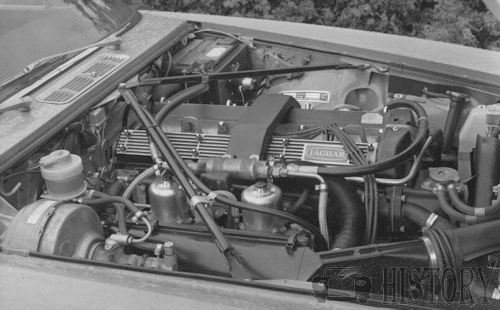
1972 Jaguar XJS v12 Engine view
The Jaguar V12 engine was a V12 automobile engine produced by Jaguar Cars. Based loosely on an earlier design for an intended Le Mans car, the Jaguar XJ13, it was first seen in the Series 3 Jaguar E-type of 1971. The V12 was only Jaguar's second engine design to go into production in the history of the company. The all-alloy block was fitted with removable wet liners and had a SOHC two-valve alloy head with flat block mating surface, and the combustion chamber in the piston crown carved in a shallow cup form. It was regarded by some as one of the premier powerplants of the 1970s and 1980s.
Development
Initial designs for the V12 were produced as early as 1954, with a view to using it in a Le Mans car. The engine was to be a 5.0-litre, quad-cam engine with a high redline, which shared the same basic architecture of the XK cylinder head. After Jaguar withdrew from racing, the V12 designs lay forgotten until 1963 when Jaguar Cars purchased Coventry Climax and, as a result, Walter Hassan who designed the XK engine with William Haynes at SS Cars Ltd, rejoined the team together with Harry Mundy and Claude Baily.
The engine was re-examined as a possible powerplant for a return to Le Mans. After an extensive redesign by the team, the alloy block DOHC engine with fuel injection was born, and installed on the Jaguar XJ13 in 1966. After its racing aspirations were put on hold in 1967, the team considered the use of this quad-cam configuration for road use but it was judged to be too complex, large and heavy, as well as unacceptably noisy for a luxury limousine, which was contemplated at the time.
The racing engine was extensively redesigned and the cylinder heads were replaced with a more conventional two-valve design, employing a SOHC acting directly on vertically inclined valves through bucket tappets, in a move that bore striking similarity to the cylinder head design of the contemporary Rover 2000, a similarity which is further noted in the use of a flat-cylinder head and dished 'heron' pistons of both engines. These changes greatly reduced complexity, weight, size and noise. The revised head design had restrictive and long inlet ports which sacrificed top-end power but which, along with an increase in displacement to 5.3 litres, greatly improved performance at low-mid engine speeds, which was desirable in what was planned to be a heavy luxury car. The chain-driven SOHC heads and the soft valve springs fitted to reduce valvetrain noise resulted in the redline being lowered to 6,500 rpm from the 8,000 rpm of the original quad-cam design. When the limousine project was cancelled the engine was again retired for a number of years before finally seeing production in the series III E-type in 1971.
5.3 Litre

1975 Jaguar 5 3 CC Engine fuel-injected form
The 5.3-litre (5,344 cc)(326.1 ci) version had an oversquare 90 mm (3.5 in) bore and 70 mm (2.8 in) stroke. It produced 210 kW (282 hp), (242 hp (180 kW) to 295 hp (220 kW) depending on emission controls and compression ratio) and 400 N⋅m (300 lbf⋅ft) in fuel-injected form. Right from the start of production in 1971 for the Series 3 E-Type, the V12 engine had Lucas OPUS electronic ignition. This system was used until 1982 when the Lucas CEI system was introduced. Initially the OPUS ignition amplifier unit was secured directly to the engine between the cylinder heads and had problems due to overheating. Later cars had the ignition amplifier moved away from the engine where it could get air flow for cooling. Originally the V12 was supposed to get an advanced fuel injection system under development by AE Brico but this plan was cancelled at a late stage, possibly due to concerns that the design was too similar to Bosch products. The V12 as used in the Series 3 E-Types, Series 1 XJ12 and early Series 2 XJ12s (1973-April 1975) had four Zenith-Stromberg side draft carburettors. After April 1975, the V12 engine used in the S2 XJ12 and the new XJS had a Lucas fuel injection system which was based around the Bosch D-Jetronic system.
This version was used in the following cars:
- 1971-1974 Jaguar E-Type
- 1975–1981 Jaguar XJS
- 1972–1981 Jaguar XJ12(Series 1 and 2)
- 1973–1981 Daimler Double-Six(Series 1 and 2)
- 1972-1981 Panther J.72
- 1974-1985 Panther De Ville
5.3-litre HE
A high-efficiency 5.3 HE version debuted in 1981. This used the special high-swirl design "May" cylinder heads, and had an unusually high compression ratio (10.5:1 – 12.5:1, depending on market and year). In any given market, power levels remained similar to the previous model, but fuel economy was improved by nearly 50%. The HE V12 engines had a fuel injection system from Lucas (dubbed Lucas Digital P) which was based on the Bosch D-Jetronic system.
The Lucas CEI ignition system continued until mid-1989, when it was superseded on the XJ-S by a system from Magneti Marelli. Series 3 XJ12 and Daimler Double Six cars used the Lucas CEI system until the end of production in 1992. The Marelli ignition system was used until the end of XJ-S production and on the 6.0 L V12 used in the XJ81 four-door saloons made in 1993 and 1994.
The 5.3 HE was used in these cars:
- 1981–1992 Jaguar XJ12 (Series 3)
- 1981–1992 Jaguar XJS
- 1981–1992 Daimler Double-Six (Series 3)
6.0 Litre HE
The engine was stroked to 78.5 mm (3.1 in) in 1992 for a displacement of 6.0 L (5993 cc)(365.7 ci) to make this one of the most powerful Jaguar production engines to date at 318 hp (237 kW) and 336 ft⋅lb (456 N⋅m) at 3750rpm. The 6.0-litre engine on X305 used a new Nippondenso distributorless crank-fired ignition system with coil packs very similar to Ford EDIS-6 units. The last Jaguar V12 engine was produced on April 17, 1997.
The 6.0 HE was used in the following cars:
- 1992–1995 Jaguar XJS
- 1993–1997 Jaguar XJ12 (XJ81 and X300)
- 1993–1997 Daimler Double-Six (XJ81 and X300)
TWR/Lister
In 1985, Tom Walkinshaw Racing became Jaguar's official team in World Endurance Championship, taking over the project from American team Group 44. Their first car, XJR6, used the 6.0 L engine, but in the following year the engine was upgraded to 6.9 L and in 1988 the XJR9 used the engine's most famous displacement of 7.0 L. By 1991, the V12 was good for 7.4 L inside the XJR12, developing an impressive 750 bhp (559 kW)
TWR also upgraded production Jaguar cars (usually XJRS's), with a variety of styling, handling and performance modifications. Most of the cars thus modified were straight from the Jaguar factory and sold through Jaguar dealerships.
By 1989, TWR were selling moderate numbers of XJRS's fitted with a 6.0 litre version of the V12, which pre-dated the Jaguar production version by some 3 years.
Lister Cars, a well-known Jaguar tuner with a long history of technical collaboration with the British automaker. The first Jaguar Lister XJRS's were built by the company BLE Automotive in Erdington, Birmingham in the early 1980s until the Lister brand was passed on to WP Automotive of Leatherhead . In 1991, they fitted the 7.0 L (6995 cc/426.9 in³) version of the engine, with a 94 mm (3.7 in) bore and 84 mm (3.3 in) stroke, into a modified Jaguar XJS, which was rebadged Lister Le Mans. This engine officially produced 407.2 kW (546 hp) and 786.37 N·m (580 lb·ft). From 1993, Lister Cars owner Laurence Pearce produced the company's first in house design the Lister Storm, which, naturally, continued using the V12 engine, both on the road and on the track, the car becoming a mainstay of the FIA GT Championship and several national championships for the following decade.
1972 Jaguar XJS v12 Engine cutaway view

- Details
- Parent Category: Engines Makes
- Category: Jaguar Engines
- Hits: 296
Jaguar AJ6 engine
Production 1984 to 1996

Jaguar AJ6 engine Overview Manufacturer Jaguar Cars Production 1984–1996 Layout Configuration DOHC I6 Straight 6
The AJ6 (Advanced Jaguar 6-cylinder), and the similar AJ16, was an inline-6 piston engine used by Jaguar in the 1980s and 1990s. It was designed to replace the much-loved Jaguar XK6 engine, and was introduced in 1984. The AJ6 was only the third engine ever designed by the company. The AJ16 was replaced in 1996 with the Jaguar developed Jaguar AJ-V8 engine.
Jaguar had considered cutting the V12 in half to build a V6, or possibly a V8, but chose instead to develop a new inline-6. The cylinders are inclined, as in a slant-6, by 22 degrees. It uses an aluminum block to reduce weight, and has an optional DOHC head for higher efficiency and power.
AJ6
The original engines were the DOHC 3.6 and the SOHC 2.9. The DOHC 3.6 was revised and enlarged to 4.0 in 1990. It is still essentially an "AJ6", however. This was, as per usual, offered for the XJ-S before it was built into the XJ40 saloon.
3.6
The 3.6 was the first AJ6 engine, debuting in 1983 on the XJ-S. It had DOHC 4-valve heads with a 91 mm (3.6 in) bore and 92 mm (3.6 in) stroke. Power was 165 kW (224 PS; 221 hp) with 325 N⋅m (240 lb⋅ft) of torque. Power was reduced to 201 hp (150 kW) for versions having catalytic exhaust system. Early versions of the 3.6L AJ6 as used in the 1984 - 1987 XJ-S cars had a conventional distributor type of ignition system with electronics within the distributor body. This early AJ6 ignition system is nearly identical to the system used on the XK engine in the Series III XJ6 cars. The Lucas fuel injection system on the 3.6L AJ6 engines in these early XJ-S cars sensed engine load using a Manifold Absolute Pressure (MAP) sensor just like the V12 cars from the same era. Later 3.6L AJ6 engines as used in the 1986–1989 XJ40 cars had a crank-sensor type of ignition system with a bare distributor that only carried the spinning ignition rotor inside the distributor cap. The fuel-injection system used on the later 3.6L AJ6 engines used a hot-wire Mass Air Flow sensor to determine engine load.
Vehicles using the 3.6 were:
1984–1989 Jaguar XJ-S
1986–1989 Jaguar XJ6
1986–1989 Jaguar XJ6 Sovereign
1986–1989 Daimler
2.9
The 2.9 used a SOHC head from the Jaguar V12 engine, and was prone to failure. The block is the same as the 3.6, with the crankshaft and pistons lowering the stroke to 74.8 mm (2.9 in). Only the 1986–1989 Jaguar XJ6 used the 2.9. It was used for the entry-level XJ6 in Britain and Europe but rarely, if ever, seen in models exported to the US. The SOHC 2.9, which was generally considered somewhat underpowered for such a large car, was discontinued in 1990 (Actually 3.2 starts with a J-plate, so late 90 2.9 is possible) and replaced with a DOHC 3.2 (essentially identical to the DOHC 4.0).
The 2.9 Engine was, as in earlier years the 2.8 XK-engine, sized to match road-tax regulations in some European Countries like Italy or France. In France cars with more than 3 litres of engine size had to pay a luxury tax.
4.0 (1989–1994) The 24-valve DOHC 4.0 L (3980 cc) version replaced the 3.6 L AJ6 in 1989. It featured a longer 102 mm (4.0 in) stroke, and generated 183 kW (249 PS; 245 hp) power and 392 N⋅m (289 lb⋅ft) of torque. The 4.0L engines as used in the 1990–1994 XJ40 cars continued with the crank sensor and empty distributor type of ignition system and the hot-wire Mass Air Flow sensor type of fuel injection control system as the 1988–1989 3.6L XJ40 cars.
TWR modified XJ40s resulting in the XJR. Jaguarsport was also formed as a partnership between TWR and Jaguar. The first XJR, the XJR 3.6L, had extensive appearance changes coupled with stiffer suspension, anti-roll bar/links, power steering valve that reduced efficiency by 40% and an LSD but no performance enhancements. Interior-wise it included special stitching, "sport" or "XJR" embossed front headrests, and Jaguarsport speedometer labels and tread-plates.
1990 XJRs had the upgraded 4L engine with the old style body-kits, and appearance changers.
XJR 4.0Ls from 1990 on had all of the XJR 3.6 handling upgrades and benefits from engine enhancements such as high lift cams, improved double plenum inlet manifold, and a compression ratio of 9.75:1. They were sent to TWR in Coventry to be modified directly after being produced.

The exterior changed again for the last generation of the XJ40 XJR (from H-registration year onwards). Bodykit was re-sculptured and the boot spoiler was deleted. Side mouldings were now added, with the smaller "XJR" badge embedded in them. Engine now had a plaque saying "Jaguarsport XJR 4L" on the rocker cover. XJR badge size was decreased on the boot (had previously ranged from XJR-3.6, XJR-4L, 4-litre and "XJR". The later one ("XJR") is most common and the only badge you could choose on the boot infil panel models. A "sport" one on the front within its own unique XJR grill. In this unique grill a "sport" badge was installed. Interior even had XJR specific wood (SPB part number).
Total XJ40 cars built was 208,733 and supposedly 500 JaguarSport cars built, 200 of the round headlight versions and then about 300 with the square headlights like the Sovereigns and Daimler's. 1990+ XJR power output is around 250 bhp (186 kW; 253 PS) / 278 lb⋅ft (377 N⋅m).
3.2 (1990–1994)

A 24-valve DOHC 3.2 L, essentially a shorter-stroke (83 mm) 4.0 L, replaced the 12-valve SOHC 2.9 in 1990. It produced 149 kW (203 PS; 200 hp) of power and 298 N⋅m (220 lb⋅ft) of torque, and proved a popular engine in Europe (sales outnumbered 4.0 L saloons roughly 4:1) but was not exported to America.
Following the launch of the Aston Martin DB7, the Jaguar AJ6 was used by Aston Martin as well (both companies being owned by Ford at the time). This version featured an Eaton supercharger.
Aston Martin DB7 supercharged Engine specifications
| Engine Size | 3239cc |
|---|---|
| Cylinders | 6 |
| Valves | 24 |
| Fuel Type | Petrol |
| Power | 335 bhp |
|---|---|
| Top Speed | 165 mph |
| 0-60 mph | 5.5 secs |
| Torque | 490 Nm, 361 ft-lb |
| CO2 Emissions | 349 g/km |
| Euro Emissions Standard | - |
| Miles Per Tank | 372 miles |
Cars using the 4.0 and 3.2 included:
Jaguar XJS (4.0 only)
Aston Martin DB7 (modified, supercharged 3.2)
Jaguar XJ6
Jaguar Sovereign
Jaguar XJR (4.0 only)
Daimler Six
AJ16
Both the 3.2 and 4.0 were substantially revised for the 1995 launch of the new X300 saloon. These are the "AJ16" engines, both now featuring coil-on-plug distributorless ignition, new engine management systems, magnesium alloy valve covers, revised pistons and other detail changes. The AJ16 was discontinued with the launch of the AJ-V8 (XK8 and XJ8 in 1996/7).
4.0 / 3.2 (1994–1997) For the launch of the new X300 saloon for 1995, substantial revisions were made to the 4.0 L and 3.2 L AJ6 engines. The new design was called the AJ16 to reflect the major differences between it and the original AJ6.
Jaguar XJS 4.0 Engine specifications
| Engine Size | 3980cc |
|---|---|
| Cylinders | 6 |
| Valves | 24 |
| Fuel Type | Petrol |
| Power | 238 bhp |
|---|---|
| Top Speed | 147 mph |
| 0-60 mph | 7.4 secs |
| Torque | 382 Nm, 282 ft-lb |
| Miles Per Tank | 509 miles |
Cars using the 4.0 and 3.2 included:
Jaguar XJS (4.0 only)
Jaguar XJ6
Jaguar XJ6 Sovereign
Jaguar XJ6 Sport
Daimler
AJ16S
A supercharged version of the 4.0 L AJ16 was released in 1994 in the Jaguar XJR which used an Eaton M90 blower to boost output to 240 kW (326 PS; 322 hp) and 512 N⋅m (378 lb⋅ft)

