
Renault Engines
- Details
- Parent Category: Engines Makes
- Category: Renault Engines
Renault-Nissan V9X Diesel Engine
 |
|
|
Production base |
French Renault Clion factory |
|
Manufacturing period |
2008 on |
|
Engine type |
V type 6 cylinder DOHC 24 valve |
|
Displacement |
2,993cc |
|
Fuel |
Diesel |
|
Cooling |
Water cooled |
|
Inner Diameter x Stroke |
84mm x 90mm |
|
Compression ratio |
16 |
|
Maximum output |
173kW (235PS) -177kW (240PS) |
|
Maximum torque |
450N m (45.9kgf m) /1,500rpm |
The Nissan V9X is a V6 diesel engine manufactured by Renault since 2008 and installed in Nissan and Renault passenger cars .
History
The V9X engine was jointly developed by Nissan and Renault in Europe from 2005 . Initially, the development of a V-type 8-cylinder diesel engine was also considered, but since there was also a plan to mount an FF in common with Renault, it was finally decided to use a 3.0-liter V-type 6-cylinder , with a maximum output of 175 kW at the time of development. A maximum torque of 550N m and compliance with European emission standards, Euro 5, were targeted. The bank angle is 65 degrees so that it can be mounted vertically or horizontally on a model that was developed on the premise that only a gasoline engine will be installed .The engine with Bosch Common rail fuel injection has a single central turbocharge unit with intercooler.
It was first installed in the Renault Laguna Coupe announced in October 2008, and in 2010, the Infiniti brand will launch the EX30d and FX30d equipped with the V9X type in Europe. In addition, this model is the first diesel engine-equipped car for the Infiniti brand, and in September of the same year, the M30d, which is the European version of the Y51 Fugue equipped with a V9X engine, released.
Equipped vehicles with V9X engine
- Renault Laguna
- Renault Latitude
- Infiniti QX50
- Infiniti QX70
- Infiniti Q70
- Infiniti FX30d
- Infiniti EX30d
- Infiniti M30d
- Nissan Navara
- Nissan Pathfinder

- Details
- Parent Category: Engines Makes
- Category: Renault Engines
Isuzu P9X V6 DMAX engine

The Isuzu V6 DMAX engine is a 3 litre four-stroke diesel internal combustion automotive engine with six V-cylinders used by Renault ,Saab and Opel.
History
This P9X engine is mounted on high-end models of various brands under engine names D308L ,Y30DT ,Z30DT.This uses high-pressure common rail direct injection with four valve per cylinder, cylinder heads engine bored directly into the cast iron block, open at 65 °, water cooled, with a 4-bearing crankshaft, with 4 shafts overhead cam, driven by a belt distribution notched with two yokes aluminum 24 OHV. This engine is produced by the Japanese manufacturer Isuzu , but the design rights for this engine are now owned by General Motors.
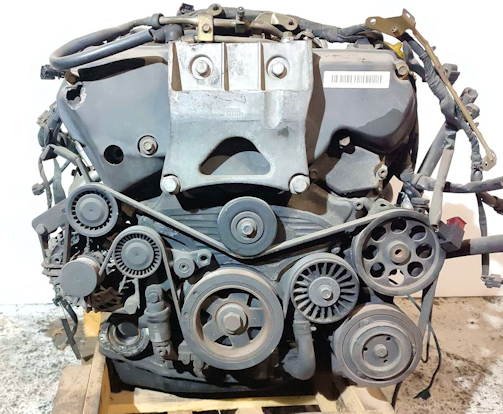
The characteristics of this engine are:
- 6-cylinder V-shaped architecture
- Displacement 2958 cm 3
- Bore and stroke 87.5 × 82 mm
- Square motor
- 65 ° angle between rows of cylinders
- Direct injection with common rail direct injection technology
- Supercharged by variable geometry turbocharger and intercooler
- Compression ratio equal to 18.5: 1
The DMAX V6 engine initially developed an output of 177 hp at 4,400 rpm , with torque of 350 Nm at 1,800 rpm . Subsequently, from 2006, this engine was slightly revised, developing 180 hp of maximum power at 4,000 rpm and 400 Nm of torque at 1,800 rpm with turbocharger and intercooler . This engine was fitted to models of different brands, but somehow linked together. These models are:
- Renault Vel Satis
- Renault Espace IV
- Saab 9-5
- Opel Vauxhall Vectra
- Opel Vauxhall Signum
The link between these brands is quite simply that Opel belonged to General Motors at the time , Saab also belonged to this American giant, as for Renault, they manufacture utility vehicles for Opel. The Fiat group was also interested in this V6 Diesel project, for the Lancia Thesis , but the project fell through.
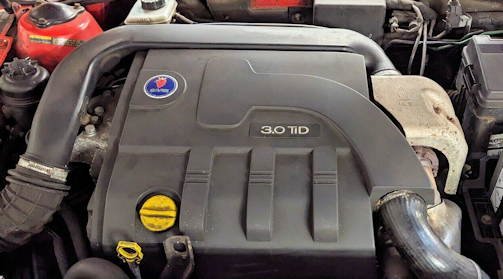
At Renault, it bears the name: P9X , at Saab: 6de1 and at Opel: Y30DT .
- Details
- Parent Category: Engines Makes
- Category: Renault Engines
Renault R9M engine

The R9M Renault engine is a 1.6L automotive internal combustion Turbo diesel four-stroke, with 4 cylinders in line bored directly in the block, water-cooled, with a 5-step crankshaft, 2 camshafts head driven by a chain distribution, with a cylinder head in aluminium, valve head, manufactured by Renault, making its appearance on the Scenic III.
History

These 4 cylinders is completely new designed specifically for diesel applications. Renault started from a blank page to design this block. Engineer Philippe Coblence is head of the R engine design office, which looked after F1 engines at the start of the 2000s. Three meeting points between F1 technology and this new R engine: square engine, circulation transverse water, reduction of internal friction.
Appeared in 2011 on the Scénic III, this first 1.6 dCi version of the R9M type is equipped with technologies usually reserved for more high-end engines, it is intended to replace the “F engine” which appeared in the early 1980s on the Renault 9 and Renault 11, therefore the 1.6 dCi type R9M replaces the 1.9 dCi type F9Q of equal power, with increased torque or 130 and reduced consumption and emissions along with a more powerful 160 twin-turbocharged version.
With a smaller displacement, this engine consumes less than the one it is intended to replace, while maintaining performance thanks to improved supercharging. This block and its mobile coupling have been designed to withstand the strong constraints inherent in diesel engines.
The pistons in this engine feature U-shaped segments, a technology inspired by F1. It is equipped with a variable-flow oil pump which therefore uses less energy because the pumped oil is entirely used to lubricate the engine and not delivered. Its cooling circuit is in 2 parts, when cold the water does not circulate around the cylinders in order to accelerate the warm-up of the engine.
Fitted to (not extensive)
- 2011 - Renault Scénic
- 2011 - Nissan Qashqai
- 2012 - Renault Mégane
- 2013 - Renault Fluence
- 2015 - Renault Kadjar
- 2016 - Renault Talisman
- 2015 - Renault Espace
- 2015 - Renault Talisman
- Renault Trafic
- Vauxhal
l Vivaro

- Details
- Parent Category: Engines Makes
- Category: Renault Engines
Renault-Nissan H engine

The H engine at Renault, is an internal combustion automobile four-stroke gasoline engine with 3 or 4 cylinders since 2004
History
The H engine also known as the HR engine at Nissan has in line bored directly into the aluminium block, cooled by water, with a crankshaft 4 on bearings versions cylinders 3 and 5 levels in the 4-cylinder, 2 camshafts head driven by a timing chain, with a cylinder head made of aluminium, OHV, manufactured by Renault and Nissan, making its appearance on the Mégane III. In 2009, the H engine appeared on the Mégane III, in a 4-cylinder version of the H4Jt type. (1.4 TCe 130). This new engine is intended to replace the K engine which appeared on the Mégane I in 1995, which was a final evolution of the legendary Cléon-Fonte engine.
At the end of 2012, when the Clio IV was launched, the 3-cylinder version of the H4Bt type (0.9 TCe 90) made its appearance, with the aim of gradually replacing the D engine manufactured by the French mechanical company and which had appeared on the Twingo I and the Clio I phase 3, in 1996. This engine was also fitted to Smart vehicles in a 0.9 turbo and 1.0 atom version. Renault is also offering 1.5L petrol in India from 2017.Also from 2017 the 1330 cm 3 displacement (H5Ht) arrives in the Renault range, including the new Scénic 4. Called to replace the old H5Ft, it offers power ratings from 115 to 160hp. It was designed in collaboration with Daimler.
Engine failures for the 1.2l H5Ft and HRA2DDT. In march 2016 on confidential manufacturer technical notes which noted problems of excess oil consumption on Renault 1.2 TCe engines from 2012 until, 2016 also 6confirming that Nissan and its 1.2 DIG-T engine was also affected .The manufacturers have since developed a reprogramming of the engine control unit and have also improved the chrome coating of the piston rings on the new 1.2 TCe and DIG-T models, without however recalling engines previously produced and potentially affected by however, this defect can cause premature engine wear .But also highlights a hidden defect in the H5Ft produced between 2012 and 2016. A pressure defect in the intake duct would prevent the natural filling of the engine. which would consequently lead to excess oil consumption and premature wear. The warning signs for this failure which appears apparently from 60,000 km and would be amplified if the engine is mainly used in city driving. Later reveal another cause of failure mentioned in Renault's internal documents: a fault in the knock sensor causing the appearance of a self-ignition phenomenon (known as "LSPI": Low Speed Pre-Ignition), which would cause the gradual degradation of these engines.
Models with Defects
- Renault (1.2 TCe 100 *, 115, 120 and 130 hp)
- Captur, Clio IV, Kadjar, Kangoo II, Megane III, Scénic and Grand Scénic III
- Dacia (1.2 TCe 115 and 125 hp)
- Duster, Dokker and Lodgy
- Mercedes-Benz (1.2 115 hp)
- Citan
- Nissan (1.2 DIG-T 115 hp)
- Qashqai II, Pulsar and Juke
Also following the DieselGate scandal, the Vehicle Market Surveillance Unit in Great Britain went further than the Royal Commission in France in 2016; they also decided to test gasoline vehicles in real driving conditions in order to check whether they respected the NOx emission thresholds for which they were approved. The result was overwhelming in real driving conditions, the Nissan Qashqai tested in this way had emissions nearly 10 times higher than in NEDC tests. The report also states that because the Nissan Qashqai did not have a sequence to activate "dynamic" mode, a vehicle-specific wiring harness was required in order to drive the vehicle on the NEDC test dynamometer chassis.
Renault H4Jt
1397 cc, 96 kW (130 PS) at 5500 rpm, 190 Nm at 2250 rpm. Bore: 78 mm (3.07 in); Stroke 73.1 mm (2.88 in)
2009–2013 Renault Mégane III
2009–2013 Renault Scénic III
Renault H4K
The HR15DE is a 1.5 L (1,498 cc) naturally aspirated straight-4 engine. Bore: 78 mm (3.07 in); Stroke 78.4 mm (3.09 in); 16 valve DOHC; EFI with variable valve timing. It produces 74 kW (99 hp; 101 PS) at 6000 rpm and 134.4 N⋅m (99 lbf⋅ft) at 4000 rpm and is fitted to the following vehicles:
2012–2017 Renault Scala N17
2015–present Renault Duster HS
2016–present Renault Captur/Kaptur GA
Renault H4M
The HR16DE is a 1.6 L (1,598 cc) naturally aspirated gasoline straight-4 engine, 16 valve DOHC; EFI; with variable valve timing. This engine has two fuel injectors per cylinder to improve fuel economy and reduce emissions. Bore: 78 mm (3.07 in); Stroke 83.6 mm (3.29 in). It produces 77 to 88 kW (103 to 118 hp; 105 to 120 PS) and 158 N⋅m (117 lbf⋅ft) at 4000 rpm.
A new version (still 8 Cycle) has been released to equip Renault hybrids (E-Tech), it produces 67 kW (90 hp; 91 PS) at 5600 rpm and 144 N⋅m (106 lbf⋅ft) at 3200 rpm.
It is fitted to the following vehicles:
2008 Renault Mégane MK3
2020 Renault Clio MK5 (HEV)
2020 Renault Mégane MK4 (PHEV)
2020 Renault Captur MK2 (PHEV)
2020 Renault Sandero (2020) LATAM
2021 Renault Arkana E-tech
Renault H4D
The HR10DE is a 1.0 L (999 cc) multi point injected, naturally aspirated, straight-3 engine. It produces 45 to 52 kW (60 to 70 hp; 61 to 71 PS) at 6000 rpm and 91 N⋅m (67 lbf⋅ft) at 2850 rpm.
2014–2019 Renault Twingo SCe 70
2019– Renault Twingo SCe 65

Renault H4Bt
The H4Bt is a 0.9 L (898 cc) multi point injected, turbocharged, straight-3 engine. It produces 66 kW (89 hp; 90 PS) at 5500 rpm and 135 to 140 N⋅m (100 to 103 lbf⋅ft) at 2250–2500 rpm. A 110hp version was available in the Twingo GT (2016-2018).
2012-2020 Renault Clio TCe 90
2013-2020 Renault Captur TCe 90
2014- Renault Twingo TCe 90/95 and GT (TCe 110)
Renault H4Dt
The HR10DET is a 1.0 L (999 cc) multi point injected, turbocharged, straight-three engine with a 72.2 mm (2.84 in) bore and a 73.1 mm (2.88 in) stroke. It produces 74 kW (100 PS; 99 hp) at 5000 rpm and 160 N⋅m (118 lbf⋅ft) at 1750 rpm. This engine is also available as an LPG version. Maximum power is unchanged but torque is 170 N⋅m (125 lbf⋅ft) at 2000 rpm.
2019 Renault Clio V TCe 100
2020 Renault Captur II
2021 Renault Kiger TCe
2021 Renault Triber TCe

Renault H5Ft
The HR12DDT is a 1.2 L (1,197 cc) all-aluminium direct injected and turbocharged straight-four engine equipped with lifetime timing chain, 16v DOHC, VVT, variable displacement oil pump, Stop-Start and regenerative braking, Bore: 72.2 mm (2.84 in), Stroke 73.1 mm (2.88 in). It produces two choices, 85 kW (114 hp; 116 PS) at 4500 or 5000 or 6000 rpm with 190 N⋅m (140 lbf⋅ft) at 1900–4000 rpm and 97 kW (130 hp; 132 PS) at 5000–5500; rpm with 205 N⋅m (151 lbf⋅ft) at 2000–3000 rpm depending on the application. Renault marketing names for these engines are TCe115, TCe120, TCe125, and TCe130.
2013–2018 Renault Captur I
2013–2018 Renault Mégane III + IV

Renault H5Ht
The HR13DDT is a 1.3 L (1,332 cc) all-aluminium direct injected and turbocharged straight-four engine equipped with lifetime timing chain, 16v DOHC, VVT, variable displacement oil pump, Stop-Start,
regenerative braking, and Bore Spray Coating system (as installed in Nissan GT-R models), Bore: 72.2 mm (2.84 in), Stroke 81.3 mm (3.20 in). There are three different versions: 85 kW (114 hp; 116 PS) at 4500 rpm with 220 N⋅m (162 lbf⋅ft) at 1500–3500 rpm, 103 kW (138 hp; 140 PS) at 5000 rpm with 240 N⋅m (177 lbf⋅ft) at 1600–3600 rpm, and 117 kW (157 hp; 159 PS) at 5500 rpm with 270 N⋅m (199 lbf⋅ft) at 1800–3500 rpm depending on the application. Renault brands for these engines are TCe115, TCe140 and TCe160. This engine tests WLTP proof (Euro 6c).
2018 Renault Mégane IV
2018 Renault Scénic / Grand Scénic IV
2019 Renault Arkana (Russia)
2019 Renault Captur I + II
2019 Renault Clio V
2019 Renault Kadjar
2019 Renault Talisman
2020 Renault Samsung XM3/Renault Arkana/Renault Megane Conquest
2020 Renault Kaptur (Russia)
2020 Renault Koleos II
2021 Renault Kangoo III
2022 Renault Austral
Renault H5Dt
The HR10DDT is a 1.0 L (999 cc) direct injected, turbocharged, straight-3 engine. It produces 85 or 86 kW (114 or 115 hp; 116 or 117 PS) at 5000 rpm or 5250 rpm and 200 N⋅m (148 lbf⋅ft) at 2750 rpm or 180 to 200 N⋅m (133 to 148 lbf⋅ft) at 1750–4000 rpm.
2020 Renault Mégane sedan
- Details
- Parent Category: Engines Makes
- Category: Renault Engines
PSA ESL L7X V6 engine (1997 to 2010)

The Petrol 2.9 L (2,946 cc) PSA V6 60° V-angle engine also known under the code "engine ES" ES9 PSA and "L" L7X engine is used by among others Citroën, Peugeot and Renault from the late 90s to the early 10s.
History
Introduced in 1997 with the Peugeot 406 Coupé, its design was most modern for the time. It provides a power of 140 kW (190 hp) for 2 946 cm 3 of displacement. It is also equipped with a catalyst, which has become essential for the respect of European emission standards.
The Petrol PSA V6 ESL engine also known under the code "engine ES" PSA and "motor L7X" is an automobile internal combustion gasoline four-stroke, six-cylinder V with dry cast iron liners in the aluminium block, cooled by water, with 4 camshafts head, driven by a belt distribution notched with two yokes constructed entirely in aluminium, and DOHC 24-valve type.
ESL is the acronym for ES (PSA) and L (the Renault). This replaced the old “V6 PRV engine “used in Peugeot, Renault and Volvo. It is the result of a collaboration between the two French car manufacturers PSA and Renault, and its costs were shared. For Renault, it is part of a motor investment campaign of about 2 billion Euros. The "V6 ESL engine" is machined and assembled at Douvrin, in the plant of the Société Française de Mécanique created in 1969 by Renault and Peugeot, each of which owned 50% of the company.
It was later updated in 2000 for the release of the Peugeot 607 and the Citroën C5, and continued on the Peugeot 406 and 406 Coupé with help from Porsche introducing variable valve timing its power is increased to 155 kW (211 hp EEC) as the ES9 J4S version.
Renault with its engine SOLUTION pushes the power even more for its Clio V6, its power is raised to 230hp (169 kW). For its Clio V6 phase 2, the injection ramp is split and the injectors are 50% bigger. The preparation, once again at Porsche Engineering, allows the engine to develop 255 hp (188 kW), making it one of the best V6 of the time.
The Renault-Nissan Alliance led Renault to use the " V6 VQ “Nissan of 3.5 litres so this engine is no longer available in any form since it was removed from the Citroën C5 II in January 2, 2010. It had been used up to in 2009 on the Peugeot 607, 407 Coupé and the Citroën C6.
List of vehicles non-exhaustive equipped with the V6 ES9 / L7X block:
- Peugeot
- 406 (1997 - 2004)
- 406 Coupé (1997 - 2004)
- 407 (2004 - 2009)
- 407 Coupe (2005 - 2009)
- 605 (1998 - 1999)
- 607 (2000 - 2009)
- 807 (2002 - 2005)
- Citroën
- XM (1997 - 2000)
- Xantia (1997 - 2001)
- C5 I (2000 - 2008)
- C5 II (2008 - 2010)
- C6 (2005 - 2009)
- C8 (2002 - 2005)
- Renault
- Clio II
- Laguna I
- Laguna II
- Safrane
- Espace III
- Avantime
- Venturi
- Venturi 300 Atlantic (Biturbo)



