
Cosworth Engines
- Details
- Parent Category: Engines Makes
- Category: Cosworth Engines
- Hits: 54
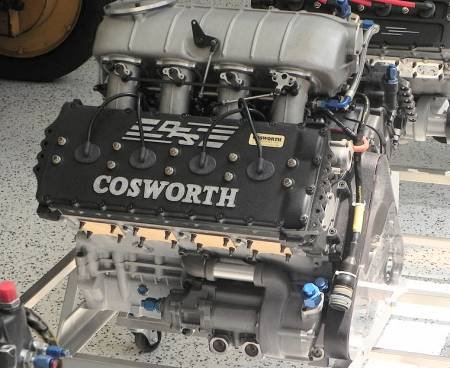
The Cosworth GBA V6 Engine

Cosworth experimented with turbocharged BD derivatives, before settling on an all-new turbocharged 1,500 cc (91.5 cu in) V6 engine to be badged as the Ford TEC (internally it was known as the GB-series). This had a long development history dating back to the 1984 British Grand Prix at Brands Hatch where Cosworth and Ford's competition department agreed to build a new turbo engine to replace the outdated DFV. The TEC raced only briefly, in 1986, with the Haas Lola team and in 1987 with the Benetton team. The development of the GBA engine at Cosworth became the subject of a British TV documentary in Channel Four's Equinox series, broadcast in 1986.
The GBA was designed by Keith Duckworth who originally chose to try and develop a modified 4 cylinder sports car engine as he believed 4 cylinder engines were more compact and economical than a V6. However, after numerous failures of the test engines which were eventually traced to an incurable vibration at the crankshaft, Duckworth designed an all new 120° V6 engine instead, the same configuration as the Ferrari V6 turbo engine. As time had been lost in trying to get the 4 cylinder engine to work, Ford and Cosworth's plan for the engine to debut with Haas Lola in 1985 was pushed back to the 1986 season.
The engine made its Formula One debut with 1980 World Champion Alan Jones driving Haas Lola's new car, the Lola THL2 at the 1986 San Marino Grand Prix. Jones qualified in 21st place and retired after 28 of the races 60 laps due to overheating. Jones also recorded the engine's first finish when he placed 11th in the Belgian Grand Prix. Jones and team mate Patrick Tambay captured the Ford V6 turbo's first ever points when they finished 4th and 5th respectively in the Austrian Grand Prix, with Jones backing up in the next race in Italy with a 6th placed finish, the final points the engine would gain in 1986.
Producing approximately 900 bhp (671 kW; 912 PS), the turbocharged V6 is the most powerful Formula One engine designed and built by Cosworth. With Haas Lola not competing in 1987, Benetton, having lost the use of the 4 cylinder BMW engines when the German giant pulled out of Formula One, signed with Ford to race their V6 for the season. While in 1986 turbo boost had been unrestricted by the rules, 1987 saw the FIA introduce the pop-off valve to the turbocharged engines in a two-year plan to outlaw the turbos and make all Formula One engines 3.5 litres and naturally aspirated by the start of the 1989 season. While Cosworth adapted the TEC to 1987's 4.0 Bar turbo limit and the new 195 litre fuel limit, development of the V6 turbo engine which would be obsolete in less than two years virtually stopped. Cosworth instead worked on the DFR that was introduced with Benetton in 1988. The turbo engine would be more successful with Benetton in 1987, with Teo Fabi taking the engine's first podium with third in Austria, followed by its last podium when Thierry Boutsen also scored third in the last race of the season in Australia.
- Details
- Parent Category: Engines Makes
- Category: Cosworth Engines
- Hits: 160
The Cosworth WAA 190E 2.3-litre Engine

Cosworth’s involvement with Mercedes-Benz came with moves in the mid-1980s from the German manufacturer to re-enter motorsport the new W201 Chassis (190E Model) and turned to the expertise of Cosworth to shorten the development time for this project.
The request was a huge surprise for Cosworth, and the original brief for a 320 bhp engine based on the 136 bhp Mercedes M102 2.3-litre SOHC 4-cylinder engine was duly passed to Mike Hall, who “drew the famed DFV and BDA engine”. Designed around the existing M102 head bolt pattern, the new twin cam, 16-valve, pentroof head, had its valves set at 45° included angle, rather than the 40° angle of the BDA. The valves were the biggest that could be fitted into the combustion chamber. Flat top pistons delivered the 10.5:1 compression ratio. The new Cosworth WAA engine also was Cosworth’s first one-piece head, i.e. the camshaft carrier was cast integral with the head itself. Again the constraints of the existing head-bolt pattern meant that Hall had to shift the camshaft bearings from outside each pair of camlobes as in the BDA to in between each cylinder's pair of cam lobes. The upside being that this configuration made for less flex at high rpm.

The advent of the AWD turbo Audi Quattro gave the rear-wheel-drive, normally aspirated 190E rally car no chance of being successful and the competition car was stillborn. Instead Mercedes-Benz decided to recoup its development cost by selling the car as a road going sports-sedan. Hall detuned the WAA race engine to 185 bhp by reducing the port diameters and a more restrictive fuel injection and induction was substituted for the race items to complete the detune. All WAA 2.3-16 engines were built in the Cosworth factory with the heads being produced by the Coscast method.
Cosworth assisted with the later 2.5-16 engine (WAB), and the short-stroke 2.5-16 Evo engines (WAC) although these were all manufactured in house by Mercedes-Benz.The 190E 2.3-16 became the basis for privateer Mercedes entries into the DTM from 1988. The short-stroke 2.5-16 190E EVO II was race-developed to 375+ bhp, gaining the 1992 DTM crown with Klaus Ludwig at the wheel.
A 4,300 cc (262.4 cu in) V10 designated WDA was also built and tested in a Volvo S80 in 1997, but this did not see production.

- Details
- Parent Category: Engines Makes
- Category: Cosworth Engines
- Hits: 124
The Cosworth FBA and FBC V6 Engine "BOA"

The FBA and FBC engines were found in the Ford Granada and Ford Scorpio Ultima. The FBA came first in 1991 also known as the 'BOA', it was based on the Ford Cologne V6 used in the Ford Sierra and Ford Capri and other models and was a twin overhead camshaft 24valve conversion for more power, producing 195 metric horsepower (143 kW; 192 bhp) and better idle quality.
In 1995, with a new version of the Scorpio, it was upgraded with a wider torque spread and higher power - to 204 PS (150 kW; 201 hp), from a variable intake system and reprofiled cams. The NVH was improved with a change from a single chain to drive all four camshafts - to one chain to drive one bank of cams and a second for the other bank, this engine was known as the 'BOB'.
A racing version was also available for a short time - FBE - with individual throttle butterflies for each cylinder.
FBB and FBD engines did exist as development engines but these were never released.
The two production engines were always mated to an automatic gearbox but have become popular in the custom car scene where they have been mated to the 4x4 manual transmission and the rear-wheel-drive manual transmission from the Ford Sierra XR4 and XR4x4. There are also companies that offer twin and single turbo conversions, and other modifications to increase power to usually around 400 bhp (300 kW). These engines can be bought relatively cheaply and providing they are well serviced, engines have been known to cover over 200,000 miles without major work being required
The Cosworth Engine in a ford Granada

- Details
- Parent Category: Engines Makes
- Category: Cosworth Engines
- Hits: 104
Cosworth DFV Engine
The DFV is an internal combustion engine that was originally produced by Cosworth for Formula One motor racing. Named Four Valve because of the four valves per cylinder, and Double as it was a V8 development of the earlier, four-cylinder FVA (four valve type A engine), making it a Double Four Valve engine.Its development in 1967 for Colin Chapman's Team Lotus was sponsored by Ford. The engine was a 90°, (3.373 x 2.555 in) 2,992.98 cc V8, and produced over 400 bhp (408 bhp at 9,000 rpm, 270 ft·lbf (370 N·m) torque at 7,000 rpm was quoted) from the start, reaching over 500 bhp (510 bhp at 11,200 rpm was quoted) by the end of its remarkable Formula 1 career. The 1983 (3.543 x 2.316 in) 2,993.38 cc DFY variant gave 520–530 bhp at 11,000 rpm, 280 ft·lbf (380 N·m) torque at 8,500 rpm. For many years it was the dominant engine in Formula One, and it was also used in other categories, including CART, Formula 3000 and Sportscar racing.
Background
In 1965, the Fédération Internationale de l'Automobile, that administered Formula One racing, agreed to raise the series' maximum engine capacity from 1.5 litres (92 cu in) to 3.0 litres (183 cu in) from 1966. Up until that point, Colin Chapman's successful Team Lotus cars had relied on power from fast revving Coventry Climax engines, but with the change in regulations Coventry Climax decided for business reasons not to develop a large capacity engine.
Chapman approached Keith Duckworth, previously a gearbox engineer at Lotus but now running his fledgling Cosworth company with Mike Costin, who commented that he could produce a competitive three-litre engine, given a development budget of £100,000.
Chapman approached the Ford Motor Company and David Brown of Aston Martin for funding, each without initial success. Chapman then approached Ford of Britain's public relations chief, former journalist Walter Hayes, with whom he had developed a close working relationship from the early 1960s. Since Hayes had joined Ford in 1962 the pair had already collaborated in the production of the successful Lotus Cortina, introduced in 1963. Hayes arranged dinner for Chapman with Ford employee Harley Copp, a British-based American engineer who had backed and engineered Ford's successful entry into NASCAR in the 1950s. Hayes and Copp developed a business plan, which was backed by Ford UK's new chairman Stanley Gillen, and approved by Ford's Detroit head office as a two-part plan:
- Stage one would produce a four-cylinder twin-cam engine for Formula Two.
- Stage two would produce a V8 engine for Formula One, by May 1967.
Formula One
The project was revealed by Hayes in a PR launch in Detroit at the end of 1965, but the engine was not ready until the third race of the 1967 season, on the 4 June at Zandvoort, but its debut proved electric. Graham Hill, who was in the team at the specific request of Ford and Hayes, put his DFV-powered Lotus 49 on pole position by half a second, and team-mate Jim Clark stormed home to win. However, this dominant performance belied a serious fault in the timing gear. Clark took three more wins that season, but reliability problems left him third in the Drivers' Championship, 10 points behind Champion Denny Hulme. The progress of the engine was documented in a film produced by the Ford Motor Company's film section, entitled "9 Days in Summer".
Initially, the agreement between Ford, Cosworth and Lotus was binding on all parties, and Ford as the funder had no plans to sell or hire the DFV to any other teams. However, it occurred to Hayes that there was no competition: the Ferrari engine was underpowered; the BRM complex and too heavy; the Maserati unreliable; the Honda overweight; while Dan Gurney's Weslake motor was powerful but unreliable. Only Brabham's Repco V8 engine provided a usable combination of power and reliability, but its age and design left little room for further improvement. Hayes concluded that Ford's name could become tarnished if the Lotus were to continue winning against only lesser opposition, and that they should agree to use the unit in other teams, and hence potentially dominate Formula One.
At the end of 1967, Copp and Hayes gently explained to Chapman that he would no longer have monopoly use of the DFV and in August 1968 it was announced that the power unit would be available for sale, via Cosworth Engineering, to racing teams throughout the world.Hayes released the DFV initially to French team Matra, headed by Ken Tyrrell with Jackie Stewart as a driver. What followed was a golden age, where teams big or small could buy an engine which was competitive, light, compact, easy to work with and relatively cheap (£7,500 at 1967 prices or about £90,000 in 2005 money). The DFV effectively replaced the Coventry Climax as the standard F1 powerplant for the private (mostly British) teams.
Lotus, McLaren, Matra, Brabham, March, Surtees, Tyrrell, Hesketh, Lola, Williams, Penske, Wolf and Ligier are just some of the teams to have used the DFV. In 1969 and 1973 every World Championship race was won by DFV-powered cars, with the engine taking a total of 155 wins from 262 races between 1967 and 1985. The advent of ground effect aerodynamics on the F1 scene in 1977 provided a new lease of life for the now decade-old engine. The principle relied on Venturi tunnels on the underside of the car to create low pressure regions and thus additional downforce. Previously, teams running Ferrari and Alfa-Romeo flat-12 engines had enjoyed a handling advantage because of the low centre of gravity in such a configuration. However for ground effect, the wide-angle engine was completely the opposite of what was required: the cylinder heads protruded into the area where the Venturi tunnels should have been. In contrast, the V-configuration of the Cosworth engine angled the cylinders upwards and left ample space under the car for the necessary under-body profile which massively increased downforce and gave more efficient aero balance, thus increasing cornering potential and straight line speed. Ground effect British cars and DFV engines effectively killed off the V12/flat 12 engines of Ferrari and Alfa Romeo which many pundits had believed in the mid-1970s would dominate F1 well into the mid-1980s. Drivers Mario Andretti in 1978, Alan Jones in 1980, Nelson Piquet in 1981 and Keke Rosberg in 1982 used a combination of British ground effect chassis and a DFV engine to claim the Drivers' Championship while DFV-powered cars took the Formula 1 Constructors' World Championship in 1978, 1980 and 1981.
The onset of the turbo era in the early 1980s put an end to the DFV's F1 activities, as even with modifications the 15-year-old engine could not hope to compete with the vast power being put out by the new 1.5-litre turbocharged engines. However, in the early days of turbo F1 cars (1979-1982) the Renault, Ferrari and Toleman were unable to offer consistent opposition to the Cosworth DFV British teams. The early turbo Renault, though powerful (particularly so on high altitude tracks such as Interlagos, Kyalami, Jarama, Dijon-Prenois and the Österreichring) were much heavier, cumbersome, complicated and significantly, much more unreliable than the British Cosworth DFV teams. The extra power and torque of a turbo engine put much more strain on the gearbox, driveshafts and brakes on the Renaults and Ferraris, and during the early 1980s the sight of a Renault or Ferrari wilting under the strain of its extra power was a common sight. The turbo engine was also hampered by "throttle lag", a delay in throttle response which made the turbo cars very slow on tight, twisty circuits such as Monaco, Long Beach, Zolder, Montreal, Brands Hatch and Detroit, where as the nimble normally aspirated Cosworth DFV emjoyed pin sharp response and accuracy. By contrast, the light, agile, nimble British cars exploited ground effect technology so well that even on fast tracks such as Buenos Aires, Silverstone, Hockenhiem the DFV engine was able to win. For a few years, between 1977 when Renault debuted the powerful but unreliable turbo engine and 1982 when the DFV-powered teams began to negotiate deals for turbo engines of their own, a competitive equilibrium was established. Michele Alboreto took the DFV's last F1 win in a Tyrrell at the Detroit Grand Prix in 1983, and Martin Brundle was the last person to race in F1 with a DFV, also in a Tyrrell at the Austrian Grand Prix in 1985.
Other formulae
The DFV's success was by no means limited to Formula 1, with the engine being used in sportscar racing with some modest success. The design of the crankshaft caused vibrations that caused reliability problems in endurance racing. The first such vehicle to use the DFV was Ford's own P68, built as early as 1968. However, this car, and its derived sister the P69, failed to finish a single race. Seven years after it was introduced, the engine won the Le Mans 24 Hours twice, first in the Gulf-sponsored Mirage driven by Jacky Ickx and Derek Bell in 1975, then with the surprise winners Rondeau in 1980, driven by Jean Rondeau and Jean-Pierre Jaussaud.
The DFV was also the engine for which the Formula 3000 series was created in 1985, and thus it won every race that year. The DFV and its variants continued racing in F3000 for a decade, Pedro Lamy taking the last win for a DFV in top-class motorsport, at Pau in 1993, its 65th F3000 win in 123 races.
Variants
DFW
The first variant produced from the DFV was a reduced-capacity unit for the Australia and New Zealand-based Tasman Series races of 1968–69. The changes between the DFV and DFW specification were limited to a reduced stroke, taking capacity to 2491 cc and reducing power output to ~360 bhp. This was the smallest capacity variant of the DFV that was officially produced by Cosworth. The engine was a direct replacement for its DFV parent in Lotus's 49s. The small engine proved just as competitive as the larger version; and Jim Clark took four victories in 1968, followed by one win for Piers Courage and brace of victories for Jochen Rindt in 1969. After the demise of the 2.5L component of the Tasman Formula following the 1971 season, the four DFW engines were converted to DFV specification.
Formula One
The DFV had three major upgrades over its life in the top formula, with the development of first the DFY and then the DFZ, followed by a major redesign to produce the final DFR type.
DFY
With the introduction of turbocharged engines towards the end of the 1970s, Cosworth's naturally aspirated DFV began to lose its predominance. In an attempt to recover some of the performance deficit Cosworth designer Mario Illien reconfigured the cylinder aspect ratio to allow the engine to rev more freely, and combined this with a narrow-angle valve set-up. The changes upped power output to ~520 bhp, but this was not sufficient to keep pace with the turbo cars at most tracks, and it was only through a modicum of luck that Michele Alboreto was able to take what would prove to be the DFV-family's final F1 victory, at the 1983 Detroit Grand Prix. The DFY lived on with back-marker teams until the end of the 1985 season, when Cosworth switched their efforts to supporting the new turbocharged Ford GBA V6.
DFZ
The announcement at end of the 1986 season that turbocharged cars would be banned from 1989, and the introduction of the Jim Clark Cup and Colin Chapman Trophy championships for naturally aspirated cars for 1987, prompted Cosworth to revive their elderly engine design. This resulted in the DFZ, essentially an updated version of the final DFY design. However, the capacity increase for the new 3.5L naturally aspirated formula running alongside the 1.5L turbos in 1987 allowed Cosworth to increase the power output of the unit to 575 bhp (429 kW; 583 PS). The engine was intended as a temporary measure to tide smaller teams over until the turbos were banned at the end of the 1988 season. Tyrrell, AGS, March, Lola and Coloni chassis were all powered by Cosworth in 1987. Jonathan Palmer of Tyrrell eventually won the drivers' Jim Clark Cup, and his team took the constructors' laurels in the Colin Chapman Trophy. The engine remained in service with minor teams until the end of 1988 and development saw a slight power increase to 590 bhp (440 kW; 598 PS). The DFZ did not race in Formula One beyond 1988 as the general release of the DFR engine made it obsolete.
DFR
From 1987 Benetton had been operating as the works Ford team, essentially taking over the role from the now defunct Haas Lola team. With the abandonment of turbocharging it was clear that the venerable DFV/Y/Z design was nowhere near being competitive with far newer offerings from Honda and Renault who were building V10 engines for 1989 and beyond, and Ferrari who were building what they knew, a V12 (Lamborghini entered F1 in 1989 and like Ferrari, also went down the V12 path). To counter this, drastic changes were made for the DFR of 1988. Although superficially a DFV-design, almost the only feature carried over from previous versions into the DFR was the basic 90° V8 engine architecture. The DFR became available to all customers in 1989, with the Benetton team also using this engine until the 1989 French Grand Prix. The DFR struggled on until the 1991 season finally being eclipsed by the higher revving abilities of new pneumatic valve gear engines such as the HB, and was last used in that year's Australian Grand Prix by the Footwork, Fondmetal, Larrousse and Coloni teams, nearly a quarter of a century after the DFV's first race. By the time of its demise, continued improvement had pushed the DFR power output to nearly 630 bhp (470 kW; 639 PS), 60% higher than the original 1967 DFV.
The DFR enjoyed success in 1988 with Benetton. The team was the best performed non-turbo team of the season finishing third in the Constructors' Championship behind Ferrari (turbo) and the all-conquering McLaren-Honda's. Thierry Boutsen recorded five podium finishes and Alessandro Nannini scored two podiums. The DFR was also the most powerful non-turbo of the season with a reported 620 bhp (462 kW; 629 PS). This compared to the 590 of the DFZ and the new Judd V8 with a reported 600 bhp (447 kW; 608 PS). Unfortunately this still lagged behind the Honda and Ferrari turbos which were producing over 650 bhp (485 kW; 659 PS) each.
North American series
DFX
A 2.65L turbocharged version of the DFV was developed privately by the Vels Parnelli Jones team for the 1976 USAC season. Cosworth became involved in the project soon after, and the engine was henceforth known as the DFX. It went on to dominate American Indy car racing in much the same way the DFV had dominated Formula 1. The engine won the Indianapolis 500 ten consecutive years from 1978 to 1987, as well as winning all USAC and CART championships between 1977 and 1987. It powered 81 consecutive Indy car victories from 1981 to 1986, and 153 victories total. By the time it was replaced the DFX was developing over 840 bhp (630 kW).
DFS
In 1986 GM financed the British Ilmor firm to build a competitor to the DFX in American Indy car racing. Mario Illien's Ilmor-Chevrolet Indy V-8, which owed not little to the DFY of five years earlier, quickly took over dominance of the sport.
Ford responded by commissioning Cosworth to redesign the DFX to include a number of DFR improvements. In 1989, they introduced an updated "short stroke" version of the Indy car engine which would be referred to as the "DFS" ("S" for short stroke). The engine was fielded by two teams in its first season: Kraco Racing (Bobby Rahal) and Dick Simon Racing (Arie Luyendyk), and its development was an effort to regain dominance of the sport. At Indy, neither car qualified in the front two rows, but both started in the top ten. On race day, both drivers dropped out with engine failures. Rahal won one race in 1989 at the Meadowlands. However, the Kraco team merged with Galles at season's end, dropped the program, and switched to Chevrolets.
In 1990, the factory development was continued by Scott Brayton and Dominic Dobson, but neither won any races. The engine was utilized by other CART teams in 1991–1992, and was retired after the introduction of the Ford Cosworth XB with only one victory, that being Rahal's in 1989.
DFL
In 1981 a variant of the DFV named the DFL (for long-distance) was produced specifically for use in the new Group C (and later C2) sports car racing categories. The engine was modified to a larger capacity of 3,298 cc (201.3 cu in) and evolved into a 3,955 cc (241.3 cu in) version. Both versions used wider bore and longer stroke dimensions than the standard DFV, and were tuned for reliable power during endurance events. The 3.9 L version was notorious for having vibration issues and proved unreliable, but the 3.3 L engine found many uses during the mid-1980s, and was particularly successful in the C2 category, powering many privateers cars, mostly Spices and Tigas, to class victories around the world, including Le Mans. The 3.9 L version never achieved the same success as its smaller sibling with most users finding un-curable engine vibrations. It was used to power the famous Ford Supervan and Supervan 2 promotional projects, as well as the Australian designed and built Romano WE84 in the Australian Sports Car Championship, which ran the 3.0 L DFV in the championship before upgrading to the 3.9 L DFL for the 1984 World Endurance Championship round at the Sandown Raceway in Melbourne.
A Cosworth DFV engine in the Tyrrell 008

- Details
- Parent Category: Engines Makes
- Category: Cosworth Engines
- Hits: 214
Ford Cosworth YB series Engine

The YB series of 1,993 cc (121.6 cu in) engines are based on the older Pinto engine block, and were introduced in the road-going Ford Sierra RS Cosworth in 1986 with 204 PS (150 kW; 201 bhp). With 5,000 units built for homologation purposes in Group A, both for rallies and touring cars. Racing versions could develop about 400 hp (298 kW; 406 PS). A limited edition evolution model was introduced in 1987, the RS500, with power now exceeding 550 hp (410 kW; 558 PS) in full racing trim. The RS500 came to dominate touring car racing in its heyday from 1987 to 1992, winning multiple championships and major races in Europe, Japan and Australia. This included wins in the three major races, the Spa 24 Hours held at Spa-Francorchamps in Belgium, the Bathurst 1000 at Mount Panorama in Australia, and the InterTEC 500 at Fuji in Japan.
At the end of its life in Group A in 1992, the Australian Sierra teams were reportedly getting around 600 bhp (447 kW; 608 PS) from the YB engines.
Ford Cosworth YB with Normally Aspirated induction

The various colour cam covers that distinguished each version were as follows: Red: YBB (Sierra Cosworth 2wd, both 3-door and Sapphire), YBD (Sierra RS500), YBJ (Sierra Sapphire 4wd, non cat); Green: YBG (catalyst equipped 4x4 Sierra Sapphire Cosworth); Blue: YBT (large-turbo Escort Cosworth); Silver: YBP (small-turbo Escort Cosworth).
Further evolutions of the YB included a reduced-emissions road version, as well as the block used in the Escort RS Cosworth (which used the Sierra floorpan). The engine stopped being used on new cars in 1997, with the Focus WRC and road-going Focus RS relying on Zetec designs
A upgraded Ford Cosworth YB

The most common engine is the original YBB (3 dr and 2wd Sapphire), which can be easily tuned with chip and turbo modifications to increase the boost level. However, the 4x4 head is the ideal base since the early type has less water jackets and is susceptible to blowing head gaskets with serious hikes in boost.
To begin with, you’ll need to upgrade the actuator to -31 (dash 31) type and upgrade the management chip to increase the fuel and boost level too - this will typically be to around 270/280bhp. We would recommend that you also fit a good stainless exhaust such as our Mongoose range, plus a K&N filter.
After that stage, you need to swap the injectors for 803s – commonly known as Dark Greens. To this you’ll need a different chip again, plus a 3-BAR MAP sensor to up the boost to 19 PSI (1.3 BAR) resulting in approximately 320-330bhp.
Beyond this level, we’d recommend fitting a Group A or multi-shim head gasket and for extra security in high-boost applications, and an ARP stud and nut kit.
However, around this level, the standard Garrett T3 turbo will have reached its limit although there are now several paths to take in turbo choice. These though are always a trade off between turbo lag and driveability – hence why going straight to a T4 isn’t always a good move. Popular choice is to fit an Escort T34 or a hybrid T3 along with a larger intercooler. T38’s are also available although these aren’t an off-the-shelf Garrett unit and are seen more as a hybrid. You should see power potential with this to around 460bhp, whilst the T34 will give you power to around 380bhp.
At this point – and especially if you want to use a T4 with power potential to the touring car levels of 540bhp - the engine needs to be purpose-built to suit. The reason is you’ll need extra head work in terms of porting, different cams (although BD14s are the limit on the street), lower compression ratios and long stud conversion. The trick is making the most of the unit whilst producing power without huge amounts of lag. Once you get to this stage, we can advise you on the best way forward, depending on the type of engine you have.
A different route, and still popular way to tune the YB, is to return it to the original N/A application, which involves raising the compression. For this, we stock Accralite forged pistons to increase the ratio to as much as 12.5:1 although they can be machined to lower the CR since they have raised crowns for this purpose.
On top of this modification, the head needs the ports seriously opening out and for ultimate horsepower applications, larger valves installed. The cams too need swapping for non-turbo profiles although they aren’t designed to work with the standard YB hydraulic lifters and therefore need converting to solid lifter type.
The bottom end is fine for this type of aspiration since the rods and crank are both steel. We would recommend however, that the rod bolts are upgraded for high-revving applications. For ultimate power though, we also stock steel H-section rods. Lastly, you will need to swap the turbo inlet manifold for a twin DCOE type allowing either 45/48 side draughts or throttle body fuel injection. In this form, you should be able to achieve in excess of 225bhp+.

