
Lotus Engines
- Details
- Parent Category: Engines Makes
- Category: Lotus Engines
- Hits: 130
Lotus 900 series Engine range
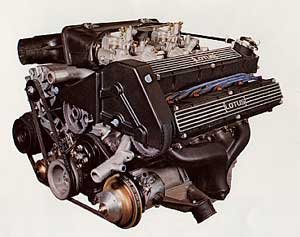
A lotus 912 Engine
It is a common misconception that the Lotus 900 series engines were modified Vauxhall engines. The 900 series was designed by Lotus as their first self developed engine, and due to similarities in dimensions and layout, Vauxhall 4-cylinder iron blocks were used as testbeds for the Lotus DOHC 16 valve cylinder head.
The 900 series engine was introduced in production form as the Lotus 907 in the 1972 Jensen-Healey, and went on to power Lotus into the late 1990s. It is regarded as the first modern DOHC, 16-valve production engine made.
The Jensen-Healey was released for sale to the general public with the first 907 engine shortly before the Cosworth Vega which also had a DOHC, 16-valve engine. Pre-war DOHC 4 valve per cylinder production engines included the Duesenberg and the Stutz DV-32 straight-8 engines.
904
The initial 2.0 litre Lotus 904 engine was first used in the Lotus type 62 Europa racecar, and indeed used a Vauxhall iron block. The Lotus marketing designation for this engine was LV220 for Lotus/Vauxhall 220 bhp. According to Jeremy Walton this 220 bhp (164 kW; 223 PS) was developed at 8000rpm.
907

The Lotus 907 engine, the first production version, was 2.0 L (1973 cc) and was used in the Jensen-Healey and later Lotus Esprit, Lotus Elite and Lotus Eclat. Bore was 3.75 in (95.28 mm) and stroke was 2.725 in (69.24 mm), and a DOHC 4-valve head was fitted, one of the first in modern times. Breathing through dual carburettors, the engine in final form as used in the Esprit produced 160 bhp (119 kW; 162 PS) at 6500 rpm with 140 lb·ft (190 N·m) of torque. Initial figures for the Jensen-Healey version were 140 bhp (104 kW; 142 PS) and 155 bhp (116 kW; 157 PS) as used in the first Elite cars.
Applications:
- 1972-1976 Jensen-Healey
- 1975-1976 Jensen GT
- 1974-1980 Lotus Elite S1
- 1975-1985 Lotus Eclat S1
- 1975-1978 Lotus Esprit S1
- 1978-1981 Lotus Esprit S2
911
The engine was modified in 1978 into the 2.2L type 911, which was fully designed by Lotus, used in the winning Lotus Talbot Sunbeam rally and production cars. In road trim the Lotus type 911 engine produced 150 bhp (112 kW; 152 PS) at 5,750rpm and 150 lb·ft (203 N·m) of torque at 4,500rpm. In rallying trim this was increased to 250 bhp (186 kW; 253 PS).
Applications:
- 1979 - 1981 Sunbeam Lotus
912
Also known as the naturally aspirated "Lotus 910", the stroke was increased to 76.2 mm giving a displacement of 2.2 L (2174 cc). As used in the 1980s Lotus production cars this engine was rated at 160 bhp (119 kW; 162 PS) at 6,500rpm and 160 lb·ft (217 N·m) of torque at 5,000rpm. For 1990 Lotus Excel this rating was raised to 180 lb·ft (244 N·m).
Applications:
- 1981 Lotus Esprit S2.2
- 1981-1990 Lotus Esprit S3 and NA
- 1981 Lotus Eclat S2.2
- 1982 Lotus Excel SE
910

Turbocharged engines introduced in 1980 were known as the type 910, which in high compression configuration produced 215 hp (160 kW) and an 220 lb·ft (300 N·m) of torque. For markets with stringent emissions requirements, Lotus introduced Bosch KE-Jetronic fuel injection - the first fuel-injected Esprits. This Bosch fuel injection was used in 1986, 1987, and 1988 model years. In 1989 The Bosch fuel injection system was superseded by Delco GMP4 electronic fuel injection. Included in this change to Delco engine management is the addition of crank-fired wasted spark ignition that removed the need for a distributor. The engine was again upgraded in 1990 to the type 910s for use in the Esprit SE where it produced 280 horsepower (210 kW) with the addition of a water to air intercooler known as the Chargecooler. In its ultimate incarnation as used in the Sport 300, X180R and S4s the engine was capable of 300 horsepower (220 kW), propelling these cars to 0-60 times in the low 4 seconds.
Applications:
- 1980-1990 Lotus Esprit Turbo
- 1990-1993 Lotus Esprit SE
- 1993 Lotus Esprit Sport 300 and X180R
- 1993-1996 Lotus Esprit S4
- 1995-1996 Lotus Esprit S4s
920
The 920 is a 2.0 litre configuration, originally only available in the Italian market where the lower engine displacement meant the vehicle would fall into a lower tax regime. The 920 was again utilized from 1996 to 1999 in the Esprit GT3 models, utilizing the improvements that served the SE models making these cars good for 240 hp (180 kW). This was the last application of the 900 series Lotus engine, which had a lifespan of nearly 30 years. However, unlike the 907 and its derivations, this engine was of a more square design, 84.45 x 89 mm, making for an overall displacement of 1,994 cc.
918
A 3.5 liter V8 derivative of the 900 series dual overhead cam inline 4, the 918 saw its only production car application in the Lotus Esprit V8.

Lotus 918 series Engine
- Details
- Parent Category: Engines Makes
- Category: Lotus Engines
- Hits: 64
Lotus 907 engine
The Lotus 907 was an engine designed and manufactured for automotive applications by Lotus Cars. It was an original design, dual overhead cam, 16 valve all alloy powerplant. It displaced 1973 cc and developed approximately 144 bhp (107 kW) with dual side-draft Dell'Orto carburetors or horizontal Zenith Stromberg carburetors for US cars. It was nicknamed "The Torqueless Wonder" for its lack of bottom end but good high end horsepower.
History
The Lotus 907 was the first production variant of the Lotus 900 series engine and the Jensen-Healey was the first production car to receive the Lotus 907.
It is said that when Vauxhall unveiled its new slant-four engine at the 1967 Earls Court Motor Show its bore centers were exactly the same as those proposed by Lotus. Colin Chapman immediately negotiated a deal with Vauxhall to buy some of their cast-iron blocks so that development of Lotus' own aluminum cylinder head could be sped up to produce the 907 engine.
Lotus Esprit
The original Lotus Esprit, the Lotus Elite, and the Lotus Eclat were fitted with a 907 engine. Developments to this engine resulted in the subsequent type 910, the 912 and the V8 type 918.
Problems
Oil leakage was commonplace in the first few years of production, though the problem was eventually addressed by aftermarket cam cover gaskets made from reusable rubber. Later 900 series Lotus engines included a revised cam tower that greatly improved the cam cover sealing design. The later cam towers can be retrofitted to the earlier 907 engines.
Early Jensen-Healey engines (1972–1973) had oil supply issues that made the oil pressure slow to build on start-up. Some early engines also had issues with oil drainage which resulted in too much oil being retained in the cam carriers. Differences between early and late 907 engines included rope seals for the rear of the crankshaft versus regular spring-loaded rubber lip seals for the rear of the crankshaft on later 907 engines
- Details
- Parent Category: Engines Makes
- Category: Lotus Engines
- Hits: 92
Lotus Ford Twin Cam Engine
 |
|
| Overview | |
| Manufacturer | Lotus Cars |
| Also called | Lotus TwinCam, Cosworth Mk.XIII, Cosworth Mk.XV |
| Production | 1962–1975 |
| Combustion chamber | |
| Configuration | Inline 4 |
| Displacement | 1557.46cc |
| Cylinder bore | 82.55mm (3.25") |
| Piston stroke | 72.75mm (2.864173") |
| Cylinder block alloy | Ford 116E cast iron |
| Cylinder head alloy | Aluminium |
| Valvetrain | DOHC, 2 valves / cyl., chain driven |
| Chronology | |
| Successor | Lotus 907 |
The Lotus-Ford Twin Cam is a 1557 cc engine developed for the 1962 Lotus Elan and also used in a variety of other vehicles up until the mid 1970s.
Design
Lotus required a low cost, compact, yet powerful engine for the Elan, as the custom-built all-aluminium Coventry Climax FWE for Elite was very costly.
Colin Chapman initially chose to use the overhead valve (OHV) cast iron block 997 cc (60.8 cu in) Ford 105E inline four used in the Ford Anglia as the basis of this new engine. While the basic engine design was oriented toward performance (being of oversquare design with indivisual intake and exhaust ports that are not siamesed), 105E was by no means a performance engine. Soon the 1,339 cc (81.7 cu in) 109E for Ford Consul Classic became available, and most of the development was carried out on this three bearing 109E block.
To achieve the power required, Chapman commissioned Harry Mundy (of BRM V16 fame) to design a dual overhead camshaft (DOHC) conversion. This comprised an aluminium cylinder head and an aluminium front cover and its back plate assembly containing the water pump and the camshaft drive chain. However, the 5 main bearing 1,498 cc (91.4 cu in) version for Consul Capri became available in time for production, and the design was converted on this 116E block, crankshaft and 125E Type C conrods.
After the initial design was finished, Richard Ansdale, as an outside consultant, provided the detail design and drew the plans needed for production. Steve Sanville, a Lotus employee, headed the production engineering team including Mike Costin, Neil Francis and Bob Dance, which incorporated the port shape modifications suggested by Harry Weslake, who conducted a flow bench analysis on the head. Keith Duckworth had already left Lotus, but was responsible for Special Equipment cam design, as well as the assembly of the first two production-specification engines, one of which powered Lotus 23 on its sensational debut at Nürburgring.
Likely reflecting Chapman's obsession (as an engineer, he was known to go to the extreme in lightweight designs) to save weight by using one mechanical part for as many purposes as possible, the water pump used the engine front cover as its housing, making water pump replacement difficult. The intake manifold was cast as an integral part of the cylinder head, making the later heads using Stromberg carburetors not interchangeable with those for Weber or Dell'Orto carburetors. These designs were unique then, and very few have followed suit.
Also notable is that the original camshaft was retained as an intermediate shaft driving the DOHC cam sprockets via a front-mounted, single – long – timing chain, having the side-mounted distributor and nearby external oil pump/filter assembly in original locations, requiring few modifications to the mass-produced iron block.
Originally, the engine had a bore of 3-3/16" (80.9625 mm) and 72.75mm (2.8642 inches) stroke for a capacity of 1,498 cc (91.4 cu in) and produced approximately 100 bhp (75 kW) at 5700rpm. This compares to the original Ford pushrod 116E of about 60 bhp (45 kW) at 4600rpm.
After the initial 50 engines were contracted out and assembled by J.A.Prestwich, the specification was changed to a larger 3-1/4" (82.5500 mm) bore, increasing the capacity to 1,557 cc (95.0 cu in). Only 22 of the 1.5 Litre engines made their way into roadgoing "Elan 1500", the rest being used on Lotus 20B, 22, 23, 26R as well as in Elan and Lotus Cortina prototypes and a LHD Ford Anglia mule, which, fit with one of the first prototype engines, had overtaken a fast Jaguar at well over 100 mph in the hands of Jim Clark on his way back from Goodwood to Scotland. The 1,557 cc (95.0 cu in) displacement of the new specification allowed an overbore of 0.040 in (1.0 mm) as permitted by the FIA regulations, while keeping the cubic capacity below the new FIA 1600 cc class limit.
The Name
Chapman named the engine "Lotus TwinCam" at its introduction in 1962. However, coinciding with the production switch-over from Cortina-Lotus to the Cortina Twin Cam based on the Ford Cortina Mark II, Ford acquired the rights to the design, and the name was changed to "Lotus-Ford Twin Cam" in 1967.
Technical
The 1557 cc twincam engine, although often being quoted as 1558 cc, had internal dimensions of 82.55 mm (3.25 inches) bore x 72.75 mm (2.8642 inches) stroke, resulting in a displacement of 1557.46 cc.
The cylinder head has hemispherical combustion chambers similar to that first used by Peugeot on their 1912 Grand Prix car and subsequently refined by Vittorio Jano in the 1920s and 1930s, as well as by Walter Hassan in the 1940s and 1950s, among other notable engineers who continually borrowed ideas from the aeronautics industry. Valve sizes used are 1.530" diameter inlet and 1.325" diameter exhaust on all engines except the "big valve" Elan Sprint and Lotus Europa models which have an inlet valve measuring 1.565" diameter, with the valve stem axis inclined 27 degrees from vertical on both intake and exhaust.
The initial cam timing was 15/53/53/15 with the same cam profile as the ET418 Coventry Climax FWE cam, which resulted in 100 bhp at 5700 rpm for the 1.5 Litre with a 9.5:1 compression ratio. The Special Equipment engines had camshafts developed by Cosworth (CPL1 -Cosworth Production Lotus) with 22/62/62/22 timing and 0.349" lift, which became known as the 'L1' cam. The Elan Sprint engines with larger valves had the same timing with 0.360" lift, and the same timing was used again on the later Lotus 907 engines as well.
For the first years of production, the Lotus blocks were simply selected for the thickest cylinder walls from the standard production line, and identified with an "A" stamped into the timing cover mating face. Later, the blocks were specially cast with twin-cam production in mind and identified with an "L" cast into the block under the engine mount.
The 116E block was used in 5 basic versions
- The Mark 1 - from 1962 to 1967
- The -6015 block with round main bearing caps and 4 bolt crankshaft
- The Mark 2 - from 1967-1975
- The 3020-6015 block with round main bearing caps and 6 bolt crankshaft
- The 681F-6015 block with round main bearing caps and 6 bolt crankshaft
- The 681F-6015 block with square main bearing caps and 6 bolt crankshaft
- The 701M-6015 block with square main bearing caps and 6 bolt crankshaft
By 1966 all major engine parts – block, crank, rods, pistons and flywheel were unique to the Lotus engine. By the end of production, some 55,000 units had been built.

Applications
- 1962–1974 Lotus Elan
- 1963–1964 Lotus Cortina (made by Lotus)
- 1964–1966 Cortina-Lotus (made by Ford)
- 1966-1970 Lotus 47 (Cosworth Mk.XIII)
- 1967–1970 Cortina Twin Cam (made by Ford)
- 1968–1970 Ford Escort Twin Cam
- 1972–1975 Lotus Europa Type 74
- 1972 Lotus Seven (15 examples at the end of production)
- 1973–1974 Caterham Super Seven
Special Equipment
In order to accommodate Elan and Lotus Cortina customers who wanted a higher performance engine, Lotus sold cars with optional Special Equipment engines, and Lotus Components Ltd sold the parts used in these engines. At first, these were Cosworth developed and assembled engines with cast cranks and Cosworth name plates on the cam cover. However, Cosworth soon distanced themselves from this business, and Lotus started selling 'BRM' equivalents. BRM Phase I consisted of BRM camshafts and high compression cast pistons, and BRM Phase II added Mahle forged pistons, BRM forged conrods, small-end bushes and big-end bolts to the Phase I. When offered in assembled form, these engines carried a BRM name plate on a specially cast 'BRM' cam cover, but the actual assembly of these high performance 'BRM' road engines was carried out by Rubery Owen & Co. Ltd., an affiliated company of BRM through its ownership, not by BRM itself.
The term "Special Equipment" was later converted by Lotus to designate those Series 2 and later Elans with higher output motors, which are referred to as Elan SEs.
Motorsport and Cosworth
Cosworth founders Keith Duckworth and Mike Costin were former employees of Lotus, and with strong ties to Lotus founder Colin Chapman developed this engine for competition use. One of the initial batch became the experimental Cosworth Mk.X (3-3/16" x 72.75mm, 1498 cc) in 1962, then the dry-sump Mk.XII (83.50mm x 72.75mm, 1594 cc, 140 bhp) with racing camshafts designated the 'CPL2' (26/66/66/26) and high compression Cosworth pistons was born in 1963, and used actively by Team Lotus in Lotus 20B, 22, 23 and 23B.
The Mk.XII was further developed by using Cosworth 12 bolt forged steel crankshaft, Cosworth forged conrods, wilder camshafts and Weber 45DCOE for Formula racing to become the Cosworth Mk.XIII (83.50mm x 72.75mm, 1594 cc, 140-150 bhp). This Mk.XIII became a big seller in 1965 when the SCCA created Formula B category in America. As a result, not only did SCCA Formula B practically become a Cosworth-engine class (inherited later by Cosworth BDD when it became Formula Atlantic), helping Cosworth establish its corporate financial base, but ironically this enabled the now-viable engineering firm to move from near-total dependence on Lotus. The proliferation of the Mk.XIII triggered establishment of new European style racing engine builders in the US, performing rebuilding and maintenance work needed on the Mk.XIII, who also contributed to Cosworth's revenue.
Although it still used the Ford iron block, Mk.XIII was a properly developed racing engine that was far from just another souped-up production motor, and its dominance in Formula B was close to being absolute against the main rivals Satta/Hruska designed Alfa Romeo 105/115 1570 cc DOHC unit, and Alex von Falkenhausen designed SOHC 1573 cc BMW M116 engine.
Other Cosworth engines based on Lotus-Ford Twin Cam include Mk.XV (1594 cc, wet sump, 130-140 bhp, for Lotus 26R and Lotus Cortina, almost all for Team Lotus and affiliated teams) and Mk.XVI (1498 cc, dry sump, 140-150 bhp) the 1.5 Liter Class version of Mk.XIII. The Mk.XVI was used by Bob Gerard Racing on Cooper T71/73 for John Taylor at 1964 British Grand Prix, but was no match against Coventry Climax FWMV and BRM P56 V8s, which were generating about 200 bhp.
Cosworth designed its own aluminium reverse-flow 2 valve gear-driven SOHC cylinder head (which shared many basic design attributes with Coventry Climax FWE head) for the same Ford 116E block with a shorter-stroke forged steel crank for 1 Liter Formula 2 to be named SCA (997 cc, 120-140 bhp) in 1964, and then a gear-driven DOHC 4 valve cross-flow aluminium head on the same block with the Mk.XIII forged crank for the new 1.6 Liter Formula 2 named FVA (83.60mm x 72.75mm, 1597 cc, 210-220 bhp) in 1966. This is when the development on Lotus TwinCam ended on the part of Cosworth.
When the customers wanted to race the TwinCam seriously, they turned to Holbay, Vegantune, Novamotor and other engine builders, who carried on the development after 1966 not only for Elan and Cortina, but also for Formula 2, 3 and other categories, which were served later by Brian Hart, Richardson, Wilcox and other newer tuners as well.
The Lotus TwinCam is an enduring engine and even to this day is still used in rallying, hillclimbing, autocross and of course, historic motorsport events. In fact, some may argue that the "twink" is more popular in motorsport now than it was during its production. This, in no small part, is due to the likes of companies such as QED Motorsport or Burton Power who strive to keep the engine in service with hard or impossible to find engine components. QED bought the license to officially re-produce the Twin Cam's cylinder head.
It is not unusual to see 170-180 bhp from a properly built "Lotus TwinCam" on a dyno for Historic Formula races these days (2013) with the advancements in ignition, air/fuel measurement, metallurgy, lubricants and computer-aided manufacturing/development tools, however, it is very little known that this dry-sump steel-crank racing engine is more accurately called Cosworth than Lotus.
Power output
The power output for roadgoing versions are as follows (official figures as claimed by Lotus)
100 bhp (75 kW; 101 PS) Elan 1500 105 bhp (78 kW; 106 PS) Elan 1600, S2, S3 105 bhp (78 kW; 106 PS) Elan S4 115 bhp (86 kW; 117 PS) Elan S2 S/E, S3 S/E, S4 S/E 118 bhp (88 kW; 120 PS) Late Elan S3 S/E 126 bhp (94 kW; 128 PS) Elan Sprint For Cosworth racing engines,

