
Willys Overland
- Details
- Parent Category: W
- Category: Willys Overland
- Hits: 69
Willy's 37/38/48 / Speedway / Americar
 |
|
|
Manufacturer: |
Willys-Overland |
|
Production period: |
1937 to 1942 |
|
Class: |
Motor car |
|
Body versions: |
Saloon, station wagon, coupe, pickup |
|
Engines: |
Gasoline engines :2.4 liters (35-46 kW) |
|
Overall length: |
175 in |
|
weight |
Saloon 2,250 lbs. |
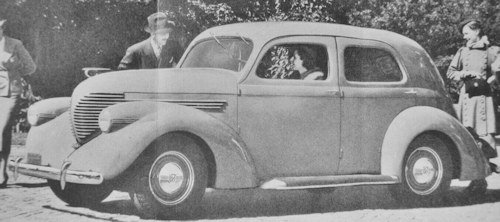
The Willy's 37/38/48 / Speedway / Americar cars from Willys-Overland in Toledo (Ohio) first brought out in 1937 an updated pre-war car based on the 77. Basically, the vehicle was an evolution of the previous Whippet. In the years until the entry of the United States in the Second World War, the model series under the name Willys 37, Willys 38, Willys 48, Willys Speedway and Willys Americar was further developed. When civilian car production in the USA had to be discontinued in 1942, this vehicle also disappeared from the market. The car had a front longitudinally mounted four-cylinder in-line engine with 2388 cc and 48 bhp (35 kW) power. The wheelbase was just 2540mm and the car was offered for under $ 500, making it the cheapest American car of its time. Also, the operation was quite cheap, since the car only 9.4 ltr. Gasoline consumed to 100 km.
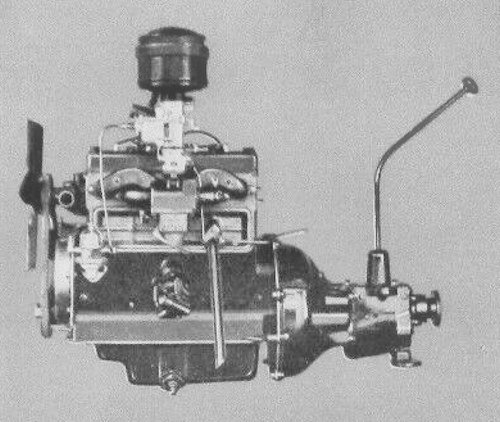
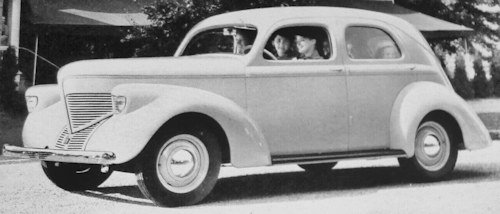
Model year 1937: For the model year 1937, the car was stylistically revised. A forward-looking alligator bonnet with horizontal grille bars in body colour and the headlights recessed in the bulky front fenders gave the model a more modern look. It was renamed Willys 37, but the technique remained the same. Also from the coupe, there was now a luxury version. For the model year 1938 The Willys 38 now has a rocket-shaped radiator emblem and there were new models in standard and luxury version. The Double drop, X-member type chassis frame with All-steel body, with solid steel top, sound and heat insulated, non-glare windshield and safety glass all round with remote door controls.
With leather upholstery or with cloth upholstery. in Blue or colour grey large glove box on either side of instrument panel; horn control at centre of steering wheel, starter button, throttle and choke controls, ignition lock and mechanical fuel gauge in instrument panel. The spare wheel carried in rear luggage compartment. The petrol tank at rear, with 6.6 gallons capacity.
Model year 1939: The unchanged in itself car was now Willys 48 and in addition to the "Deluxe" models, there were also "Speedway" versions (only 2-door). For a short time, the vehicles were also sold under the traditional name Overland.For the Model years 1940 The following year was another stylistic revision: The alligator bonnet was now flatter and no longer had a grille; this was now below the hood and had horizontal bars in body colour. The model was now called Willy's Speedway and its wheelbase was now 2,591 mm. In addition to the 2-door coupe and the 4-door sedan in basic and deluxe equipment, there was for the first time a station wagon in Deluxe design.
Model year 1941: The Willys Speedway was renamed Willys Americar this year; Speedway was just a name for the structure. Add to that the more expensive "Plainsman" versions. Stylistically, the cars remained unchanged, but got stronger engines with 63 bhp (46 kW) and the wheelbase grew to 2642 mm.Model year 1942: In the shortened model year 1942 (until February 1942), the Americar models were continued almost unchanged; only the grille was now chrome.
- Details
- Parent Category: W
- Category: Willys Overland
- Hits: 33
Willy's Six car 89 / 98B / 97 / 98D / 90 / 90A
 |
|
|
Manufacturer: |
Willys-Overland |
|
Production period: |
1918 to 1920 and 1930 to 1933 |
|
Class : |
Motor car |
|
Body versions : |
Touring car , roadster , sedan , coupe |
|
Engines: |
Gasoline six-cylinder in-line (33-48 kW) |
The Willys Six was an American car, from Willys-Overland in Toledo (Ohio) ,that was brought out 1918 . Until then, the company had only made Willys-Knight vehicles with sleeve pusher engines . This year, for the first time, she offered a car with conventional globe valves.
History
The car had a front longitudinally mounted six-cylinder in-line engine with 45 bhp (33 kW) power. Its wheelbase was 3048 mm and the purchase price - depending on the version - 1625 US $ to 2045 US $. This Series 89 was built alongside the Knight 88 Series models until 1920 to make way for a cheaper range of models with only four-cylinder Knight engines.
In 1930, engines with lift valves appeared again at Willys. The six-cylinder in-line engine with 65 bhp (48 kW) power accelerated the car up to 115 km / h. The wheelbase was 2794 mm and the vehicles cost between 695 US $ and 850 US $.
Until 1933, the Six was offered in different versions. This year, the company went bankrupt, but production continued. Along with the Willys-Knight , the Six was discontinued in favor of the smaller Willys 77 with four-cylinder engine.

Models years
Model Years 1918-1920:The 89 series was offered as a 7-seater touring car, a 4-seater club roadster and a 6-seater sedan. There were no changes in the two following years.
Model year 1930:Of the series 98B there was a roadster with 2 or 4 seats, a 5-seater touring car, a 2- and a 4-seater coupe with 2 doors and a 2- and 4-door sedan, the latter also in luxury.
Model year 1931:The successor of the 98B was called Series 97 . In addition, there was also the series 98D with 3 '' extended wheelbase (2870 mm). Of these vehicles issued a Victoria coupe and a sedan, each in basic and luxury execution.
Model year 1932:Successor to the 98D (long wheelbase) was the 90 series . The cars were given the nickname "Silver Streak" The short wheelbase models disappeared, but the 90 with all the previously mentioned bodies was available.
Model year 1933:Unlike the Willys Eight , the Six Silver Streak was adopted without major changes from the previous year and was called Series 90A .

- Details
- Parent Category: W
- Category: Willys Overland
- Hits: 52
Willy's Aero Ace/Eagle/Falcon/Heavy Duty/Lark/Wing/Bermuda/Custom Series
 |
|
|
Manufacturer: |
Willys Overland |
|
Production period: |
1952 to 1955 |
|
Class : |
Motor car |
|
Body versions : |
Sedan |
|
Engines: |
|
Willys Aero was a series of American cars, from 1951 to 1955 by Willys Overland in Toledo (Ohio). It was the first postwar car series by Willys.
The new pontoon wagons were designed by Phil Wright and designed by Clyde Paton . The wheelbase of the two-door sedans was 2743 mm and they were equipped with six-cylinder in-line engines with 2640 cc displacement (bore × stroke = 79.5 mm × 88.9 mm).
Until 1955, the cars were manufactured in different trim levels as two- and four-door sedans and two-door hardtop sedans. Later, the 3.7-liter engine of the Kaiser Special was available. 1955 accounted for the name "Aero".
Models history and range
Aero Lark
The Aero Lark was the basic model. It was offered in 1952 as a two-door sedan with five seats. Its side- mounted engine delivered 75 bhp (55 kW) at 4000 rpm.
In 1953, a four-door sedan was added. In 1954, engine output increased to 90 bhp (66 kW) at 4200 rpm due to higher compression (7.6: 1 instead of 6.9: 1).
In 1955, the Aero Lark was no longer offered.
Aero Heavy Duty
The Aero Heavy Duty corresponded to the four-door Aero Lark and was only sold in 1953 in exactly 186 copies. His price was $ 100 higher than that of the Aero Lark.
Aero Wing
The Aero Wing was better equipped than the otherwise identical Aero Lark. The 1952 offered two-door super-luxury sedan offered in addition to a two-tone paint and bumper horns above all a counter-rotating engine with 90 bhp (66 kW) power at 4200 / min.
1953 accounted for the Aero Wing from the model range.
Aero Falcon
In 1953, the Aero Falcon Super DeLuxe replaced the Aero Wing. The speed at unchanged 90 bhp rated power rose to 4400 / min. In addition to the two-door sedan was now also offered a four-door version. 1954 also accounted for the Aero Falcon.
Aero Ace / Ace
Willy's Aero Ace 2-door Sedan (1952). This vehicle is a custom car technically and optically not the same as theoriginal vehicle. The best equipment of all sedans in 1952 was the Aero Ace . The two-door custom sedan was technically and outwardly the Aero Wing, although the interior was more luxurious. Like the other models there was in 1953 next to the two-door sedan also a four-door. Also, the cars received the higher-compression, side-controlled engine of the Aero Falcon with consistent performance. However, the Aero Ace offered this year for the first time a one-piece windshield (the others had a split in the middle) and a panoramic rear window .
In 1954, the Aero Ace models an Aero Ace Deluxe 226 was set aside. Kaiser Motors , which had bought Willys-Overland in 1953, delivered the new side-controlled twin-rotor 3703 cc engine with 115 bhp (85 kW) at 3650 rpm. from our own production. Thus, the car reached a top speed of 136 km / h. Some models were also experimentally equipped with a turbocharger and reached a performance of 140 bhp (103 kW).
1955 accounted for the name Aero, the car was called only Ace . Also accounted for the two-door sedan and Willy's own six-cylinder engine with 90 bhp; only the Kaiser engine with 115 bhp was available. In the two-tone painting now not only the roof, but also bonnet, trunk lid and all parts above the swinging in the rear doors side line was kept in the additional color.
Aero Eagle
The Aero Eagle was the hardtop coupe of the Aero series. Technology and equipment corresponded to the Aero Ace. This top model also made with the technical and stylistic changes of the Aero Ace in the years 1953 and 1954 (including the new Kaiser engine).
In 1955, the model was no longer offered.
Bermuda
In 1955, the Bermuda replaced the Aero Eagle. The stylistic changes compared to the predecessor corresponded to those of the Ace compared to the Aero Ace.
Custom Series
In 1955, the two- and four-door sedan were offered as a successor to the Aero-Ace -226 models of the previous year in simpler equipment. The four-door sedan was at least 131 US $ cheaper than the Ace.
Brazilian Aero Willys
The Aero Willys in Brazil. After the end of production in the US in 1955, the production facilities were preserved. In the late 1950s, a new use was found in Brazil, where the government was keen to build national vehicle production.In March 1960, the Brazilian Aero Willys was introduced. He initially largely corresponded to the US model from 1955. There was only the four-door sedan and the well-known 2.6-liter six-cylinder engine with 90 hp (66 kW) power.
In the fall of 1962, the car was thoroughly revised. He received a new body, the engine output rose to 110 hp (81 kW).In 1966, the program was supplemented by two models. The Itamaraty was a luxury version of the Aero Willys 2600, the Executivo a long version mainly for the Brazilian government, which wanted a representative vehicle from national production. 1967, an enlarged engine was introduced with 3.0 liters of displacement and a power of 132 hp (97 kW).
In the same year, Willys do Brasil was taken over by Ford. The Aero Willys was further built until 1971 and then replaced by the Brazilian version of the Ford Maverick .A total of 116,967 cars were produced in Brazil from 1960 to 1971, including only 27 Executivos.
General Specification
Engines: Gasoline engines : 2.6-3.7 liters
Power: 55-85 kW
Length: 4592-4821 mm
Width: 1830 mm
Height: 1520 mm
Wheelbase: 2743 mm
Curb weight: 1122-1316 kg

- Details
- Parent Category: W
- Category: Willys Overland
- Hits: 126
Whippet (Willys-Overland)

Whippet was an American automobile brand manufactured by Willys-Overland in Toledo, Ohio between 1926 and 1931 . The car was named after the English dog breed of the same name, and the radiator emblem showed a whippet leaping through a tire.
History
After completing production of the Overland vehicles in 1926, John North Willys wanted to produce a particularly small and cheap car. The result was a car with the shortest wheelbase of all US produced cars at that time only 100.25 "(2546 mm) in the fall of 1926. The model 96 had a four-cylinder engine with 2,196 cc, which made 30 bhp (22 kW) This car was available as a 5-seater touring car, 5-seater sedan or 2-seater coupe.
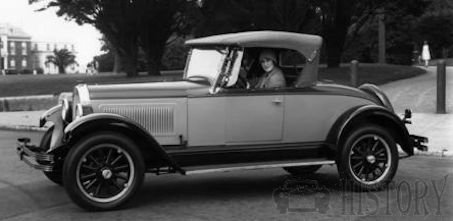
In January 1927, the wheelbase of this car was extended to 2,648 mm and there were a number of other bodies. At the same time he was the model 93A with a six-cylinder engine to the side, the 40 bhp (29 kW) delivered. The chassis of this car had a wheelbase of 2,775 mm and there were the same bodies as the smaller model. This car proved its speed in 1927 at the 24 - hour race in Indianapolis , where it reached an average speed of 56.52 mph (90.54 km / h).
The cheapest Whippet, the four-cylinder cabriolet, was available in 1928 for $ 545, - less than the cheapest Ford . The prices of the other models ranged between US $ 615, - and 745, -, and so the Whippet 93A could be marketed as the cheapest six-cylinder of its time. Despite the low price, the cars had mechanical brakes for all four wheels and seven crankshaft bearings and recirculating-pressure lubrication in the engine.
Already in the first full year of production in 1927, 110,000 vehicles were built in 1928 and 1929 together created 242,000 pieces (of 315,000, the Willys-Overland in total at this time produced!).
In 1928 the model 93A became the model 98 . 1929 was the four-cylinder model 96A and the six-cylinder model 98A . These vehicles were made with a variety of bodies for 2 - 5 passengers, but the appearance and the technology of the vehicles changed little.

For 1930 Light delivery vans to 1 and a half ton trucks and pick ups ,coupes and four passengers built.
All Whippet models were also manufactured and distributed in Australia by the Holden bodyshops, but with 21-inch instead of 19-inch wheels and minor changes to the body.
The collapse of the Wall Street Stock Exchange on Black Friday and the resulting global economic crisis, however, put an end to the brand: In the spring of 1931, Willys-Overland decided to discontinue the Whippet in favor of the Willys Six and the new Willys 77 the Whippet delivery vans continued into the early 30s with Crossley in the UK also supplied them .

- Details
- Parent Category: W
- Category: Willys Overland
- Hits: 65
Willys-Overland Motors History (1908)
 |
|
| Type | Truck Manufacturing |
|---|---|
| Industry | Automotive |
| Genre | Military Jeeps (MBs) and civilian versions (CJs) |
| Founded | 1908 |
| Founder(s) | John Willys |
| Headquarters | Toledo, Ohio, United States |
Willys-Overland Motors was an American automaker that sold its vehicles under the brand names Willys, Aero-Willys, Overland and Jeep .
History
In 1908, John North Willys renamed it to Willys-Overland Motor Company after buying Overland Automotive Division from the Standard Wheel Company .In 1913, Willys acquired a license to the Knight engines and manufactured vehicles under the name Willys-Knight . By the Mid-1920s, he also bought the FB Stearns Company in Cleveland, and built cars of the brand Stearns-Knight .
In 1914 the Electric Auto-Lite Company and in 1915 the Russell Motor Car Company in Ontario ( Canada ) was added, in 1917 John N. Willys founded the Willys Corporation as a holding company. In 1919 he acquired the Duesenberg -Werk in Elizabeth (New Jersey) . Here, Willys had a new model developed independently of other corporate influences, the Willys Six-89 . The engineers behind this project were Owen Skelton , Carl Breer and Fred Zeder who had previously worked at Studebaker and later key positions at Chrysleroccupied. In 1918, Willys-Overland acquired the majority of shares in the Moline Plow Company .
The plant in Elizabeth was replaced by a larger one in which the Six-89 was to be made. It did not come to that, the recession forced the Willys Corporation to its knees. The Chase National Bank as the main creditor then commissioned Walter P. Chrysler in 1919 to revise the corporate and model obsession. Chrysler had previously been president of General Motors ' Buick Division . Walter Chrysler was transferred in 1922 the renovation of Maxwell-Chalmers . Meanwhile, the work came in Elizabeth including the prototype of Willy's Six-89under the hammer. Chrysler bid for Maxwell, but the contract went to his former boss William C. Durant who had meanwhile had to leave General Motors and set up a new corporation employing Durant Motor Corporation . Durant's reasonably priced Star car was to be built in this factory . From the Willys prototype Durant wanted to develop a Buick competitors. This required a larger and heavier vehicle. According to these specifications, the vehicle was heavily revised, made ready for production and came out in 1923 as a flint . Walter Chrysler brought Skelton , Breer and cedarto Chalmers, letting her refine the original design. After successful renovation Walter Chrysler took over the company. Almost four years after the completion of the Willys Six-89, in January 1924, it was unveiled in a slightly modified form as the Chrysler Six Model B-70 and was an immediate success.
1926 ended the production of Overland models; instead, the Whippet was built. After the stock market crash in 1929 followed the global economic crisis , some Willys car brands were therefore set. Stearns-Knight was liquidated in 1929. The manufacture of the Whippet ended in 1931; he was replaced by the models Willys Six and Willys Eight . The Willys Knight was set in 1933.
Willys adjusted his model program and decided to produce only two new models, the four-cylinder Willys 77 and the six-cylinder Willys 99. After the company was on the verge of bankruptcy, only the Willys 77 was built. It had to sell its Canadian subsidiary, which was also in poor financial shape, and began a major reorganization. After that, only the main plant in Toledo and a few smaller factories belonged to Willys-Overland. The remainder was sold to a newly established real estate company, from which Willys-Overland leased some properties. So the company could survive the difficult times.
In 1936, the Willys-Overland Company was renamed Willys-Overland Motors . In the 1920s and 1930s, Willys-Overland was one of many small automakers in the US. Willys-Overland also applied for the US Department of War when it came to finding automakers that could quickly build a light commercial vehicle based on the American Bantam- designed prototype.
In 1938, Joseph W. Frazer left Chrysler and took over the leadership of Willys-Overland. He immediately tried to improve the products and expand the activities into other business areas. One of them was the all-terrain Willys MB , later known as the Jeep . Another task was to improve the four-cylinder engine so that it could withstand the difficult conditions that the Willys MB would be exposed to. Production of the Willys MB began in 1941 with 8,598 units, and by the end of the Second World War , 359,851 copies were built, to which a similar number came under license from Ford.
After the war, Willys stopped producing pre-war cars and focused on building jeeps and vehicles based on them. The first postwar vehicle was the Jeep CJ-2A , a Willys MB without the typical military details, such as the taillight, and with a rear door.
Willys fought for a market for the unusual vehicle and tried to sell it as a tractor to the farmers. Tractors were not made in wartime and therefore hard to get. Nevertheless, the Agri-Jeep sold poorly, mainly because the vehicle was too light to provide sufficient traction.
However, the CJ-2A was one of the first civilian vehicles to be factory fitted with four-wheel drive. He became popular with farmers, ranchers, hunters, and other people who needed a light vehicle for dirt roads and rough roads.
In 1946, a year after the introduction of the CJ-2A, Willys produced the Jeep Wagon , which was equipped with the same drive and styling influenced by the CJ-2A. Next came the jeep truck with four-wheel drive. In 1948, there was also the four-wheel drive for the Wagon, which made him a pioneer of today's SUVs .
Willys also later introduced the Jeep M38 for the US Army and continued the Jeep CJ series . Another variant of the Jeep was the Jeepster . As a tamer version, it was available with four- or six-cylinder engine and only with rear-wheel drive.
From 1951, Willys again participated in the car market with the new "compact car" Willys Aero . First, there was this vehicle only as a two-door with side or counter-clocked six-cylinder engine. Abroad, the Aero was also available with the four-cylinder engine (from the Jeep CJ). From 1953 there were also four-door, a hardtop coupe and taxi executions.
In 1953, Willys-Overland was bought by Kaiser Motors and changed its name to Willy's Motor Company .
World War II and the Jeep
Willys-Overland was one of several bidders when the War Department sought an auto maker that could begin rapid production of a lightweight truck based on a design by American Bantam.
Production of the Willys MB, better known as Jeep, began in 1941, shared between Willys, Ford and American Bantam. 8,598 units were produced that year, and 359,851 units were produced before the end of World War II. Willys-Overland ranked 48th among United States corporations in the value of World War II military production contracts. In total, 653,568 military Jeeps were manufactured. The origin of the name "Jeep" has been debated for many years. Some people believe "Jeep" is a phonetic pronunciation of the abbreviation GP, from "General Purpose", that was used as part of the official Army nomenclature. The first documented use of the word "Jeep" was the name of a character Eugene the Jeep in the Popeye comic strip, known for his supernatural abilities (e.g., walking through walls). It was also the name of a small tractor made by Minneapolis-Moline before World War II. Whatever the source, the name stuck and, after the war, Willys filed a successful trademark claim for the name.
Post-war struggles
After the war Willys did not resume production of its passenger car models, choosing instead to concentrate on Jeeps and Jeep-based vehicles. The first post-war Willys product was the CJ-2A. The CJ-2A was an MB stripped of obviously military features, particularly the blackout lighting, and with the addition of a tailgate.
Willys initially struggled to find a market for the vehicle, first attempting to sell it primarily as an alternative to the farm tractor. Tractors were in short supply, having been out of production during the war. However, sales of the "Agri-Jeep" never took off, mainly because it was too light to provide adequate draft.
The CJ-2A was among the first civilian vehicles of any kind to be equipped with four-wheel drive from the factory, and it gained popularity among farmers, ranchers, hunters, and others who needed a lightweight vehicle for use on unimproved roads and trails.
In 1946, a year after the introduction of the CJ-2A, Willys produced the Willys "Jeep" Utility Wagon based on the same engine and transmission, with clear styling influence from the CJ-2A Jeep. The next year came a "Jeep" Utility Truck with four-wheel drive. In 1948, the wagon was available in four-wheel drive, making it the ancestor of all sport utility vehicles.
Willys planned to re-enter the passenger car market in 1947 with the Willys 6-70 sedan. Its name came from the fact it was powered by a 6-cylinder engine that produced 70 hp. The 6-70 was touted as the first stock car in America that offered independent suspension on all four wheels, but it never entered production.
In 1948 under a contract from the US Army Willys produced a small one-man four-wheeled utility vehicle called the Jungle Burden Carrier which evolved into the M274 Utility ½-ton vehicle.
Willys later produced the M38 Jeep for the U.S. Army, and continued the CJ series of civilian Jeeps. One variation was the Jeepster, which came with a 4-cylinder or 6-cylinder engine but only with two-wheel drive to the rear.
The 1950s
In 1952 Willys re-entered the car market with a new compact car, the Willys Aero. At first available only as a two-door sedan, it was available with either an L-head or F-head six-cylinder engine. Export markets could get the Aero with a four-cylinder engine. A four-door sedan and a two-door hardtop were added for 1953 along with taxi models. The Aero cars were called Lark, Wing, Falcon, Ace or Eagle depending on year, engine and trim level, except for a small production run in its final year (1955) with models called Custom and Bermuda. The bodies for the Willys Aero were supplied by the Murray Body company, which also made the bodies for the short-lived Hudson Jet. Also in 1952, CJ3B Jeeps went into production. By 1968, over 155,000 were sold.
In 1953 Kaiser Motors purchased Willys-Overland and changed the company's name to Willys Motor Company. The same year, production of the Kaiser car was moved from Willow Run, Michigan, to the Willys plant at Toledo, Ohio. Although Jeep production was steady, sales of the Willys and Kaiser cars continued to fall. Willys established an assembly plant in Brazil in 1953, after the government prohibited the import of assembled vehicles as part of an import substitution program. In 1954, the CJ5 debuted at the start of its three-decade run.
After the last Willys passenger car was built in 1955, Willys shipped the Aero's tooling to Brazil, where it was built from 1960 to 1962, almost unchanged. Brooks Stevens restyled the Aero for 1963, and it was built by Ford(which bought the Willys factory) until the 1970s.
In American the company changed its name in 1963 to Kaiser-Jeep Corporation; the Willys name disappeared thereafter.
Willys-Overland established its Brazilian operations in 1953, just before the Kaiser-Frazer takeover.The tooling for the Aero went to Brazil, where it entered production in 1960. In 1956-1957 Brazil's Executive Group for the Automotive Industry (GEIA) had approved Willys-Overland for production of the Aero, the Willys MB Jeep, a truck version of the Jeep called the Rural, and the French Renault Dauphine small car. The Aero-Willys replaced an earlier plan by a company called Chrysler-Willys do Brasil S.A. to build the 1956 Plymouth Savoy there. The Dauphine was a result of Kaiser's Renault connection, and was produced by Willys do Brasil from 1959 until 1968. Willys held a market share of around 30 per cent in Brazil from 1960 until 1966, its last full year as an independent, mostly Brazilian-owned company.
In 1962 Willys started building the French Alpine A108 as the Willys Interlagos. It was produced until 1966 and was the first Brazilian-made sports car. It was also the car in which many Brazilian racers cut their teeth, including greats such as Emerson Fittipaldi. Willys also designed and showed a larger sports car called the "Capeta" (Devil) in 1964, powered by the 2.6 litre six-cylinder Aero engine.In 1965 Willys Overland do Brasil and Renault began collaborating on a new front-wheel drive car, called "Project M" and meant to replace the aging Dauphine. Developed in parallel with the Renault 12, which it pre-dated, the car eventually saw light as the Ford Corcel. Early Corcels had "Willys" stamping in the glass, and the Corcel line (which continued in production until 1997 as the Ford Pampa) always showed its French origins in its characteristic three-bolt wheels. In 1967 Ford took a controlling interest in Kaiser and thereby gained control of Willys-Overland do Brasil.
The Aero-based Itamaraty continued in production until the early 1970s, in latter years wearing "Ford" badges. Dauphine production ended in 1968, but the Willys Rural/Pickup and its derivatives were built as the Ford F-75 until 1983. The only visual difference is that the post-1970 cars have a tailgate with "Ford" rather than "Jeep" stamped in it. There was also a military version of the Jeep Pickup, called the F-85.
Legacy
Kaiser-Jeep was sold to American Motors Corporation (AMC) in 1970 when Kaiser Industries decided to leave the automobile business. After the sale, AMC used engines it had developed for its other cars in Jeep models to improve performance and standardize production and servicing.
Renault purchased a major stake in AMC in 1979 and took over operation of the company, producing the CJ series until 1986. Chrysler purchased AMC in 1987 after the CJ had already been replaced with the Jeep Wrangler (also known as the YJ and later TJ), which had little in common with the CJ series other than outward appearance. The Jeep marque, owned by DaimlerChrysler and later Fiat, produces Jeep vehicles at a new Toledo Complex.
DaimlerChrysler introduced the Overland name for a trim package on the 2003 Jeep Grand Cherokee. The badging is a recreation of the Overland nameplate from the early twentieth century.
Overland Model 91 Touring 1923


