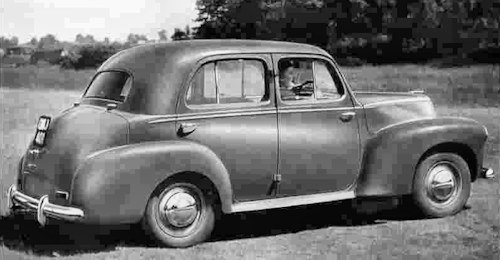
Vauxhall
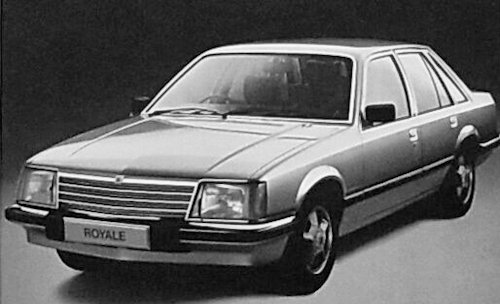
Vauxhall Royale
 |
|
|
Production period: |
1978 to 1983 |
|
Body versions: |
Saloon, Coupe |
|
Engines: |
Gasoline: 2.8-3.0 litres |
|
Length: |
192 in, 488 cm,Coupe 187.30 in. 476 cm |
|
Width: |
68 in, 173 cm |
|
Wheelbase: |
105.60 in, 268 cm |
|
Curb weight: |
1335-1430 kg |
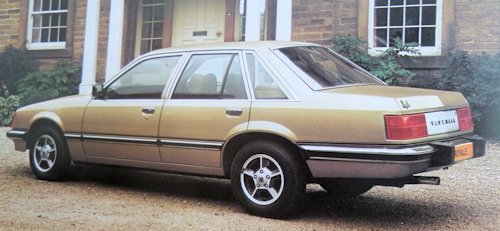
Flagship of the Vauxhall ranger similar in appearance to Opel Senator but powered by 2.8-litre carburettor-equipped instead of 3-litre fuel-injected engine. Available as four-door saloon or three-door hatch coupe.
History
The saloon is based on the German Opel Senator, and the hatchback on the Monza Coupé, both models coming complete with power-steering, automatic transmission, central door locking, sunroof, electric windows, and headlamp wash/wipe equipment. The hatchback has a folding rear seat, making it a useful as well as a fast-sporting coupé. Replacing the VX series, the Royales became the Flagships of the Vauxhall fleet. Apart from the different grille, the interior has individual Vauxhall features, including a different instrument panel. Great care is taken to ensure silence and refinement, including injection of foam into body box sections.
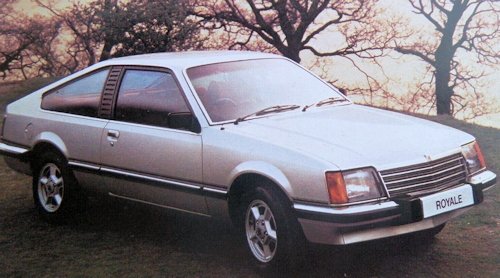
The three-door Coupe model was also offered asides the saloon. Introduced in October 1978 and assembled in Germany. assigned partly to the upper middle class, but partly also to the upper class. Body and technology were derived from the record E (Senator A) and Omega A (Senator B). A successor to Senator B was no longer developed due to the low sales figures.The Smaller-engine of two coupe versions of top Royale model the 2800 Vauxhall model, also available in 3-litre fuel-injected form and supplementing four-door saloon models, all based still based on Opel Senator/Monza range the Opel’s sell only with a 180 bhp fuel-injected 3-litre engine and the Vauxhalls with a 140 bhp carburetted 2.8 litre engine. As on the Opel’s, automatic transmission is standard but a manual gearbox is available to special order at no extra cost.
Royales only come as one version, with a lavish equipment list that is barely matched by even the most expensive versions of its rivals. The Royale's 2784 cc straight-six engine with a seven-bearing crankshaft, and block and head of iron it operates the in-line valves via short pushrods and rockers. Vauxhall's own top speed figures of 113 mph. with 140 bhp (DIN) at 5,200 rpm and 161 1b ft of torque at 3,400 rpm, with single twin-choke carburettor fitted with an automatic choke. The use of a single carburettor to supply fuel to six cylinders is not good fuel distribution,explaining why the Royale's poor fuel consumption at 17.6 mpg, even allowing for the automatic transmission which would give a theoretical range of 350 miles on the 16.5 gallons required to fill the Royale's tank the Royale does not have the luxury of electronic ignition untill later on the 3.0L.
- PERFORMANCE 2.8L
max speed: 113 mph, 182 km/h
max power (DIN): 140 hp (103 kW) at 5,200 rpm
max torque (DIN): 161 1b ft, 22.2 kg m (218 Nm) at 3,400 rpm
max engine rpm: 6,150
50.3 hp/l (37.4 kW/l)
power-weight ratio: 21.8 lb/hp (29.5 lb/kW), 9.9 kg/hp (13.4 kg/kW)
acceleration: standing 1/4 mile 18.3 sec, 0-50 mph (0-80 km/h) 8.5 sec
Fuel consumption: 19.3 m/imp gal, 16.1 m/US gal - Royale Coupé 2.8L
max speed: 115 mph, 185 km/h
power-weight ratio: 21.8 lb/hp (29.5 lb/kW), 9.9 kg/hp (13.4 kg/kW)
acceleration: 0-50 mph (0-80 km/h) 9 sec. - PERFORMANCE 3.0L
max speed: 130 mph, 210 km/h Coupe 134 mph, 215 km/h;
power weight ratio: 17.1 lb/hp (23.8 lb/kW), 7.7 kg/hp
max power (DIN): 177 hp (127 kW) at 5,800 rpm
max torque (DIN): 182 1b ft, 25.1 kg m (246 Nm) at 4,800 rpm
59.6 hp/h (42.8 kW/l)
acceleration: 0-50 mph (0-80 km/h) 9 sec.
Transmission: Single-disc diaphragm clutch and four-speed manual gearbox or three-speed automatic transmission. Rear-wheel drive,GM's automatic transmission as fitted to the Royale the gear selector generally has a light and pleasant action it provides the smooth gearchanges, up and down. Although it is not difficult to spin the rear wheels in first gear on a wet road even if you accelerate hard from standstill to achieve full-throttle kickdown you have to push your foot to the floor.
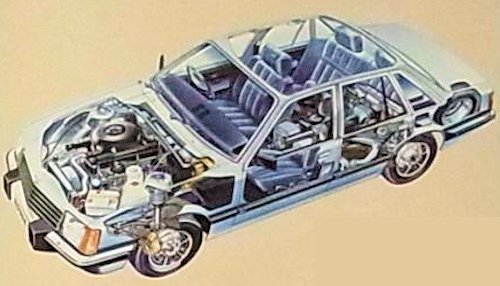
The Royale's straight forward suspension, is nothing unusual with the use of MacPherson strut coil-spring suspension at the front and coil-sprung semi-trailing arms at the rear, along the use of power assistance recirculating ball steering gives precise feel. Front, independent with MacPherson struts. coilsprings, telescopic shock absorbers and anti-roll bar. Rear.independent with trailing arms, coil springs, telescopic shock absorbers and anti-roll bar,
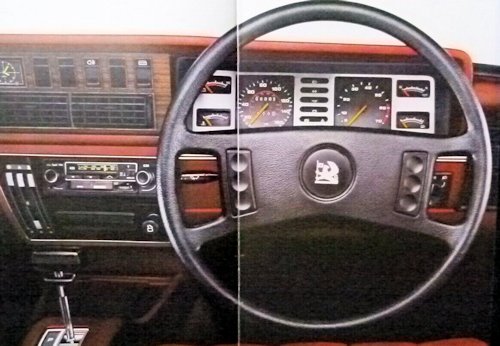
The interior has good size locker, trays on the transmission tunnel, and a pair of front door bins.The amount of legroom available depends not only on the seats' fore/aft settings but also on the height settings, at their highest setting leaves sufficient room for tall rear passengers and Headroom is plentiful. The well-shaped boot with 14.2 cu ft. A two-speed plus intermittent wiper and giving four automatic sweeps of the wipers when the washers are employed, and incorporating headlamp washers for poor weather. The Royale, which has a tilt-adjustable steering wheel only a single column stalk is provided, which controls dip/flash, wash/wipe and indicator, height-adjustable seat, and variable adjustment for the backrest angle. All the major controls are sensibly located in relation to one another, while the seats themselves are well cushioned. The lights switch is a rotary knob on the facia also switches on the interior light when it is pulled out. Switches for the electric windows are located on the transmission tunnel by the gear-lever.
Standard equipment includes alloy wheels, tinted electric window lifts, sliding roof, tinted glass. velour upholstery and head restraints.
With the Royale's instrumentation under a single reflection-free pane of glass display large, calibrated dials for the speedometer and tachometer incorporating a push-to-reset trip odometer, the latter being red-lined at 6,200 rpm with an orange sector starting at 5,800 rpm voltmeter and water temperature gauge to the left along with oil-pressure and fuel gauges additionally a clock on the facia. Four vertical slide controls for heating system; one for temperature; two for flow volume to the floor and screen and the fourth for the fan, which has a variable speed control. Apart from the floor and screen vents, there are also two vents at each end of the facia which can be used to demist the side windows or direct heated air towards the front seats. Fresh air at ambient temperature is provided through two central face-level vents and can be fan boosted.
Vauxhall Carlton Mark I
 |
|
|
Production period: |
1978 to 1986 |
|
Body versions: |
Saloon, station wagon |
|
Engines: |
Gasoline: 1.8-2.2 Liters (66-85 kW) |
|
Length: |
4620-4678 mm |
|
Width: |
1720-1726 mm |
|
Height: |
1470 mm |
|
Wheelbase: |
2668 mm |
|
Curb weight: |
1145-1305 kg |
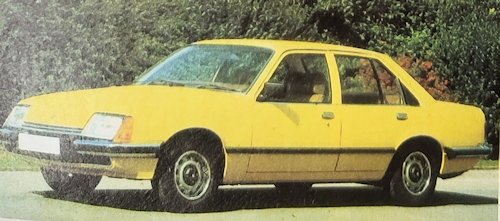
The first-generation Vauxhall Carlton was introduced in late 1978 as a replacement for the Vauxhall VX. The Carlton replaces the old VX (formerly Victor) range, and is of the “upper middle class" category; with its 2-litre engine, generous accommodation for five in its four-door body, and above-average boot space.
History
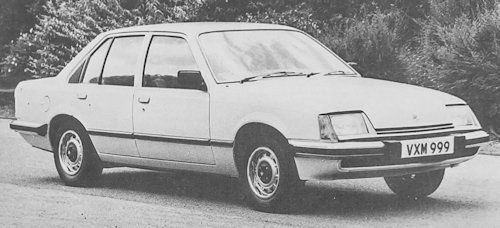
The Vauxhall Carlton offered in the United Kingdom from the end of 1978 to the spring of 1994. It was based on the contemporary Opel Rekord, but had the typical for Vauxhall "Droop snoot" (between the headlights lowered front end) and thus no conventional grille.
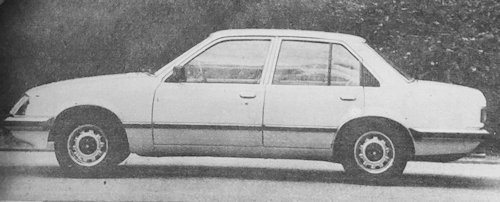
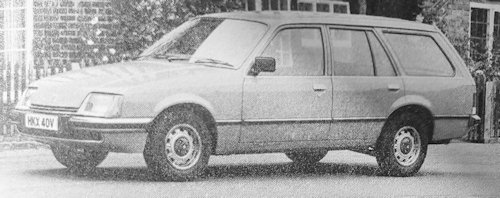
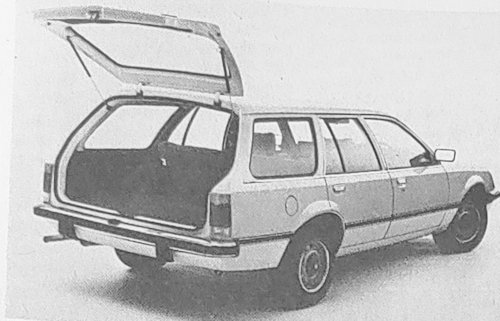
The cars were available as a sedan or estate with rear-wheel drive and a large, comfortable interior (initially only in "L" equipment). The drive was a four-cylinder engine with 2.0-liter displacement and carburettor, which gave the car sufficient power and was characterized by smoothness and economy. The 1979cc engine performs well has appeared in various body’s including the Cavalier since it was introduced Although it originates from the smaller engines, it has a different block, by the increased bores with the camshaft mounted high in the head and operating the valves via short pushrods, hydraulic tappets and rockers. With a 9.0:1 compression ratio, the power output is 100 bhp (DIN) at 5,200 rpm; the peak torque, of 116.5 1b ft (DIN) at 3,600 rpm. Fitted with a 14.8-gallon fuel tank, for which four-star petrol with a minimum octane rating of 97 is recommended.
- PERFORMANCE: 2.0L
max power (DIN): 100 hp (73.6 kW) at 5,200 rpm;
max torque (DIN): 116.5 1b ft, 16.1 kg m (158 Nm) at 3,600 rpm
max engine rpm: 6.000 50.5 hp/l (37.9 kW/l)
max speeds: (I) 29 mph, 48 km/h; (II) 51 mph, 82 km/h; (III) 80 mph, 129 km/h; (IV) 107 mph, 172 km/h
power-weight ratio: 33.7 lb/hp. (32.4 lb/kW), 11.4 kg/hp (14.7 kg/kW)
carrying capacity: 1,036 1b, 470 kg
acceleration: standing 1/4 mile 18.5 sec, 0-50 mph, (0-80 km/h) 8.5 sec
Fuel consumption: 24.4 m/imp gal, 20.3 m/US gal, 11.6 1 x 100 km.
There were some interesting extras, such as central locking, alloy wheels and power windows, which was exceptional for a large-scale model in the late 1970s.Both design and construction are better than ever they were now that Luton has swapped American influence for German authority with close links with Opel been highly beneficial to both companies. But Vauxhall still has retained its own, distinctly British character and history. So, the Opel Rekord and Vauxhall version is called the Carlton. Two largely similar models under different labels. Not only do the two models look different, but there are enough changes in specifications for them to appeal to different customers but the Carlton is mechanically identical but a restyling job by Wayne Cherry recognisably a droop-snoot Vauxhall so the aerodynamics have been improved in the Carlton, yet which uses most of the same panels the Carlton also differs from the Rekord by its more wrap-around bumpers. While the overall length is greater than that of the old VX 2300, this is all accounted for by increased overhang mainly due to the large rubber overriders the wheelbase, is unchanged.
The GM four-speed gearbox is a good strong unit and it gives rapid changes. The clutch is also smooth through the gears. For the suspension the Carlton is also fitted with MacPherson strut front suspension in conjunction with an anti-roll Bar and independent brake reaction arms. The rear fitted with a Panhard rod, and live axle by four trailing links the coil springs are mounted on the lower links, ahead of the dampers.
Good use has been made of interior space. There are other internal differences between the two cars. The line of the facia surround, the seams in the door trim panels are horizontal in the Carlton, whereas they are vertical in the Opel. The seat cover material is different type of velour and the steering wheel has two rather than four spokes. The seats are comfortable with variable backrest angle adjustments, in addition to the lockable glove box, there are bins in the front doors and a pair of trays in the central console. There is a single, centrally-mounted ashtray in the front, and others in each of the rear armrests. The wide doors allow easy access, and there is generous room for four or even five adults. with the front seats whose head restraints are adjustable fully rearwards, there is plenty of knee room in the back and adequate headroom. A rear central armrest is fitted as standard.
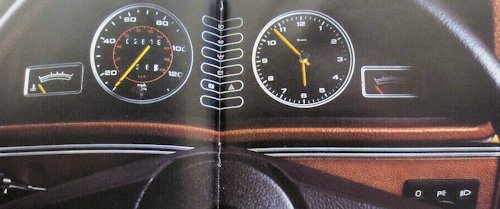
The boot is easy to load and 12.4 cu ft capacity The large glass window area enables excellent visibility on the move. Large door mirrors give an excellent view of the road behind. The two-speed wipers do not lift, even at high speed, but they leave an unwept area near the offside pillar. Fitted with powerful halogen headlamps the main lights switch is a wheel on the facia (which is also used to turn on the interior light) and back window is quickly cleared away by the rear screen heater. The horn button is in the centre of the steering wheel. The usual single multi-function stalk with Twisting functions operates the wipers, indicating, dipping and flashing the headlamps, also operating the screen wash. the instrument panel features a large speedometer separated by large clock and warning lights, and with gauges for water temperature and fuel level to either side behind a single curved pane of glass which eliminates reflections.
The heating and ventilation slide controls are mounted to the left the central console thermostatically-controlled powerful fan boost.The amount of air admitted to footwells and demisting the side windows. There were also extended and more powerful models based on the Carlton and record. Directly above, the Vauxhall Viceroy - almost identical to the Opel Commodore - placed, and above the Vauxhall Royale - an Opel Senator - and its coupe variants Vauxhall Royale coupe, or Opel Monza. Of the latter, the Opel versions in the UK but were more widespread than their Vauxhall counterparts.
By late 1982 carried facelift accounted for the typical for Vauxhall "Droop snoot" and the rectangular radiator grille was the Opel type. At this time, the marketing of Opel models was discontinued in the UK, as it was apart from the emblems, no differences to Opel. During the revision, as in the record E, additional engines were introduced: a 1.8-liter R4 petrol engine and a 2.3-liter R4 diesel engine. Also introduced in addition to the entry-level variant "L" as a further equipment lines "GL" and "CD”. In 1984, a 2.0-liter in-line four-cylinder injection engine, which was replaced in 1985 by a 2.2-liter.
- PERFORMANCE: 1.8L
max power (DIN): 90 hp (66 kW) at 5,400 rpm;
max torque (DIN): 106 1b ft, 14.6 kg m (143 Nm) at 3,000-3,400 rpm
max engine rpm: 6,000; 50.1 hp/l (36.7 kW/l)
max speed: 107 mph, 173 km/h - Estate Car 104 mph, 167 km/h
power-weight ratio: saloons 27.3 lb/hp (37.3 lb/kW), 12.4 kg/hp (16.9 kg/kW)
Fuel consumption:: 35.8 m/imp gal, 29.8 m/US gal - PERFORMANCE: 2.0L Injection
max speed:116 mph, 187 km/h
power-weight ratio: 22.9 lb/hp (31.2 lb/kW), 10.4 kg/hp (14.1 kg/kW)
Fuel consumption:32.2 m/imp gali 26.7 m/US gal, 8.8 1 x 100 km at 75 mph, 120 km/h.
max power (DIN): 110 hp (81 kW) at 5,400 rpm
max torque (DIN): 120 1b ft, 16.5 kg m (162 Nm) at 3,400 rpm - PERFORMANCE 2.3L (diesel)
max power (DIN): 71 hp (52 kW) at 4,400 rpm
max torque (DIN): 99 1b ft, 13.7 kg m (135 Nm) at 2,400 rpm
max engine rpm: 4,600; 31 hp/l (23 kW/l)
max speed: Saloon 99 mph, 160 km/h - Estate Car 95 mph, 153 km/h
power-weight ratio: Saloon 39.4 lb/hp (53 lb/kW), 17.9 kg/hp (24 kg/kW)
Fuel consumption: Saloon 37.7 m/imp gal,75 mph, 120 km/h - Estate Car 35.3 m/imp gal at 75 mph, 120km/h.
Vauxhall Chevette HS and HSR
 |
|
|
Manufacturer |
Vauxhall Motors |
|
Production |
1976 to 1980 |
|
Assembly |
United Kingdom |
|
Class |
Sports car |
|
Body style |
3-door hatchback |
|
Engine |
4-cylinder 2279cc. |
|
Transmission |
5-speed manual |
| Length | 157.2in. (3993mm). |
| Width | 62.2in. (1580mm). |
| Height | 53.6in. (1362mm). |
| Wheelbase | 94.2in (2395mm) |
The Vauxhall Chevette HS and HSR was a three-door 4 seat hatchback introduced as Vauxhall's first homologation special, equipped with a larger in-line four-cylinder engine than that of the regular series.
History
In 1976, Vauxhall now part of GM (General Motors) decided to enter the popular international rallying. The rally developed version built in conjunction with Blydenstein Racing with a works version of the Vauxhall Chevette in order to compete in international rallying as with other manufactures 400 production vehicles needed to be made available for public sale to meet the be homologated Group 4 regulations. The Rally Chevette 2300HS is a name to be reckoned with in international events. And the Chevette 2300HS, although sharing many features of its rally counterpart, has all the refined road manners essential for a thoroughly practical car required for everyday use.

Chevette HS. 1976-79 (produced: 400).
In January 1978 the Chevette HS three-door hatchback was introduced Vauxhall's first pure 'homologation special', intended as an Escort-beater and often succeeding.
Road cars had special 16-valve twin-cam cylinder heads 2,279-cc. slant-four engine, The 4-cylinder 2279cc (139.2 cu. in) engine is built in a special assembly area. It features twin overhead cams and 16-valve aluminium head.It produces and is capable to develop up to 240bhp, and the flat torque curve is an indication of the engine's easy pulling power throughout the speed range.
Vauxhall designed and Getrag five-speed close-ratio gearboxes, though early rally cars used lotus heads and ZF 'boxes, with synchro on all gears, comfortably handles all the available torque. The heavy-duty clutch, being mechanically actuated by cable, gives a positive response but still light in operation.These rally cars used the Lotus 16-valve head Fitted with two Stromberg carburettors the engine developed 135 bhp. The Standard-16-vaIve, twin-camshaft 2279 cc engine with twin 175 CD carburettors

PERFORMANCE
- max speed: 115 mph, 185 km/h
- power weight ratio: 14.5 lb/hp (19.7 lb/kW). 6.6 kg/hp (8.9 kg/kW).
- max power (DIN): 135 hp (99.3 kW) at 5,500 rpm
- 59.2 hp/l (43.6
Exceptional braking efficiency is a feature shared by every Chevette. On the Chevette 2300HS, Vauxhall specify extra width 9.6 in diameter discs at the front and wide 9.0 in diameter self-adjusting drums at the rear. There are dual circuits and the entire system is servo-assisted.
Balanced handling the high performance Chevette 2300HS features rally-tuned suspension, independent front suspension with coil springs, long and short wishbones, and at the rear, a live axle with coil springs. Add to this set up anti-roll bars front and rear, plus heavy duty shock absorbers all round, and the result is exceptionally taut handling and outstanding road adhesion.
Steering is rack and pinion with only 3-5 turns lock to lock and a tight 30.2 ft turning circle. The small, 13-5 in diameter padded steering wheel with leather rim,combines with an energy-absorbing steering column.
Structure basically as bread-and-butter Chevette hatchbacks, but drive line all special, meticulous attention to aerodynamics to exploit the performance potential resulted in the ducted air dam and rear spoiler on a shape that was already highly efficient. Result is exceptional straight line stability and a low drag coefficient. with wide-rim alloy wheels plus full glass-reinforced plastic front air dam, and rear spoilers and uprated brakes and suspension. 135bhp and 120mph flat-out for 1978 was appealing, but the HS was not refined enough to attract larger sales
Inside additional instrumentation and black and tartan interior sports trim. All factory HS's were painted Silver Starfire metallic. with red decals.The interior styling treatment also reflects a highly individual approach and a driving set up that ensures everything is to hand, including the push-button radio fitted as standard equipment. Keen drivers will also appreciate the pedal spacing and height, which allow for comfortable and precise heel-and-toe operation.

Reclining front seats with head restraints Inertia reel front seat belts Contoured, cloth-trim seating Leather-rim sports steering wheel with Ignition steering column lock. Fitted carpeting Fold-down rear seat Carpeted load deck Extensive sound insulation Deep front parcel shelf Front armrests Matt-black door release levers and window winders. Twin sun visors Cloth-trim door panels with carpeted kick-pads Front and rear ashtrays Coat hook Rear view mirror.Fresh air heater with 2-speed blower fan Adjustable face level fresh air vents.Through-flow ventilation Opening rear quarter vents Heated rear window.
Instrument binnacle with speedometer, tachometer, clock, warning lights for alternator, oil pressure, main beam and direction indicators, 2-speed wipers with flick-wipe Electric screenwash handbrake-on and brake fluid loss.Single stalk control for headlamp dip/flash, horn, turn indicators.Centre console with integral oil pressure, water temperature and fuel gauges plus battery condition meter Push-button radio.
Metallic silver is the standard finish with Acrylic lacquer for the 2300HS, complemented by bright red side window frame mouldings, waist level 'strobe stripes' and large Vauxhall rear decal rectangular headlamps with halogen bulbs integral steel-reinforced front bumper . Other distinguishing features include tinted glass, twin door mirrors and 6j alloy road wheels with 205 /60HR radials.Full underbody seal and body protection process.
Chevette HSR. 1979-80 (produced: 50).

To maintain competitiveness even in the eighties an evolution was prepared, the Chevette HSR. The HS has great rally success with wins for drivers such as Jimmy McRae and Tony Pond the HSR was the 'evolution' of the HS, purely for rallying use most of the 50 built actually being converted unsold HSS or uprated and modifying customers vehicles. In any case this was still successful for several more years. Basically, as HS, but with more extrovert styling which included flared wheel arches and side skirts, plus twin-plate clutch, revised back axle location, wider-rim wheels and 150bhp Rougher, rortier, less civilised even than that of the HS, but Vauxhall didn't care they had an even better rally car from 1980 to 1983, better than Escort RS or Sunbeam-Lotus in most conditions The Chevette HSR project was dropped in favour of the Manta 400 for more Europe sales as Opel.

Vauxhall Ten 10-Four
 |
|
|
Manufacturer |
Vauxhall |
|
Production |
1937–1940 and 1946–1947 |
|
Class |
Motor Car |
|
Layout |
Front-engine, rear-wheel-drive |
|
Engine |
1203 cc ohv I4 34.5 bhp (1937–1940) |
|
Transmission |
3-speed manual |
|
Wheelbase |
94 in (2,388 mm) (1937–1940) |
|
Length |
155.5 in (3,950 mm) (1937–1940) |
|
Width |
61 in (1,549 mm) |
|
Curb weight |
2,016 lb (914 kg) |
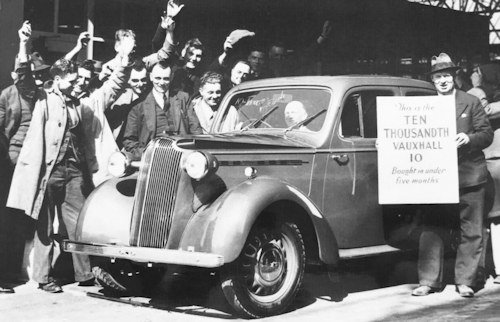
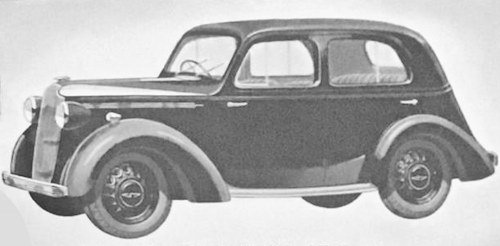
The Vauxhall Ten or Vauxhall 10-Four H-type is a low range small British sedan that was built pre and post war from 1937 to 1947.
History
The Vauxhall Ten as a Standard or Delxe body Saloon first shown at the 1937 London Motor Show and also built in Australia as the HIY. However, the Second World War intervened and in 1940 the Luton plant was converted for the production of tanks and military trucks, so that the Ten could no longer be manufactured from this date but still with a large production produced up to 1940 of around 50,000. The name of the car corresponds to the taxable horsepower which then defined the class in which the car competed against its competitors. These were as the Morris Ten, Standard Ten and the Ford Ten Junior.
A key structural innovation was the self-supporting body, which was used by Vauxhall after the pattern of the 1935 Opel Olympia, the Vauxhall Ten became known in the company as the million-pound car, which reflected the extent of the company's investment in tooling for the new model to ensure a long production time and high production figures of future cars. The co-ordination of frame and body to give a structure which is not only of exceptional light- ness, thus assisting to give a lively and economic performance, combined with more body space, but is also allied with a structural strength equal to that of the conventional separate chassis frame and body construction. The chassis frame and body are integral with the exception of a short sub-frame' which supports the engine and front suspension units. This sub-frame is of welded steel construction, consisting of six- principal members, which include two channel section side members and two main cross members welded together. Forward extensions of the main cross sections are welded to the side members to form a hollow box section. The body itself is built with an inherent strength supplied by steel pressings so welded together to give a triangulated box girder construction not only along the base of the body as with a normal chassis frame, but also round the sides of the roof also. Transverse strength is obtained by box section girder welded to' the underside of the body and a perforated girder con- struction pressing welded into position and acting as a support for the front of the rear seat. Additional strength is supplied to the front of the car by tubular supports mounted toward s the forward end of the sub-frame and terminating at the base of the windscreen pillars, so forming a triangulated' construction between sub-frame and body.
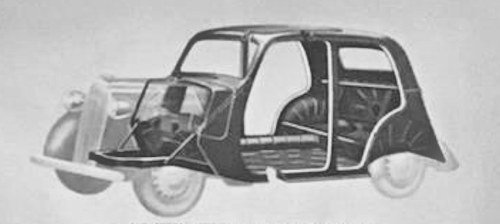
Independent torsion bar front-wheel suspension, bodying special coil spring and lever compensators and double-acting shock absorbers, with the suspension units. All operating and there are no lubrication points. Rear suspension is by long semi-elliptic springs of conventional type, with rollers between the tips of the longer spring leaves to reduce friction and prevent squeak, and single-acting hydraulic shock absorbers. They are specially calibrated to meet the requirements of the car, and in combination with the front suspension, ensure an equally comfortable "Silentbloc" rubber bushes are' fitted to all rear spring shackles.
The Gearbox has three forward speeds and reverse. Helical cut gears and splines throughout for silent operation. Vauxhall controlled synchromesh. Silent constant mesh type second speed. Central ball gear change. Open tubular propeller shaft with needle roller bearings to both front and rear universal joints. Single dry-plate clutch with flexible centre for smooth engagement. Ball thrust clutch withdrawal mechanism for ease and silence. Clutch operation effected through a flexible chain to obviate engine movement on the rubber mountings being transmitted to the clutch pedal. Rear axle Semi-floating type. Spiral-bevel gears with straddle- mounted bevel pinion for strength and quietness. Detachable forged steel hubs keyed to tapered ends of axle shafts. Rear axle anchorages to springs insulated by means of rubber pads. Detachable ventilated disc-type wheels and 4.50 x 17 medium-pressure tyres. Large easily detachable plated hub covers.
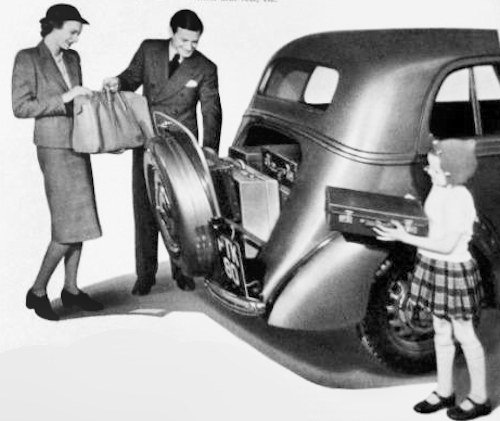
Inside the interior, body space allows generous rear seats accommodation for two adult passengers and a child, with ample leg room. The front seats, upholstered in leather, are of special "body conformity" design, and the whole of the body is made "drum-proof" and draught-proof and fume-resisting insulator is fitted as a bulkhead between the engine and body. The front windows are of Vauxhall '(No-draught" design, allowing passengers to control the amount of air entering or leaving the windscreen wipers Noiseless and reliable mechanical twin wind screen wipers are also driven from the engine camshaft. The steering Burman-Douglas worm-and-nut gear, all parts being of robust construction and having oil-bath lubrication with filler-plug replenishment; 3-spoke steel-core steering wheel with vulcanised rubber finish. Horn button integral with steering-wheel boss, and trafficator
switch and self-cancelling gear mounted on side of steering column for easy manipulation.
The Lockheed hydraulic brakes operating on all four wheels. brake shoes per drum with linkage arranged to produce semi-servo action on leading shoe, giving increased brake efficiency. The brake drums are of malleable iron, heavily ribbed on the exterior, and brake adjustment is achieved through a hole in the outer face of the brake drums, and can be performed via the hub covers without removing the road wheels. The hand-brake operates the same shoes as the foot-brake on the rear wheels only, by means of flexible steelebles. The hand-brake lever and ratchet are situated on the right-hand side of the instrument panel below the instrument board, within easy reach, but without impeding access to the driver's seat.
The performance of the Vauxhall Ten was stated in 1937 with 34 bhp (25 kW). It was originally released briefly in 1946 with the same ohv motor with 1203 cc capacity as before the war, but with lower power (and presumably lower compression due to poor fuel quality). Otherwise, the post-war model differed only slightly from the pre-war Vauxhall Ten. The British consumers, who had little money after the war, did not want small pre-war limousines, so the car did not succeed.
Vauxhall Velox LIP
 |
|
|
Production period: |
1948 to 1951 |
|
Class |
Motor car |
|
Body versions: |
Touring car, Saloon |
|
Engines: |
Petrol: 2.3 litres |
|
Length: |
4178 mm |
|
Width: |
1575 mm |
|
Height: |
1600 mm |
|
Wheelbase: |
2483 mm |
|
Curb weight: |
1029 kg |
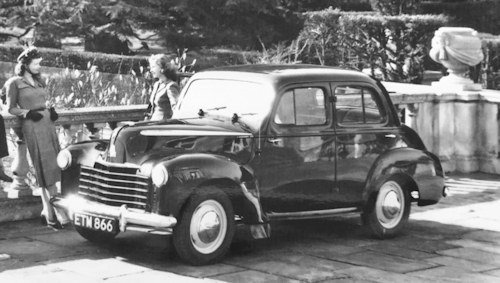
The Vauxhall Velox LIP model is a post war saloon from the late 1940s to the early 1950s.
History
The Vauxhall Velox was built as the successor of the Vauxhall 20 hp. The four-door sedan has a light weight body made possible by the type of construction and the reduction of wind drag by the new styling bonnet flutes, " V " fronted, low and broad grille, composed of six horizontal slats which are chromium plated. With good fuel economy with petrol consumption of 25-28 m.p.g. with normal driving and good performance The Velox has the bumper over-riders and fitted with cream wheels with embossed hub-caps. This version has a newly developed 6-cylinder OHV in-line engine with 2275 cc and 54 bhp (39.7 kW) now with 12-volt Ignition.
The Vauxhall was one of the first British cars to adopt full body/chassis integral construction, and since 1937 all models have been of this chassis less type. The one-piece steel roof completes the all-welded structure of great rigidity and yet of light weight, a steel bulkhead between the body and luggage boot stiffens the rear structure. The car reaches a top speed of 119 km / h. Transmission is by an open Hardy Spicer shaft to a spiral bevel rear axle.
In the same bodywork, the Vauxhall Wyvern was offered with a smaller engine. Independent front suspension is torsion bar and tube type with inbuilt double acting hydraulic shock absorbers. The rear semi-elliptic, underslung springs are encased in gaiters and with double acting shock absorbers. The brakes are drum and over 100 square inches of lining area with Vauxhall designed shoes and Lockheed hydraulic operation.
Inside the Velox is upholstered in leather Both front seats are of the single full-width type and fully adjustable. Also, a centre folding armrest to the rear seat and side arm slings. The installing a radio and car heater are options switch-operated screen wipers are self-parking, upon being switched off. The one-piece bonnet is locked from within the car, and can give very easy access to the engine for maintenance.
As well as being built at Vauxhall's Luton plant in England, early Velox and Wyvern models were assembled by Holden Australia and in New Zealand at the GM plant. In Australia, there was also a touring car in addition to the sedan.