
Vanden Plas
- Details
- Parent Category: V
- Category: Vanden Plas
- Hits: 25
Vanden Plas Princess 4 Litre limousine
 |
|
|
Make: |
BMC |
|
Production period: |
1960-1968 |
|
Class : |
Luxury car |
|
Body versions : |
Pullman limousine |
|
Engines: |
Gasoline: 4.0 liters (88 kW) |
|
Length: |
5461 mm |
|
Width: |
1842 mm |
|
Height: |
1770 mm |
|
Wheelbase : |
3353 mm |
|
Curb weight : |
2121 kg |
|
successor |
Daimler DS420 |
The Vanden Plas Princess 4 Litre was a four-door luxury limousine Pullman and sedan of the British Motor Corporation (BMC) from 1960 to 1968.
History
The Vanden Plas Princess 4 Litre is a long wheel base limousine and saloon which came to the market in 1960 as the successor to the Austin model Princess IV by dropping Austin from the name enabled the Nuffield dealers to sell the Princess, so in 1960, this larger Princess became the Vanden Plas Princess but not to be confused with the Vanden Plas Princess 4 Litre R which has the body of the Vanden Plas Princess 3 litre,this was part hand built for various options.
The Vanden Plas Princess 4 Litre limousine came with a more luxurious high-end body than the 3-litre princess used for diplomates and often Chauffeur driven with 6 and up to 8 seat options.From the previous model, the car took over the body without significant stylistic changes. However, the wheelbase and vehicle length were significantly increased. The six-cylinder inline engine with 3993 cc displacement was also from its predecessor, its performance was only 120 bhp.

The car with options such as a Rolls-Royce automatic gear box. hydraulic torque convertor and planetary gears with 4 ratios and power-assisted steering, 3.5 turns of steering wheel lock to lock;plus selectaride electrically controlled rear dampers, short or long wave radio options.
The performance with a top speed of 98 mph, 157.8 km: h;. The gas consumption was 14.1 m/imp gal, 11.8 m/US gal a max power (DIN) of 120 hp at 4000 rpm and the max number of engine rpms: 4500.
PERFORMANCE:
max torque (SAE) 185 1b (t, 258 kqm at 2000 rpm
acceleration: standing mile 20.6 sec, 0-50 mph (0—80 km, h) 11.5 sec
speed in direct drive at 1000 rpm. 19.4 mph. 31 2 km h.
max speed in 1st gear: 15 mph, 24.1 max speed in 2nd gear: 36 mph, 58 km h: max speed in 3rd gear 53 mph. 85.3 km/h; max
speed in 4th 98 mph.
In 1968, the production was discontinued. After the merger of a large part of the British auto industry in the British Leyland Motor Corporation efforts were made to streamline the model program when they were replaced with Daimler DS420 limousines
- Details
- Parent Category: V
- Category: Vanden Plas
- Hits: 25
Vanden Plas Princess MK I 1000 (BMC ADO16)
 |
|
|
Production period: |
1962 to 1967 |
|
Class : |
Motor Car |
|
Body versions : |
Sedan |
|
Engines: |
Petrol :1.1 liters |
|
Length: |
3725mm |
|
Broad: |
1534mm |
|
Height: |
1346mm |
|
wheelbase : |
2375mm |
The Mark 1 Vanden Plas Princess 1000 was models built on the BMC ADO16 chassis from 1963 to 1967
History
The Vanden Plas Princess designates a compact luxury car of the British Motor Corporation (BMC), which was sold under different brand names and type designations. For a time in the 1960s, the ADO16 was the best-selling passenger car in Britain .
This series were manufactured in Great Britain. The car was introduced on August 15, 1962 as the Morris 1100 . The range was then extended to the Vanden Plas Princess 1100 from October 1962.The Introduction of the Vanden Plas 1100 . It is the top-of-the-line model with walnut veneer dashboard and door panels, rear picnic tables and front seats in Conolly leather, Wilton carpeting and West of England cloth headlining.Options such as sliding roof and heated rear window also a twin speaker radio.
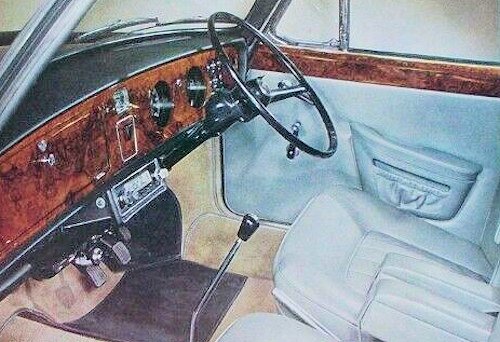
The ADO16 was designed by Alec Issigonis . Pininfarina , the Italian designer who previously designed the Austin A40 Farina for BMC , designed the body. After the successful but unprofitable Mini , BMC needed a larger lower mid-range car. The ADO16 essentially has the drive technology of the Mini: the transversely installed BMC-A motor, which drives the front wheels via a transmission located in the oil sump . Also the chassis with double wishbones at the front and parallel swingarmsrear is similar, but the ADO16 got disc brakes with floating calipers.
It was the first car to receive the Hydrolastic suspension devised by Alex Moulton - a hydraulic coupling of the front and rear wheel suspension on each side of the car, with all the arms of the wheel suspension being mounted in rubber. The wheels on one side were mechanically connected and shared a spring unit. As a result, body roll was less than what the very soft suspension would suggest, but at the expense of a greater tendency to pitch. With the Hydrolastic system, in which the spring elements on the same side of the vehicle are connected to each other with hose lines, pitching is greatly reduced by damping valves in the connecting line.
The original Mark I models (1962–1967) can be recognized by the almost vertical tail fins with the small rear light units. Promotional brochures highlighted the spacious interior compared to 1964 UK competitorsThe under-engine gearbox, which also shared the oil supply with the engine, featured four forward gears, the top three of which were synchronized. From November 1965 there was a four-speed automatic from Automotive Products (AP).
PERFORMANCE ENGINE CAPACITY 1100 (67 cu in, 1,098 cu cm)
FUEL CONSUMPTION 35,3 m/imp gal. 29.4 ml us gal, 8 x 100 km
MAX SPEED 87 mph. 140.1 km/h
max power (SAE): 59 hp at 5,500 rpm
max torque (DIN): 61 1b ft. 8.4 kg m at 2,750 rpm
max number of engine rpm: 6,400
power- weight ratio: 32.2 lb/hp, 14.6 kg/hp
acceleration: standing 1/4 mile 21.9 sec, 0—50 mph (0—80 km/h) 14.4 sec
max speeds: 28 mph, 45.1 km/h in 1st gear; 49 mph, 78.9 km/h in 2nd gear; 69.5 mph, 111.9 km/h in 3rd gear; 87 mph, 140.1 km/h 
- Details
- Parent Category: V
- Category: Vanden Plas
- Hits: 24
Vanden Plas Princess 3-litre Mark II
 |
|
|
Manufacturer |
BMC |
|
Production |
1959 to 1964 |
|
Designer |
Pininfarina |
|
Class |
Luxury car |
|
Body style |
4-door saloon |
|
Layout |
FR layout |
|
Engine |
2.9 L C-Series I6 |
|
Wheelbase |
86 in (2,184 mm) |
|
Length |
187.75 in (4,769 mm) |
|
Width |
68.5 in (1,740 mm) |
|
Height |
59 in (1,499 mm) |
|
Dry weight: |
3416 1b, 1549 kg |
The Vanden Plas Princess 3 Litre series II was a four-door sedan of the British Motor Corporation (BMC), which they manufactured under the traditional name Vanden Plas 1961 to 1964.
History
The Princess 3 Litre Mark II from 1961 with the body of Pininfarina in the style of the Austin version .This replaced the mark one built from 1959 to 1961. Now with a slightly more powerful engine with 120 bhp (88 kW). The outside dimensions remained the same but used the same chassis and body but a diffrent Vanden Plas style front grille , but the wheelbase was extended by 2 "(51 mm) and anti-roll bars were added to the suspension front and rear and improved brakes. As a result, the inner fenders were not so far in the interior, and there was more space available inside.

The interior was typical Vanden Plas luxurious in style, with built-in drop-down picnic tables for the rear seat passengers , high-quality carpeting burr walnut wood trim , leather seats and door panels. Options of rear divider and air-conditioning. axle ratio of 3.545:1,power-assisted steering and Borg-Warner automatic gear box.
Vanden Plas Princess 3 Litre series II was powered by BMC's 3-litre engine, developing 126 hp and top speed of 105.6 mph, 170 km h; with fuel consumption of 20 m/imp gal, 16.7 m US gal, 14.1 1 x 100 km .
PERFORMANCE:
ENGINE CAPACITY: 178.10 cu in, 2912 cu cm;
max power (SAE): 126 hp at 4750 rpm; max torque (SAE): 163 1b ft, 22.5 kgm at 2750 rpm
max number of engine rpm: 5600
max speed in overdrive: 105.6 mph, 170 km/h
power-weight ratio: 27.1 lb/hP, 12.3 kg/hp
acceleration: 0-50 mph (0—80 km/h) 11 sec
speed in direct drive at 1000 rpm: 21 mph, 33.8 km/h.
max speed in 1st gear: 37.9 mph, 61 km/h; max speed in 2nd gear: 71.4 mph, 115 km/h; max speed in 3rd gear: 99.4 mph, 160 km/h
This model was discontinued in 1964 and replaced by a new Rolls-Royce powered model the Princess 4 Litre R .

