
Triumph
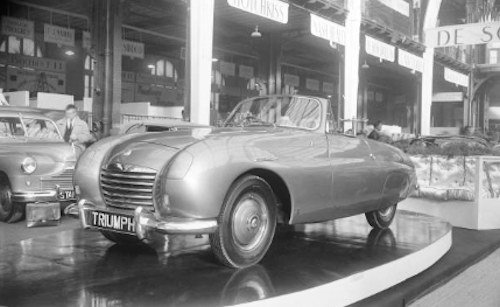
Triumph TR-X Roadster "Silver Bullet"
 |
|
| Manufacturer | Triumph |
|---|---|
| Production | 1950 to 1951 |
| Produced | 3 |
| Class | Prototype Concept |
| Body style | Roadster |
| Engine | 2,088 c.c. |
| Wheelbase | 7 ft. 10 in. |
| Length | 13 ft. 10 in. |
| Width | 5 ft.10 in. |
| Height | 4ft 7 in |
This Triumph TR-X Roadster car was first announced in October 1950 motor shows in Paris and at Earls Court motor shows.
History
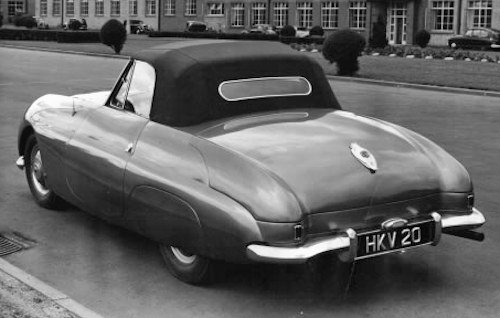
The Triumph Roadster prototypes fitted with light aluminium body panels on a open body mechanically using Renown saloon and Standard Vanguard parts but substantially lower and smoother body shape that features at the front enclosed headlights and air intake with horizontal chromium-plated slats the chromium-plated grill can be quickly detached. The back of the body has opening the locker lid for the luggage space and fuel tank location on the smaller wheel base of 7 ft. 10 in.
This Triumph Roadster incorporated more power actuated components than any previous British car. Those components including: headlights concealed behind shutters automatically opened when the headlights were switched on; windows; An electro-hydraulic motor under the bonnet supplies power for seats with back and forth adjustment along with the folding hood that is also raised or lowered by hydraulic jacks. from the pair of quick-acting clips. via a switch central locking mechanism, and then swinging the cover up by hand through 90 degrees. and radio aerial. Some of the electro-hydraulic mechanisms were concealed between the twin skins of the body along with matched loudspeakers within the walls of the double skin. A deep recess in the scuttle provides accommodation for the battery and heater, supplying air to the interior via ducts behind the windscreen.The doors are hinged at the front and the locks are of push-button type, The hydraulic door windows are also raised or lowered by hydraulic system.
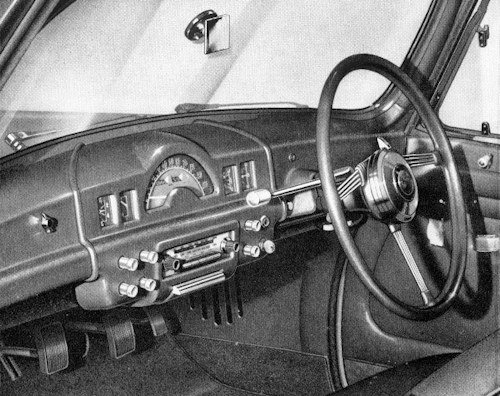
Inside the bench-type front seat using Dunlopillo for the upholstery. fitted with a wide centre armrest .The leather covered facia panel is laid out with central grouping of the instruments Beneath the facia panel a parcels tray runs the full width of the car, the steering wheel is also leather covered,there is a space behind the rear seats which can be used for carrying small cases .
With an higher output 4 cylinder engine, this gave the Triumph Roadster a top speed of 85 m.p.h with engine output of 71 b.h.p at 4,200 r.p.m.,with two horizontal S.U. carburetters an improved version used in the Roadster engine with higher compression ratio.On the Roadster, four speed gearbox is standard equipment the top gear an electrically operated Laycock-de Normanville overdrive with a rear-axle ratio of 4.375 : 1.The brake system features Lockheed 11-in. diameter by 21-in. wide brake drums.
The TR-X was discontinued after only three prototypes had ever been built by 1951.
Triumph GT6 MKIII
|
|
|
|
Manufacturer |
Triumph |
|
Production |
1970 to 1973 |
|
Class |
Sports car |
|
Body style |
2-door fastback |
|
Layout |
FR layout |
|
Engine |
1,998 cc (2.0 L) OHV I6 |
|
Transmission |
4-speed synchromeshed manual with optional overdrive |
|
Wheelbase |
2,128 mm (83.8 in) |
|
Length |
3,785 mm (149.0 in) |
|
Width |
1,486 mm (58.5 in) |
|
Height |
1,193 mm (47.0 in) |
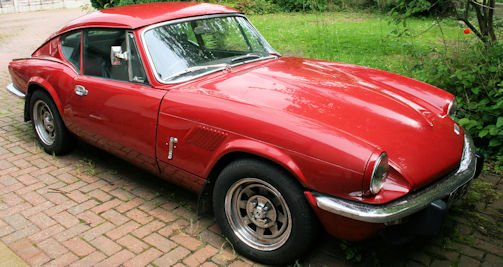
The GT6 Mk3 is a improved 6-cylinder sports car which was built by Triumph. Production ran from 1966 to 1973.The GT6 was based on the popular Triumph Spitfire .
In November 1970, the Mk 3 version took over, With all the same re-style features as the Spitfire Mk IV, namely the squared-off tail, re-skinned nose and integrated front bumper, There were no major chassis changes, but through-flow ventilation in the cabin, and an alloy-spoked steering wheel, all helped, along with different road wheels (no longer Rostyle type). When fitted option, the overdrive was controlled by a slide switch in the top of the gear-lever knob, which was a British motor industry "first". The top speed with improved aerodynamic shape was now up to 112mph and as was the handling in 1973 when the Spitfire-type swing-spring rear suspension took over.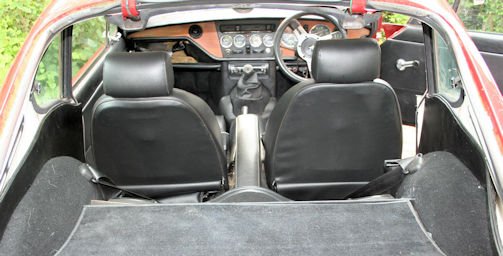
The final major facelift for the GT6 came in 1970, to make the MK3. This time the whole bodyshell was revised to match the changes made to the Spitfire Mk IV; these included a cut-off rear end, recessed door handles and a smoother front end. Only detail changes were made to the mechanics, but in 1973 close to the end of the car's production life the rear suspension was changed again, this time for the cheaper (but still effective) "swing-spring" layout also fitted to the Spitfire Mk IV. This was a modification of the swing axle rear suspension used on the lesser Herald-derived models, with the transverse leaf spring mounted on a pivot, eliminating roll stiffness at the rear, and thus greatly reducing the jacking effect under cornering loads. To compensate for this loss of roll stiffness, a larger front anti-roll bar was fitted. A brake servo was also added in 1973, and seats were changed from vinyl to cloth. There was still a fairly comprehensive options list, but the "knock-on" wire wheels were no longer available. The unladen weight increased slightly to 2,030 lb (920 kg).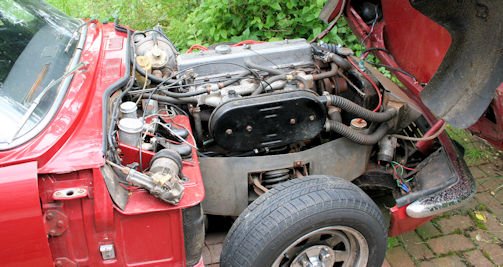
Engine power and torque for the Mk III was similar to the Mk II, but better aerodynamics led to a new top speed of 112 mph (180 km/h) and a 0–60 mph time of 10.1 seconds; this was now comfortably ahead of the MGB GT, which topped out at about 105 mph (169 km/h) and reached 60 mph in approximately 13 seconds. Fuel economy was also improved to 28 mpg-imp (10 L/100 km; 23 mpg-US). The last USA models performed comparatively poorly however, as compression ratios were lowered to accommodate lower octane unleaded gasoline.
The Mk III never sold in the numbers hoped for by Triumph, and was comprehensively beaten in the marketplace by the MGB. Triumph refused to release an official convertible version of the GT6 and, after poor sales, it was dropped from the Triumph range at the end of 1973, although a few cars were sold the following year.
PERFORMANCE
max power (DIN): 95 hp at 5,250 rpm
max torque (DIN): 106 1b ft, 14.6 kg m at 3,000 rpm
max engine rpm: 6,000; 47.5 hp/l
max speeds: (I) 46 mph. 74 km/h: (II) 68 mph, 110 km/h; (III) 96 mph, 155 km/h; (IV) 110 mph, 177 km/h
power-weight ratio: 20.3 lb/hp, 9.2 kg,/hp
acceleration: standing 1/4 mile 18.2 sec, 0-50 mph (0-80 km/h) 8 sec
fuel consumption: 25.7 m/ imp gal, 21.4 m/ US gal, 11 1 x 100 km.
Production ran out at the end of 1973 when it now rationalised its sales to the USA due to changes in emission and safety regulations. Predictably enough, the Mk 3 were the thought to be best of all the GT6s not only because they were fastest; but because they handled best and had the best. ventilation and packaging in the cabin, Well thought of in later years.
OPTIONAL
Laycock-de Normanville overdrive on III and IV (0.787 ratio), with 3.890 axle ratio
wire wheels
servo brake. 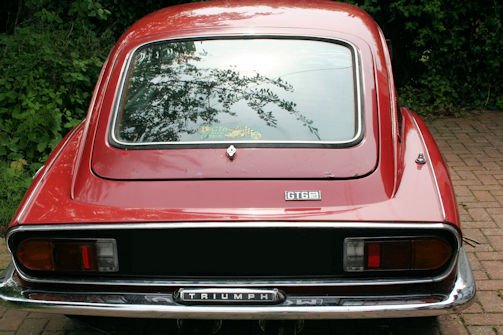
Triumph GT6 MKI
 |
|
| Overview | |
|---|---|
| Manufacturer | Standard-Triumph |
| Production | 1966 to 1968 |
| Class | Sports car |
| Body style | 2-door fastback |
| Layout | FR layout |
| Related | Triumph Spitfire Triumph Herald Triumph Vitesse |
| Engine | 1,998 cc (2.0 L) OHV I6 |
| Transmission | 4-speed synchromeshed manual with optional overdrive |
| Dimensions | |
| Wheelbase | 2,128 mm (83.8 in) |
| Length | 3,717 mm |
| Width | 1,450 mm (57 in) |
| Height | 1,193 mm (47.0 in) |
The GT6 MKI is a 6-cylinder sports car which was built by Triumph. Production ran from 1966 to 1968 .The GT6 fixed head coupe that was based on the Triumph Spitfire .
History
The GT6 is the result of a happy marriage between the little Spitfire andthe 2000 Saloon, but in some ways it is quite different from both. The new coupé has taken the body used by the official works team or the 1964 and 1965 Le Mans 24 Hours (the power bulge on the bonnet is one difference from the Spitfire) and also the chassis and suitably strengthened suspension. The 2000 engine has been taken over, but, with the compression ratio increased to 9.5, it now develops 95 hp DIN at 5,000 rpm. Since this car weighs only 1,793 pounds (913 kg) the power-weight ratio is extremely favourable for a car of this category and results in formidable acceleration powers (from O to 50 miles per hour in under 7.8 seconds), Both for this reason and because the maximum torque is very high (117 1b ft. 16.2 kgm at 3,000 rpm) there is no need. even in town traffic, to change gear
too frequently.The suspension is independent all round, with wishbones, coil springs,like the co-axial telescopic dampers and anti-roll bar on the front, and— swinging semi-axles with a transverse semi-elliptic leafspring and Spitfire longitudinal radius rods on the rear.
With the Spitfire, Triumph introduced an affordable sports car in 1962. At the time, the competitor MG had a coupe on offer from the MGB, which sold well. Triumph therefore commissioned the Italian designer Giovanni Michelotti to also design a coupé based on the Spitfire The new body was a sleek fastback with an opening rear hatch .It was a two-seater, but a little extra back seat could be obtained if needed, and it was big enough for small kids The basic price new was £ 985 inc in the UK and just over $ 2,000 in the US . Due to the higher weight, however, the performance of the Spitfire engine proved to be insufficient in this car, which is why the 2-litre six-cylinder engine from the Triumph Vitesse was installed in the new Spitfire coupe.
The Triumph GT6 was a new car that was released in 1966. With its rear hatchback. The GT6 was well equipped. Inside that as the spifire with addition to the wooden dashboard with four instruments, it had a two-speed windshield wiper, a two-speed heater fan, a padded steering wheel and bucket seats as standard. There is
also a collapsible safety device for the steering column in case of accidents. The polished wood facia includes trip arid total mileage recorder, rev counter, temperature gauge and fuel gauge. There is no oil gauge, but a warning light comes on when the pressure falls too tow. finger-tip stalks from the steering column control indicators, overdrive and lights. The courtesy light is operated by the rear door as well as the two side doors.
The chassis as of the Spifire was double backbone, channel section with outriggers. The swing-axle system adopted from the Spitfire and the Triumph Herald small saloon.The Mk.1 model was 3717 mm long and 1450 mm wide.Front suspension was independent, wishbones, coil springs, anti-roll bar, and telescopic dampers the
rear independent, swinging semi-axles, transverse leafspring upper arms,swinging longitudinal trailing arms,and telescopic dampers.

Powered by 2 Stromberg 1-50 CD horizontal carburettors , the old 6-cylinder delivered 95 hp , thanks to the weight of only 864 kg, to undermine the original set-up (identical to that of the Spitfire ). Due to the higher weight, however, the performance of the Spitfire engine proved to be insufficient in this car, which is why the 2-litre six-cylinder engine from the Triumph Vitesse was installed in the new coupe.The enlarged 6-cylinder engine demanded a redesigned bonnet top with a power bulge, and the doors were equipped with opening quarter light windows and squared-off glass in the top rear corner, and the family resemblance to the Spitfire Mk II was evident.The 6-cylinder engine was adjusted to produce 95 horsepower (71 kW) at 5000 rpm and 117 pound-feet of torque (159 Nm) at 3000 rpm.
PERFORMANCE
- engine capacity 121.92 cu in, 1,998 cu cm
- fuel consumption 25.7 mlimp gal, 21.4 ml US gal
- max speed 107 mph, 172.3 km/h
- max power (DIN): 95 hp at 5,000 rpm
- max torque (DIN): 117 1b ft, 16.1 kg m at 3,000 rpm
- max engine rpm: 6,000
- specific power: 47.5 hp/l
- power-weight ratio: 19 lb/hp, 8.6 kg/hp
- acceleration: standing 1/4 mile 17.7 sec, 0—50 mph (0— 80 km/h) 7.8 sec
The increased power necessitated certain changes to the Spitfire mechanics; the radiator was new and mounted further forward in the car and the gearbox was the stronger unit from the Vitesse, with optional overdrive. Front springs were uprated to cope with the extra weight from the new engine. The overall vehicle weight unladed was 1,904 lb (864 kg). The interior of the GT6 was well equipped; a wooden dashboard housed a full complement of instruments, with carpets and heater included as standard.
The new car had some very strong selling points. The new engine provided a 106 mph (171 km/h) top speed and 0–60 mph in 12 seconds, better than the MGB GTs rather harsh 4-cylinder engine B series engine. Fuel economy was very reasonable for the period at 20mpg, and the interior well up to the competition. The only major criticism was of its rear suspension; the GT6 inherited the swing-axle system from the Spitfire, which in turn was copied from the Herald small saloon. In the saloon it was tolerated, in the little Spitfire it was not liked and in the powerful GT6 it was heavily criticised. Triumph had done nothing to improve the system for the GT6 and the tendency to break away if the driver lifted off the power mid-corner was not helped at all by the increased weight at the front of the car. The handling was most bitterly criticised in the USA, an important export market for Triumph, where they were traditionally very strong. Similar criticism was being levelled at the Vitesse saloon, which shared the GT6's engine and its handling problems.

Triumph Vitesse MKI 6 and 2-Litre
 |
|
| Manufacturer | Standard-Triumph |
|---|---|
| Production | 1962 to 1968 |
| Class | Sports car |
| Designer | Giovanni Michelotti |
| Body and chassis | |
| Body style | Two-door saloon Two-door convertible |
| Powertrain | |
| Engine | 1596 cc or 1998 cc Triumph I6 |
| Transmission | Four-speed manual, Optional overdrive |
| Drive | RWD |
| Dimensions | |
| Wheelbase | 91.5 in (2,324 mm) |
| Length | 153 in (3,886 mm) |
| Width | 60 in (1,524 mm) |
| Height | 52.5 in (1,334 mm) |
| Curb weight | 2,072 lb (940 kg) |
The Triumph Vitesse Mk1 is a sports car built by Standard-Triumph from May 1962 to July 1968.
History
The Triumph Vitesse is a compact six-cylinder car built by Standard-Triumph. The car was styled by Giovanni Michelotti, and was available in saloon and convertible variants.
The Vitesse name was first used by Austin on their 1914–16 Austin 20 and 30 hp models, then first used by Triumph between 1936 and 1938. The name remained unused until 1982, when Rover used it on their SD1 until 1986, and later on the final Rover models for ten years from 1988 to 1998.
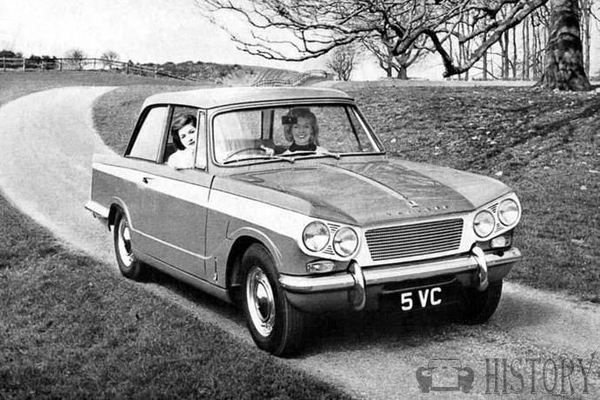
The Triumph Vitesse 6 was introduced on May 25, 1962. It was the high-performance variant of the Herald small two-door sedan. The Herald was introduced on April 22, 1959. Its shape also came from Michelotti. In the early 1960s, Triumph considered building a small six-cylinder sports sedan based on it. Michelotti was in turn tasked with the styling and presented a car that used almost all of the Herald's body panels and featured a new front end. The front of the vehicle with its offset twin 4-headlights was called "Chinese Eye".
Standard-Triumph incorporated the familiar 1,596 cc straight-six engine from the Standard Vanguard Six, but with a smaller bore of 66.75mm instead of the Vanguard's 74.7mm and twin Solex B32PIH downdraft carburettors. These carburettors were replaced with B321H carburettors soon after the car's introduction as the accelerator pump proved to be a problem. Close inspection reveals a seam on the cylinder block between the third and fourth cylinders, indicating the beginnings of this engine design as the 803-cc block of the 1953 Standard Eight. The manual gearbox was strengthened and with an overdrive offered by Laycock-de-Normanville, D-type. Disc brakes at the front and more powerful drum brakes at the rear were offered as standard, and the Herald's fuel tank was enlarged while retaining the spare cock of the smaller tank. Due to the higher weight of the six-cylinder engine, the front wheel suspension was equipped with stronger coil springs, on the rear axle the Herald system was equipped with a swing axle and transverse leaf spring, but soon proved to be unsuitable for the more powerful Vitesse. The chassis essentially corresponded to that of the Herald. A sedan and a convertible were available; a coup that was also designed never made it to series production. A handful of station wagons were also built on special customer request at Standard-Triumph's Park Royal service depot in west London.
The interior was upgraded from the Herald, wooden door panels matched the wooden dashboard; in addition, the car had better seats and door controls. A Webasto sunroof in vinyl or fabric finishes was available as an extra on the sedan. Externally, there were stainless steel mouldings on the car's sides and aluminium bumper mouldings (instead of the Herald's white rubber mouldings). The side trim strips run the entire length of the vehicle and are also routed around the radiator grille.
About a year after its launch, the Vitesse's styling was revised for the first time; the dashboard received several round instruments instead of the single one from the Herald and from September 1965, from chassis number HB27986, the Solex twin carburettors were replaced by Zenith-Stromberg CD 150. Previously, the engine had done 70 bhp (51 kW) at 5,000 rpm and 125 Nm of torque. Now the values increased enough to make the car more flexible and powerful than before. A 13-14 bhp (9.6-10.3 kW) increase in power was quoted, which was a little overoptimistic, but an engine magazine put the top speed at 146 km/h; the acceleration from 0 to 130 km/h was managed in 33.6 seconds instead of 46.6 seconds.
The Vitesse 6 sold extremely well and was the most popular Vitesse model. The car was very popular for its good driving performance and fuel economy, as well as for its elegant interior. The Vitesse had few competitors: its driving performance matched that of many sports cars (Triumph called it the "two-seater beater"), but it offered room for the whole family. The cabriolet in particular had no competitors on the market until the Stag from the same company appeared many years later.
The Vitesse 6 convertible was also exported to the United States in 1962–1964; the left-hand drive version was called Triumph Sports 6 and was marketed as a "Limited Edition" (special model). Because of its high price, only 679 units were sold.The Sports 6 was probably better suited to US highways than the Herald, but faced cutthroat price competition from cars like the Ford Mustang. The Vitesse sedan was not officially sold in the US, although some examples were imported privately, usually by American service personnel. The official retail price for the Sports 6 Cabriolet was US $2,499.
Vitesse 6 (1600): May 1962 – September 1966
- saloon: 22,814
- convertible: 8,447, includes 679 Sports 6 (USA)
Vitesse 2-Litre
In 1966 Triumph upgraded the engine to 1998 cc, also used it for the GT6 coupe and brought out the Triumph Vitesse 2-Litre. Power increased to 95 bhp (70 kW); the new car accelerated from 0–60 mph time of just over 11 seconds (0 to 100 km/h in 13 seconds). The power increase also revealed the shortcomings of the rear suspension, which were also came from the GT6 and the Spitfire and an improved stronger differential was fitted. There were some detail improvements for the 2-Litre like a stronger gearbox all synchromesh gearbox, better brakes and "VITESSE" lettering on the aluminium strip above the reversing light and badges on the side of the bonnet with 2 litre.. in line with the new Triumph GT6 coupé, and relaunched the car as the Vitesse 2-Litre.
PERFORMANCE: 2-litre
- engine capacity121.92 cu in, 1,998 cu cm
- fuel consumption 23.7 m/imp gal, 19.8 m/US gal, 11.91 x 100 km
- max speed 100 mph, 161 km/h
- max power (DIN): 95 hp at 5,000 rpm
- max torque (DIN): 117 1b ft, 16.1 kg m at 3000 rpm
- max engine rpm : 5,900
- specific power: 47.5 hp/l
- power-weight ratio; 20.3 lb/hp, 9.2 kg/hp
- acceleration: standing 1/4 mile 18.5 sec
Vitesse 2-Litre: September 1966 – September 1968
10,830 .Saloon: 7,328 ,Convertible: 3,502
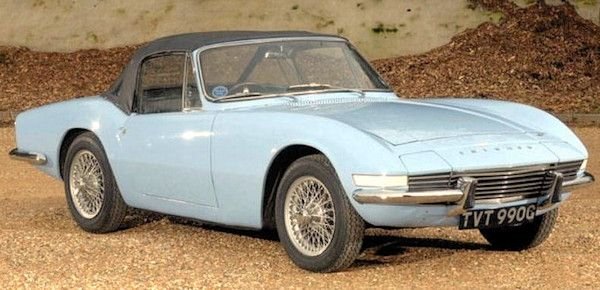
Triumph Fury prototype
| 1964 | |
|---|---|
 |
|
| Overview | |
| Manufacturer | Standard-Triumph, Leyland Motors |
| Production | 1964 |
| Designer | Michelotti |
| Body and chassis | |
| Body style | Two-door convertible |
| Layout | FR layout |
| Related | Triumph 2000, Triumph Vitesse, Triumph Spitfire, Triumph GT6 |
| Powertrain | |
| Engine | 1998cc OHV I6 |
| Transmission | 4-speed manual |
The Triumph Fury was a two-door convertible prototype by the Standard-Triumph Company of Coventry. It was the first monocoque sports car to be made by Triumph. Body design was by the Italian stylist Giovanni Michelotti and the car used components from the 2000 saloon including the 2.0L 6-cylinder engine of the time, although the use of the 2.5L 6-cylinder or the 3.0L Triumph V8 was possibly intended, had the car gone into production.
The car lost out to the continuation of the separate-chassis TR series, with the Triumph TR5 being introduced in August 1967. The decision by Triumph to not develop the car was due in part to the reluctance to invest in new production line and tooling facilities required to manufacture the model, in favour of continuing with the simpler manufacturing of the separate body and chassis design of the TR series.


