
TVR
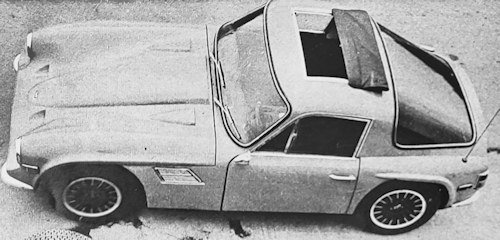
TVR Vixen S3
 |
|
|
Production: |
1970 to 1972 |
|
Body versions: |
Coupe |
|
Engines: |
Petrol :1.6 litres |
|
Length: |
145 in, 3,683 mm |
|
Width: |
64 in, 1,626 mm |
|
Height: |
48 in, 1,219 mm |
|
wheelbase: |
90 in, 2,286 mm |
|
Ground clearance: |
5 in, 127 mm |
|
curb weight: |
732-758kg |
The third series of the TVR Vixen first appeared in autumn of 1970 and was manufactured until April 1972.
History
The TVR Vixen S3 was the first Vixen to be built at the new Bristol Avenue factory in Blackpool. This hand-built sports car which was designed and built by TVR in Blackpool, England.
Externally there were only a few changes. The frame of the S3 matches that of the S2. The S3 was the last Vixen to be based on the John Turner-designed tubular frame that debuted on the 1962 Grantura Mark III. The plastic body made of glass fibre, which was built around a tubular frame of the S3 is also largely identical to that of the S2.
New were larger side vents in the front fenders, whose Aeroflow trim comes from the Ford Zodiac Mark IV installed on the C-pillar. The rear suspension was revised. Instead of the dual shock absorbers installed on the Series 1 and 2, the Vixen S3 had a single shock absorber. Instead of wire wheels, cast alloy wheels were now fitted as standard.
There were no changes in the drive. Next was the British Ford-Kent-Engine with 1599 cc the only engine. This engine was no longer available from the Ford factory in the Cortina sedan, but only in the Capri 1600 GT. The power was now increased to 92 hp.
PERFORMANCE: TVR Vixen S3 (1970-1972)
- max power (SAE): 86 hp at 5.500 rpm
- max torque (SAE): 92 1b ft. 12.7 kg m et 4,000 rpm
- max engine rpm: 6.000; 62.8 hp/l
- Power-weight ratio: 20.1 lb/hp, 9.1 kg/hp
- Acceleration: standing 1/4 mile 17 sec. 0-50 mph (0-80 km/h) 6.9 sec
- Speed in direct drive at 1,000 rpm: 18.2 mph, 29.3 km/h
- Fuel consumption: 30 m/imp gal, 25 mil'S gal, 9.4 1 x 100 km.
During this time, the focus of the company was on the Vixen 2500. TVR produced only 165 vehicles of the S3 in two years, all of them in kit form. In the same period, more than twice as many Vixens 2500s (385 vehicles) were built. The purchase price for a Vixen S3 kit in 1971 was £1,310.
TVR Tuscan V6
 |
|
|
Manufacturer |
TVR |
|
Production |
1969 to 1971 |
|
Assembly |
Blackpool, England |
|
Class |
Sports car |
|
Layout |
FR layout |
|
Engines |
V6 |
|
Wheel base |
90 in, 2,286 mm |
|
Overall length |
145.50 in, 3,696 mm |
|
Overall height |
48 in, 1,219 mm |
|
Dry weight |
2.000 lb. 907 kg |
The TVR Tuscan V6 was a front engine, rear wheel drive sports car built by TVR from 1969 to 1971.
History
In 1969, TVR would release the Tuscan equipped with a 2994cc OHV Ford Essex V6 motor, which came from Ford's British division (also used in the Ford Zodiac and Ford Capri. The brakes were changed from the V8 model, as only the front used discs, and the rear had drum brakes. The V6 powerplant fitted with a Weber 40 DFA downdraught twin barrel carburettor produced 136 hp, and the car was able to reach speeds of 125 mph.
PERFORMANCE: V6
- max power (SAE): 147 hp at 4.750 rpm
- max torque (SAE): 192 1b ft. 26,5 kg m at 3,000 rpm
- specific power: 49 hp/l
- power-weight ratio: 13.6 1b; hp. 6.2 kg/hp
- acceleration: standing 1/4-mile 16 sec, 0-50 mph (0-80 km; h) 5.5 sec
- fuel consumption: 25 m/ imp gal, 20.8 m US gal.
The car was made available in both a V8 and a V6 built in the company's Blackpool, England factory with a total of 174 cars built between the two available engine formats. In the USA, the Tuscan V6 did not meet the exhaust emission regulations there. Only seven of the 101 Tuscan V6s went abroad. Instead of the Essex engine, TVR developed the TVR Vixen 2500 for the North American market based on the Tuscan V6, which was introduced only in 1970 and had an emissions-cleaned and US-approved version of the in-line six-cylinder engine from the Triumph TR6 from the time .
The chassis type as integral with tubular backbone structure, the distribution of weight at 52% to the front axle, and 48% at rear axle. From the 1970s an updated wide body version was also built. The front suspension was independent, wishbones, coil springs and anti-roll bar with telescopic dampers at the rear also independent, wishbones, 4 coil springs and 4 telescopic dampers.
There was a total of 101 V6 cars produced before the line was stopped altogether to make way for its successor, the TVR Vixen.
TVR Vixen 2500
 |
|
|
Production period: |
1970 to 1972 |
|
Class: |
sports car |
|
Body versions: |
Coupe |
|
Engines: |
Gasoline 2.5 litres |
|
Length: |
145 in, 3,683 mm |
|
Width: |
64 in, 1,626 mm |
|
Height: |
48 in, 1,219 mm |
|
Wheelbase: |
90 in, 2,286 mm |
|
dry weight: |
1,960 1b |
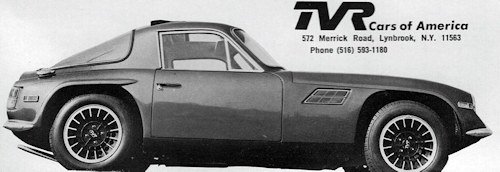
The TVR Vixen 2500 is a sports car of the British car manufacturer TVR for only two years in the 1970s.
History
The Vixen 2500 was unveiled in the fall of 1970 at the Earls Court Motor Show in London. This was designed primarily for the North American market, reviving interest in the TVR brand. This Vixen which belongs to the TVR Vixen range TVR combined the Vixen chassis with a six-cylinder British Leyland engine. Only a few copies remained in the UK, where they were sold without the name addition Vixen and just as the TVR 2500. The Vixen 2500 was at times TVR's most successful model in the USA.
After TVR was taken over by Martin Lilley in November 1965, some new models appeared, with which TVR turned away from the previous technology supplier BMC later British Leyland and Ford of Britain. The conversion had cost reasons above all: The Ford components were cheaper than the parts of BMC. The Vixen with Ford technology replaced the 1967 Grantura, and took the place of the Griffith 400 of the external and technically very similar Tuscan V8, further comprising a up to 271 bhp strong American Windsor engine. This found only a few buyers in the US and remained largely unnoticed in Europe. The Tuscan V6 has a British Ford Essex four-cylinder V-engine with 3.0 litre capacity. By 1971, 101 copies of the Tuscan V6, of which all but seven cars in the United Kingdom. The export of the Tuscan V6 in the US was excluded because the Ford Essex -Motor did not meet US emission regulations. That's why TVR developed the Vixen 2500, which was sold there instead of the Tuscan V6, especially in view of the North American market. For this market TVR returned temporarily back to engines and transmissions from British Leyland, which was also true for the 1971 introduced base model Vixen 1300. With the introduction of the Vixen 2500 the production of the Tuscan V6 ended. Later in 1972, the 2500M replaced the Vixen 2500. It had the same engine as the Vixen 2500, but the chassis and body of the M-Series.
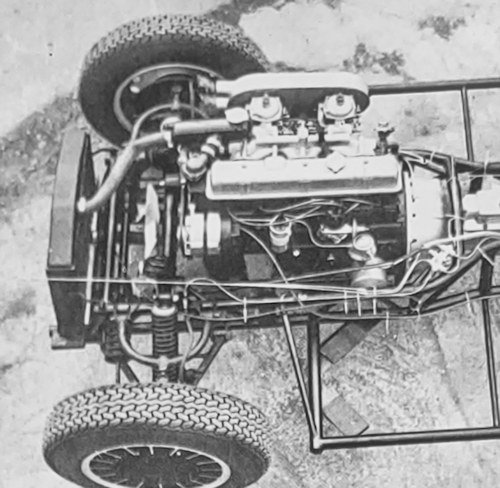
The Vixen 2500 uses a six-cylinder in-line engine of the British Leyland brand Triumph instead of the usual Ford TVR technology since 1967. The 2498 cc engine was published in 1967 with electronic fuel injection by Lucas in the European version of the Triumph TR5 and was found from 1968 in its successor TR6. Since the injection engines did not meet the US emissions regulations, there was a detoxified version with two Stromberg’s for the overseas market, which was significantly weaker. The carburettor engine was installed in the Triumph TR250 and the US version of the TR6. This version took over TVR for the Vixen 2500. The carburettor version delivers 106 bhp in the Vixen 2500 and is therefore one third weaker than the injection version. The power increase compared to the Vixen S3 with the 1.6-liter Ford four-cylinder engine is only about 18 bhp. The Tuscan V6 with the Ford Essex engine, however, was significantly stronger with 136 bhp. Many American customers restored the engine of the Vixen 2500 to the injection version privately. Instead of the usual at the regular Vixen models four-speed transmission of Ford is used, a manually shifted transmission Triumph when Vixen 2500, which - with - differently than the Ford transmissions overdrive is equipped. Also, the limited slip differential comes from Triumph.
PERFORMANCE: TVR Vixen 2500 (1970-1972)
- Max power (SAE): 104 hp at 4,500 rpm
- Max torque (SAE): 117 1b ft, 16.2 kg m at 3,000 rpm
- Power-weight ratio: 18.7 lb/hp, 8.5 kWh hp
- Acceleration standing 1/4 mile 17 sec, 0-50 mph (0-80 km/h) 6 sec
- Fuel consumption 28 m/ imp gal, 23.3 m/ US gal
The Vixen 2500, TVR combined the technology and bodywork of the Vixen S3 with a six-cylinder Triumph engine. The additional designation 2500 refers to the displacement of the engine, which is approximately 2500 cm³.Most Vixen 2500 have the tube frame of the Vixen S3, which was introduced in 1968, the S2 and 11.5 cm longer than that of the S1. However, in 1972, the last year of production, TVR changed the technology. The finished the year with the Vixen 2500 on the newly developed chassis of the TVR-M series, but are otherwise unchanged. The plastic body of the Vixen 2500 almost completely matches that of the Vixen S3. Only the slightly differently shaped bonnet took over TVR for the Vixen 2500 of the TVR Tuscan V6. It has a noticeable bulge over the engine. The change to the chassis of the 1972 M series had no influence on the design of the Vixen 2500: its body remained unchanged.
In addition, TVR offered the car as TVR 2500 (without the model’s name Vixen) in the UK. Again, there was only the factory-cleaned engine version with 105 bhp, not the variant with gasoline injection. From 1970 to 1972, a total of about 385 copies of the car, the last 96 created with the chassis of the M series. 1970 built TVR eight, 1971 then 237 cars, and in 1972 it was again 127 vehicles. 1971, the Vixen 2500 was the most successful single model of TVR. From 1972, the car had next to the chassis and the body of the M-series; in this version it was marketed as TVR 2500M.
TVR Tuscan V8
|
|
|
Manufacturer |
TVR |
|
Production |
1967 to 1971 |
|
Assembly |
Blackpool, England |
|
Class |
Sports car |
|
Layout |
FR layout |
|
Engines |
V6 and V8 |
|
Wheel base |
90 in, 2,286 mm |
|
Overall length |
145.50 in, 3,696 mm |
|
Overall height |
48 in, 1,219 mm |
|
Dry weight |
2,128 1b, 965 kg |
The TVR Tuscan V8 was a front engine, rear wheel drive sports car built by TVR from 1967 to 1971.
History
The car was made available in both a V8 and a V6 built in the company's Blackpool, England factory with a total of 174 cars built between the two available engine formats. It replaced the Griffith 400 on the US market and the TVR Griffith 200 in Europe.
In 1967, the first Tuscans were made available with only the V8 motor. The motor was a 4727cc Ford V8 with cast iron block and head, similar to the motor available in early Ford Mustangs with compression ratio of 11. The motor was equipped with a Ford 4-barrel carburettor, made 271 hp, and was capable of propelling the car to a top speed of 155 mph. Stopping power came from disc brakes in the front and drums in the rear the chassis type as integral with tubular backbone structure, the distribution of weight at 52% to the front axle, and 48% at rear axle. From the 1970s an updated wide body version was also built. The front suspension was independent, wishbones, coil springs and anti-roll bar with telescopic dampers at the rear also independent, wishbones, 4 coil springs and 4 telescopic dampers.
Production of the V8 models dwindled after the release of the V6, and was discontinued altogether in 1970. In total, 73 cars were sold by TVR with a V8.
Tuscan V8 : Largely identical to the Griffith 400. A total of 24 examples.
Tuscan V8 LWB : Extended wheelbase model; The basis is the new chassis of the TVR Vixen S2. Again 24 copies.
Tuscan V8 LWB Wide Body : widened version with the front end of the new TVR M-series .
PERFORMANCE: V8
- engine capacity 288.44 cu in, 4,727 cu cm
- fuel consumption 22 m/imp gal, 18.4 ml US gal
- max speed 175 mph, 281.7 km/h
- max power (SAE): 306 hp at 6,000 rpm
- max torque (SAE): 314 1b ft, 43.4 kg m at 3,400 rpm
- max engine rpm: 7,000
- specific power: 64.7 hp/l
- power-weight ratio: 6.8 lb/hp, 3.1 kg/hp
- acceleration: 0-50 mph (0-80 km/h) 3 sec
TVR Griffith 400
(1964 to 1967)

The standard engine in the 400 was the more powerful Ford 289 'HiPo' Windsor engine w/271 hp that was available in the Series 200 as an option. The 400 weighed a few more pounds than the 200 due mostly to the new Salisbury independent differential that gave it a higher gear ratio providing it with a higher top speed.
As the Series 400 cars were being produced in early 1965, the entire east coast of the US was crippled by a prolonged dock strike. This not only caused a disruption in the supply of the series 400 bodies that were being shipped from TVR in Blackpool, UK, it also caused a delay in the shipment of the newer body design of the Series 600. Frank Reisner, whose Intermeccanica body works in Turin, Italy, was building the new steel bodied Griffith, was also unable to have the bodies shipped. Jack Griffith attempted to bring his car to the public by having these bodies airlifted across the Atlantic.
With only 59 copies of the 400 and 10 600s off the assembly line at the Griffith factory in Plainview, Long Island, N.Y, USA, the company was dissolved.It's to be noted that Grantur Ltd. of England designed the independent suspension for the TVR automobiles which later became the Griffith 200 and 400. What makes the Griffith 400 a Cobra killer is the unequal wishbone suspension on all four corners and weighing a couple of hundred pounds less than a Cobra. Many people are not aware of the sophisticated Formula One type of suspension system on the Griffith's. Furthermore, with a center of gravity below the ground it is basically a legal race car for the road. As stated above some people refer to the Griffith 400 with its original kamm tail effect as the King of the middle sixties A Production sportscars. See: 2011 Silverstone;Gentlemen Drivers;UK and one will see one blue Griffith 400 beat a host of Shelby AC Cobras,Jaguars,Aston Martins, Corvettes,Ferraris,and Porsches. It's to be noted that the Griffith 400's are so fast that they run the fastest of the qualifying times and usually are with the superfast Ford GT 40's. See: Six hour GT 40 race at 2011 SPA Francorchamp.
Specifications
- Engine capacity: 4,722cc/289 cid V8
- Power: 271 bhp (202 kW; 275 PS)
- Top speed: Approximately 155 mph (249 km/h)
- Transmission: 4-speed manual gearbox, rear-wheel drive
Others say that there were 203 1964 Griffith 200's built and that in 1965 there were 58 Griffith 400's built before the end of the Griffith tho a few cars were sold after that as later model year cars. In fact the car was very crude, very lighly built, very cramped inside, very hot and due to being designed originally for various English 4-cylinder engines of roughly 100 hp and then having an engine of more than double the power installed it just was a very crude car that made a fast race car - it had some racing success but had variable reliability. The Griffith was one of the many hibred European cars with American V8 power and some were more successful than others. See also the Iso Rivolta, Shelby AC Cobra, Sunbeam Tiger, Intermeccanica and later the DeTomaso Pantera and several others.
References
The references made to the Griffith are somewhat factual in performance and body fit but the following facts are part of the complete history of the Griffith Motorcar.
1: The engines used in the Griffith were Ford 289 ci Windsor engines, so called because they were produced in Windsor, Ontario, Canada. These excellent, lightweight engines were available in various displacements and degrees of tune in nearly every model car and truck that Ford built throughout the sixties, seventies, and eighties. The original Griffith, the Series 200, was named because the car was originally powered by a 200 horsepower engine that featured one 2-barrel carburetor, while the 225 hp or the legendary 271 hp 'HiPo' motors with their four barrel carbs were optional.
2: There were 192 Series 200 cars built at the Syosset and Plainview Long Island, New York plants and 59 Series 400 cars built at the Plainview plant as well as ten of the continuation Series 600, Cumberford-designed and [Frank Reisner] Intermeccanica-built cars produced.
3: Though the Griffith was produced in a relatively small quantity, total production of the three series being 261, it would provide the hinge-pin for moving the TVR marque from that of a four-cylinder little British sport car to a very overpowered and superior competition vehicle, a reputation that has lasted into the racing records of the 21st century. Reference The Griffith Years by Mike Mooney, Griffith factory test driver

