
Tyrrell
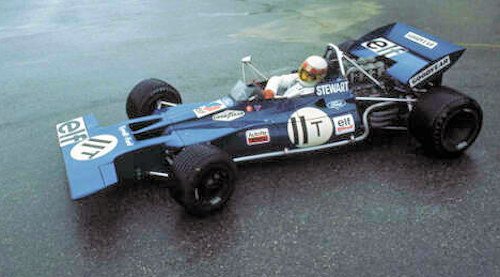
Tyrrell 003 F1 car
 |
|
|
Constructor: |
Tyrrell |
|
Designer: |
Derek Gardner |
|
Chassis: |
Aluminium monocoque |
|
Engine: |
Cosworth DFR V8 |
|
Wheelbase: |
2536 mm |
|
Mass: |
560 kg |
|
Tire: |
Goodyear |
|
Max Power: |
440 bhp at 11000 rpm |
|
Max Speed: |
180 mph (290 kmh) |
The Tyrrell 003 is a racing car of the former British Formula 1 team Tyrrell. Together with the largely identical Tyrrell 002 and Tyrrell 004 in the 1970s.
History
Tyrrell formed a model family, which followed in 1971 on the presented in the previous prototype Tyrrell 001. The family 002/003/004 established the reputation of Tyrrell as one of the leading racing car designers of their time. The 003 was just like its sister models unique. This was exclusively used by Jackie Stewart. The 003 was the most successful car in the 002/003/004 model family, winning half of the World Championship races it was used to. With him Jackie Stewart won the 1971 drivers' championship. This year, Tyrrell also became a constructor.
Tyrrell regularly called his racing cars a continuous three-digit number code. Until 005, the name did not refer to a series, but to individual chassis. The 002, the 003 and the 004 were therefore each unique piece. In technical terms, however, they were almost identical. Although Tyrrell in the course of regular development sometimes initially equipped only one of the cars with a new technical solution; the other vehicles, however, moved regularly within weeks.
The Tyrrell Racing was a pure customer team, the chassis from Matra combined with Cosworth engines. As Matra for the 1970 season, the further chassis delivery to Tyrrell dependent on the use of French engines, Ken Tyrrell ended the relationship with Matra. With no other competitive customer chassis available, he decided to design his own racing car. After a brief transition period with March's chassis, the first prototype, the Tyrrell 001, was operational in August 1970. The by Derek Gardner designed in great secrecy car was quick, but had numerous teething problems, including lack of oil and fuel supply, but also included reliability problems in the mechanical field. Based on the 001 Gardner designed the model family 002/003/004. They were evolved and improved versions of the 001, which they still very much resembled.
The Tyrrell 003 had an aluminium monocoque, which was formed of stronger aluminium sheets than its predecessor. The monocoque was 10 cm longer than that of the 001 and offered more elbow room. it corresponded to the extent the Tyrrell 002. The only difference between Stewart's 003 and 002 concerned the length of the vehicle: Stewart's car was extended in 1971 in individual race by additional spacers. The roll bar behind the driver had been strengthened.
In addition, Gardner had revised the front suspension. Instead of two-part wishbone now a one-piece construction was used. track, front, 63 in (160 cm); rear, 63-65 in (160-165 cm). The brake system was revised during the 1971 season; at some races there were double disc brakes from Girling. For some races, Tyrrell eventually experimented with coolers built into the rear wings. Normally, however, it remained at the front coolers, which were in the car's nose. As drive Tyrrell continued to use the well-established Cosworth DFV twin ohc V8 engine with 3.0 litre displacement; the power transmission took over a five-speed gearbox from Hewland (FG40). However, Tyrrell was one of Cosworth's preferred customers. While most of the DFV engines made about 435 hp, the Tyrrell drivers were specially reworked versions available, which gave 10 to 15 hp more.
The body initially corresponded largely to that of 001. In the course of 1971, however, changed some attachments. For the Grand Prix of the Netherlands, Gardner introduced a plastic scoop that was installed above the engine. It was mostly painted black; but at some races she also received a blue livery. In France, the 003 received a new front spoiler, which stretched over the entire width of the vehicle and should direct the air over the front wheels. 002 was adapted at the following race in the UK.
The Tyrrell 003 was Jackie Stewart's car. Stewart drove it from the Grand Prix of Spain in April 1971 to the German Grand Prix in July 1972. During this time, the 003 was reported to 16 World Championship races (10 in the 1971 season and 6 in the 1972 season), plus three races without world Championship status.
Jackie Stewart's Tyrrell 003 was the dominant car of the 1971 season. Stewart won six of the 11 World Championship races of the year, including the first race of the 003 in Spain. Apart from that, there were only two failures Austria and Italy in addition came a fifth and an eleventh place. Given the superiority of the 003 Ken Tyrrell's team was suspected of using a non-compliant car. In France the inspectors took fuel samples but found no irregularities. After racing in the UK, the engine of the 003 was sealed and inspected by experts; it was thought Tyrrell would use Cosworth engines with increased displacement. Again, there were no complaints in the result. At the end of the year, Stewart won the drivers' championship superior. He had 62 World Championship points, 56 of which in 10 races with the 003. Ronnie Peterson, the championship second, had 30 points less than Stewart.
In the 1972 season Stewart drove in 003 two victories, namely at the inaugural race in Argentina and in the penultimate race of the car in the UK. From summer 1972 Stewart started in the newly constructed Tyrrell 005, the sister model of 006. Like the 002, the 003 remained in the factory.
Tyrrell 001 F1 car
 |
|
|
Constructor: |
Tyrrell |
|
Designer: |
Derek Gardner |
|
Chassis: |
Aluminium monocoque |
|
Engine: |
Cosworth DFR V8 |
|
Wheelbase: |
2388 mm |
|
Mass: |
545 kg |
|
Tire: |
Dunlop (1970) |
The Tyrrell 001 is the first self-constructed racing car of the former British Formula 1 team Tyrrell from the early 1970s.
History
The Tyrrell Racing organization had competed since the 1950s in Formula Junior, Formula 3 and Formula 2. After running temporary Cooper Formula 2 and Formula 1 factory teams in the 1960s, With Ken Tyrrell's racing team, which had used only customer vehicles from other manufacturers since 1968, became an independent designer. The 001 replaced in the fall of 1970 the March 701, with which the team had started so far. The single piece remained only until spring 1971 in use; after that this was replaced by the advanced models 002, 003 and 004. Ken Tyrrell brought his own team to Formula One in 1968. For the first two years, Tyrrell was a pure customer team. The chassis supplier was the French manufacturer Matra, who also had a factory team based in France. While Matra, however, used its own twelve-cylinder engine, Tyrrell used the new Cosworth-DFV eight-cylinder, which was more compact, lighter and stronger than the French aggregate. The combination of Matra chassis and Cosworth engine was successful from the beginning.
In the first year Tyrrells driver Jackie Stewart won three Grand Prix, and in 1969 he was with six victories with 63 points driver world champions. In 1970, Tyrrell separated from Matra. The French manufacturer, which had come under the control of the Chrysler Group, no longer supported the connection of its chassis with a Ford- funded Cosworth engine. Matra tied the further delivery of chassis on the condition that used Tyrrell Matras twelve-cylinder engine in the future. Ken Tyrrell, who was convinced of the qualities of the lightweight and powerful Cosworth DFV engine, then turned away from Matra. After Tyrrell attempts customer vehicles from BRM, McLaren and Lotus to take over, had failed, he opted for the construction of an own racing car, until its completion transitional three 701 chassis from March Engineering was used. Ken Tyrrell was not satisfied with the March cars.
Tyrrell's first Formula One car was designed by Derek Gardner, who previously worked for Ferguson Research and was not well known in the motorsport industry. The car was created under the greatest secrecy. Gardner developed the car in his private apartment in Leamington Spa. Many parts he ordered in his own name without reference to Tyrrell suppliers. In the summer of 1970, the individual components were finally assembled in a workshop on the premises of the timber business, the Ken Tyrrell business with his brother in Ockham. The development and construction of the Tyrrell 001 cost a total of £ 22,500; a new March 701 cost less than half. The 001 remained a unique piece. The experience from his missions flowed into the construction of the 002 and 003, which appeared in 1971 and are considered improved versions of the 001.
Derek Gardner based his design in some details on the Matra MS80, with which Tyrrell had won in 1969. The car had an Aluminium monocoque with a body that tapered off in the centre of the car. The structure of the Matra MS80 was very similar in this respect. There were also similarities with the wide front wing and the cooling air inlets in the vehicle nose. The hot air was channelled around the cockpit with wings positioned over the suspension. The front suspension consisted of double wishbones; Rear was above and below wishbone with push rods installed. The rear suspension was attached to the engine by means of a subframe. The car had four fuel tanks, which were housed centrally between the front and the rear axle. As drive Tyrrell used the now established Cosworth DFV engine with 3.0 litre displacement; the power transmission took over a five-speed transmission from Hewland (FG40). The Tyrrell 001 weighed 545 kg. Thus 15 kg above the minimum weight, but was significantly lighter than the March 701, which weighed 565 or 590 kg depending on the source.
The Tyrrell 001 was launched in nine Formula 1 races; five of them were World Championship races, four were races without world championship status. The car was reserved for Jackie Stewart, the top driver of the Tyrrell team. Stewart's team-mate François Cevert did not use the 001 in any World Championship race. He received only in 1971 the newly built 002.
In the 1970 season, the Tyrrell 001 reached no finish line. In the first few months, the 001 suffered from a lack of oil and fuel supply, plus reliability problems. The 001 debuted in late August 1970 at the Oulton Park Gold Cup, a championship-free race in Cheshire. Stewart started because of technical problems from the end of the field. Also, in the race there were repeated problems that forced Stewart to several pit stops. On the other hand, he drove the temporarily fastest lap twice during the race. Ultimately, he failed due to a defect in the oil supply.
The first World Cup run of the Tyrrell 001 was the Canadian Grand Prix, which took place a month later in Mont-Tremblant. Stewart qualified by a tenth of a second for Jacky Ickx (Ferrari) for the pole position. In the race he led for several laps, but then fell out after an axle damage in the 32nd round. In the subsequent race in the US Stewart started from second behind Ickx. Again, Stewart temporarily took the lead. After two thirds he had to give up because of oil loss. At the last race of the season in Mexico Stewart again qualified for the second starting position. He also could not finish this race. On lap 27, he left after a collision with a running on the track dog because his suspension had been damaged.
In the 1971 season Stewart was only at the inaugural race in South Africa with the 001 at the start. Prior to the race, Stewart had completed extensive tire testing for Goodyear in Kyalami in 001. The insights gained helped the team make the best use of the tires during the season. In the qualifying session for the Grand Prix of South Africa drove Stewart in 001 the fastest time; his lap time was half a second under the time of Chris Amon at the factory Matra. In the race, however, Stewart fell back because of poor engine performance. He came second behind Mario Andretti (Ferrari) to the finish. That was the only goal finish of the 001 in a world championship race.
In the following three months, the 001 appeared in three British races that had no World Cup status. The Race of Champions and the Questor Grand Prix in Ontario, California completed Stewart in second place in 001, the Oulton Park Spring Trophy in April 1971 in third place. After that, Tyrrell first put the 001 down. Stewart received the newly built Tyrrell 003, which largely corresponded to the 002 used by François Cevert since the beginning of the season. The 001 came in October 1971 at the US Grand Prix in 1971 for its last use, when Tyrrell reported alongside Stewart (Tyrrell 003) and Cevert (002), a third car for Peter Revson. It was Revson's first Formula One race in seven years. He qualified the 001 for the 19th starting position. In the race he fell out in the first lap after a clutch damage.
Tyrrell Racing Organization Ltd.

The Tyrrell Racing organization was a British motorsport racing stable, which acted exclusively in Formula 1 between 1970 and 1998 .
History
Founder and namesake was the English timber trader Ken Tyrrell , who achieved considerable success with his team led by the pilot Jackie Stewart at the beginning of the 1970s and won two driver and one Constructors' World Championship. The last of 23 Grand Prix successes on a Tyrrell scored the Italian Michele Alboreto in 1983. Then began the sporting decline. The racing team still existed until 1998, before leaving the Anglo-American Tobacco group BAT which formed the team British American Racing (BAR).
The Stewart Era: From the Customer Team to the Designer
After the Tyrrell Racing organization had competed since the 1950s in Formula Junior , Formula 3 and Formula 2 , the racing team became involved in Formula 1 from 1968 onwards . Tyrrell competed in the first six Formula 1 years with Jackie Stewart as a regular driver. These years were the most successful phase of the team: Tyrrell won during this time three driver championships (1969, 1971, 1973) and a Constructors Championship (1971). Stewart and his successes shaped the image of the team so much that chroniclers later said that Tyrrell had actually been a Stewart team.
For the first two years, Tyrrell was a pure customer team. The chassis supplier was the French manufacturer Matra , who also had his own factory team. However, while Matra used its own twelve-cylinder engine, Tyrrell used the new Cosworth DFV eight-cylinder, which was more compact, lighter and stronger than the French engine.
For the debut race of the team at the 1968 South African Grand Prix Tyrrell used a Matra MS9. The car was originally intended for Matras twelve-cylinder engine and was equipped for Tyrrell once with a Cosworth FVA engine. From the second race of the year, Tyrrell received the Matra MS10, designed by Bernard Boyer specifically for Tyrrell and the Cosworth DFV engine. Stewart won with this combination the third race of the 1968 season, the Grand Prix of the Netherlands . Outstanding was Stewart's ride at the Grand Prix of Germany on the wet Nürburgringwhere, with a broken wrist, he took a lead of more than four minutes on the runner-up. Jackie Stewart finished the season with 39 points as runner-up.
In 1969 , Stewart won six of eleven World Championship races and became with 63 points driver world champion. His next pursuer, Brabham pilot Jackie Ickx , scored just 37 championship points. The Constructors' World Championship went to Matra, which did not have its own factory team this year.
In 1970 , the paths of Tyrrell and Matra parted ways. The French manufacturer, which had come under the influence of the Chrysler Group, no longer supported the connection of its chassis with a Ford- sponsored Cosworth engine. Matra tied the further delivery of chassis on the condition that Tyrrell future used Matras twelve-cylinder engine. Ken Tyrrell, who was convinced of the qualities of the lightweight and powerful Cosworth DFV engine, then turned away from Matra. After failing to take over McLaren or Lotus chassis, Tyrrell decided to design his own race car, which was then completed by the temporary installation of three March Engineering customer chassis .
During 1970, Derek Gardner developed a dedicated chassis for Tyrrell, which was presented to the public at the Italian Grand Prix and had its first World Cup appearance under Jackie Stewart at the subsequent Canadian Grand Prix in Mont Tremblant . From 1971 , Tyrrell consistently used their own cars. The Tyrrell 001 to 005 were unique pieces; the numbers each indicated the chassis numbers. It was not until 006 that the name referred to a type of vehicle that usually produced several replicas .
Jackie Stewart won in 1970 with the March 701 a World Cup run and a not counting for the World Cup Formula 1 race . Stewart's team-mate was initially Johnny Servoz-Gavin . The Frenchman played the first three World Championship races for the British team. At the Grand Prix of Monaco he missed the qualification. It was the first non-qualification of the Tyrrell team since 1968. After this event, Servoz-Gavin ended his active driving career for health reasons. In May 1970, he explained that he had been scared of some races and was no longer able to drive at risk. Ken Tyrrell wanted Servoz-Gavin's cockpit with firstRe-occupy Brian Redman . However, Tyrrell's main sponsor, the French oil company Elf , prevailed François Cevert , although this was bound in Formula 2 to the rival company Motul . Jackie Stewart, who knew Cevert since the 1969 Grand Prix de Reims, supported this decision. Between Stewart and Cevert a close friendship developed in the following years.
In the 1971 season Stewart was 003 the dominant car: Stewart won six out of 10 World Cup races, he drove in 003, and decided a second time, the drivers' world championships for itself; This year, Tyrrell also became a constructor. In 1972 , the success could not be repeated. There were still a few victories, but the 1970 Tyrrell cars 002 and 003 had lost their dominant position. The 1972 season was instead determined by the Lotus 72 , with the Emerson Fittipaldi became world champion. First the newly constructed Tyrrell 005 and 006, which appeared in the fall, were again on the level of the top cars.
The 1973 season marked a turning point for the Tyrrell team. Although Stewart could end the year with the third driver title. However, he had come in the spring of 1973 to the decision to end his Formula 1 career with the end of the season. However, this decision should be announced only after the end of the season. Tyrrell's plans went in early summer to move the now established Cevert in the position of the top driver, while the British Formula 2 driver Gerry Birrell should take the role of junior partner. These considerations, however, went nowhere, as Cevert and Birrell fatalities within three and a half months. Birrell died training for a Formula 2 race in Rouen-les-Essartsand Cevert fell victim to an accident at the last race of the season in Watkins Glen .
The 1970s
Ken Tyrrell had the season 1974 then start with a completely new driver pairing, which had no growing ties to the team. 1974 thus became a new beginning. In the following years, the performance of the team diminished noticeably. With the legendary six-wheeled Tyrrell P34 , the team caused another stir. The P34 was the first and only Formula 1 racing car to feature six wheels (four front, two rear) and was used in the race. In 1976, Jody Scheckter and Patrick Depailler drove the car, in 1977 Depailler and Ronnie Peterson . This model had two small front wheels on each side. The advantages lay in better aerodynamicsand better traction. In the first year, this concept was successful. So Jody Scheckter won the Grand Prix of Sweden in 1976 , in which Patrick Depailler finished second. After considerable tire problems, however, the concept of the P34 came to an end in late 1977. In the retrospective, Ken Tyrrell saw the P34 as the wrong path. This experience shaped him sustainably so that it in the following decade and a half mostly conservative unspectacular and no longer competitive vehicles used brought Victories were rare. Ronnie Peterson and Jody Scheckter occasionally drove high-class pilots for the team; In general, however, Tyrrell went on to engage young, inexpensive drivers. The team suffered repeatedly from financial difficulties in the transition from the 1970s to the 1980s. Ken Tyrrell kept the team alive with grants from his personal fortune. At the same time he reduced personnel. In the 1981 season, the team had only 25 employees, 20 less than the year before.
Tyrrell in the Turbo era
The unsatisfactory experience with the unconventional P34 leaves Tyrrell's long-standing refusal understandable to switch from Cosworth suction engines to turbocharged engines. So the team had already in 1980 the opportunity to take over Renault turbo engines . Tyrrell refused this step, however, and strove in the early 1980s, as the superiority of the turbo concept was already clearly visible and even teams such as Toleman , Ligier or Arrows used long-loaded engines, initially not around corresponding concepts. 1985 was Tyrrell, except for Minardi, the last team still using naturally aspirated engines. At that time, the lack of competitiveness of the traditional racing stable was already clearly felt. The last victories on the occasion of the Las Vegas Grand Prix in 1982 and Detroit in 1983, which each imported Michele Alboreto , came about only under the special circumstances that governed city courses. In 1984, Tyrrell was so poor in performance that the team started with irregular, underweight cars. When the fraud struck, Tyrrell was excluded from the 1984 Formula One World Championship. For some outstanding achievements provided only Stefan Bellof , who gave his 1984 Formula One debut at Tyrrell. Of particular importance was theGrand Prix of Monaco 1984, a wet race in which Ayrton Senna in the Toleman, in 2nd place, and the third-placed Bellof fought each other and put the leading Alain Prost in the turbocharged McLaren noticeably under pressure. Prost won the Grand Prix, as race director Jackie Ickx prematurely stopped the race because of bad weather.
The 1985 Formula 1 season was a fresh start for Tyrrell. Almost without sponsors, the team fought until the summer with two-year-old cars and low-power naturally aspirated engines with no chance of success. In the second half of the season, Tyrrell finally received Renault turbo engines , but was beside Lotus and Ligier one of several customer teams, the special support, as they had, for example, McLaren by Porsche two years earlier when the introduction of the turbochined MP4 / 1E had not benefited. Tyrrell could not cope with the little-valued turbo engine, and after a difficult 1986 season in which the team could only score 11 world championship points - Williams had made 141 points in the same period - in 1987 Ken Tyrrell said he was glad to return to naturally aspirated engines.
The naturally aspirated engine era
The change to the highly valued at Tyrrell Cosworth - Achszylinders, which were now called DFR and later DFZ, brought the team initially little luck. In the first three years of the new naturally aspirated era, Tyrrell was struggling to pass the qualification, and it often happened that even poorly financed newcomers such as Coloni and AGS achieved better results than the traditional Tyrrell team. All this had a negative impact on the finances of the team, and in 1989, in the 22nd year of the Formula 1 engagement, drove the Tyrrells at numerous races with almost no advertising around the racetracks. The international media drew attention to the seriousness of the situation by reporting that Ken Tyrrell had spent his 65th birthday driving a team truck to Monaco because he did not have enough money for a driver.
Thanks to a skilful personnel policy, the situation changed in 1990 . On the one hand, Tyrrell had contracted British engineer Harvey Postlethwaite and Italian aerodynamicist Jean-Claude Migeot, who, with ground-breaking high-nose Tyrrell 019, gave the team the first innovative design concept since the P34; On the other hand, the young, a year earlier discovered Jean Alesi moved the compact, handy car with a lot of commitment. As a result, there was a second place (as well as another with the model year 018B converted to the model of the 019), the annual financial statements as the fifth constructor rating and a contract with Honda on the reference to Japanese ten-cylinder engines used in the 1991 season .
The Honda engines corresponded to the 1989 and 1990 used by McLaren engines. The preparation of the engines was - unlike in the case of McLaren - not at Honda itself, but at its subsidiary Mugen . However, the engines were reported exclusively under the name "Honda". Tyrrell's relationship with Honda had come about McLaren. After Honda delivered McLaren exclusively since 1988, the company saw the opportunity to obtain additional data through the use of a customer team to make the engines even more competitive. Similarly, Ferrari acted from 1991 with Minardi and BMS Scuderia Italia, Tyrrell in turn hoped by the more powerful engines to improve their own athletic position.
Ultimately, the expensive alliance with Honda paid off just as little for Tyrrell as Minardi's connection to Ferrari did in the same year. A Special Problem Tyrrell was the 1991 Tyrrell 020 bomber. The benefits of the highly praised predecessor were not transferred to this model. The black-painted car sponsored by the German electrical appliance manufacturer Braun was heavy and unwieldy. In particular, Honda's 10-cylinder engine did not meet Tyrrell's expectations: the engine was heavier and significantly larger than the previously used Ford engine. This adversely affected the car's weight distribution and handling, In addition, the creator of the success with the 019 left the team: Jean Alesi and Jean-Claude Migeot joined in early 1991 both to Ferrari, while Harvey Postlethwaite went in the spring of 1991 to Sauber to prepare for the entry of this racing team in Formula 1. These disposals had a negative impact on the performance of the team. At the end of the year, Tyrrell decided not to continue the use of relatively expensive and now outdated Honda engines for the 1992 season . Instead, the team took over the ten-cylinder engines of Ilmor , the year before exclusively from Leyton Housewere used and were known for small dimensions and low weight.
However, Tyrrell failed to make the new engine the basis for a resounding package. The agreement with Ilmor came late - only in December 1991 - concluded. In that regard, Tyrrell's engineering team led by Mike Coughlan had little time to adapt the existing car to the new engine. Therefore and because of limited financial resources, the most effective solutions were not always pursued. The lack of funds also meant that the team could only do a few test drives. As a result, coordination and reliability were increasingly lagging behind. Tyrrell ended the 1992 season, in which Andrea de Cesaris and Olivier Grouillard drove for the team, sixth in the Constructors Championship. However, Ken Tyrrell had hoped for better results. Because the financing of the team for the future was not secured for a long time, he considered repeatedly in the year 1992 to sell his team. Interested parties were quite available; among them was the Italian Formula 3000 team Il Barone Rampante . Finally, Ken Tyrrell went on.
Yamaha and Ford: The Last Years
In 1993 , the 020 in its C version received the third engine - a Yamaha- funded development of the Judd -GV ten-cylinder named Yamaha OX10A - but neither Ukyō Katayama nor the seasoned Andrea de Cesaris could even a single World Cup point for the British Achieve team. Even the 021, which was used only briefly in the second half of the 1993 season, was not a successful car. 1993 was the first year in the history of the team where no World Cup points were scored.
In 1994 the situation improved again. Harvey Postlethwaite had returned to Tyrrell and built a compact, well-to-drive and promising car with the 022. However, there was a lack of financial resources needed for adequate parts maintenance and adequate test drives. These shortcomings had a detrimental effect on the reliability of the vehicles. What the 022 and he could do showed Tyrrell's new driver Mark Blundell at the Spanish Grand Prixin Barcelona when he finished third. However, it was the last podium placement for the Tyrrell Racing organization. In Hockenheim convinced also Ukyō Katayama: The Japanese drove for a long time in second and third place and scored on the forest straight a top speed, which was 2 km / h above that of the Williams -Renault; however, he dropped out shortly before the finish line with a faulty throttle cable.
In 1995 , Tyrrell finally had a decent budget: Ukyō Katayama was supported to a greater extent than before by Japan Tobacco (with the Mild Seven brand), and Mika Salo brought in funds from the Finnish telecommunications company Nokia . The initially blue, later white painted Tyrrell 023 was fast but not reliable. Particularly in the field of drive technology, the defect series continued, so that the first championship points could only be retracted in the last race of the year.
In 1996 , some disappointed sponsors left the team again. Tyrrell could not afford a completely new car; the 024 was therefore nothing more than a thoroughly revised version of the previous year's model. During the season, Tyrrell increasingly lost the connection to the midfield. At the end of 1996, the alliance with Yamaha finally broke after four years. The Japanese company announced that it would deliver the engines to Arrows for free . Although Tyrrell had the opportunity to continue to use as a paying customer team Yamaha engines. Given the continued lack of reliability of the engines Ken Tyrrell decided to revive the 1997 connection with Cosworth.
Harvey Postlethwaites Tyrrell 025 drove in 1997 then a Ford-ED - cylinder from Cosworth . The ED a revised version of already constructed in 1989 Cosworth HB . It was next to the Hart engine of Minardi as the oldest and weakest engine of the year, but consumed little fuel. Tyrrell hired his former pilot Satoru Nakajimawith the mediation of sponsors. The Japanese, however, directed only a little; apart from PIAA, a company affiliated with Nakajima for years, only a handful of financiers joined the tradition team. The white Tyrrell 025 was therefore largely sponsorless at many races of the year at the start. In this difficult year, Tyrrell was one last time innovative: For the Grand Prix of Argentina , the cars appeared for the first time with two upstanding spoilers on the side boxes, which were soon referred to as Tower Wings or Tyrrell Towers . This unusual concept was developed in the course of the year 1997 by numerous competition teams from Jordan over Prost up to the Scuderia Ferraricopied and belonged until the beginning of 1998 to the standard equipment of many vehicles, before it was forbidden by the FIA because of alleged safety deficiencies, but above all because of its unattractive appearance. At the 1997 Monaco Grand Prix Mika Salo scored the last World Championship points for the Tyrrell Racing organization. They were due to the bad weather on race day and the fact that the Tyrrell 025 was a fuel efficient engine with its old Cosworth engine. So succeeded Salo rain-related lean mixture attitude to deny the entire race without refueling and tire change. The time gained by this was enough for fifth place in the race.
At the end of 1997 Ken Tyrrell, already suffering from cancer, sold his team to British American Tobacco . The Formula One 1998 season was set to be a transitional year before BAT, with Craig Pollock, Adrian Reynard and Jacques Villeneuve for 1999 , formed the British American Racing team . Ken Tyrrell was initially in the team engaged, but had to realize early that Craig Pollock and his partner Adrian Reynard made the crucial decisions. This included the driver choice. Tyrrell had long resisted the commitment of Ricardo Rosset and the retention of Jos Verstappenpronounced. His recommendation was not implemented. In February 1998, before the first race of the season, Ken Tyrrell left his team after more than 30 years of uninterrupted Formula One involvement. The Tyrrell Racing organization finished last year without a single World Cup point.
Tyrrell, the driver scout
Ken Tyrrell has had a reputation as a talent scout since the late 1970s . So numerous young hopes and later Grand Prix winner made their first attempts in Formula 1 on a Tyrrell, u. a. Patrick Depailler (1972), Jean-Pierre Jabouille (1975), Didier Pironi (1978), Michele Alboreto (1981), Stefan Bellof (1984) and Jean Alesi (1989). However, Ken Tyrrell did not see himself as an outspoken talent promoter. For him, the obligation of young drivers was a mere necessity. In an interview with the magazine motorsport aktuellHe explained in the summer of 1996: "Of course I would much rather oblige Michael Schumacher. But he is too expensive. I just have to take what I can afford. "
The Legacy
In 1999, British American Racing took over the place of the Tyrrell Racing Organization. This resulted in 2005, the Honda -Werksteam, which was taken over in 2009 by Ross Brawn and led under the name Brawn GP in the same year for the drivers and constructors championship. Since Formula 1 season 2010 , the team is entering the Mercedes Grand Prix .
Individual vehicles, which were no longer used in the factory team, sold Tyrrell - similar to Brabham , March or Williams - initially to private customers. Some cars appeared until the late 1970s in repeatedly at individual Formula 1 races and occasionally in other series.
Private Tyrrell in Formula One
- The first private Tyrrell in Formula 1 was used for the Grand Prix of South Africa in 1973 by Eddie Keizan for the team Blignaut Lucky Strike Racing . Keizan reported the 1971 Tyrrell 004, which had been replaced in the factory team for a long time by the models 005 and 006/1. Keizan started in 22nd place out of 25 riders and finished 12 laps behind. He was not scored.
- On the occasion of the South African Grand Prix in 1974 Keizan repeated his commitment. Here he brought the Tyrrell 004 with two laps behind the 14th vehicle finish and was thus two positions better than Niki Lauda in Ferrari 312B3 .
- For the 1975 South African Grand Prix , Lexington Racing announced a Tyrrell 007 made last year for Ian Scheckter . Scheckter qualified ahead of Jacky Ickx in the Lotus T72 for 17th place, but fell out of the race after 55 laps due to an accident.
- The following year, Lexington Racing and Ian Scheckter again competed with the Tyrrell 007 for the Grand Prix of South Africa . Scheckter entered the race in 16th, but dropped out in the first lap after colliding with Michel Leclère's Werk Williams .
- For the Grand Prix of Germany , Austria , the Netherlands and Italy of the Formula 1 season 1976 the team Scuderia Gulf Rondini reported each a Tyrrell 007 for Alessandro Pesenti-Rossi . Apart from the race on the Circuit Zandvoort Pesenti-Rossi could qualify regularly and came each outside the points to the finish.
- In 1976, the ÖASC Racing Team announced a Tyrrell 007 for Otto Stuppacher at the Grand Prix of Canada and the USA . Stuppacher already failed in the qualification.
- For the Japanese Grand Prix in 1976 , the Japanese team Heros Racing reported a Tyrrell 007 for Kazuyoshi Hoshino . The Japanese qualified 21st, but failed in the race after a tire defect in the 27th lap.
- The last announcement of a private Tyrrell in the Formula 1 World Championship took place on the occasion of the Grand Prix of Japan in 1977 by the Japanese team Meiritsu Racing . Japanese Kunimitsu Takahashi qualified 22nd with a Tyrrell 007 and finished ninth. The car he used was the same car Hoshino had used the year before.
Tyrrell vehicles in the Aurora series
In the late 1970s, the so-called Aurora F1 series was held in the UK , a junior class for young talents, with revised Formula 2 vehicles, but alternatively also with used Formula 1 cars mostly older date to the performance level of the Grand Prix-Sports should be introduced. The series also temporarily served the purpose of a British Formula 1 Championship. Many of the teams used disused Formula 1 cars. Most of them were cars of Arrows, March Engineering or Williams. In 1979 , however, two Tyrrell found their way into the Aurora series: In the second season of the series Melchester Racing set two years ago produced Tyrrell 008 for Desiré Wilson andGordon Smiley on ; occasionally Neil also drove Battridge. The best results were Wilson. She reached four podiums and finished with 28 points Seventh championship .
Tyrrell vehicles in Formula 3000
In the first Formula 3000 season, a few teams tried to defend themselves with the disused Formula 1 cars against the specially tailored to the new series of customer cars of Lola and March . In the first two races of the Formula 3000 season in 1985, the British Barron Racing Team produced a 1983 Tyrrell 011 for Claudio Langes and another 011 for Roberto Moreno in the first four races . Both drivers could not do anything with the vehicles. After the fourth race of the season, Barron Racing ended its involvement in the Formula 3000.

