
Tatra
Tatra Tatraplan Typ 600
 |
|
|
Production period: |
1948 to 1952 |
|
Class: |
Motor Car |
|
Body versions: |
Saloon |
|
Engines: |
Gasoline :2.0 litres |
|
Length: |
4540 mm |
|
Width: |
1670 mm |
|
Height: |
1520 mm |
|
Wheelbase: |
8ft 10in (270 cm) |
|
Curb weight: |
1200 kg |
The Tatra 600 or Tatraplan is a car model with aerodynamically shaped body of the former Czechoslovak and today Czech vehicle manufacturer Tatra.
History
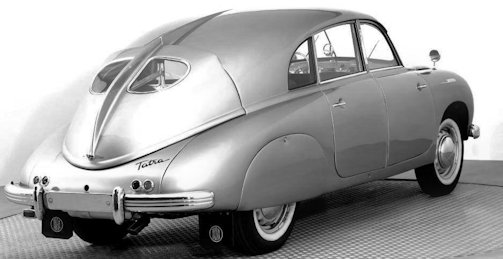
The Tatraplan is somewhat unusual in appearance. The body (which is built integrally with the chassis) is very streamlined and has a fin at the back which passes between the rear windows. There is evidence of the rear-engine in the two air intakes at the side back windows and the apparent thickness of the bodywork the back of the car and the back seats.
in 1923 the first Tatra with an air-cooled engine was introduced, followed in 1934 by their first rear-engine model. the Tatraplan, which has a " flat-four " four-stroke air-cooled engine in the rear. This has a bore of 85 mm. and a stroke of 86 mm. giving a capacity of 1,950 c.c. and at 4,000 r.p.m., 52 b.h.p. is developed. O.h.v. design is used, and there are two carburettors,
one for each pair of cylinders. There is a large fan mounted above the crank-shaft and a large cowling encloses both this and the cylinder block to ensure adequate circulation of air. Suspension front and rear is independent: there are two transverse leaf-springs at the front mounted one above the other, while torsion bars are used in conjunction with swinging axles at the rear. Telescopic shock absorbers and hydraulic brakes are incorporated. The four-speed gear-box is controlled from the steering column.
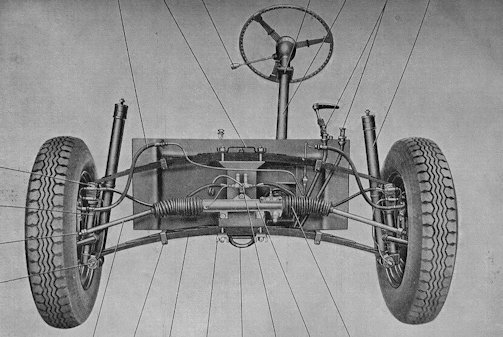
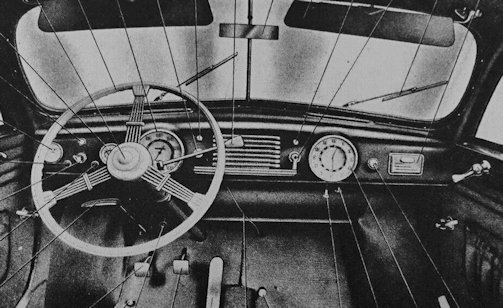
The front grille is simple and the top of the " bonnet " which houses the spare wheels and luggage is curved. The " six-light "four-door body seats six. The windscreen is V-shaped and the
facia board, although simple in layout, has a loudspeaker grille and a large clock, apart from the usual instruments. It is perhaps interesting to note that when the driver looks through his two back windows, he or she is looking through three panes of glass. This is because there is a double window in the bulkhead between the engine and the interior (to minimise noise from the engine) and a further thickness of glass in the engine cover. To avoid obstructing the view, the air filters are placed just out of the line of vision.
This was the first after 1945 newly constructed Tatra car and as such the successor of the Tatra 97 and only a short time-built Tatra 107. The production ran from 1948 to 1952. Last year she was transferred to AZNP (Škoda) to Mladá Boleslav to Tatras capacities for the truck Construction. The car was increasingly exported over time and found a number of customers in Europe and overseas. A total of 6342 copies were produced by the Tatra Plan.
Immediately after the end of the Second World War ran in May 1945 at Tatra in Kopřivnice (Nesselsdorf) production again. The work was hardly affected by war damage. Initially, the production of passenger car and truck models from the prewar period continued. In 1946, the 107 built just a year as a modified version of the previous model 97 with a new 1750 cc OHV engine, new suspension with independent suspension and central box frame with partially self-supporting body appeared.
In 1938, after the incorporation of the Sudetenland into the German Reich, the Type 97 had been set on Hitler's orders because of its similarity to the KdF car. Now the development of a completely new middle - class car of the same design with air - cooled four - cylinder rear engine began. The new and significantly more modern designed car, which developed the experience with the T107, should bear the name Tatra T600 with the epithet Tatraplan. The name Tatraplan is a wordplay with double meaning, because on the one hand the introduction of the state-controlled planned economy in Czechoslovakia should be symbolized, on the other hand one wanted to allure the good aerodynamic qualities of the body similar to that of an airplane advertising effective (compare e.g., with the English Word "Airplane", Czech), which emerges from contemporary sales brochures and billboards. The project was headed by Tatra's newly appointed Julius Mackerle after long-time chief engineer Hans Ledwinka was deposed and detained.
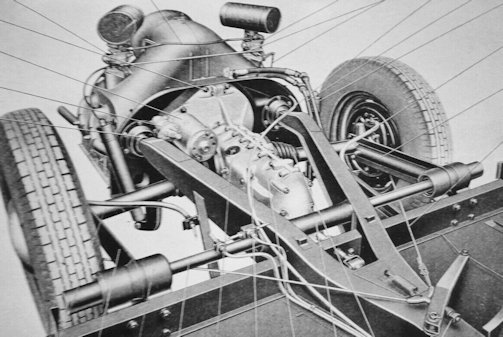
The first prototype, "Ambrož”, was built in December 1946 by hand, the second prototype "Josef" in March 1947. The Tatraplan received a newly designed larger air-cooled four-cylinder -Viertakt- Otto -Boxer motor in the rear with OHV - valve control (an underlying Camshaft, bumpers and rocker arm), a displacement of 1952 cc and a power of 52 hp (38 kW) at 4000 / min. That with a stroke ratio of 85 × 86 almost square designed aggregate had with 26 HP per Liter displacement the same specific achievement as the engine of the larger Tatra 87 (V - eight-cylinder, 2958 cm³, 75 HP, 160 km / h). The chassis had an independent front suspension on two transverse leaf springs on top of each other and in the rear the Tatra already traditional swing axle, in this case with torsion bar suspension. The car reached a top speed in excess of 130 km / h, with the optional longer version available for the predominant use on the shallower land, just over 140 km / h. In the for his Class unusually spacious interior of the self-supporting all-steel body found place on two benches six people. The drag coefficient was measured at 0.32.

- Power: 52 hp (38 kW) at 4000 rpm
- Maximum speed: 130 km / h (factory specification), with optional longer transmission 140 km / h
- Consumption: 11 litres / 100 km
The new model introduced by the TATRA factory is the result of tests and trial work extending over several years. It meets the most exacting demands respect Of
Speed and cfriving comfort,The shape of the body has received especially extensive trials. Each separate profile of the model wc's designed and tested in accordance; with the latest aerodynamictheory. Final overall shape of the car emerged as a result, of extensive wind tunnel experiments, A great number of models and studies with extensive and thoroughh work devoted to this task to attain a shape most suitable to the aerodynamic theories and guaranteeing the minimum air resistance. The proper technical work has been advantageously supplemented by the proposals of the designers with whose help the present model gained in appearance and elegance. Similarly interior has been created with artist-designers so that its arrangement is spaciousness for even the most pretentious motorist, The interior offers comfortable accommodation for 2 to 3 people in the front and for 3 in the rear seats. The dashboard may be fitted with a
radio. The all-metal four-door body is self-supporting and is welded in one piece with the central backbone. In winter it is heated by hot air passing through heating elements.
A spacious luggage trunk Of 10 Cub.ft- Capacity (for about 220 1b of baggage) provided.
After extensive testing, the series production of the Tatra Plan began in 1948; Tatra was the same year after the February overthrow of the communists nationalized. Around the same time, export and use of the car in motorsport began. The Tatraplan found quite a good sales success and measured by the rather bad economic situation of most countries in the after 1945 also in the export numerous buyers. Interestingly, in addition to orders from other states in the Eastern Bloc, including the Soviet Union, 168 were from Canada and 200 from the People's Republic of China one. Most of the cars, namely 435, were exported to Austria, 1953 went to West Germany and 153 to Switzerland. The total of 184 cars for Sweden were built because of the left-hand traffic with left-hand drive, which was still used there until 1967. The Tatraplan was so because of its success abroad to one of the " currency procurers " of the government of Czechoslovakia from 1948, but also proved inland as surprisingly successful, especially since he in contrast to the still produced until 1950 larger Tatra 87 with V8 engine in similar Space was a lot cheaper.
In addition to the standard sedan with four doors and six seats emerged in small numbers, a version as an ambulance with combi -like structure and a pickup truck with rear cargo area from the B-pillar. These two variants had, unlike the sedan, a front engine, which was installed 180 degrees rotated about the vertical axis.
As sporty versions there were z. B. the two-door Tatra 601 Tatraplan Monte Carlo and the Tatra 602 Tatraplan Sport. They drove from 1948 to 1953 - one year after the end of production - racing successes. Some specimens were equipped with the 2545 cc V8 engine of the later new model Tatra 603, with which the Tatraplan Sport - without further performance increase - could reach over 170 km / h.
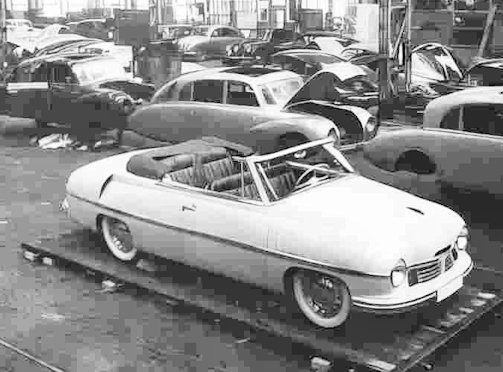
A special feature was the Tatra 601 Tatraplan Cabriolet, a single open vehicle based on the two-door sports model Tatra 601, which was built in 1951 with a slightly different front by the famous body company Sodomka and was given to the Soviet state and party leader Josef Stalin.
In the same year 1951 the state planning department of the ČSR decided to move the production of the Tatraplan to AZNP (Škoda) to Mladá Boleslav. Tatra should be completely switched to truck production following the discontinuation of the last passenger car model, as planned by the RGW. This decision was extremely unpopular with the workforces of both companies, and since production at Škoda was rather bad, it was decided that, despite the success in the market the car had (and still could have), after just one year in Mladá Boleslav 1952, which caused regret, especially on the export markets. The Tatra plan was the last mid-range car of Tatra and found after the end of production even later no successor. A total of 6342 specimens were built, of which 4242 in Kopřivnice and 2100 in Mladá Boleslav.
The cars built at Škoda can be easily distinguished by the rounded rather than pointed top of the rear hood and a few other small details, but are otherwise the same. Overall, Škoda had difficulty meeting the quality standard of Tatra.
In the last year of production in 1952, three prototypes of the Tatra 600 Diesel, also known as Tatraplan Diesel, were built. The vehicle had the chassis and body of the production vehicle with petrol engine, but an air-cooled 4-cylinder diesel boxer engine also with 1952 cc displacement and a power of 42 hp (30.8 kW) at 3300 / min. He accelerated the car to 100-110 km / h with a consumption of 8 to 9 ltr. /100 km. The start of series production was planned; Economic difficulties prevented this.
Prototypes
- Tatra 600 "Ambrož" (1946)
- Tatra 600 "Josef" (1947)
- Tatra 600 Tatraplan Sport (1950),
- Tatra 600 Diesel (1952)
Special versions
- Tatra 600 Tatra Plan
- Tatra 600 Tatraplan ambulance (with front engine)
- Tatra 600 Tatraplan pickup truck (with front engine)
- Tatra 601 Tatraplan Cabriolet (single piece as a gift for Josef Stalin)
- Race versions
- Tatra 601 Tatraplan Monte Carlo (including single copies with the V8 engine of the later type 603)
- Tatra 602 Tatraplan Sport
Tatra 603
 |
|
|
Production : |
1956 to 1975 |
|
Class: |
Luxury car |
|
Body versions: |
limousine |
|
Engines: |
Gasoline:2.5 litres (70-77 kW) |
|
Length: |
4975 mm |
|
Width: |
1895 mm |
|
Height: |
1530 mm |
|
Wheelbase: |
2750 mm |
|
Curb weight: |
1470 kg |
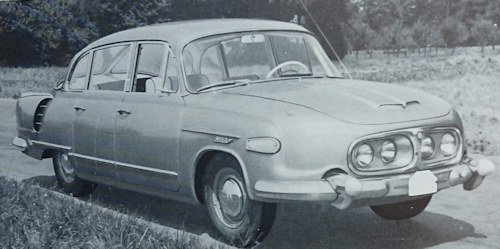
The Tatra 603 is a luxury car of the Czechoslovak car manufacturer Tatra. It was produced from 1956 to 1975 in three series.
History
The Tatra 603 continued the tradition of streamlined styling at Tatra, which dates back to Hans Ledwinka. Another special feature was the air-cooled V8 engine in the rear of the car. Thus, the Tatra 603 stood out, both technically and externally, significantly different from other passenger car models. As a representative vehicle of the upper class, it was in the Eastern bloc high-ranking persons and organs of the society by allocation at the disposal.in Czechoslovakia the production of luxury passenger cars was considered needed. In addition, the government now recognized that the construction of luxury cars was quite a question of national prestige, and therefore granted Tatra in 1953 permission to produce new luxury cars.
The Tatra 603 was exported from the early 1960s to numerous countries in the socialist economic area. Mostly he was assigned to appropriate persons and organs for official, representative purposes. In Czechoslovakia were the higher functionaries of the Communist Party, senior civil servants, directors of the larger state enterprises as well as authorities and Czechoslovakian intelligence agents. The T 603 was also state body of Czechoslovakia and was available to the government members and diplomats. However, the president was not chauffeured with this vehicle, but settled in stretched Soviet limousines by GAZ drive. A few older specimens were used as a repainted emergency vehicle by firefighter commanders. From the civil service outdated specimens often came into private hands. Few copies were used in some cities of the CSSR in private hands as a taxi. In the course of their mission, many vehicles were sent to the factory for overhaul, where they received some of a new body and older versions were often upgraded to the current state. Exports to the East began in late 1959. Before the fall of the Iron Curtain in 1989, the T 603 was a rarity in the West. After 1990, many of these cars were privately exported to the West.
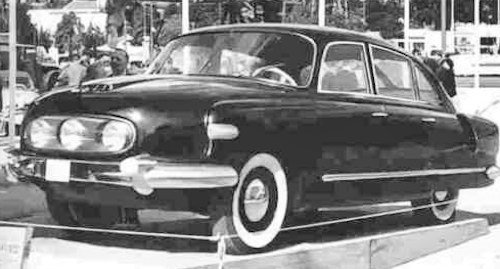
The model’s name Tatra 603 is derived from the engine type 603, which was designed differently than the newly designed body in 1949. This new engine was albeit modified accordingly in 1950 in the GP racing car Tatra 607 Monoposto and 1951 in 601 Tatra plan Monte Carlo for use in motorsport and was therefore proven and proven. The T 603 was the last Tatra to have a streamlined bodywork. With his predecessor T 87 he had only the basic principles in common (air cooling, Rear-engine, rear-wheel drive, swing axle rear), but has been completely redesigned. The central fin on the rear of the car, which featured the pre-war T 77 and T 87 prototypes in the 1955 prototype, was not included in the series. One style feature is the air intake hoses needed for air cooling, which are integrated into the rear wheel arches. A special feature of the first series (1955 to 1963) were the three main headlights of the same size behind a bodywork shaped vaulted glass cover, which was chosen to optimize the aerodynamics of the body.
The work on the new Tatra 603 began in the early 1950s in secret form in a design office in Prague. During this time, the construction of the first prototypes began. The government wanted a six-seat car and a 3.6-liter V8 rear engine within half a year. In the years 1954 and 1955, a large-capacity sedan based on the Tatra 603 under the name "Tatra 707" was designed, but never realized even as a prototype. Was developed a completely new large car with aerodynamic body, an air - cooled V - eight - cylinder engine in the Rear (603F version) with a displacement of (initially) 2545 cc, OHV - valve control and a power of 95 HP (73 kW).
The car was presented in 1956 at home and abroad to the public with the beginning of mass production. The initially 95 and later 105 hp engine accelerated the big car up to 165 km / h (first series 170 km / h), which not least made the streamlined bodywork possible. Since 1962, a new engine version was installed (603G), which had a slightly reduced to 2474 cc engine displacement, but increased by 10 hp performance. The Tatra 603 had despite the Hecktriebsatzes a largely uniform weight distribution (distribution of weight 45% front axle, 55% rear axle). The T 603 is easy to steer despite the lack of power steering and still convinces with good suspension comfort. The performance was impressive and make the 603 still a fast-touring car.
PERFORMANCE:
- Engine Capacity: 151.19 cu In, 2472 cu cm
- Fuel Consumption: 21.7 m imp gal, 18.1 m/US gal, 13 1 100 km
- Max Speed: 100.6 mph, 162 km h
- max power (SAE): 125 hp at 4800 rpm
- max torque (DIN): 112 1b ft, 15.5 kgm at 3000 rpm
- max number of engine rpm: 5000
- specific power: 50.6 hp/l
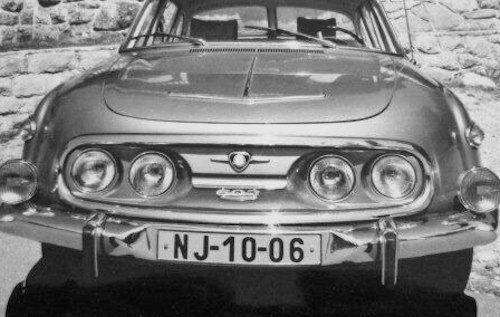
In 1963, the car was modernized to type 2-603. The most noticeable change was in the front of the vehicle, where the front three headlamps behind the glass cover were replaced by four smaller narrow headlamps with no further cover. As a result, the front of the T 603 was slightly rugged, which increased the air resistance; the top speed dropped by 5 km / h despite the slight increase in output. Further smaller optical retouching’s on the body followed. The middle headlight served until then as cornering light, but caused space problems in the trunk, which was located at the front, since the engine was placed in the rear.

1968 was followed by another revision, with a new and more stable engine version (603H) installed and the four headlights were slightly further outward. This version to be called Tatra 3-603. However, because of the high financial expenses for homologation, it remained officially known as Tatra 2-603 (Type 603-2). For distinction, however, the car was often called Tatra 603-2 model in 1969. Again, minor changes have been made to the bodywork. Most striking were the front, the chrome strips on the side (now arranged continuously and set higher) and the new, simplified, tapered in the centre instead of previously arched hubcaps.
The T 603 was also used in motorsport. Factory teams appeared at the Monte Carlo Rally, the Marathon de la Route and other international racing events, as well as national Czechoslovakian championships. Once, the Tatra team even managed to win the Marathon de la Route with a performance-enhanced T 603 of the first series, which was upgraded to 190 hp. The last racing versions were the Tatra 603 B5 in 1965 and the Tatra 603 B6 in 1968. At an Austrian Alpine rally, five vehicles started and were the first to arrive in succession.
The production of the T 603 ended in 1975, after a year ago the more modern and stronger successor 613.From 1956 to 1975 20,422 copies were mostly made by hand in twenty years; Thus, this model represents the most frequently produced passenger car type of Tatra. The Tatra 603 was also the last passenger car produced in Kopřivnice. Successor to the T 603 was from 1974 the Type 613.

