
Thames
Ford Thames 300
 |
|
|
Manufacturer: |
Ford of Britain |
|
Class: |
Commercial vehicle |
|
Type: |
van |
|
Production period: |
1954 to 1961 |
|
Engine: |
Petrol engines |
|
Wheelbase: |
7ft. 3in. |
|
Length: |
11 ft 8 in |
|
Height: |
5ft. 3in |
|
weight: |
5 cwt: 1,563 lb.; 7 cwt: 1,640 1b. |
The Ford Thames 300E is a small car derived van produced by Ford of Britain from 1954 to 1961.
History
The Thames 300E produced by Ford of Britain from 1954 to 1961.The Thames and Thames Trader name was given to all available sizes produced by British Ford Commercial vehicles from the time following the dropping of the Fordson badge. The Thames 300E was introduced in July 1954 built on the Ford Anglia, this was also based on the the original Ford Squire that was a two-door estate design, related to the Ford Prefect 100E four-door saloon with an all-steel body along with the Ford Escort version that was a mechanically identical estate car with the lower trim level of the Ford Anglia, it was substantially shorter than both the Prefect and the closely related Ford Anglia 100E two-door saloon.It used the short front doors of the four-door model because the bodyshell was optimized for use as the Thames 300E panel van.Production of the Thames 300E panel van continued along with the original Escort until 1961.
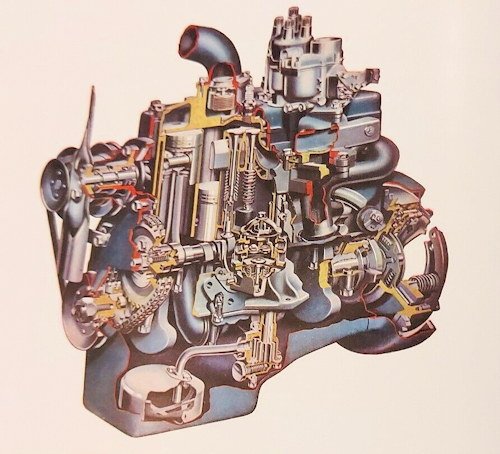
The Ford Thames 300E received the petrol 1172 cc four-cylinder in line, side valve engine this came with 36 bhp at 4,500 r.p.m. and Glide ride suspension independent Type front
and the rear Longitudinal semi-elliptic leaf. The bodyshell was optimized for use as a small delivery panel van rather than an estate with its two, short passenger doors and shorter overall length than the saloons.
The basic instruments around the steering column directly ahead of the driver. speedometer. odometer. fuel gauge. oil warning light and main beam indicator. Ignition warning light. ignition. lighting Controls Choke and starter knobs and instrument lighting switches windscreen wiper knob ; foot—operated headlamp dipper switch. in a small cluster,the gear change was floor-mounted. during production the dashboard was revised twice replaced by a central panel with twin dials by 1957 along with a new mesh radiator grille replacing the 3 slated version grill, new front lamp surrounds and larger taillights and from 1959 more changes .
Inside ,Sun visor,Ashtray,Bucket type driver's seat.parcel tray beneath facia panel, Vacuum-operated Windscreen wipers. Optional extras available : demister; passenger seat, with second visor, flashing indicators. rear quarter bumpers. twin windtone horns.
Colours Suede Grey primer. (at extra cost) Black, Dover White. Kenilworth Blue. Richmond Blue, Pembroke Coral. Newark Grey. Ludlow Green, Durham Beige.
Initially, there was only one model with 5 cwt with 21.5 cwt (250 kg) carrying capacity. Later standard and deluxe models with 7 cwt variant with 23.5 cwt 350 kg payload and stronger rear leaf springs with 6-ply tires. They all had the same 66-cubic-foot (1.9 m3) load volume. Inside plenty of leg and head room the passenger seat and heater was optional the extra spare wheel is positioned against body side when passenger seat is fitted, a well-designed facia with a full-width parcel shelf A low loading height of 23" for 5 cwt and 24" for 7 cwt increases the load space, and automatic retainers hold open the Wide rear doors.
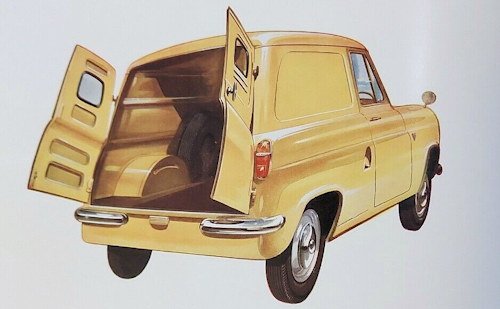
300E production ended in April 1961 and the van's replacement, the Anglia 105E based Thames 307E, was introduced in march of the same year. A Production totaled 196,885 examples comprising 139,267 5 cwt, 10,056 Standard 7 cwt and 47,562 Deluxe 7 cwt units. Were manufactured until the end of production 1961.
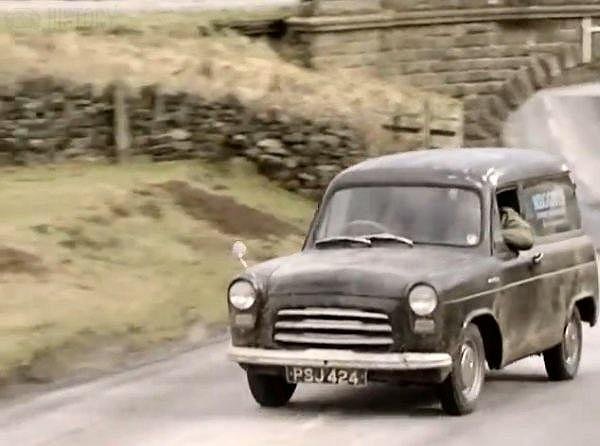
A 1956 Thames Van 300E in Heartbeat tv series
Ford R-Series Bus
 |
|
|
Manufacturer |
Ford Thames |
|
design type |
service bus |
|
Production period |
1964-1986 |
|
engine |
Ford R 2.8 liter diesel engine |
|
power |
128 hp / 140 hp / 150 hp |
|
length |
10 or 11 m |
The Ford Thames R-Series was an bus chassis manufactured by Ford Thames in Dagenham , England. This was manufactured from 1964 to 1986.
History
The Ford R-Series was an omnibus chassis. A number of components, including the engines, were shared with the Ford D-Series truck . The engine was here, however, still mounted in front of the front axle, in order to arrange the passenger entry directly next to the driver's place. The vehicles were 10 (model R192 , later R1014 ) and 11 meters ( R226 , later R1114 ) long and equipped with a 140 hp diesel engine.The series has been continuously developed. In the last variants R1015 and R1115 , the turbo diesel engine was tilted to the side in order to save height. These variants were built from 1978.
The R-series was primarily a competitor of various Bedford - chassis , which were very successful at that time. Both chassis were a cheaper alternative to the designs of the then market leader Leyland Motors and later by Volvo and DAF . A synchronized transmission was standard, but some vehicles were later fitted with Allison automatic transmissions to reduce the driver's workload in urban areas. The superstructures came from Duple Coachbuilders and Plaxton and also Willowbrook .
The R-Series enjoyed great popularity in Britain in the 1970s. However, following the conservative government's election in 1979, local public transport subsidies were cut sharply and demand eased. The last vehicles were produced in 1986. Buses with front engines are now rarely used in Europe because of the increased demands on accessibility that can only be met with low-floor buses .
Some buses of the R-series are still used in passenger transport, such. For example, in Malta , other vehicles have been converted into motorhomes and car transporters.An important user of the buses built on this chassis was Jersey Motor Transport . In the 1970s and 1980s, the fleet consisted almost entirely of buses of the R-series. The reason was the willingness of the manufacturer and various bodybuilders to deliver non-standard shorter and narrower buses that met local size constraints. Most of these buses had the narrow structure of the Duple Dominant , earlier constructions also came from Willowbrook, later from Wadham Stringer. Jersey Motor Transport also owned several larger and longer buses with Plaxton bodies, originally built for operators in northeast England. These buses needed special operating instructions and could be on jerseyonly be used on some routes. Because of the operating restrictions, they were sold after a few years.
The South Korean manufacturer Hyundai built from 1969 to 1976, the Ford R192 with the 125 hp and R182 from 1973 to 1977 with the 150 hp diesel engine by badge engineering . After that, Hyundai replaced it with its own developed Hyundai HD160 / HD170 series .

Fordson Thames 7V
 |
|
|
Manufacturer: |
Ford of Britain |
|
Production period: |
1937-1949 |
|
Type |
Truck various bodies |
|
Engines: |
3.6-liter Ford Flathead V8 petrol engine |
Depending on the dealer network of Ford of Britain offered Fordson Thames 7V or Fordson 7V in 1937 as a successor to the Ford Model BB was first introduced. With a payload of up to 5 tons available, at that time very modern truck in cab-over-construction, made possible a larger maneuverability in urban environment. Two different wheelbases were available, and the chassis provided the basis for various bodies.

As the Fordson Thames 7V at the time of World War II, it was most widely used as a troop transport and fire engine, The model series was powered by the well-known V8 Ford Flathead side valve engine with 85 hp power. By means of three-speed with optional four-speed manual transmission and cardan shaft, the drive to the rear wheels took place. Outstanding for the time was the one-piece windscreen, which could be opened for ventilation, and a sunroof over the passenger seat.
Early 7Vs built in 1937 and 1938 had a curved, round radiator grille, while from the 1939 built 7Vs it was flat and just like the headlights was smaller. These measures were the result of the beginning of the war and the resulting shortage of raw materials. The production of civilian 7Vs was maintained throughout the war. For the use of the army also an armored version was produced.
Immediately after the war, numerous improvements were introduced, the most outstanding being a new brake system, and a 4.7-liter Perkins engine-series six-cylinder diesel engine with 45 hp was optional from 1948 onwards. Until mid-1949, the model series was produced in Dagenham and replaced by the Fordson Thames ET . Ebro built the model under license as Ebro 7V.

Fordson Ford Thames E83W
 |
|
|
Manufacturer: |
ford |
|
Production period: |
1938-1957 |
|
designs: |
Flatbed , panel van , various special bodies |
|
Engines: |
Gasoline engine : 1.2 liters (7 kW) |
|
Payload: |
0.5 t |
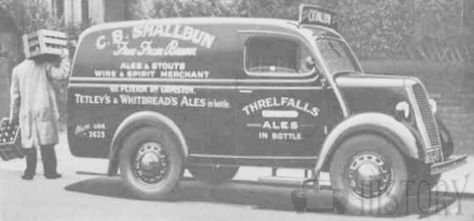
The Fordson E83W , later also built as a Ford Thames E83W , was a light commercial vehicle from Ford of Britain . Between 1938 and 1957 that ran off the line at the Dagenham plant in the UK , initially with a payload of 500 kg. In Australia, this was sold as a Ten-Ten. After the Second World War , Ford exported it almost worldwide, while in some cases only chassis were exported and the construction was carried out locally. In addition to the chassis, the model was used as a flatbed and panel van with metal and wood construction. Aligned the E83W for regional transport of freight trade, bakeries and the like. During and after the Second World War, many specialized variants such as mobile canteens, ice trucks and even fire pumps were built on the E83W chassis.
The E83W was powered by a 1.2-liter Ford side-valve engine that delivered 10 hp, combined with a 3-speed manual and rear-wheel drive and 36 ft turning circle and 8 inch ground clearance. This made the Fordson E83W much slower than the sedans with the same engine. For example, it only reached a maximum speed of 40 miles per hour. Apart from the engine, this shared very few parts with the other small Fords of the time, including the contemporary Ford V8 models 62 and E71A Pilot . The headlamps were shared with the Fordson E27N tractor for which they were optional 6 volt system with a large battery and positive ground.
The E83W was a simple and slow mode of transport but with a 120 cubic inch load space it was still stable and reliable, serving well into the 1960s, and has survived in large numbers in many parts of the world.In 1957 replaced with the Ford Thames 400E .

Thames Trader Truck
From 1957 to 1965
 |
|
|---|---|
| Overview | |
| Manufacturer | Ford Motor Company |
| Production | 1957-1965 |
| Assembly | Dagenham, England |
| Body and chassis | |
| Body style | 2-door pickup 2-door van |
| Layout | FR layout |
| Dimensions | |
| Wheelbase | 118.0 in (2,997 mm) 138.0 in (3,505 mm) 152.0 in (3,861 mm) 160.0 in (4,064 mm) 108.0 in (2,743 mm) |
The Thames Trader was a range of trucks manufactured by the British arm of the Ford Motor Company built between 1957 and 1965.Produced at the Dagenham plant for the European market . The trader was also exported to South Africa , Indonesia and Australia . From 1963 the trader was also produced by Ebro in Spain as Ebro C-400, C-500 and C-550. Also starting from 1963 the production began at Otosan in Turkey and in the Ford plant in Rhodesien - Egypt, after the end of the production in England as Ford K series .
Thames Trader FC Series
In March 1957, Ford England introduced the new Thames Trader FC (Forward Control) series as the successor to the Fordson Thames ET and the Fordson E83W . The new trucks were the most versatile that Ford England built until then, as the payload now ranged from two to seven tons. The design was based on the American Ford C-series and stood out clearly from other commercial vehicles of the same time. As engines 4- or 6-cylinder diesel or gasoline engines were used. In addition to flatbed , This was also used as a chassis produced, which were provided by designers with a variety of structures, for example, as a bus .
The distinctive cab design, which sets it apart from other British commercial vehicles, was a forward-control (or semi-forward control) design and the Thames Trader model covered a much wider weight range than the existing normal control ET Thames model or the earlier forward control 7V model. Both these earlier models had been based on Ford of America designs, the new Thames Trader was the first heavy commercial to be designed by Ford of Britain, (although if you look at the headlight surrounds of the American Ford C series truck of the mid 1950s there is a definite family resemblance).
Mechanicals and wheelbase types
The Thames Trader model range covered weights from 2 to 7 tons, powered by either petrol or diesel engines in four- or 6 cylinders guises. The lower weight vehicles were available with 118 and 138 inch wheelbases, the heavy weight vehicle with 138, 152 and 160 inch wheelbases, there was also a 108 inch tipper wheelbase. In addition there was also a low frame chassis model - typically used for furniture van bodywork.
Mk2
was revised and introduced as MK II. You could now order a conventional cab NC (NC for Normal Control) and a 17 ton truck tractor. The NC models had the cab of the German Ford FK series , whose production was discontinued in 1961. In 1965, production in England was discontinued, while the model in Turkey and Egypt for the non-European market was further produced. The successor model was the Ford D-series , which revived under the name Ford N-series in 1973.
A Mk 2 version was introduced in mid-1962. Externally it is very easy to differentiate between Mk1 and Mk2 versions; the Mk1 has the words THAMESTRADER in red on a chrome strip along the bottom of the bonnet opening and the white painted grill between the headlights has a vertical divider with a red circular badge with 4 stars, whereas the Mk2 has just the word THAMES under the bonnet, and TRADER in white letters spaced out between the headlights replacing the divider and badge. The Mk2 Diesel engined variants had either a 4D or 6D chrome badge on each front wing, on the Mk1 it was a squarish chrome badge with either a red painted 4, 6, 4D or 6D to indicate the engine configuration. The lower edge of the badge had a horizontal chrome strip running the length of the lower part of the wing.

