
Skoda
Škoda 1202 STW
 |
|
| Manufacturer | AZNP |
|---|---|
| Production | 1961 to 1973 |
| Produced | 60,141 produced |
| Class | Comercial, Motor car |
| Body style | 4-door estate 3-door van 2-door pick-up |
| Layout | FR layout |
| Engine | 1.2 L I4 |
| Wheel base | 105.79 in, 2685 mm |
| Length | 176.71 in, 4485 mm |
| Height | 62.25 in. 1580 mm (estate) |
| Dry weight | 2370 1b, 1075 kg (estate) |
The Škoda 1202 This two basic body styles, the open bed pick-up and the STW station wagon. It was either a five-seater passenger four-door car, used as a family car produced as a station wagon with a distribution of weight for all roads with 35.3% front axle, and larger 64.7 % at rear axle, or Commercial vehicle light panel van and pick-up (Utility) and also special builds by Czechoslovakian automaker AZNP at their subsidiary plant in Vrchlabí.
The station wagon had an unusual body with one door on the driver's side and two doors on the passenger side. A saloon (sedan) version was never produced. It was introduced in 1961 as a successor to the station wagon and pick-up versions of the Škoda 1201 and closely resembled the slightly smaller Octavia Combi.
The car was powered by a 1221 cc four-cylinder ohv water-cooled engine delivering 34.5 kW (47 PS) of output, inherited from its predecessor, and which later also found its way into the company’s Octavia model. The four-speed gear-box included synchromesh on the top three ratios, power being delivered to the rear wheels via a jointed prop shaft the final drive as spiral bevel with final ratio of 5.25:1. A top speed of 100 km/h (63 mph) was quoted as from 1969, the engine now had higher power.
PERFORMANCE: (Early)
- Engine capacity: 74.68 cu in, 1221 cu cm
- Fuel consumption: 29.7 m imp gal, 24.7 m US gal, 9.5 1 x 100 km
- Max speed: 68.3 mph, 110 km h
- Max power (SAE): 47 hp at 4500 rpm
- Max torque (SAE): 63 1b ft. 8.7 kgm at 3000 rpm
- Max number of engine rpm: 5000
- Specific power: 38.5 hp/l
- Power-weight ratio: 50.5 lb/hp. 22.9 kg/hp
- Acceleration: 0—50 mph (0—80 km/h) 25 sec

Although volumes were never high, the model remained in production until 1973. More modern models Škoda 1000 MB and Škoda 100, produced in main plant in Mladá Boleslav, featured rear engine configuration, which was not suitable for station wagon and van bodies.The car was produced in Vrchlabí where a total of 60,141 units were produced. It replaced the Type 1201 STW and was later replaced by the regular delivery 1203.It was exported to Soviet Union and was the only privately-owned foreign car there until 1990.

Skoda Felicia 450
 |
|
|
Manufacturer |
AZNP |
|
Production |
1959 to 1964 |
|
Class |
Sports |
|
Body style |
2-door convertible |
|
Layout |
front engine, rear wheel drive |
|
Engine |
1.1 L I4, 1.2 L I4 |
| Wheel base | 94.56 in, 2400 mm |
| Length | 160.16 in, 4065 mm |
| Width | 63.04 in, 1600 mm |
| Height | 56.33 in, 1380 mm |
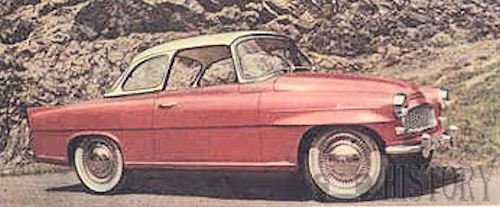
The Skoda Felicia and 450 is an open convertible automobile which was produced by AZNP from 1957 to 1964.
History
The Skoda 450 or Skoda Felicia was a rear wheel drive convertible with two doors and 2 + 2 seats seats produced by the Czechoslovak (today Czech) car manufacturer AZNP under the brand name Skoda.
The 450 was produced between 1957 and 1964 and was based on the Škoda 440. The 450 was distinguished from the sedan and combi by a more powerful engine and a fabric roof. From about 1960 a hardtop was available as a extra, which made the Felicia suitable for all weather conditions.
The 450 was made from 1957 through 1959 with a four-cylinder engine with 1089 cc and 50 hp (37 kW). With this engine, the Škoda 450 could reach a top speed of 135 km/h fitted with a 4 speed gearbox.The suspension at front was independent, wishbones, coil springs, anti-roll bar and telescopic dampers the rear suspension fitted with swinging semi-axles, laminated transverse upper arms and telescopic dampers.
In 1959 the name 450 was changed to Škoda Felicia after a modernization and some external changes. The 450 was built as Felicia until 1964. From 1961 a version with a 1221 cc 55 hp engine was also produced as Škoda Felicia Super.
The Felicia was introduced in 1959 as a 2-door convertible, replacing the Škoda 450. Able to seat five persons, it was equipped with a folding hood and a plastic hardtop. Styling is similar to that of the contemporary Škoda Octavia. The Felicia was offered only with a 1089 cc four-cylinder engine however a Felicia Super model was introduced in 1961 powered by a larger 1221 cc with 2 Jikov 32 SOPc downdraft carburettors .
PERFORMANCE: 1200cc Super
- Engine capacity: 74.68 cu in, 1221 cu cm
- Fuel consumption: 29.7 m/imp gal, 24.7 m US gal, 9.5 1 x 100 km
- Max speed: 87 mph, 140 km h
- Max power (SAE): 55 hp at 5100 rpm
- Max torque (SAE): 61 1b ft, 8.4 kgm at 3000 rpm
- Max number of engine rpm: 5500
- Specific power: 45 hp/l
- Power-weight ratio: 36.2 lb/hp, 16.4 kg/hp
- Useful load: 772 1b, 350 kg
- Acceleration: 0—50 mph (0-80 kmh) 15 sec
The Škoda Felicia was one of the few convertibles in the Eastern Bloc to be produced in large numbers. The appearance was considered successful at the time. A tightly tuned chassis and powerful exhaust sound had to underline the sporty character. The steering was indirect and the handling strongly oversteered. The engine was considered elastic, but not high-revving. Among the positive features was modest fuel consumption.
Production of the convertible ended in 1964 without replacement. The sporty model was succeeded by the Škoda 1100 MBX, a rear-engine coupé. The Felicia name was resurrected by Škoda from 1994 for the compact Škoda Felicia.In total of the original 14,863 450 and Felicias were produced.
Škoda 645
 |
|
|
Production period: |
1929 to 1934 |
|
Class: |
Motor car |
|
Body versions: |
sedan, Landauer, Tudor,, Phaeton,Cabriolet. |
|
Engines: |
Gasoline six-cylinder |
.
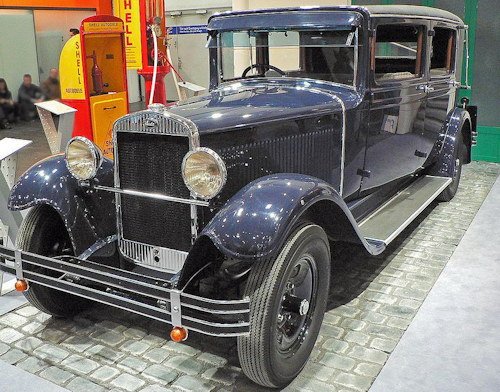
The Škoda 645 was an automobile from company Skoda from the late 1920s to the mid 1930s.
History
The Škoda 645 was the smaller sister model of the Škoda R 6 . The car was presented in 1929 at the Prague Motor Show and built until 1934. This was available in various body tpes such as a sedan, Landauer, Tudor, four-door, Phaeton or Cabriolet. The structure was built in mixed construction of wooden skeleton and sheet metal panels .The frame of the car consisted of riveted steel U-profiles.
The water-cooled, side-controlled six-cylinder four-stroke engine had a displacement of 2492 cc and a power of 45 hp (33 kW). This accelerated the 920-1240 kg car up to 90 km / h. The propulsion power was transmitted to the rear wheels via the gearbox flanged to the engine block and a cardan shaft.
Škoda 706 MT Truck
 |
|
|
Manufacturer: |
LIAZ |
|
Production period: |
1969 to 1987 |
|
Engines: |
Six-cylinder diesel engine |
|
Power: |
147 kW |
|
Payload: |
6-7 t |
|
Perm. Total weight: |
up to 16 t |
The Škoda 706 MT was a lorry of the Czechoslovakian commercial vehicle manufacturer LIAZ . It originated from the truck Škoda 706 RT . From 1984 this was also marketed under the brand name Liaz .
History
The Škoda 706 MT was a lorry had a ladder frame of the Škoda 706 RT this remained unchanged. For the vehicle various bodies were made, for which the wheelbase of the chassis was adjusted. Widely used were three-way tippers , flatbed trucks and semitrailer tractors , but also special bodies such as garbage trucks , blasting wagons and fire trucks . The cab for the flatbed trucks, tractors and some special bodies was extended and had four seats. The vehicle was imported from 1969 into the GDR .
The cab was not tiltable, access to the engine was made via flaps. Externally, the Škoda 706 MT is distinguished from its predecessor only by the cover of the cooling water inlet and the ornament of the radiator grille. As engine of the M634 was used. Like its predecessor, it is a six-cylinder diesel engine with direct injection. The capacity was slightly increased to 11.94 l, the power increased to 200 hp. The drive unit was completed by a single-disc dry clutchand a synchronized five-speed transmission with split group, resulting in 10 forward and 2 reverse gear ratios. The engine was positioned in the chassis above the front axle. The rear axle was powered by a two-piece propshaft . Instead of the previous differential but this time an external planetary gear was used, some of the rear axles were sourced from the Hungarian manufacturer Rába . Used came leaf-sprung solid axle with lever shock absorbers . The vehicle was delayed with pneumatically operated brakes on all wheels, which were supported by an engine brake . Also available was a mechanical parking brake. The truck had oneautomatic load-dependent brake on the rear axle. The steering was a hydraulic power steering with pneumatic assistance. With a vehicle mass of approximately 6 to 7 t depending on the version, the permissible total mass was approx. 16 t.
The Škoda 706 MT was replaced by the LIAZ 100 from 1977, but chassis for special bodies were still produced until 1987.
Škoda 706 RT
 |
|
|
Manufacturer: |
LIAZ |
|
Production period: |
1957-1979 |
|
Engines: |
Six-cylinder diesel engine |
|
Power: |
118 kW |
|
Payload: |
about 7 t |
|
Perm. Total weight: |
about 16 t |
The Škoda 706 RT was a truck of the Czechoslovakian commercial vehicle manufacturer LIAZ . It originated from the truck Škoda 706 R.
History
For the vehicle various bodies were made, for which the wheelbase of the chassis was adjusted. Widely used were three-way tippers , flatbed trucks and semitrailer tractors , but also special bodies such as garbage trucks , water tankers and fire trucks . The cab for the flatbed trucks, tractors and some special bodies was extended and had four seats. The vehicle was imported to the GDR from 1957 and determined the local street scene in the 1960s, after the production of heavy trucks in the GDR had been stopped.
The ladder frame of the Škoda 706 R has been shortened, as instead of the previous a front handlebar construction was used. The cab was not tiltable, access to the engine was made via flaps. The drive was the engine Škoda 706RT. It was derived from the vortex chamber engine of the Škoda 706 R. The engine, a six-cylinder diesel engine with direct injection , had a capacity of 11.78 l and offered an output of 160 hp. Performance and reliability could be increased with the new engine. The drive unit was completed by a single-disc dry clutchand a synchronized five-speed gearbox. The engine was positioned in the chassis above the front axle. The rear axle was powered by a two-piece propshaft . Used came leaf-sprung solid axle with lever shock absorbers .
The vehicle was delayed with pneumatically operated brakes on all wheels, which were supported by an engine brake . Also available was a mechanical parking brake. The steering was a hydraulic power steering with pneumatic assistance. The tires were mounted on Trilex rims . With a vehicle mass of approximately 9 t, the maximum permissible mass was approximately 16 t.
The bus Škoda 706 RTO was derived from the Škoda 706 RT .From 1960, the China National Heavy Duty Truck Group ( Sinotruk ) produced China's first heavy truck, the Huanghe JN150 , which was a replica of the Škoda 706 RT.

