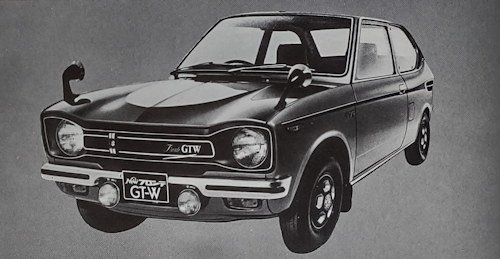
Suzuki
Suzuki Grand Vitara (FT / GT)
 |
|
|
Production period: |
1998 to 2005 |
|
Body versions : |
station wagon |
|
Engines: |
Gasoline engines : 1.6-2.7 liters |
|
Length: |
4140-4178 mm |
|
Width: |
1778-1781 mm |
|
Height: |
1709-1740 mm |
|
Wheelbase : |
2200-2479 mm |
|
Curb weight : |
1470-1735 kg |
The Grand Vitara replaced in March 1998, the predecessor model Suzuki Vitara . From this there was already since 1990 a version with longer wheelbase and five doors. Now the short versions have been called Grand Vitara.
Grand Vitaras are V6 wagons With extra standard features, Both body styles use body-on-frame construction. Top-line Grand Vitara Limited comes with exclusive leather upholstery, deep-tint glass, and fog lights. All models offer rear- or part-time 4-wheel drive; the latter, denoted by "X' in the model name, includes low-range gearing but is not for use on dry pavement. Antilock brakes come as standard equipment on the Grand Vitara JLS, JLX Plus and Limited models. In addition to the closed versions, the model was also available with soft top. The Grand Vitaras has a shiftable four-wheel drive .

The top model was the Grand Vitara XL-7 from September 2001 . It differed by its longer wheelbase and a V6 full aluminum engine, which was available only for this model. At the same time, the other variants were modeled. The XL-7 itself was revised in April 2003.
Standard features
5- speed manual transmission; rear wheel drive; steel rims; 16 x 7.0 in. rims; P235'60SR16 tires; full size spare tire; steel spare wheel; rear mounted Spare tire; front independent suspension: front stabilizer bar; ventilated front disc / rear drum brakes; rear door child safety locks; child seat anchors; remote anti-theft system; daytime running lights; intermittent wipers; roof rack; rear defogger; rear window wiper

Inside
5 person total seating capacity; bucket front seats; cloth upholstery; bench rear seat; split-folding; remote power door locks; power windows; power mirrors; AM/FM CD stereo; element antenna; cruise control; power steering; tilt-adjustable steering wheel; front cupholders; front 12v power Outlet; air conditioning; micron air filtration; front and rear floor mats; cargo area light; tachometer, low fuel level warning; skid plates; rear Side-hinged door; side-impact door beam; painted finish bumpers.

Engine choices G16A 1590 cc 4-cylinder the J20A 2.0 16V 140 hp 4-cylinder and Engine H25A 2.5 24V 160 hp 6 cyl. in V .The Grand Vitara's exclusive 155-hp 2.5-liter V6 performs its task very well in most circumstances. As with any vehicle of this size with high air resistance, wind noise is omnipresent, and average fuel consumption (12 liters per 100 km). Despite its live rear axle, the Grand Vitara offers acceptable ride comfort, but the minor bumps caused by uneven road surfaces despite its high ground clearance, its small turning circle, which makes it easy to park, and the presence of very large side mirrors.
Model History
- 03/1998: Introduction of the Grand Vitara with three or five doors
- 03/1999: Introduction of the two-door as a convertible or with steel roof; both with 2.0-liter four-cylinder gasoline engines (128 hp)
- 09/2000: New 2.0 TD with common-rail diesel
- 09/2001: Long version XL-7 (4.70 m) with 2.7 V6 gasoline engine (127 kW / 173 hp)
- 04/2003: Grand Vitara XL-7 with new front end with 2.7 V6 petrol engine (135 kW / 184 hp)
- 09/2005: Second generation of the Grand Vitara appears

Suzuki Grand Vitara 2nd generation (JT)
 |
|
|
Production period: |
2005 to 2015 |
|
Body versions : |
station wagon |
|
Engines: |
Gasoline engines : 1.6-3.2 liters |
|
Length: |
4050-4490 mm |
|
Width: |
1810-1880 mm |
|
Height: |
1685-1695 mm |
|
Wheelbase : |
2440-2640 mm |
|
Curb weight : |
1480-1816 kg |
In September 2005, the completely newly developed second generation of the Vitara with permanent four-wheel drive appeared. A barrier of the center differential and a railing reduction can be switched on electronically via a rotary switch.
The New Grand Vitara has a torsion-resistant passenger compartment with an integrated ladder frame. The rigid rear axle of the predecessor was replaced by independent wheel suspensions to get more comfort / smoothness on the road. Due to its wheelbase and ground clearance, as well as its technical features, it is closer to an off-road vehicle than an SUV and well-equipped for use in light to medium terrain.

Among other things, there is a new Comfort Plus equipment similar to the Suzuki Grand Vitara XL-7 of the predecessor series. This body version is no different from that of the other model versions. In addition to numerous other extras, this Comfort Plus features leather upholstery, Xenon headlamps and a glass sunroof, as well as root-wood imitation for the dashboard (available only for this trim level).
2009
In January 2009, the Grand Vitara received its first light facelift. The side indicators were integrated into the exterior mirrors. In addition, the control switches for the air conditioning have been changed and provided with a digital display for the set temperature.

In the summer of 2010, there was an additional change to the exhaust gas classification, so that now all gasoline engines meet the Euro 5 standard. Since 2012, the diesel engine has also created the Euro 5 standard.
2012
In autumn 2012, the Grand Vitara was subjected to another facelift . The facelift is particularly noticeable on the front, which includes a new grille and modified bumpers. There are no changes on the engine side.
After ten years, the production of this Grand Vitara generation was discontinued in the spring of 2015.
- Wheel/Length/Width/Height (mm) - 2640/4470/1810/1695
- Weight:1625 kg
- Trunk- 691,951 liters
- Fuel Tank: 66 liters
- Number of airbags: - 6
- Suspension: - Independent, suspension struts Traction Control/Stability Control Independent, multi-link
- Steering - Power-assisted rack-and-pinion
- Turning Circle: - 11.2 m
- Front/Rear Tires - P225/70R16
- Towing Capacity: - 1,361 kg

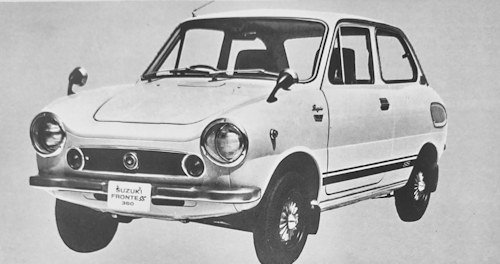
Suzuki Fronte 2nd generation 360 (type LC10)
 |
|
|
manufacturer |
Suzuki |
|
Sales period |
April 1967 - November 1970 |
|
body type |
2 door notchback sedan |
|
Drive system |
RR |
|
Engine |
0.356 L air-cooled 2-cycle in -line 3-cylinder horizontal |
|
Maximum output |
25ps/5,000rpm |
|
Maximum torque |
3.7kgm/4,000rpm |
|
Wheelbase |
1,960mm |
|
Full length |
2,995mm |
|
Width |
1,295mm |
|
Height |
1,330mm |
|
Vehicle weight |
425 kg |
The Suzuki Fronte 360 2nd generation type LC10 was a small Japanese car built in the late 1960s.
History
In April 1967 the newly released car became the Fronte 360 a smal kei-car type car this was a fairly simple but light car, the drive system was changed to rear wheel drive rear engine so in (RR) format, and the column shift was changed to the floor shift with the gearbox was mechanical type with synchromesh on all 2nd 3rd and 4th gears the powertrain was placed transversely in the rear. Along with adopting a more coke bottle rounded style the engine was also changed to an in-line 3-cylinder air-cooled that was described as a 2-stroke 3-cylinder with 356 cc hence the 360. This engine was in addition,to a 36-horsepower high-tuned SS engine .
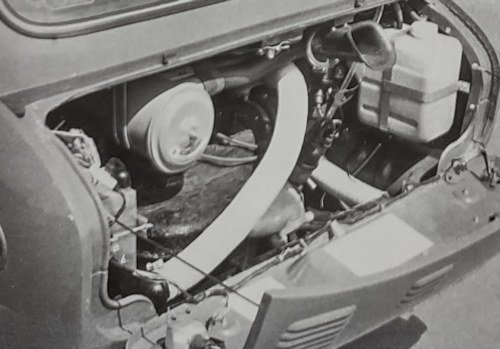
November 1968 there was Added a new more high-performance version the Fronte Street Sports (SS version) this had 36 hp at 7,000 rpm fitted with 3 Mikuni-Villiers semi-downdraught carburettors and a top speed of 77.7 mph, 125 km/h distribution of the cars weight was 38.6% to front axle, and 61.4% at rear axle with front suspension independent type with , wishbones, coil springs, anti-roll bar, telescopic dampers at the rear independent, semi-trailing arms, coil springs, and telescopic dampers The Fronte recieved with some minor updates in 1968 for stricter safety laws and later alongside the Deluxe version in 1970 came the Super Deluxe along later with the super sports sedan " Fronte (SSS)”. these came with Separate the yellow-orange direction indicator from the conventional red taillight for this model and later.
PERFORMANCE: 360 SS
- engine Capacity 21.72 cu in, 356 cu cm
- fuel Consumption 62.7 m/imp gal, 52.3 m/US gal, 4.5 1 x 100 km
- max speed 77.7 mph, 125 km/h
- max power (SAE): 36 hp at 7,000 rpm
- max torque (SAE): 27 1b ft, 3.7 kg m at 6,500 rpm
- max engine rpm: 7,600
- power-weight ratio; 26.9 lb/hp, 12.2 kg/hp
- acceleration: standing 1/4 mile 19.9 sec, 0 —50 mph (0 —80 km/h) 9.7 sec
Suzuki Front 800
 |
|
|
Make: |
Suzuki |
|
Production: |
1965 to1969 |
|
Class: |
Motor car |
|
Body versions: |
saloon |
|
Engines: |
Gasoline:0.79 litre (30 kW) |
|
Length: |
3870 mm |
|
Width: |
1480 mm |
|
Height: |
1360 mm |
|
Wheelbase: |
2200 mm |
|
Curb weight: |
770 kg |
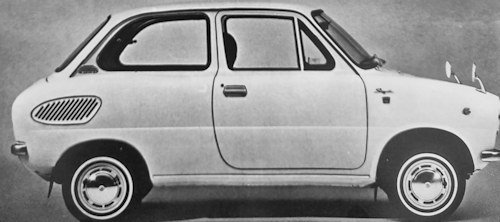
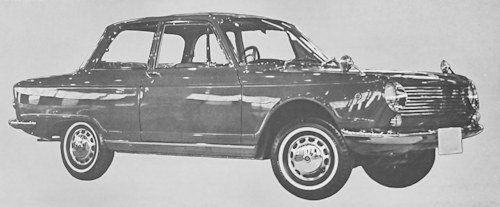
The Suzuki Fronte 800 was a Japanese car from the 1960s, that Suzuki produced from 1965 to 1969.
History
With the beginning of December 1965 sold Fronte 800 Suzuki tried to enter a larger higher market segment than that of the Suzuki Suzulight and the smaller model Suzuki Fronte. The name was adopted from other ranges to save marketing costs and because this was already known to the public.
Already at the Tokyo Motor Show 1962, a four-door 700 cc prototype was shown with body from leading Italian coachbuilders Pietro Frua. Another prototype was shown in 1963 at the Tokyo Motor Show and production announced. However, at the Motor Show 1964, another pre-production model was shown, with the announcement of the market launch in the spring of the following year. In fact, the production of the largely hand-built model began in August 1965.And only available as a larger two-door sedan.
The two-door sedan was designed by the then Suzuki chief designer Sasaki Toru. The sales figures were low, however, as the car was in direct competition with such popular cars as the Toyota Publica or Datsun Sunny. These had modern engines, in contrast to the Suzuki with now outdated two-stroke engine.
Thus, the Fronte 800 was little developed during it production The body was a modern unibody design. Suspension was front independent, wishbones, longitudinal torsion bars, telescopic dampers at the rear independent, semi-trailing arms, transverse torsion bars, telescopic dampers. Drum brakes were used all around with rack-and-pinion steering,12 inch wheels with 6.00 x 12 Tyres . The biggest change was in April 1966 separate front seats instead of a bench, which could be folded from June 1966 initially for an extra charge The boot (trunk) carrying capacity of 882 1b, 400 kg. In August 1966, the sale of the standard version was discontinued, and it was now only offered the de-luxe version with the reclining seats. The 5-seater sedan cost 465,000 yen for the standard model and 540,000 yen for the De Luxe version.
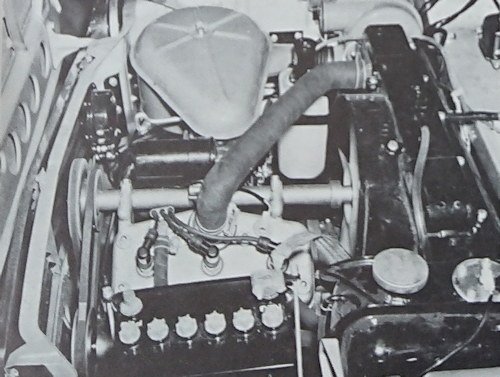
Like other Suzuki engines from the time the three-cylinder two-stroke gasoline water cooled engine with 785 cc capacity was very similar to the 796 cc two-stroke engine of the DKW Junior with a single downdraught twin barrel carburettor. A 1.1-liter version of the engine had been developed for a planned front-1100 model. The engine design was similar to the engine of the DKW F102 with 68 hp and 1175 cc; but with a triple Solex gasifier, the Suzuki engine with 80 hp was much stronger. The equipped with front disc brakes front 1100 reached a top speed of 74.5 mph (160 km / h) . However, Suzuki decided not to build a production model, although motorists increasingly demanded more power and the Suzuki Fronte 1100 could at least initially keep up with the competing offers of the larger manufacturers.
PERFORMANCE: 785 cc
- Engine Capacity 47.90 cu in, 785 cu cm
- Fuel Consumption 21.7 m/imp gal, 18.1 m/US gal, 13 1 x 100 km
- Max Speed 74.5 mph. 120 kmh
- max power (DIN): 41 hp at 4,000 rpm
- max torque (DIN): 59 1b ft. 8.2 kg m at 3,200 rpm
- max number of engine rpm: 4,500
- specific power: 52.2 hp/l
- max speeds: 74.5 mph, 120 km/h in 4th gear
The power was transmitted by fully synchronized 4-speed manual transmission; the lever was mounted on the steering wheel (column change).
Production lasted for only four years. In April 1969, the production was discontinued after less than 3000 copies built of the car in total. The reasons for this were the required production capacity for the Suzuki Fronte. Suzuki tried to place the model in such a way that it could compete with the large domestic manufacturers in the highly competitive Japanese market segment.
Suzuki Fronte 3rd generation LC10 type II
 |
|
|
Production |
November 1970 to July 1973 |
|
Class |
Motor car |
|
Body type |
2-door fastback sedan/coupe |
|
Drive system |
Rear wheel drive |
|
Engine |
0.356 L water-cooled in-line 3-cylinder |
|
Maximum output |
34ps/6,000rpm |
|
Maximum torque |
4.2kgm/4,500rpm |
|
Wheelbase |
2,010mm |
|
Length |
2,995mm |
|
Width |
1,295mm |
|
Height |
1,295mm |
|
Vehicle weight |
475kg |
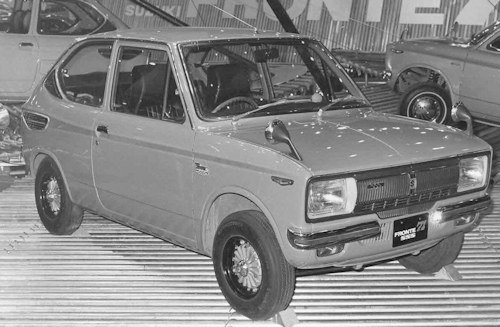
The Suzuki Fronte third generation was a small car built by Suzuki in the 1970s as the models 71,72 and 73 LC10 type II .
History
The Suzuki Fronte from Suzuki Motor Co. Ltd, was a small notchback version of the Suzuki Suzulight TL Van and was introduced in March 1962 the Suzuki fronte first had a front transversely mounted two-cylinder, two-stroke engine, which drove the front wheels. In October 1965, a further improved engine was introduced, with which the oil consumption was reduced. In addition, a larger version, the Suzuki Fronte 800, was introduced.1969 already anticipated design elements of the front 360 successor Suzuki Fronte 71.
The Sting Ray (stingrays) Fronte 71 launched in 1970 and was more of a sedan with a more hatchback look. Based on the Fronte 71 was introduced in September 1971, the Fronte Coupé, designed by Giugiaro and with a more powerful engine. This was replaced in 1976 by the Suzuki Cervo.
The car name is similar to the FF drive system adopted by the first model, but on the contrary, the RR (rear engine, rear drive) was adopted from the second to fourth generations. After the 5th generation, it returned to the origin in FF as a result. It was Suzuki's representative mini passenger car for many years until the derivative Alto appeared in 1979 and became a big hit. While the Fronte came as a passenger car with five model variants excluding the fronte van and fronte hatch described late), the initial Alto was released as a commercial model that shared the platform with the fronte.
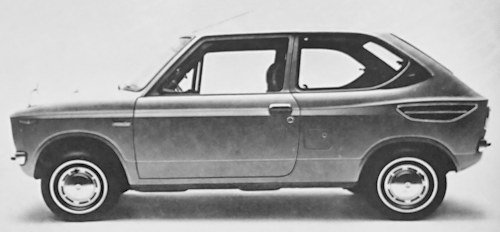
For November 1970 for 1971 the 3rd generation Fronte (Fronte 71) was released with the model type name as LC10-II. The range came as a basic standard, deluxe, high deluxe, With sportier better equipped super deluxe at 394.000 yen.
PERFORMANCE: 31 hp
- max power (DIN): 31 hp at 6.000 rpm
- max torque (DIN): 27 ft. 3.7 kg m at 500 rpm
- max engine revs 6000 rpm
- Specific power 87 hp/l
- power-weight ratio: 32.6
- acceleration: standing 1/4 mile 21.5 sec
- speed in top at 1,000 rpm: 10.4 mph, 16.8 km, h
- fuel consumption: 78.5 m. imp gal, 65.3 m, US gal
PERFORMANCE: 34 hp
- max speed 75 mph, 120 km/h
- power-weight ratio 29.8 1b, hp, 13.5 kg: hp
- fuel consumption 56.5 m/ imp gal, 47 m; US gal
The more high performance super S, SSS, SSS-R. Price from 405,000 yen. The"R" in SSS-R means radial tires (135SR10 size) standard equipment. The body style was a fastback completely new design style with the distribution of weight of 36% to front axle, and 64% at rear axle. The vehicle height was set quite low at 1,260 mm (sport type), while the front trunk was expanded. It was commonly called " the Stingray Look”. Later in 1971 a sports car version the Fronte Coupe was released. Separate from the sedan range and initially commissioned by Giorgetto Giugiaro which continues until 1976.
PERFORMANCE:71 SSS
- max power (DIN): 36 hp at 7,000 rpm
- max torque (DIN): 27 1b ft. 3.7 kg m at 6,500 rpm
- max engine rpm: 8,000
- specific power: 101.1 hp/l;
- power-weight ratio: 28 lb/hp, 12.7 kg/hp
- acceleration: standing 1/4 mile 19.9 sec:
- fuel consumption: 62.8 m: imp gal. 52.3 m/ US gal
The engine is basically a conventional air-cooled 3-cylinder 2-stroke engine. The Standard, Deluxe and Super Deluxe came with a 31 hp version while the higher spec High super, S was raised to 34 horsepower fitted with 3 Mikuni.Villiers VM 22 semi-downdraught carburettors with the top models with 36 horsepower and 3 Mikuni-Villiers VM 24 horizontal carburettors. (The SSS series).
By May 1971 Additional release of Fronte 71W. A model equipped with a new more powerful water-cooled engine while maintaining the body of the Fronte 71. The model is known as the LC10W version. Initially, there will be three specifications the GL-W, GT-W, and GT-RW also the GS-W and GO-W with 34-horsepower engine from 399,000 yen to 433,000 yen. The engine is equipped with a newly developed water-cooled 2-stroke 3-cylinder. For cooling, a unique "dual radiator system" is used. The GL-W is 34 horsepower and the GT-W series is 37 horsepower.
PERFORMANCE: LC10W 72 water cooled
- ENGINE 34 hp
- max power (SAE): 34 hp at 6,000 rpm
- max torque (SAE): 30 1b ft. 4.2 kg m at 4,500 rpm
- power-weight ratio: 30.9 lb/hp, 14 kg/hp
- acceleration: standing 1/4 mile 20.2 sec.
- ENGINE 37 hp
- max power (SAE): 37 hp at 6,500 rpm
- max torque (SAE): 30 1b ft. 4.2 kg m at 4,500 rpm
- standing 1/4 mile 19.7 sec.
More updates followed for 1972 range the name changed to 72 (Seventy-Two) with only minor change. The design of the front grille has been changed, and the interior such as the dashboard and seats has been changed. Changed sports wheel cap design. The sports type of the air-cooled engine cars is now called "Business Series" and now the water-cooled sports cars are called "Sports Series".
For the 1973 range as the New Fronte 73 series again with only minor changes to chassis and running gear but the exterior undergoes major changes to windows and the bumper to the front grille and bonnet. The headlamps have been changed from a square 2-lamp type to a round 2-lamp type. Air-cooled cars are auto clutch only. The new sporty GT-TYPE II comes equipped with dual brake master cylinder and front disc brakes.
The range is replaced in 1974 by the fourth generation the 7-S types LC20, SS10/20.