
Simca
Simca 1200S Coupe
 |
|
|
Brand |
Simca |
|
Years of production |
1967 to 1971 |
|
Production |
14,400 copies |
|
Class |
Sports Car |
|
Fuel |
Petrol |
|
Engine |
1,204 cu cm |
|
Unloaded weight |
890kg |
|
Bodywork |
Coupe, signed Bertone |
|
Chassis |
Simca 1000 |
|
Brakes |
4 discs |
|
Wheel base |
87.87 in, 2,232 mm |
|
Length |
157.36 in, 3,997 mm |
|
Width |
60.04 in, 1,525 mm |
|
Height |
50 in, 1,270 mm |
|
Dry weight |
1,896 1b, 860 kg |
The Simca 1200 S coupé are manufactured by the French brand Simca, between 1967 and 1971.
History
The historic boss of Simca Henri Theodore Pigozzi wants to replace his aging Plein-Ciel coupés and Océane cabriolets based on the Aronde and subcontracted by the Facel company. However, Facel is experiencing enormous difficulties due to the failed launch of a small Facel Vega, the Facellia. So now that borders are no longer an obstacle since the opening of the Common Market, he turns to his compatriot, the Italian master coachbuilder Bertone to design a very tapered coupe model from the mechanical base of the Simca 1000 and ensure the manufacture of the body. Penalized by a more than laborious renewal of the range, and especially by a very chaotic brand image since the takeover by Chrysler, which replaced Fiat in 1963, the new boss of Simca, Georges Héreil, then decided to restore his image and bet more on the sports card. To clearly mark this evolution, it is envisaged to relaunch the coupé and to make it more virile by June 1967.

An aesthetic update is then requested from Bertone the coupé body with two doors and seats as 2+ 2; Body of all steel unitary construction; front-hinged doors with winding windows; fully reclining front seats; carpeted flooring; comprehensive sound deadening and full undersealing, laminated windscreen; 2-point jacking system, already from of the first series. The grille is redesigned, ventilation grilles plagiarizing those of the Lamborghini Miura appear on the hood. The direction of Simca wants a more vitaminized engine and equips the car with the Poissy engine rear mounted, 4-cylinder, in line, inclined 15° to left, water cooled, 4-stroke, with bore and stroke 70 mm and capacity 1,204 c.c which will equip the future Simca 1100, developing 82 hp thanks to its two double-barrel carburettors with sports air cleaner silencer, full-flow oil filter, thermostatically controlled cooling by centrifugal water pump a front-mounted radiator and thermostatically
operated electric fan with aluminium alloy cross-flow 8-port cylinder head and twin exhaust system authorizing a speed of 170 km/h .The distribution of weight at 39.3% to the front axle, and 60.7% at rear axle. The hydraulically operated diaphragm type single dry plate clutch with 4-speed all synchromesh gearbox (Porsche licenced) controlled by floor-mounted remote lever. In 1968, the power increases slightly, to reach 84 hp.
Even more than the 1000 Coupé, the 1200 S is criticized for its insufficiently efficient braking even with disc brakes front and rear (diameter 8.70 in, 221 mm), its vague direction and the lack of flexibility of its mechanics but rack and pinion steering; 3-spoke wood-rim wheel and turning circle 34 ft. The front suspension as independent, wishbones, transverse leaf-spring lower arms, anti-roll bar, telescopic dampers at the rear independent, semi-trailing arms, coil springs, telescopic dampers. The 1200S ended its career in 1971 without being replaced. For that, we have to wait until 1973 and the Bagheera, manufactured by Simca-Chrysler, in collaboration with Matra.

The 1200 S equipment includes: solenoid-operated starter controlled by key-operated ignition lock; head lamp flasher; illuminated instrument panel with speedometer and mileage recorder; rev.counter; fuel gauge with low level indicator light; temperature gauge; oil pressure gauge; main beam warning light; air horn; self-cancelling flashing indicators with tell-tale light; self-parking windscreen wipers; twin sun visors; dipping rear view mirror; twin quartz iodine long-range driving lamps; twin reversing lamps; foot-operated windscreen washer; 2-speed fresh air heater/demister.
Only 14,400 units of the 1200 S were produced between 1967 and 1971, without ever having succeeded in attracting the customers targeted by its designers.
- PERFORMANCE: 1200 S
Engine capacity: 73.47 cu in, 1,204 cu cm
Fuel consumption: 31.4 m/imp gal, 26.1 m/US gal, 91 x 100 km
Max speed: 108.7 mph, 175 km/h
Max power (DIN): 80 hp at 6,000 rpm
Max torque (DIN): 76 1b ft, 10.5 kg m at 4,500 rpm
Max engine rpm: 6,600
Specific power: 66.4 hp/l
Power-weight ratio: 23.6 lb/hp, 10.7 kg/hp
Max speeds: 30.4 mph, 49 km/h in 1st gear: 51 mph, 82 km/h in 2nd gear; 76.4 mph, 123 km/h in 3rd gear; 108.7 mph, 175 km/h in 4th gear

Simca Ariane
 |
|
|
Production period: |
1957 to 1963 |
|
Class: |
motor car |
|
Body versions: |
Saloon |
|
Engines: |
Gasoline: 1.3-2.4 litres |
|
Length: |
177.95 in, 4520 mm |
|
Width: |
69.09 in, 1755 mm |
|
Height: |
56.46 in, 1434 mm |
|
Wheelbase: |
105.98 in, 2692 mm |
|
Curb weight: |
2425 1b, 1100 kg |
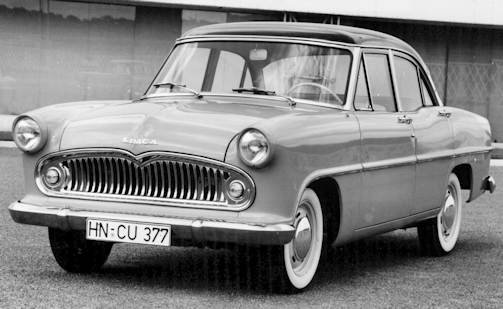
The Simca Ariane motor car was built from 1957 to 1963 By Simca.
History
The Simca Ariane was a motor car with 4 door, coachwork, 6 passenger saloon, with spacious luggage boot. Both four-cylinder and V-8 power were available in the Ariane series, which was promoted as having its own body but actually was a less-trimmed version of the Vedette's, on the same 106-inch wheelbase. with the Flash engine (or Rush engine) of the smaller Simca Aronde to bridge the gap between these two models. Continued to be manufactured by Simca, the Vedette are top-of-the-range models with a very American design, but "Frenchified". Designed by the Italian designer Rapi, these bodies still delight collectors.
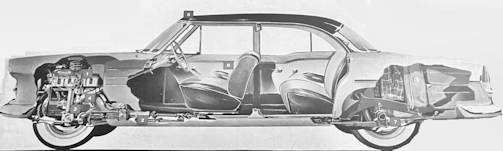
It was in 1954 that Simca bought from Ford SAF, the French subsidiary of Ford, the Poissy factory which had produced several thousand vehicles equipped with the V8 engine, including the Ford Vedette inspired by an American model. But, in a rationed France which is barely recovering from the war, these too opulent cars are selling badly and Ford is looking for a buyer for this factory which is preparing to manufacture a new Vedette. A four-speed gearbox was installed, instead of the three-speed on the Vedette. Both the Ariane and Vedette had parking lights incorporated into the grille, visored headlamps, a wraparound windshield, slender roof pillars, and curved rear windows. Tail lamps, backup lights and directional signals were grouped in sweptback fins, placed high for visibility and security. Non-deformable all-steel one-piece frame with integrated chassis. The front suspension was independent, wishbones, coil springs, anti-roll bar, and Double-action telescopic dampers at the rear rigid axle type with semi-elliptic leaf-springs and telescopic dampers.
Inside full-width seats with contoured backrests.Interiors upholstered in elasticized fabrics and leather grained vinyls. Rear seatback can be folded down, providing extended luggage space to over 6 feet.Armrests on all 4 doors, Heater-defroster-climatizer and Ashtrays.two sun visors, vanity mirror on rear of passener visor. Windscreen washers; headlamp dip controls.
The Suez crisis in 1956 disrupted this strategy. Simca, having until then only manufactured Fiats under license, had just released, five years earlier, its first vehicle entirely designed in France by the firm's design offices, the very successful and very popular Aronde. Simca then reacted very quickly to the crisis of rising fuel prices by combining the 47 hp SAE "Flash" engine of the Aronde with the bodywork of the Trianon and thus created the Ariane. The Suez crisis simply built on the economic case for a small engine version of the car, and Simca was therefore responded to the changed circumstances created by the crisis, fitting a 1290cc "Flash" series engine. This is available in several versions. But a problem arises, the body of the Ariane derived from the Simca Vedettes is too heavy with this engine, in spite of a new staggering of the gear ratios of the gearbox.
PERFORMANCE: 1.3L
- Engine capacity: 78.90 cu in, 1290 cu cm
- Fuel consumption: 29.7 m imp gal, 24.7 m US gal, 9.5 1 x 100 km;
- Max speed: 80.8 mph, 130 km h
- Max power (SAE): 62 hp at 5200 rpm
- Max torque (SAE):74 1b ft, 10.2 kgm at 2600 rpm
- Max number of engine rpm: 5400
- Specific power:48.1 hp/l
- Power-weight ratio: 39 ib/hp,17.7 kg/hp
For the 1958 models, the Trianon was replaced by an Ariane with an 84 hp SAE V8 engine: the Ariane 8. This was abolished in 1961. For 1959, the Ariane Super Luxe had an improved finish: chrome side trim, chrome windscreen and rear window surrounds, windscreen washer, vanity mirror and rear ashtray. Like all Arianes, it features new rear lights with integrated reflectors.
By the 1960s, for 1961, the Ariane Miramas Super Comfort benefits from the interior of the Beaulieu. Like the other Arianes, it is called Miramas and adopts the “Rush Super” five stage 62 hp SAE engine.
The Ariane was produced until April 1963. Very common at the end of the 1960s. In 1965 and 1967, in Argentina, the company Metalmecánica SAIC manufactured the Ariane Miramas, in "standard" and "luxury" versions; some of them are used as a taxi. 507 units will be manufactured.
In April 1957, the first model was presented. Already in October of the same year came a version with a more powerful engine: the Simca Ariane 8, which now had the same 2.4-liter Aquillon motor as the Vedette. The Ariane 8 thus replaced the base model Simca Vedette Trianon.
The Ariane was produced until 1963 with 166,363 vehicles produced.
Ariane Miramas Argentina 1965-1967
From 1965 to the end of 1967, the Ariane was produced in Argentina by Metalmecánica as Miramas in a standard and a deluxe version as well as a taxi.
Simca Abarth 1150 car history
 |
|
|
Manufacturer: |
Simca - Abarth |
|
Years of production |
1963 to 1965 |
|
Type |
Spots car |
|
Engine |
1,137 cc |
The Simca Abarth 1150 is a series of sports cars made by the Italian manufacturer Abarth on behalf of Simca .
History
The Simca 1000 is actually the result of the project "Fiat 122", the one that was to be the replacement of the Fiat 600 but which was not accepted by the general management of Fiat who preferred the project "100G" which would become the Fiat 850 . During a visit to Turin by Henri Théodore Pigozzi , boss of Simca, then a subsidiary of Fiat , in 1957 , he was seduced by this study and obtained to recover the project to achieve it in France.
The body designed in Turin by Mario Revelli de Beaumont , famous Italian designer and sees his engine at the rear by the classic design that Fiat has developed with its new Fiat 600 and 850. It is a "very back "with a four-wheel independent suspension (helical springs at the rear and blades in front) and a motor cylinder four longitudinal cantilever rear box with a four-speed synchromesh Simca Abarth 1150 and SS Corsa also with competition suspension option. It was also the last car to receive the contribution of the Fiat design office for its design very inspired by the Fiat 850 .
It was therefore not very difficult for Abarth engineers to work for an upgrade of the car in its sports version. It was during the summer of 1962 and Simca Abarth sign this cooperation agreement, especially as the main competitor of Simca, Renault, had just launched in June its new R8 Gordini and his partner had to study a sporty version.
In 1961, a first agreement was made between the two manufacturers for the supply of one hundred Simca 1000 platforms for the production, by Abarth, of the Abarth Simca 1300 GT which will be homologated in Grand Touring in 1962. The car is officially presented at the Salon Geneva in March 1962. in the 1962 24 Hours of Le Mans, with a 1000 cc engine Fiat, and two 1300 cc Fiat-Abarth engine in prototype: one in 1300 ended with an average of more than 150 km / h. In 1963, a 1300 is engaged in Grand Touring, but does not finish the race.
In December 1963, this coupe evolves in Simca Abarth 2000 equipped with a Fiat-Abarth engine of 1,946 cc developing 192 DIN hp at 7,100 rpm and a box with 4 or 6 speeds. The car will be homologated in Grand Tour at the end of January 1964.At the Turin Motor Show in November 1963, it is not a car that is presented on the Abarth stand but four! The Simca Abarth 1150, 1150S, 1150 SS and 1150 SS Corsa. carburation for the 1150 1 Solex F 32 P BIC downdraught carburettor 1150 Corsa 1 Solex twin barrel carburettor and 1150 SS 1 Solex C 32 PA IA 7 downdraught carburettor.

The engine displacement of the original 944 cc engine was increased to 1,137 cc by increasing the bore by 1 mm and the stroke by 11 mm, allowing it to develop 55 hp compared with just 50 on the model Simca. The speed was just over 150 km / h instead of below 130.
The model was different from the basic model with its grille adorned with a red banner supporting the shield Abarth, the rims were perforated to better ventilate the brakes and included hubcaps bearing the Abarth logo. The interior layout was identical to the basic model but as an option we could have a more refined and complete dashboard signed Abarth.
All Simca Abarth 1150 models have the same rear mounted 4 stroke 4 cylinders engine slanted at 15°, in line engine with 1,137 cc but each model offers different powers depending on the compression ratio with additional :
- PERFORMANCE: Simca Abarth 1150
Engine capacity: 69.36 cu in, 1,136.747 cu cm
Fuel consumption: 35.3 m/imp gal, 29.4 m/US gal, 8 x 100 km
Max speed: 93.8 mph, 151 km/h
max power (DIN): 55 hp at 5,600 rpm
max torque (DIN): 63 1b ft, 8.7 kg mat 3,500 rpm
max number of engine rpm: 6,500
specific power: 48.4 hp/l
power-weight ratio: 28.9 lb/hp, 13.1 kg/hp - Simca Abarth 1150 S
max power (DIN) 58 hp at 5,600 rpm
max torque (DIN) 64 1b ft, 8.8 kg m at 3,500 rpm
max speed 96.9 mph, 156 km/h - Simca Abarth 1150 SS
max power (DIN) 65 hp at 5,600 rpm
max torque (DIN)65 1b ft, 9 kg m at 4,500 rpm
max speed 100.6 mph, 162 km/h
fuel consumption 33.2 m/imp gal, 27.7 m/US gal, 8.5 1 x 100 km - Simca Abarth 1150 Corsa
max power (DIN) 85 hp at 6,500 rpm
max torque (DIN) 80 1b ft, 11 kg m at 4,500rpm
max speed 107.5 mph, 173 km/h,
fuel consumption 28.2 m/imp gal, 23.5 m/US gal, 10 1 x 100 km
Simca Jangada
 |
|
|
Production |
1962 to 1966 |
|
Manufacturer |
Simca Brazil |
|
Class |
Motor car |
|
Bodywork |
station wagon |
|
Engine |
2351cc |
|
wheel base |
105.90 in, 2,690 mm |
|
Length |
185.83 in, 4.720 mm |
|
Width |
69.68 in, 1,770 mm |
|
Height |
57.09 in, 1,450 mm |
|
Weight |
3,131 1b, 1,420 kg |
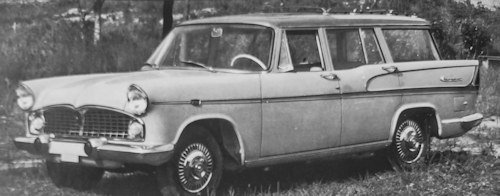
The Simca Jangada was the first large station wagon manufactured in Brazil in the 1960s, starting in 1962.
History
The combination rear wheel drive station wagon from the Chambord was called Jangada. It was a "tropicalized" version of the French Simca Vedette Marly estate wagon, but with its structure reinforced to withstand the adverse conditions of Brazilian roads. It could comfortably accommodate six adults and two children on folding seats.
The Jangada was a vehicle of a more luxury type and followed very closely the French edition of Chambord based on the Simca Vedette . The engine was that of Ford acquired Ford Flathead V8 engine with 2.4 litre displacement and first 62 kW (84 hp) at 4800 / min and 155 Nm at 2750 / min. Fitted with a single-disc dry clutch, a partially synchronized three-speed gearbox and a one-piece propeller shaft with rear wheel drive. At thefront there was MacPherson type suspension and a castor steering the rear suspension: rigid axle, semi-elliptic leafsprings, telescopic dampers. All wheels had hydraulically operated drum brakes, front duplex, called "Twinplex".
First, it was made from imported parts from France.Like the other models derived from the Simca Vedette, the Jangada had a serious power problem (the original V8 engine had only 92 hp, which made it difficult to transport the 1800 kg of cargo that the station wagon could theoretically carry). .
PERFORMANCE
- engine capacity: 147.30 cu in, 2,414 cu cm
- fuel consumption: 18.8 ml imp gal 15.7 US gal
- max speed:87 mph. 140 km/h
- max power (SAE): 100 hp at 4.800 rpm
- max torque (SAE): 120 lb ft.at 2,750 rpm
- max engine rpm: 5,400
- power-weight ratio: 31.3 lb/hp, 14.2 kg/hp
Only 2705 vehicles were produced at the Simca do Brazil factory from 1962 to 1966, in São Bernardo do Campo, of which few are still in circulation.
Simca Talbot-Matra Rancho
 |
|
|
Make |
Matra Simca |
|
Years of production |
1977 to 1983 |
|
Type |
Motor car |
|
Motor |
Poissy engine 1,442 cm |
The Rancho is a versatile and original car, designed and produced by Matra under the Matra Simca brand .In 1979, following the integration of Simca into the PSA group , the Rancho was marketed under the name Talbot - Matra until 1984.
History
Appeared in March 1977 , the Rancho is the result of the second collaboration between Matra and Simca under the Matra Simca brand . For Matra, it results from a deep reflection on the expectation of a clientele other than that of sports coupes. It prefigures, with almost 20 years in advance, the category of crossover and lugospaces now widely present on the market that combine elevated driving position, livability, correct comfort and look adventurer. unusual was the rea facing seats.

It was produced with 56 457 copies fitted with the Poissy engine of 1,442 cc inherited from the Simca-Chrysler 1308 built on the Simca 1100 VF 2 platform. Leaving the Poissy plant as a Simca 1100 utility VF 2 incomplete, the vehicles were trucked to the Matra Romorantin factory from where they were completed and finished until 1983 and sold until 1984 .
The Rancho has existed in utility version (AS), family glazed and, much more rare, family tarpaulin (Rancho "Discoverable"), with in all cases, only two side doors, because of the use of the box of the Simca 1100 VF 2 utility . It is for the same reason that it has never been entitled to 4-wheel drive or a 5-speed gearbox .The existence of two types of versions, the one utility, the other family, on the same technical basis and bodywork, the apparent to a MPV.
After the Rancho, Matra will manufacture Renault Espace .
Specification
Production total: 56,457
Engine: gasoline Poissy engine 1,442 cc
Unloaded weight: 1129 kg
Bodywork: Three doors
Length: 4315 mm
Width: 1665 mm
Height: 1735 mm


