
Subaru
Subaru History
Shibuya , Tokyo, Japan

Subaru is a Japanese automobile brand and the automotive division of the company Fuji Heavy Industries (FHI) as from 1958.
History
Fuji Heavy Industries was established on July 15, 1953, and the first prototype P1 was built in 1954The brand name "Subaru," which literally means together or join the same constellation of the Pleiades the six brightest stars in Japan make up the well-known constellation Subaru. was chosen for the company's future cars.
The Subaru 360 was the brand's first automobile, being equipped with a two-cylinder, two-stroke engine and rear-wheel drive in series in 1958. In the upcoming years, more vehicles with two-wheel drive (2WD) will be produced. Subaru produced its first 4-cylinder boxer engine ever in 1966, which was initially included into the Subaru 1000. The first front-wheel-drive Japanese production vehicle was the Subaru 1000.
In 1972, the Japanese electricity company Tohoku Electric Su Company made an order for a four-wheel-drive automobile to safely climb the snow-capped mountains of Japan and carry out maintenance work on the power lines. In order to be able to comply with the requirements of budget and car format, they built the front-wheel drive Coupe Subaru Leone and building on the combination Leone Station Wagon 4WD with switchable four-wheel drive and boxer engine. Subaru was awarded the contract and the Leone was exported from 1973 to the United States. From 1979, the advanced version L1800 4WD was available in Switzerland. To this day, Switzerland is an important market for Subaru alongside the main markets USA and Australia; The Swiss cantonal police also use Subaru models. Subaru is the world's most successful and largest manufacturer of all-wheel-drive cars. By 2008, it had sold over ten million four-wheel-drive vehicles and manufactured more than 15 million boxer engines.

Subaru attaches great importance to their own designs. Subaru is known for its vehicles with permanent all-wheel drive, called the Subaru Symmetrical AWD and for the use of boxer engines, which contribute to the low centre of gravity of the vehicle due to the low height and the design-related good mass balance are very smooth running. Also typical of Subaru were the frameless side windows, which have been completely omitted since 2009 for safety reasons.

From 2000 to October 2005, General Motors held a 20% stake in Fuji Heavy Industries and several car models were jointly developed and marketed. For example, the Saab 9-2X based on the Subaru Impreza, or the Subaru Traviq based on the Opel Zafira. Also planned was the introduction of a new model of the Subaru Justy based on the Opel Corsa and a new Saab SUV based on the Subaru B9 Tribeca, which was then but not realized. Since October 2005 there is a cooperation between Fuji Heavy Industries and Toyota Motor Corporation. Toyota has held a minority stake of 16.5% in Fuji Heavy Industries since April 2008. Together, various new models are to be developed. As a first result of this new cooperation, the Daihatsu Sirion Toyota subsidiary. However, after the end of General Motors' participation in Fuji Heavy Industries, this collaboration was also terminated (Suzuki was also partially owned by General Motors). In the US, the same car was marketed under the name Geo Metro.

Since 2008, Subaru also has a diesel engine in the program. It is a boxer engine with 2.0 litres displacement and common rail injection. To date, this engine is the world's only boxer diesel. After only 12 years in 2020, the sale of diesel vehicles should be completely discontinued. Likewise, all development. For some years Subaru vehicles of all series could be delivered on request with an LPG system ex works. In recurring actions Subaru offered these ecomatic versions to customers without additional charge. The LPG conversion is however u. a. due to the presence of a diesel engine offering and the homologation problems for the Euro 5 emissions standard no longer in the program.
Subaru rallies since the 1970s, including the Leone 1800 Turbo Hardtop Coupe (EA81), the Subaru Vivi and the Leone Turismo Turbo (EA82). 1990 Subaru began on the World Rally Championship WRC (World Rally Championship) to participate. It was initially modified versions of the Subaru Legacy and from 1993 the Subaru Impreza used, which were built at the motorsport specialist Prodrive. In addition, in 1995 Colin McRae, 2001 Richard Burns and 2003 Petter Solberg each won the drivers' championship of the WRC. On December 16, 2008, Subaru announced its withdrawal from the WRC, just one day after Suzuki. As a reason for the end of almost 20 years of engagement, the economic crisis was stated. Subaru entered the short term in the Formula 1 season in 1990 as a competitor. The parent company Fuji Heavy had acquired the majority of the Italian Formula 1 team Coloni SpA in the winter of 1989/90 and equipped the team with its own engine, the Subaru MM 3512.Subaru tried to get a prestigious Formula 1 team as a customer, but this did not succeed.

Subaru 1000
 |
|
| Production | 1966–1969 |
|---|---|
| Predecessor | Subaru 1500 |
| Successor | Subaru Leone |
| Body style | 2-door sedan 4-door sedan 2- and four-door station wagon |
| Layout | FF layout |
| Engine | 977 cc F4, 55 hp (41 kW) |
| Wheelbase | 2,420 mm (95.3 in) |
| Length | 3,930 mm (154.7 in) |
| Width | 1,480 mm (58.3 in) |
| Height | 1,390 mm (54.7 in) |
| Curb weight | 670–695 kg (1,500–1,530 lb) |
It was the first production Subaru to use a boxer engine.
In 1960, Subaru management decided to introduce a successor to the prototype Subaru 1500 with a new code name "A-5" with a four-cycle air-cooled horizontally opposed four-cylinder engine displacing 1500 cc, driving the front wheels in a compact car platform. It was to have a double wishbone front suspension. Due to FHI's limited resources, the car wasn't produced. The Subaru 360 was selling at the time but Subaru wanted a car that could comfortably carry four passengers without a cramped compartment, that would appear to be an alternative to the Toyota Publica, the Datsun 110/210, the Hino Contessa, and the Mitsubishi Colt 600. Subaru also wanted to reduce engine noise by placing the engine up front and improve interior space by implementing front wheel drive, thereby eliminating a centrally mounted drive shaft powering the rear wheels, and utilizing an independent suspension at all four wheels. The only other Japanese company to use an air-cooled, horizontally opposed engine at the time was in the Publica, and the Toyota U engine.
In 1963, Subaru tried again, with a new project code "A-4", with a smaller 923 cc engine, front wheel drive, and an overall length of 3,885 mm (153.0 in), a wheelbase of 2,400 mm (94 in), a front wheel width of 1,230 mm (48 in) and a rear wheel width of 1,220 mm (48 in), weighing 500 kg (1,100 lb). It made it towards production status and was changed to production code "A-63" and was eventually introduced as the Subaru 1000. To address space efficiency and a quiet operation with minimal vibration, the engine was developed as a water-cooled engine instead of the original intent of air-cooled in the "A-5" concept.
The Subaru 1000 was formally introduced on October 21, 1965 at the Hilton Hotel Tokyo, now known as the Hotel Tokyu Capitol. It was shown at the 12th Tokyo Motor Show Sunday October 29 later that year. It was available for purchase May 14, 1966 with a national release in Japan in October 1966. Its model code was A522. The two-door sedan, model A512 was introduced February 15, 1967, with a four-door van released September 14, 1967.
These cars featured a unique water-cooled, horizontally opposed four-cylinder engine, with overhead valves operated by pushrods. Subaru engineers examined Porsche, Volkswagen and even Chevrolet Corvair and thought it would be nice if this type of engine is combined with front wheel drive system. The neck in proceeding the mechanism was the vibrations from universal joints, but in collaboration with the bearing maker Toyo Bearing (now known as NTN), the epoch-making "double offset joint" was invented. Modern Subarus still make use of horizontally opposed four-cylinder engines, albeit of a much greater capacity and with more modern overhead-cam-driven valves.

As was typical of early front wheel drive cars, the 1000 featured inboard drum brakes up front to reduce unsprung suspension weight and an easier implementation of an independent front suspension (but atypically Subaru would retain this unusual design into the seventies). Other unique features of the 1000 were a lack of a heater core, the heating system took its warmth directly from the radiator, and a hybrid suspension system that used torsion bars in combination with coil springs (much like the front suspension of the Subaru 360). The 1000 was superseded by the 1100 (also known as the Subaru FF-1 Star in the United States and in other export markets) at the start of the seventies.
By March 1969, Subaru had produced over 4,000 units as an alternative to the Toyota Corolla series KE10 (introduced in 1966), and the Nissan Sunny series B10.
Engine
Subaru EA-52 Engine 1.0L OHV Water-Cooled Flat-4
- Displacement: 72 mm (2.8 in) x 60 mm (2.4 in), 977.2 cc
- 9:1 compression ratio and two-barrel carburetor
- Engine capacity: 59.62 cu in, 977 cu cm
- Fuel consumption: 56.5 mlimp gal, 47 mlUS
- Max speed: 83.9 mph, 135 km/h
- max power (SAE): 55 hp at 6,000 rpm
- max torque (SAE): 56 1b ft, 7.8 kg m at 3,200 rpm
- max engine rpm: 6,000
- specific power: 56.3 hp/l
- power-weight ratio: 27.6 lb/hp, 12.5 kg/hp
- acceleration: standing 1/4 mile 19.9 sec
Transmission
Four-speed manual, front-wheel drive
- Gear ratios: 1st 4.000 2nd 2.235 3rd 1.543 4th 1.033, Rev 4.100 Final 4.125

Subaru Forester Third generation
 |
|
| Production | 2008–2013 |
|---|---|
| Layout | F4 layout |
| Engine | 2.0 L H4 (Japan) 2.0 L H4 turbo(Japan) 2.5 L 170 hp (130 kW) H4 2.5 L 224 hp (167 kW) turbo H4 2.0 L H4 turbodiesel |
| Transmission | 4-speed automatic 5-speed manual (Petrol) 6-speed manual (diesel) |
| Wheelbase | 2,616 mm (103 in) |
| Length | 4,559 mm (179.5 in) |
| Width | 1,781 mm (70.1 in) |
| Height | 1,674 mm (65.9 in) |
| Curb weight | 1,470 kg (3,250 lb) |
Subaru unveiled the model year 2008 Forester in Japan on December 25, 2007. The North American version debuted at the 2008 North American International Auto Show in Detroit.
The third generation Forester was styled by Subaru Chief Designer Mamoru Ishii. The dimensions derive from engineers using the basic body structure of the Japanese-spec Impreza wagon with the rear platform of the U.S.-spec Impreza sedan.The Forester's wheelbase has increased 3.5 inches (89 mm), with overall increases of 3.0 inches (76 mm) in length, 1.8 inches (46 mm) in width and 4.3 inches (110 mm) in height. Notably, the third generation Forester forgoes the frameless side windows used on Subarus since the early 1970s. The third generation embraces the car based SUV, and leaves behind the older wagon design; it's larger in nearly every dimension and features a sloping roof line with more cargo space.

The independent double wishbone rear suspension has been redesigned for better handling and a smoother ride over the previous generation. "Sportshift" has been included with the four-speed computer-controlled automatic transmission. The in-dash, touch-screen satellite navigation system is Bluetooth compatible, and has the premium stereo integrated. Subaru also offers the six-speaker premium stereo, with surround sound enhancement, separate from the navigation system.
The new model adds 3.5 inches (89 mm) to the Forester's wheelbase, thereby improving interior space and cargo room (31 cu ft (0.88 m3) expandable to 69 cu ft (2.0 m3)). Ground clearance for the Forester is now 8.9 inches (230 mm).
Europe
The Forester is available in Europe with the popular 2.0 liter EJ20 gasoline engine with Active Valve Control System (AVCS) matched to either 5-speed manual or 4-speed automatic gearbox, and the all-new diesel-powered horizontally opposed (boxer) engine, called the Subaru EE and six-speed manual gearbox, which was introduced at the 2008 Paris Motor Show in October.The diesel engine produces a power output of 147 PS (145 hp / 108 kW).
In the UK, the gasoline-powered Forester is offered in the popular X and XS models, while trim level for the diesel models are X, XC, and XS NavPlus.

US
The Forester trim levels are the 2.5X, the 2.5X Premium, the 2.5X Limited and the 2.5XT and 2.5XT Limited both with turbo. The interior colors are either black or light gray with three upholstery selections, including leather. Nine exterior colors are offered, with four colors offered with a pearlescent appearance.
Starting July 2008, Subaru no longer offered a special-edition L.L. Bean trim level on the Forester.
The USA 2.5X model has been certified PZEV emissions (Rated 175 hp (130.5 kW) instead 170 hp (126.8 kW)), and a badge has been attached to the rear of the vehicle on the bottom left-hand side of the tailgate. All other USA models have been certified LEV2. The PZEV Forester is available for sale in all fifty states, unlike other manufacturers who only sell PZEV certified vehicles in states that have adopted California emission standards. The engine without the turbo runs on unleaded gasoline rated at 87 octane, and the turbo engine (EJ255) requires premium fuel rated minimum 91 octane.
Safety equipment includes front airbags with side curtain airbags and front passenger side airbags (for a total of six airbags) and brake assist that detects panic-braking situations and applies maximum braking force more quickly.
The manual transmission is equipped with Incline Start Assist which, on an incline, holds the brake for a second after releasing it to allow for time to depress the accelerator.
Some of the standard equipment found on the 2.5X include Subaru's VDC (Vehicle Dynamics Control), 16 inch steel wheels, and an auxiliary audio jack for MP3 players. Optional equipment includes 17 inch alloy wheels, panoramic moonroof, heated front seats and heated side-view mirrors. The L.L. Bean edition adds automatic climate control, leather upholstery, an upgraded stereo with six speakers and a six disc in-dash CD changer over the four-speaker stereo with single disc CD player, and an in-dash navigation system, as well as L.L. Bean signature floor mats and rear cargo tray.
The 2.5 XT comes with the premium stereo standard, as well as 17 inch alloy wheels, and the panoramic moonroof. The 2.5 XT Limited adds leather upholstery with heated front seats, in-dash navigation, a rear spoiler, and automatic climate control. For 2009, XT models come only with a 4-speed Automatic with Sport Shift.
Forester XTI concept
The Forester XTI concept vehicle uses the 2.5 liter intercooled turbo engine from Subaru WRX STI, 6-speed manual transmission, 18 x 8-inch S204 forged alloy wheels with Yokohama Advan Neova 255/40R18 performance tires, adjustable coil-over suspension, Brembo brakes with 4-piston front calipers, 2-piston rear calipers, Super Sport ABS and Electronic Brake-force Distribution (EBD), leather and Alcantara sport seats, a special instrument cluster, front dash and center console and leather-wrapped steering wheel. Engine is rated 315 hp (235 kW) and 300 lb·ft (410 N·m) torque.
The vehicle was unveiled in 2008 SEMA show.
Facelift
In 2010 for the 2011 model year, the Subaru Forester received a new grille insert. The naturally aspirated Foresters are equipped with an all new third generation motor with DOHC 2.5l FB25 and 2.0l flat four FB20.

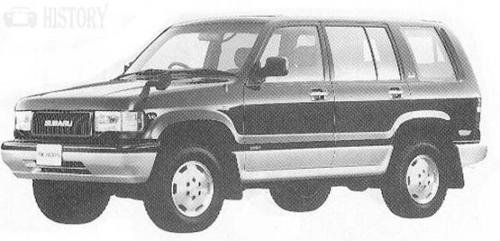
Subaru Bighorn First generation
 |
|
| Also called | Isuzu Rodeo Bighorn Isuzu Trooper/Trooper II (Pre-1989) Holden Jackaroo SsangYong Korando Family Subaru Bighorn |
|---|---|
| Production | 1981–1991 |
| Engine | 2.0 L G200 I4 (UBS13) 2.3 L 4ZD1 I4 (UBS16) 2.6 L 4ZE1 I4(UBS17) 2.2 L C223 diesel/turbodiesel I4(UBS52) 2.8 L 4JB1 diesel I4 2.8 L 4JB1-T turbodiesel I4 |
| Transmission | 4-speed Isuzu MSG manual 5-speed Isuzu MSG manual 5-speed Isuzu MAU5C manual 4-speed Aisin Warner automatic |
| Wheelbase | 3-door: 90.6 in (2,301 mm) 5-door: 104.3 in (2,649 mm) |
| Length | 3-door: 162.3 in (4,122 mm) 5-door: 176.0 in (4,470 mm) |
| Width | 65.0 in (1,651 mm) |
| Height | 3-door: 72.6 in (1,844 mm) 5-door: 71.7 in (1,821 mm) |
The first-generation Trooper was available as a three- or five-door, with a solid 4.555:1 rear axle and an independent front suspension. In the Japanese market, the car was originally introduced as the "Isuzu Rodeo Bighorn", but the "Rodeo" part of the name was soon dropped. Early engines included a 2.0-liter gasoline and a 73 PS (54 kW) 2.2-liter diesel, lightly powered even by early 1980s standards for the vehicle's 3,700 lb (1,680 kg) empty weight. The four-wheel-drive system was engaged by operating a three-position shifter adjacent to the transmission shifter. Both Aisin manual-locking and Isuzu's own auto-locking hubs were employed.
In 1986, Isuzu introduced the 4ZD1 four-cylinder 112 PS (82 kW; 110 hp) 2.3-liter engine, regarded as a considerable improvement over the previous gasoline engines because of its higher power, Kevlar timing belt replacing the chain driven ones in the 1.8l and 2.0l engines and improved and larger two-barrel carburetor. This engine eventually proved somewhat problematic with a plethora of burned valve problems because of the poor coolant flow design of the overhead cam/valve head with mechanical lifters A later head casting improvement by an Italian firm corrected this problem through improved coolant flow. Also available only for 1986 in the US was the 87 PS (64 kW) 2.2l C223T turbocharged diesel engine. It was not a popular option because of the low power generated. The C223T engine had a Garrett turbocharger and it actually performed admirably for its small size and ironically seemsto be the more dependable of the two engines offered that year because of its simplistic design and robust bottom end. Because of those problems, Isuzu changed the 4ZD1 for 1987 and used the standard 2.8L GM V6 for 1987 until their own new V6 engines could be manufactured.
In 1987, Isuzu introduced a 120 hp (89 kW) 2.6-liter (4ZE1) I-TEC fuel-injected engine for the US market. An optional General Motors 2.8-liter pushrod V6 borrowed from the Chevrolet S-10 pickup was also available. Manual transmission equipped models had a gear driven transfer case with a 2.28:1 low range ratio; models equipped with the 2.6-liter four-cylinder engine and automatic transmission had a 2.66:1 low range transfer case. Later first-generation models offered an optional four-speed automatic transmission. Models from 1988 to 1991 were equipped with live rear axles and four-wheel disc brakes. Also new in 1987 were rectangular headlights.
Overseas model engines included the Isuzu C223 (2,238 cc), C223T (a turbocharged version of the same) and in the late 80s naturally aspirated and turbocharged 2.8 L 4JB1 diesel versions, all straight-four engines. The turbocharged 2.8 originally produced 95 PS (70 kW), not much more than the 87 PS (64 kW) of the considerably smaller C223T due to new stricter emissions standards. Later versions with intercoolers fitted offered as much as 115 PS (85 kW).
In 1989 only, a short-wheelbase (90-inch) Isuzu Trooper was imported to the US market as the Trooper. All of these short wheelbase Troopers were equipped with 2.6-liter fuel-injected inline-four engines, 4.77:1 differential gears and 15×7-inch aluminium alloy "snowflake" pattern wheels. Automatic and manual transmissions were offered.
In Central America, Troopers were offered with removable roofs and a higher wheel clearance. Powertrain options included the Isuzu 2.8-liter turbo diesel.
In 1988, SsangYong Motors started licensed production of the Isuzu Trooper and sold it as the Korando Family, and was only marketed in South Korea, Southeast Asia and to a lesser degree South America. It used the same 2.2 L diesel engine but later versions used a 2.3 L Mercedes-Benz turbodiesel engine.
Subaru Traviq
 |
|
| Also called | Chevrolet Nabira Chevrolet Zafira Holden Zafira Subaru Traviq Vauxhall Zafira |
|---|---|
| Production | 2000–2004 as Subaru Traviq |
| Assembly | Bochum, Germany Rayong, Thailand (GM)) |
| Platform | T-body |
| Engine | 1.8 L X18XE1/X18XEL I4 1.8 L Z18XE1 2.2 L Z22SE 2.2 L Y22DTR diesel I4 |
| Wheelbase | 2,694 mm (106 in) |
| Length | 4,317 mm (170 in) |
| Width | 1,742 mm (69 in) |
| Height | 1,684 mm (66 in) |
| Curb weight | 1,320 kg (2,910 lb) - 1,560 kg (3,439 lb) |
| Related | Opel Astra G |
Traviq is usually referred to as Zafira A, as is customary for Opel models. Developed with the aid of Porsche, the Zafira was first shown in concept form at the 1997 Frankfurt Auto Show and entered series production in January 1999, with sales beginning in April.
The sale of the Zafira as a Subaru created a conflict with previously established Yanase Co., Ltd. retail dealerships, in that Yanase was already selling Opel products, like the Zafira. When production of the Traviq ended, Yanase continued to import Opel products into Japan until 2006.
The car was based on the same platform as the 1998 Astra G and shared much in common with that car. The Zafira A body was used in GM/Opel's concept hydrogen-powered fuel cell vehicle the HydroGen3. Offered with a series of petrol engines and initially a single diesel offering, the "X" engines were replaced by the newer "Z" engine generation in 2000.These featured variable intake manifolds and were able to meet Euro 3 emissions standards.
The Opel Zafira has seven seats arranged in three rows, the back row of which can be folded into the floor to create more space, individually or together, rather than requiring that the extra seats be physically removed from the vehicle. The system was named Flex 7. In TüV's ranking of the quality of three-year-old cars, the Zafira was by far the best Opel, only slightly behind the winning Ford Focus.
Introduced at Geneva in February 2001, the turbocharged Zafira OPC went on sale in October of the same year. With 192 PS (141 kW), this was the fastest minivan on sale in Europe.Only available with a five-speed manual transmission, 0–100 km/h (62 mph) can be reached in 8.2 seconds and the top speed is 220 km/h (137 mph).The popular 2-litre turbodiesels were complemented by a 125 PS (92 kW) 2.2 litre option in January 2002.
The Opel Zafira A was replaced by Zafira B in Europe, but was still sold in most other markets until 2012 (albet that its cousin the Chevrolet Astra was discontinued in 2011), except for Australia and New Zealand, where the model was cancelled altogether. The Zafira was sold in the Philippines from 2001 to 2005, being the last European-based Opel car to be sold in the Philippines after they stopped selling the Opel Astra in 2003.
The Zafira was sold in Japan from 2001 through 2004 as the Traviq, where it was cancelled and replaced later in 2008 by the Subaru Exiga - developed from the Subaru Legacy platform. According to Subaru, the name was a combination of the words "travel" and "quick", however, the word more closely resembles the English word "traffic".
Due to the exterior dimensions exceeding Japanese government regulations for vehicles defined as "compact", Japanese buyers were liable for additional taxes. The Traviq was originally only available with the bigger 2.2 litre engine, although a 1.8 L, lower-priced alternative was added in July 2003.The engines used were not Subaru supplied boxer engines, but were conventional in line units that were uncharasteristic to market recognized Subaru products, and all-wheel-drive technology was also not available.


