
Saab
Saab 95
 |
|
|
Manufacturer |
Saab |
|
Production |
1959 to 1978 |
|
Class |
Motor Car |
|
Body style |
3-door station wagon, van |
|
Layout |
FF layout |
|
Related |
Saab 93, 96 |
|
Engine |
841 cc 2-stroke I3 |
|
Transmission |
4-speed manual |
|
Wheelbase |
2,500 mm (98.4 in) |
|
Length |
4,300 mm (169.3 in) |
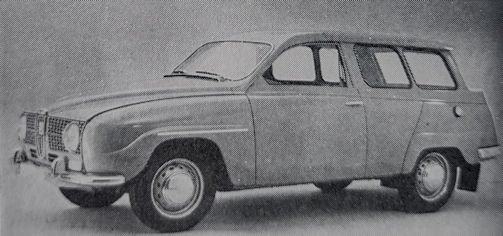
The Saab 95 is a seven-seater, two-door station wagon The station wagon version 95 (and 95 B) ran parallel to the 96 at the Saab headquarters Trollhättan .which was produced by Saab from 1959 to 1978.
Based on the Saab 93 sedan,followed closely that of the Saab 96 after the 93 production ended. Saab's two-door station wagon was introduced in June 1959, with a larger three-cylinder engine but still two-stroke. Bore was increased from 66 to 70 mm, but stroke retrained the same size. The new engine had a 12-bolt head, versus eight bolts for the smaller three-cylinder version, to solve the previous problem of blown head gaskets It had a four-speed manual transmission. Only 40 were made in 1959.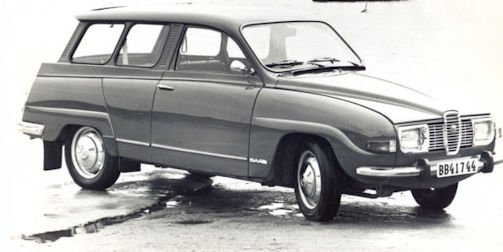
Fitted with a handle on the dash that,, put the car into a freewheeling type mode to coast downhill .A restyled rear end followed the line of the door window (instead of the sedan's familiar look).
the rear fenders formed with Twin round tail lamp pairs were mounted one over the other with the license plate between its overriders.
The 95 wagon could carry as many as seven people. Initial Type 95 wagons retained the rear-hinged doors of the 93B then switched to front-hinged doors as on the 93F. Both rear seats fold to create a long cargo area, or be used even as a bed.. Tires now larger to 5.60x15 size, and the gas tank had a larger capacity. Available luggage space with 2 passengers, floor area 63X 37 in., height of space 30 in. Weight capacities: driver plus 1,120 lb. of luggage, driver plus 1 passenger plus 935 lb., driver plus 4 passengers plus 375 lb. Overall length 14 ft; weight 1,958 lb. 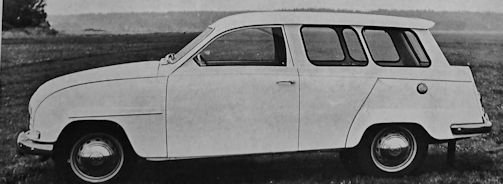
PERFORMANCE:
Engine capacity: 51.44 cu in, 841 cu cm;
Fuel consumption: 37.6 m imp gal, 31.5 m US gal, 7.5 1 x 100 km;
Max speed:: 74.5 mph, 120 km h;
max power (SAE): 42 hp at 5000 rpm
max torque (SAE)61 1b ft, 8.4 kgm at 2800 rpm
max number of engine rpm: 5500
specific power:62 hp/l
power-weight ratio: 44.1 lb/hp, 20 kg/hp;
max speed in 1st gear: 21.7 mph, 35 km/h; max speed in 2nd gear: 37 mph, 60 km/h; max speed in 3rd gear: 61 mph, 98 km/h max speed in 4th gear: 74.5 mph, 120 km/h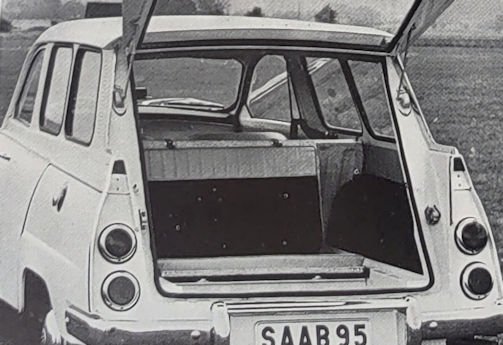
Saab 99
 |
|
|
Production period: |
1968 to 1984 |
|
Class : |
motor car |
|
Body versions : |
Sedan , station wagon |
|
Engines: |
Gasoline : 1.7-2.0 liters (59-107 kW) |
|
Length: |
4350-4480 mm |
|
Width: |
1680 mm |
|
Height: |
1450 mm |
|
Wheelbase : |
2470 mm |
|
Curb weight : |
1120-1160 kg |
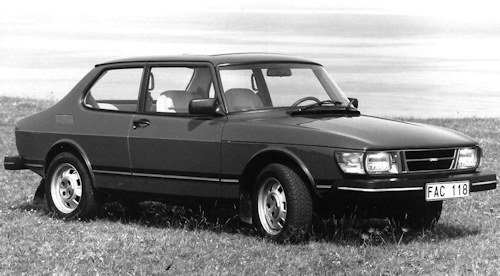
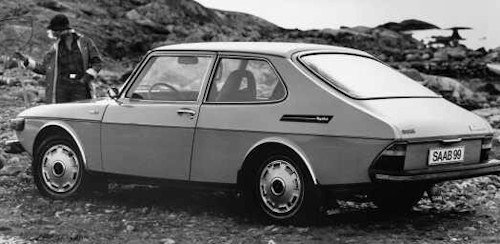
The Saab 99 was a car of the car manufacturer Saab , which was manufactured from early 1968 to 1984.
History
The Saab 99 was designed by Sixten Sason .Successor was introduced in the late summer of 1978 Saab 900 . As a slightly modified version of the 99 This ran from summer 1984 to mid-1987 as the Saab 90.The Saab 99 had a two or four-door self-supporting body, front-wheel drive, independent front suspension on double wishbones and rear a rigid axle , which was led by two Watt links and a Panhard transversely mounted.
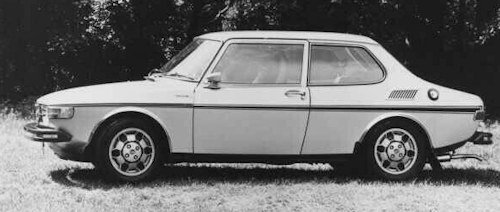
From the spring of 1970, the car was also available as a four-door and was provided with a new, padded dashboard and headlight washer.The Saab 99 was elaborately made: the assembly of a vehicle took 73 hours. Modern vehicles have assembly times of less than ten hours .The body was designed so stable that the Saab 99 initially received the homologation for motor sports, without the need for separate roll bars had to be mounted .
Originally Saab had commissioned the British development company Ricardo with the construction of an engine for the 99. As the development progressed, however, it quickly became clear that designing your own engine was too expensive and too risky for such a small company as Saab.
Ricardo had best contacts to various British automakers. As a result, it was known that at the same time at the manufacturer Triumph, a team around the local designer Harry Webster developed a new four-cylinder for the Triumph automobiles. Ricardo then built a contact between Saab and Triumph. So Saab could finally take over the new Triumph engine.
Initially, this had 1.7-liter displacement, which was later increased to 1.85 liters. This could be combined with a D-Jetronic injection system. The engine was installed longitudinally over the front axle, the four-speed gearbox was under the engine. From 1970, an automatic transmission was available. Noteworthy here was the reverse mounting position of the engine with the flywheel towards the radiator and the camshaft drive in front of the bulkhead. A later two-liter version of this engine (Series H) was a pure Saab development, which in many respects (higher engine block in favor of a broader land, distributor drive directly from the camshaft) of the Triumph construction and not with that of Triumph-built two-liter variant is related.
- PERFORMANCE:1,709cc (early)
- Engine capacity: 104.28 cu in, 1,709 cu cm
- Fuel consumption: 31.4 m/imp gal, 26.1 m/US gal, 9 1 x 100 km
- Max speed: 96.3 mph, 155 km/h
- Max power (SAE): 87 hp at 5,500 rpm
- Max torque (SAE): 98 1b ft, 13.5 kg m at 3,000 rpm
- Max engine rpm: 5,700
- Specific power: 51 hp/l
- Power- weight ratio: 25.1 lb/hp, 11.4 kg/hp
- Acceleration: standing 1.4 mile 19 sec
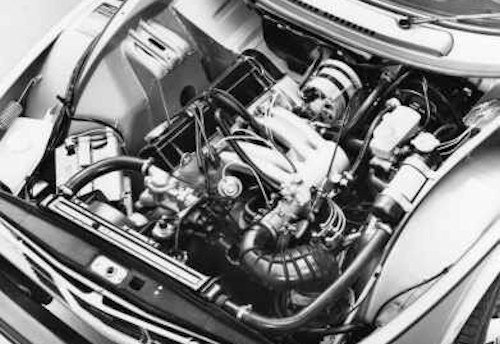
PERFORMANCE 2.0L (1970s)
max power (DIN): 100 hp at 5,200 rpm;
max torque (DIN): 120 1b ft, 16.5 kg m at 3,500 rpm
max engine rpm: 6,000; 50.4 hp/l
max speeds: (l) 30 mph, 48 km/h; (Il) 47 mph, 76 km/h; (Ill) 70 mph, 112 km/h; (IV) 102 mph, 164 km/h
power-weight ratio: 25.6 lb/hp, 11.6 kg/hp
fuel consumption: 29.1 m/imp gal, 24.2 m/US gal, 9.7 Ix 100 km.
Together with the group partner Scania , who had gained experience with turbocharged diesel engines , they developed a modern engine with turbocharging. This worked differently than previous turbo engine concepts of competition according to the torque philosophy , characterized by a relatively small turbocharger, which was combined with a specially developed wastegate valve for boost pressure regulation. This system produced sufficient air pressure at lower engine speeds and responded faster than conventional turbochargers. The engine delivered 107 kW (145 hp) at 5,500 rpm and accelerated the vehicle from 0 to 100 km / h in 8 seconds; the top speed was just over 200 km / h. Optionally, there was the vehicle with water injection , which additionally increased the performance. However, the model was only introduced after an intensive test phase with 100 test cars, which were provided to motor journalists and test drivers for a detailed analysis.
The Saab 99 Petro was a variant of the Saab 99 presented by the company Saab in 1967. The production of the Saab 99 began at Saab-Valmet in 1969. It was the basis for Saab-Valmet brought to production Saab 99 Petro. In 1977, the first model of this kind was presented. This was produced exclusively in the Uusikaupunki(Nystad) factory. This was only available with the two-door body of the Saab 99.
As with the Horizon Petro, This had a low-compression engine. This was the two-liter turbo engine, but without turbocharger, which made only 85 hp. The top speed was 150 km / h. The tank was divided, with the larger half for the motor petroleum and 45 liters summed up. Externally, he distinguished himself next to the Petro lettering by a second filler neck, which was located to the right of the license plate.With the cessation of production of the Saab 99 also ended the production of the Petro models.
In the late summer of 1978, the Saab 900 was introduced, a slightly extended and extended model based on the Saab 99. The variety of models decreased at 99 now a bit and so the 99 Turbo was offered only in Europe for homologation purposes as a two-door model. Just like the EMS in only a small number. In the early '80s, the range of 99 models had shrunk to two- and four-door models with single carburetor 100-horsepower engine, not to compete with the model 900.From 1981, the 99 was produced only in Finland in the local factory of Saab-Valmet , but on an excellent quality level.
In 1982, the so-called H-engine, which was also used in the 900, was installed as a further development of the existing engine and a five-speed gearbox was available for selection.A gentle facelift and good equipment ensured from 1983 again increasing sales figures. Even to the last year of production in 1984, the steadily improved and now very mature car was upgraded again with contactless ignition and modified steering geometry.
Also in 1985 was not final, because the Saab 99 learned in August 1984 as the Saab 90 a sequel in an unusual style: The front end was provided with the rear of the Saab 900 Sedan and could act until August 1987 as an entry level model. Since the 900 is actually a development of the 99, the concept could exist until the end of 1993.The Saab 99 was not only manufactured at the Trollhättan (Stallbacka) plant, but also at the Uusikaupunki plant in Finland by the subsidiary company Oy Saab-Valmet . The Saab 99 was therefore also used as a police car in Finland. There were also models made in Mechelen , Belgium .
Model history
- 1970: In spring comes as an addition to the 99E with injection and automatic transmission. The performance increases from 80 to 87 hp.
- 1971: New dashboard. In addition to the engine with 1.7 l displacement comes a 1.85 l engine with carburetor or injection and without freewheel. Introduction of the headlight wiper-washer system and for the first time as standard an electric seat heating of both front seats.
- 1972: First large facelift, all models without freewheel gearbox other front suspension. Larger and differently placed combination lamps in front. Also new were powerful active bumpers at the front and rear of the car. Although these caused a slightly better accident protection, as they were up to 6 km / h deformable and self-repairing, but the car lost its graceful line and now seemed a bit clumsy.
- 1973: Side impact protection in the doors, shock-absorbing inner sky. There was also a 1.971 liter engine. The new engine was introduced with the start of production of the Saab 99 EMS with Bosch D-Jetronic, later also on the carburettor versions. Black grille with polished aluminum trim.
- 1974: In addition to the two- and four-door models came on a variant with hatchback and large tailgate with low sill on the market, the Combi-Coupé (short: CC) was called. This had a folded rear seat a cargo volume of 1,600 liters. New seats with integrated head restraints in the front and in the saloon rear neck impact protection with rear window defroster nozzles for rear window heating and improved bumpers on the outside, which are now self-repairing up to 8 km / h.
- 1975: Second extensive facelift, completely revised technology on suspension and drive, the engine power increases from 95 hp to 100 hp and from 110 hp to 118 hp. The grille is now made of plastic. The Triumph engine is eliminated. As an additional model, a two-seat van comes into the offer. In the model EMS, the sports variant, the K-Jetronic is equipped and the car went from now next to the Saab 96 in rallying to the start - driven by Stig Blomqvist and Per Eklund. The rally version received 1976 cylinder heads with 16 valves and two camshafts. This rally-proven variant was also the basis for the turbo engine from Saab.
- 1976: Expansion of the engine range by a dual-engined engine with 108 hp. Electric rear window heating also for two- and four-door. As an additional body variant, the five-door Combi coupe is introduced and a luxury version with 118 hp engine equal to the EMS but only 4-door and with power steering namely GLE.
- 1977: Small model care externally by larger rear lights in the sedan and enlarged combination lights in all variants front. The combination lights contained a cornering light and side reversing lights (not approved in Germany). In the fall, the model Turbo was a three-door Combi Coupé in pearly white on the 47th IAA in Frankfurt and was delivered from the fall of the year to customers, primarily in the US. Pre-production of 100 vehicles for test purposes already in advance as 'EMS-Turbo' launched to motor journalists and car testers in the spring.
- 1978: Series production of the Saab 99 Turbo begins with the model year. He is equipped with a 2.0-liter engine, the charged 145 hp and 235 Nm torque possesses. Only available as 3-door CombiCoupe in black and carinal red, with sunroof as standard. GLE model now only 5-door.
- 1979: Technical adaptation to the Saab 900, simplification of the equipment, including omission of the neck protection of the rear passengers. Fewer model variants. Turbo no longer available in 3 doors. But now as a 2-door sedan only for Europe in marble and acacia green in small numbers as well as EMS.
- 1980: Longer bumpers and further technical adaptation to the Saab 900. Only available as a sedan. Two-door turbo in fixed small numbers but also available with five-speed gearbox.
- 1981: engines with 100 hp carburetor or 118 hp injection. Four or five gears, no automatic transmission available. Production only in Uusikaupunki / Finland at SAAB-Valmet.
- 1982: Due to changes in the front area, the 99 can now be equipped with the H engine from the 900. Exterior new side trim and grille from the 99 EMS.
- 1983: Grille is adapted in design to the Saab 900.
- 1984: Contactless electronic ignition. Production will be discontinued in April.
Saab EV-1 Concept Car
(1985)
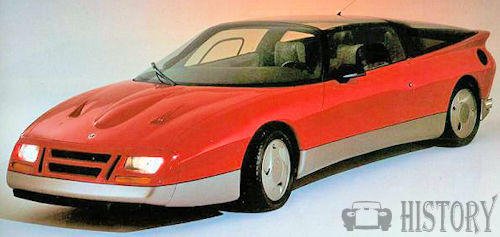
Saab EV-1, or Saab 900 Turbo EV-1, was developed by Saab in 1985 as a fully functional concept car, EV-1 stands for "Experimental Vehicle One".
History
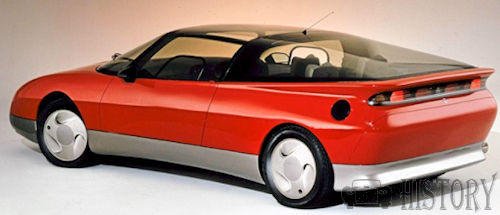
It was based on the Saab 900 Turbo 16v and featured a wedge-shaped 2 + 2 sports coupé body type. The body was made of steel, and the roof was entirely made of glass. Björn Envall designed it, while Leif Mellberg did the metalwork. It incorporated amenities like a solar-powered interior cooling fan with 66 solar cells set in the glass ceiling. When the car was parked in the sunlight, this mechanism kept it cool. The front and rear bumpers (fenders) were created to absorb impacts and return to their original shape afterward. They were built of Aramid fibre reinforced composites (Twaron or Kevlar). Carbon-fibre side impact protection was included on the side doors.
Most of the parts were from the Saab 900 Turbo 16 and modified, but the seats came from a Chevrolet Corvette.The windshield is wrap-around and very deep and steeply inclined for the era, while the A-pillar has a much more vertical angle, providing excellent driver visibility.
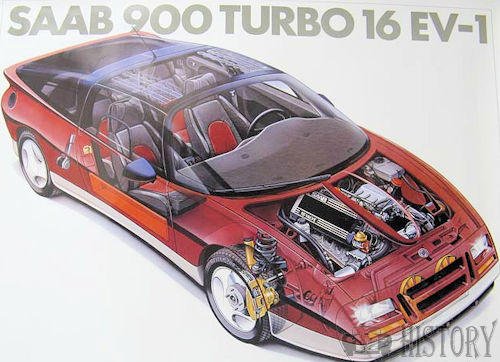
The engine was tuned to give 285 hp (213 kW). The top speed was 270 km/h (168 mph) and 0 to 100 km/h (62 mph) acceleration took 6.9 seconds. The speedometer lights only illuminate the area around the current speed; a modified version of this feature has been incorporated as standard on later production Saab models.
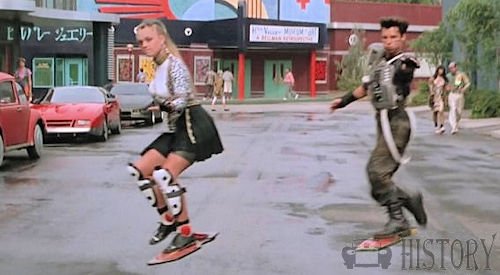
The EV-1 can be seen in the background of Back to the Future Part II.
Saab 9000
 |
|
| Manufacturer | Saab Automobile |
|---|---|
| Production | 1984–1998 (503,087 produced) |
| Assembly | Sweden: Trollhättan Finland: Uusikaupunki (1984–1991) |
| Successor | Saab 9-5 |
| Class | Executive car |
| Body style | 4-door sedan (CD) 5-door liftback (CC, CS) |
| Layout | Front-engine, front-wheel drive |
| Platform | Type Four |
| Engine | 2.0 L I4 (petrol) 2.0 L I4 (t/c petrol) 2.3 L I4 (petrol) 2.3 L I4 (t/c petrol) 3.0 L V6 (petrol) |
| Transmission | 4-speed automatic 5-speed manual |
| Wheelbase | 2,672 mm (105.2 in) |
| Length | CC: 4,620 mm (181.9 in) CD 4,782 mm (188.3 in) CS: 4,665 mm (183.7 in) |
| Width | 1,763 mm (69.4 in) |
| Height | 1,420 mm (55.9 in) |
| Curb weight | 1,410–1,475 kg (3,100–3,250 lb) |
| Designer(s) | Björn Envall Giorgetto Giugiaro |
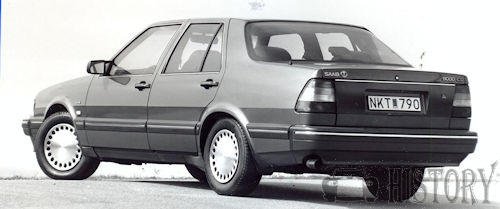
The Saab 9000 is a large executive car that was produced by the Swedish company Saab from 1984 to 1997. Representing the company's foray into the executive car scene, the 9000 remained in production until it was replaced by the 9-5 in late 1997.
Saab designed the 9000 as part of the Type Four platform in conjunction with the Italian automaker Fiat.
While the Lancia presented in autumn 1984 and the Fiat presented in mid-1985 looked very similar to the Saab, the Alfa Romeo introduced in autumn 1987 had only a few visible body parts in common with these models. Some parts among the four vehicle types were interchangeable. For example, the doors of the Fiat Croma also fit into the Saab 9000, but the door strips are different and fastened differently.
The side impact protection , which was standard on Saab models from 1986 onwards , was also missing from the Fiat doors , as Fiat took a different approach to occupant safety for the Fiat Croma and the Lancia Thema. Fiat designed a more stable passenger cell for its models (in particular the second series of the Thema, which was available from autumn 1988 and the Croma, which was revised at the beginning of 1991), while the Saab 9000 continued to use the original, jointly designed body with struts and improvements (such as the side impact protection struts in the doors ) was reinforced.
Various chassis parts (dome bearings, suspension struts, etc.) are interchangeable, and the windshield of the Croma, Thema and the Alfa 164 are the same as that of the Saab 9000. The drag coefficient (c w ) is 0.32. The mold was of Giorgetto Giugiaro designed .
On the 9000, the ignition lock is in the dashboard next to the steering wheel and not on the gear lever as on the Saab 99 , 90 or 900 . The chassis consisted of MacPherson struts at the front with anti-roll bar and a rigid axle at the rear with coil springs , anti-roll bar, trailing arms and Panhard rod . The standard tire size was 195/60 VR 15.
tomobiles. Fiat retailed similar derivative versions as the more basic Fiat Croma, the luxury-themed Lancia Thema, and the sports-oriented Alfa Romeo 164. Unlike the 164, which shares only the chassis, the Croma and Thema are outwardly similar to the 9000. As such, much of the bodywork appeared interchangeable between the 9000, Croma and Thema; for example, the doors. However, because Saab fitted heavier side impact protection they will not fit.Only seven different parts are actually interchangeable.The 9000's body was designed by Giorgetto Giugiaro and Saab designer Björn Envall.
Despite being shorter overall than the 900, the 9000 had a longer wheelbase and greater interior space, and was the first vehicle imported to the United States to be classed as a "large car" by the EPA.
History
The 9000 was launched in 1984 as a five-door liftback only sharing much of its appearance and bodywork with the Type Four platform relatives—the Fiat Croma and Lancia Thema. Later in 1988, Saab released a sedan variant of the 9000 known as the "CD". This was followed by the 1991 release of a partially redesigned five-door liftback, known as the "CS". At the release of the "CS", the original liftback variant was retrospectively designated "CC" to differentiate it from the newer version, which it continued to sell alongside in some markets as an entry-level model.
With the introduction of the "CD" in 1988, Saab took the opportunity to re-style the front-end for the sedan. This involved smoothing the edges of the headlamps and grille, and sloping the front outwards, marking a departure from the more upright front styling of the 1984 original. From late 1990, the "CC" liftback received this same front-end facelift. A second facelift arrived in 1991 with the launch of the "CS" liftback. Fitted with a much narrower front profile, this facelift made its way to the "CD" sedan in 1994, albeit, with clear as opposed to the amber front turn signals fitted to the "CS". The "CS" was in turn facelifted in circa 1995 gaining these clear lenses that had earlier debuted on the sedan (CD). Therefore, while each body variant received one facelift, they were all applied at different times.
Unlike the 900, the 9000 kept the ignition switch in the more conventional steering column position rather than between the front seats. The inspiration for the seats was taken by Björn Envall from The Muppet Show's Pigs in Space,a sketch by the late puppeteer Jim Henson.
Saab Direct Ignition was fitted to the 9000 CD in 1988 on some models and expanded to all turbocharged 9000s in 1990. As early as 1989, the 9000 was equipped with the larger B234 2.3-litre engine, providing 150 hp (110 kW) in the normally aspirated engine. From late 1990, the B234 became available with a turbocharger, producing 147 kW (200 PS).
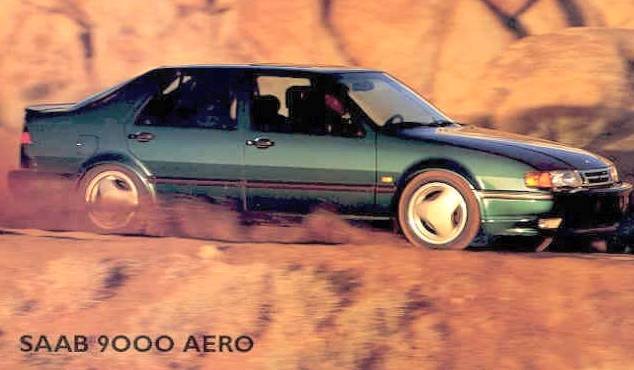
In 1993, the "Aero" was introduced, and was the most powerful Saab to date upon its introduction. The "Aero" was powered by a 168 kW (225 hp) version of Saab's 2.3-litre B234 engine, with more power courtesy of a larger Mitsubishi TD04 turbocharger. Automatic transmission-equipped "Aeros" were limited to 149 kW (200 hp) and kept the regular turbocharged models' Garrett AiResearch T25 turbocharger. Aeros were equipped with paint-matched body kit and spoiler, eight-way Recaro-designed heated sports seats, a sport suspension, and 16-inch Super Aero wheels. The Aero's in-gear acceleration was strongly emphasised; the Aero was capable of accelerating from 80 to 121 km/h (50 to 75 mph) faster than a Porsche Carrera 4 or a Ferrari Testarossa. The Aero was discontinued after 1997.
An optional trip computer, the SCC, was introduced for the 1993 model year, and provided mileage, speed warning, and alarm functions.A new turbocharger management system, Trionic 5, was equipped from the 1993 model year onwards. The Trionic system used resistor spark plugs to detect for engine knock in place of the knock sensors incorporated into the engine block in the previous APC system.
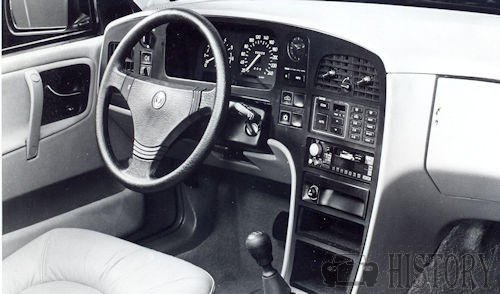
From 1988, all 9000 variants were equipped with a Saab Information Display (SID) which showed fuel consumption, distance to an empty fuel tank, alternator output voltage, outside temperature, and lowest battery voltage during vehicle start.If the outside temperature fell to -3 to 3 °C (27 to 37 °F), the temperature display is automatically selected to warn of possible "black ice" road conditions. A separate pictogram monitored door and hatch opening and exterior light bulb condition.
In the United Kingdom, a limited run of 9000 "Carlsson" models were produced, with a paint-matched airflow body kit, spoiler, and specially tuned turbocharged engine producing 160 kW (220 hp) with a manual transmission or 150 kW (200 hp) with the automatic. A number of the Carlsson editions fitted with the B202 turbocharged engine were sold into the Australian market.
A limited edition "Anniversary" model was introduced to mark Saab's 50th anniversary, featuring leather seats embossed with the classic, aircraft-inspired Saab logo and a colour-keyed body kit.
Only 1,400 9000s were produced for the 1998 model year, and of these only 400 were exported to the United States. In total, 503,087 Saab 9000s were manufactured.
| Fuel Capacity | 66 litres |
|---|---|
| Weight | 1360kg |
| Length | 4761mm |
| Width | 1778mm |
| Height | 1420mm |
| Wheelbase | 2672mm |
| Turning Circle | 10m |
9000 CC (liftback)
Originally known simply as the "9000", the original liftback variant was later given the "CC" identifier, standing for "combi coupe", to differentiate it from the CD sedan and CS liftback. While originally equipped with an upright front design, this was replaced by the sloped version in mid-1990—the design that had earlier debuted on the 9000 CD (sedan) in 1988.
The original 1984 model was powered by a water-cooled, turbocharged, double overhead camshaft, 16-valve inline-four engine, providing 130 kW (175 hp).Earlier on in the development, the PRV engine had also been considered. Both a five-speed manual and four-speed automatic transmissions were available. Later in 1984, a normally aspirated engine was introduced in the 9000 and 9000 S models, producing 97 kW (130 hp).
9000 CD (sedan)
At the Birmingham Motor Show in September 1988, Saab premiered the four-door sedan body style with a slightly more aerodynamic nose. Known as the "CD", this was originally available only with the turbocharged engine. In late 1989, the CD range in most of the world was expanded downward with the naturally aspirated 2.0-litre inline-four. This change did not happen until late in the 1990 model year for the US market, when Saab introduced the 150 hp (112 kW) 2.3-litre B234 normally aspirated engine.
The limited edition 9000 "CD Griffin" was available in 1991 for the 1992 model year in the United States and was highly appointed with luxury features including all available electric options, special eucalyptus green paint, a separate rear-seat air conditioning system, walnut trim and rear window blinds.
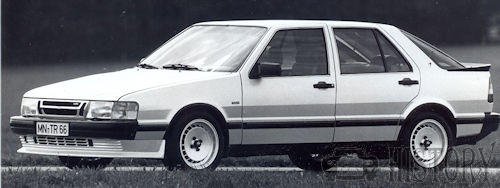
When Saab released the redesigned liftback model, designated CS in 1991, it debuted a slimmer front-end design characterised by a much smaller (thinner) grille and headlamps. As part of a 1994 facelift, Saab grafted this slimmer frontal styling to the CD as well. At the same time, the tail-lamps were refreshed, with extensions to either side of the license plate alcove and white turn signal lenses replacing the previous model's amber rear turn signals.
9000 CS (liftback)
Saab presented an updated version of the liftback body variant in 1991 for the 1992 model year with the "CS". Featuring a lowered front fascia with new headlights, grille and a substantially redesigned rear-end. Both the "CS" and better-equipped "CSE" editions were available with a 2.3-litre inline-four—either turbocharged or in normally aspirated tune. The "CS Turbo" was equipped with a low-pressure turbocharger setup producing 127 kW (170 hp), while the "CSE Turbo" sported a full-pressure turbocharger with 149 kW (200 hp). Both systems used the same Garett T25 turbocharger with a base boost pressure of .4 bar (6 psi) but the full pressure turbo is equipped with a boost control valve that is manipulated by the ECU. This allows the boost pressure to be increased as the ECU sees fit. Maximum stock boost on a full pressure turbo varies from .7 to 1.02 bar (10 to 15 psi) depending on the year and transmission.
2.3 CSE Turbo Performance
Performance 2.3 Turbo S
Power 203 PS (149 kW) at 5000 rpm
torque 244 1b ft (337 Nm) at 2000 rpm
Top gear speed at 1000 rpm: 21.6 mph (34.8 km/h).
Maximum speed 140 mph (225 km/h)
0 to 60 mph (97 km/h) 7.5 sec
80 mph (130 km/h) 11.5 sec.
Fuel consumption at constant 75 mph (120 km/h): 31.4 mpg
| Power | 225 bhp |
|---|---|
| Top Speed | 149 mph |
| 0-60 mph | 6.7 secs |
| Torque | 342 Nm |
| CO2 Emissions | 227 g/km |
| Euro Emissions Standard | 2 |
| Miles Per Tank | 406 miles |
In European markets, a smaller 2.0-litre engine was offered in normally aspirated form 97 kW (130 hp), light-pressure turbo 112 kW (150 hp) or full-pressure turbo 130 kW (175 hp).The "CDE" model was offered initially with only the 149 kW (200 hp) turbocharged engine, and later the 3.0-litre V6.
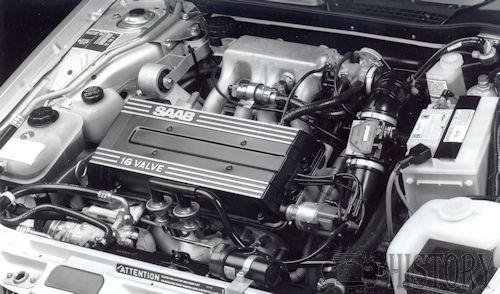
In 1995, a 3.0-litre B308 V6 engine with 157 kW (210 hp) was introduced as standard for the "CDE" sedan and optional for the "CSE" liftback. The V6 was discontinued in the United States after one year along with the "CDE" model, but continued on in Europe until 1997. In some European markets, a high-spec "CDE Griffin" model was offered with numerous luxury appointments. After the 1995 model year, naturally aspirated four-cylinder engines were discontinued in the United States.
For the 1998 model year, all manual transmission equipped 9000 CSEs received the 168 kW (225 hp) Aero engine, along with special 16-inch Super Aero wheels detailed with exposed lug nuts.
Saab 9-3 First generation
| (1998–2003) | |
|---|---|
 |
|
| Overview | |
| Production | 1998–2002 |
| Assembly | Trollhättan, Sweden (hatchback) Uusikaupunki, Finland (Valmet Automotive) (1999–2003 convertible and Viggen) |
| Designer | Einar Hareide |
| Body and chassis | |
| Body style | 3-/5-door hatchback 2-door convertible |
| Layout | Transverse front-engine, front-wheel drive |
| Platform | GM2900 platform |
| Related | Opel Vectra Saab 9-5 Saturn L-Series |
| Powertrain | |
| Engine | 2.0 L B204 I4 2.0 L B205 I4 2.0 L B205R I4 2.3 L B235R I4 2.2 L Turbodiesel I4 |
| Transmission | 5-speed manual 4-speed automatic |
| Dimensions | |
| Wheelbase | 2,605 mm (102.6 in) |
| Length | 1999–2000 Viggen & 2001–02: 4,630 mm (182.3 in) 1999–2000: 4,628 mm (182.2 in) 2001-02 Viggen: 4,640 mm (182.7 in) |
| Width | 1,712 mm (67.4 in) |
| Height | Hatchback: 1,427 mm (56.2 in) Convertible: 1,422 mm (56.0 in) 2001-02 Viggen Hatchback: 1,415 mm (55.7 in) 2001–02 Viggen Convertible: 1,410 mm (55.5 in) |
The first generation 9-3, a substantially improved "new-generation" Saab 900 was launched in 1998 for the 1999 model year. Saab claimed that 1,100 changes were made, including a revised suspension in an attempt to tighten up the handling characteristics of its predecessor, the Saab 900 (1994–1998 model).It featured slightly sleeker styling with some models sporting a black rear spoiler and removed Saab's trademark centrally mounted "snow flap".
It was available as a three door hatchback.

Five-door hatchback.

And two-door convertible.

It was the last small Saab to use the company's H engine. Notable improvements over the Saab 900 were improved ride and handling and substantially improved crash-worthiness with standard side impact airbags with head protection and active headrests. The Saab 9-3 along with the Saab 9-5 and the Volvo S70 were the first cars in the world to earn the maximum score in a side impact augmented by a pole testbased on Euro NCAP testing. The 9-3 continued the Saab safety tradition of performing a Moose Test.
The 9-3 was available with a new variant of the B204 engine (B204E, 154 hp (115 kW)), a low pressure turbo (LPT) engine based on the B204L used in the last generation Saab 900. For the U.S. market, all 9-3s were turbocharged petrol engines with the "full pressure turbo" (B204L, 185 hp (138 kW)) as the standard offering, and a "HOT" (B204R, 200 hp) variant in the SE models for the 1999 model year. The 2000 model year saw a revision from SAAB's Trionic 5 to Trionic 7 engine management system. The first generation 9-3 was also the first Saab available with a diesel engine, also found in the Opel Vectra, Astra G, Signum, Zafira A.
A Saab innovation is the 'Night Panel', carried over from the Saab 900, which permits dousing of the instrument panel lighting, except for essential information, for less distraction when night driving.
A total of 326,370 first generation 9-3s were built.
Saab Viggen

It came with a turbocharged 2.3 L engine, (B235R) giving 225 bhp (168 kW; 228 PS) later 230 bhp (172 kW; 233 PS) on 1.4 bar (20 psi) of boost from its Mitsubishi TD04-HL15-5 turbocharger. Acceleration from 0–100 km/h could be reached in 6.4 seconds and the top speed is electronically limited to 250 km/h (160 mph). To provide and handle the high power and performance, the following elements were changed/modified:
- Higher capacity intercooler
- Higher performance tuned ECU
- Larger flow-through exhaust system
- Heavy duty clutch and pressure plate
- Stiffened and lowered springs
- Firmer dampers
- Stronger CV joints and driveshafts
To enable the front wheels to cope with the amount of torque available, the maximum torque was electronically limited.
- 1st gear was limited to 250 N·m (180 lb·ft)
- 2nd gear was limited to 330 N·m (240 lb·ft)
- 3rd gear and on had the full 350 N·m (260 lb·ft).
Forty-six hundred Viggens were manufactured, of which only 500 units were produced for the UK market.
Production summary:
- Model Year 1998: 14 cars
- Model Year 1999: 1099 cars
- Model Year 2000: 1621 cars
- Model Year 2001: 1251 cars
- Model Year 2002: 615 cars (Production ended 06/2002)
Total: 4600 cars
Complements of SAAB USA:
These numbers represent the total number of each body style Viggen imported into the USA:
- 1999: 3-door > 426| 420 Blue| 2 Silver |2 Monte Carlo Yellow |2 Black
- 2000: Convertible > 245, 3-door > 138, 5-door > 421
- 2001: Convertible > 738, 3-door > 129, 5-door > 285
- 2002: Convertible > 322, 3-door > 71, 5-door > 157
- Totals:
- 1999 = 426
- 2000 = 804
- 2001 = 1,152
- 2002 = 550
- Totals: 3-door = 764, 5-door = 863, conv. = 1,305
In 1999, the Viggen was the first 9-3 to use Saab's Trionic 7 engine management system, which processes 2 million calculations every second analysing combustion temperature, boost control, variable torque curves and many other critical engine processes. In addition, the 2001 model year introduced a Traction Control System (TCS) to the Viggen.
In addition to extra power and torque, it also featured a special rear wing (increasing the downforce by 50%) requiring relocation of the radio antenna, aerodynamically designed bumpers and side skirts reducing the drag coefficient by 8%, specially bolstered and colored leather seats (available in four colors: black with black inserts (charcoal), black with blue inserts (deep blue), black with orange inserts (flame ochre), and tan with tan inserts), sportier suspension, bigger wheels, upgraded brakes, and other upgraded parts.
The Viggen was only available with a five-speed manual transmission, CD player, power moonroof, and (what were initially) Viggen-specific motorised and heated leather seats with the Viggen delta logo embossed in the backrest; these were later also available in the Aero model (U.S. market 'SE' model) without the embossed Viggen logo. Some colors featured carbon-fibre interior trim from its introduction to the middle of the 2001 model year, when Saab substituted a less expensive printed gray pattern for the dash and standard trim for everything else.
New Viggen buyers in the USA were treated to two days of advanced driving instruction at Road Atlanta and dined with Saab USA executives from nearby Norcross, Georgia. This programme, operated by Saab and Panoz, was called Viggen Flight Academy and later transformed into the current SAAB Aero Academy.
Some motoring journalists were critical of untamed torque steer in low gears. Although the torque steer can be nearly eliminated through the use of a steering rack brace,also called a "Viggen Rescue Kit" available through a few aftermarket vendors.


