
SS
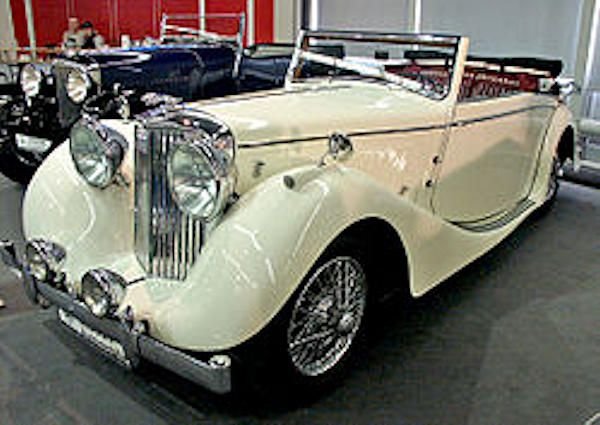
SS Jaguar Mk IV 3½ Litre
 |
|
| Production | 1937–1948 3162 made |
|---|---|
| Body style | 4-door saloon 2-door drophead coupé |
| Engine | 3,485 cc (3.5 l) I6 |
| Wheelbase | 120 in (3,050 mm) |
| Length | 186 in (4,720 mm) |
| Width | 66 in (1,680 mm) |
The 3½ Litre, introduced in 1938, was essentially the same body and chassis as the 2½ Litre but the larger 125 bhp engine gave better performance but at the expense of economy. The rear axle ratio was 4.25:1 as opposed to the 4.5:1 on the 2½ Litre.
The Jaguar Mark IV (pronounced mark four) is an automobile built by Jaguar from 1945 to 1949. It was a relaunch of a pre-Second World War model made by SS Cars Ltd from 1936.
Before the Second World War the name Jaguar was the model name given to the complete range of cars built by SS Cars Ltd. The saloons were titled SS Jaguar 1½ litre, 2½ litre or 3½ litre. The two-seater sports car was titled the SS Jaguar 100 2½ litre or 3½ litre.
After the war the company name was changed to Jaguar Cars Ltd. Although the post-war saloons were officially the Jaguar 1½ litre, 2½ litre etc., the term "Mark IV" was sometimes applied retrospectively by the trade to differentiate them from the officially named Mark V.
All the cars were built on a separate chassis frame with suspension by semi-elliptic leaf springs front and rear.
SS 90 Jaguar
 |
|
| Manufacturer | SS Cars Ltd |
|---|---|
| Production | 1935 |
| Successor | Jaguar SS100 |
| Class | Sports car |
| Body style | Tourer, 4-seat Coupé |
| Layout | FR layout |
| Engine | Straight-6 |
The SS90 was a British two-seater Roadster sports car first built by SS Cars Ltd in Coventry, England in 1935. In 1945 the company changed its name to Jaguar Cars Ltd.
The car used a six-cylinder side-valve Standard engine of 2663 cc with an output of 68 bhp (51 kW). The engine differed from the one used in the ordinary cars by having Dural connecting rods, an aluminium cylinder head with 7:1 compression ratio, and twin RAG carburettors. At 8 feet 8 inches (2.64 m) in length the chassis was a shortened version of the one used on the SS 1, and was also supplied by Standard. Suspension was by half-elliptical springs all round, with an underslung back axle. The braking system was Bendix.
The cars rapidly gained attention for their elegant sporting styling, but were not well regarded by the sporting fraternity as their performance did not match their appearance. True sports car performance had to wait for the SS 100, which had similar styling and suspension but an engine fitted with an overhead-valve cylinder head.
The SS 90 does not seem to have been tested independently by any magazines, therefore contemporary performance figures are unknown, but it was widely believed to be capable of reaching 90 mph (140 km/h). In 1932 the basic tourer cost £395. Twenty-three were made.
The car was 12 feet 6 inches (3.81 m) long and 5 feet 3 inches (1.60 m) wide and weighed typically 2,519.9 pounds (1,143.0 kg).The prototype SS 90, ARW395, was owned by Hugh Kennard from 1938 until at least November 1940. The prototype is one of the surviving cars.
Technical data
- Engine: Six - cylinder inline engine , 2662 cc, Bore / stroke: 73 mm × 106 mm,Power: 70 bhp (brake horse power) (51 kW)
- Transmission: 4-speed
- Wheelbase: 2590 mm
- Length: 3810 mm
- Width: 1600 mm
- Height: 1370 mm
- Weight: 1143 kg
- Top speed: 142 km / h,0-80 km / h: 12 seconds

SS Cars Ltd History (jaguar)
 |
|
| Fate | Renamed to Jaguar Cars Ltd |
|---|---|
| Successor(s) | Jaguar Cars |
| Founded | 1934 |
| Defunct | 1945 |
| Headquarters | Coventry, England |
The Swallow Sidecar Company had moved from its roots making stylish sidecars to become first a coachbuilder adding new bodies to other makers chassis and running gear and in 1932 launched a car of its own, the SSI. It had also moved in 1928 from Blackpool to Coventry, in the heart of the British motor
Under the guidance of the chairman, William Lyons, the company survived the depression years by making a series of beautifully styled cars offering exceptional value for money although some enthusiasts criticised them at the time for being "more show than go". The engines and chassis were supplied by the Standard Motor Company with a large design input to the latter from SS with the bodywork being added in the Coventry works. In 1929 John Black (standard motor company) and William Lyons realised a long standing dream and produced a one of a kind sports car, This "First" SS ( standard Swallow ) was a sleek Boat Tail Roadster, Its flowing design and streamlining, points to an obvious attempt at making a fast car, possibly with the intention of venturing into racing. This car is believed to have been shipped to Australia in the late 1940s.

The first of the SS range of cars available to the public was the 1932 SSI with 2- or 2 1⁄2-litre side-valve, six-cylinder engine and the SSII with a four-cylinder 1-litre side-valve engine. Initially available as coupé or tourer a saloon was added in 1934, when the chassis was modified to be 2 inches (50 mm) wider.
The first of the sports cars came in 1935 with the SS90, so called because of its 90 mph (140 km/h) top speed. This car used the 2 1⁄2-litre side-valve, six-cylinder engine. Only 23 were made.
To counteract the "more show than go" criticism Lyons engaged William Heynes and Harry Weslake. Weslake was asked to redesign the 2 1⁄2-litre 70 bhp side-valve engine to achieve 90 bhp. His answer was an overhead-valve design that produced 102 bhp and it was this engine that launched the new SS Jaguar sports and saloon cars in 1936.
The sports car carried the title: SS Jaguar "100". One of the finest looking cars of all time, only 198 of the 2 1⁄2-litre and 116 of the 3 1⁄2-litre models were made and with a 100 mph (160 km/h) top speed and 0-60 mph time of 11 seconds the survivors are highly sought after, rarely coming on the market.
The SS Jaguar 2 1⁄2-litre saloon with its 102 bhp six-cylinder Weslake-designed engine caused a sensation when it was launched to the press and dealers at the Mayfair Hotel, London.
The audience were asked to write down the UK price for which they thought the car would be sold: the average of their answers was £765. Even in that deflationary period, the actual price at just £395would have been a pleasant surprise for many customers. Also available was a similar looking but scaled-down version using a 1 1⁄2-litre four-cylinder side-valve engine.
In 1938 production moved from coachbuilt (wood framed) to all steel construction. A 3 1⁄2-litre was also added to the range at this point. The 2 1⁄2- and 3 1⁄2-litre cars shared the same chassis and body design although it was necessary to use a wider radiator for the 3 1⁄2-litre. The new 1 1⁄2-litre for 1938 used the same body shell as the six-cylinder cars but on a shorter chassis. The engine was also increased to 1776 cc and had overhead valves.
Car production stopped in 1940. After the war SS Cars Ltd dropped their SS identity and adopted the Jaguar model name as the company name and when production restarted the saloons were simply named Jaguar 1 1⁄2-, 2 1⁄2- or 3 1⁄2-litre. The model that followed these cars was called the Jaguar Mark V and so the immediate post war trio have become known unofficially as the Mark IV Jaguars. The sidecar making business along with the Swallow trademark was sold, the new company making the Swallow Doretti sports car.
Swallow Coachbuilding Co. (1935) Ltd. #07720862 is owned by Canadian Peter Schömer of Chichester, West Sussex England. Swallow trade mark #2591789 and the winged SS logo is registered at the Intellectual Property Office, that is also owned by the Swallow Coachbuilding Co.(1935) Ltd.

Image credited " © JDHT "

