
Standard
Standard Ensign
|
|
|
|
Production |
1957 to 1963 |
|
Body style |
4 door saloon, estate car |
|
Engine |
|
|
Transmission |
4-speed manual |
|
wheel base: |
102.00 in, 2591 mm |
|
length: |
171.65 in, 4360 mm |
|
width: |
67.72 in, 1720 mm |
|
height: |
59.84 in, 1520 mm |
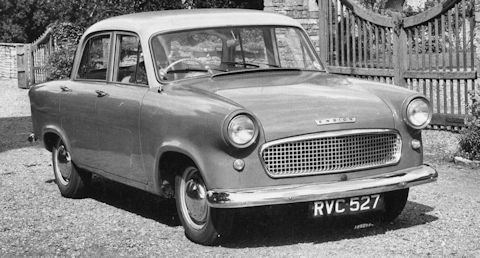
The Standard Ensign, restyled by Michelotti. announced in October 1957 first with 1670 cc engine, developing 63 b.h.p. (gross) at 4,000 r.p.m.The Ensign shared its main body and basic specification with the Vanguard Series III.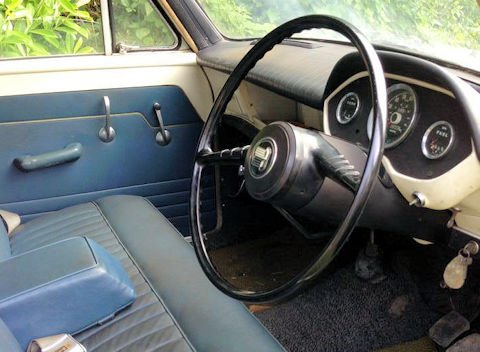
Body: 4-door 5/6-seater Despite the generally lower specification, the Saloon had steel panelled and rust-proofed fitted with Triplex toughened glass; curved windscreen and "wrap round" rear light; press-button door handles; anti-draught ventilators on front doors.
seating: front and rear scats of divan type with centre armrests at front, front seat adjustable fore and aft; upholstery Vynide; instruments grouped in front of driver including speedometer with trip, fuel and water temperature gauges, warning light for oil pressure, ignition, flashing tramcator indicator light and high beam warning lights; parcel and luggage accommodation: parcel shelf in facia and behind rear seat, large luggage boot; spare wheel housed under luggage boot; general equipment includes: sun visors adjustable to all positions; driving mirror; interior panel light independently. controlled by combined switch and rheostat; interior light with integral switch and courtesy light switches on front doors; ashtrays front and rear.
The Ensign was the first Vanguard-based car to have a four-speed gearbox. The gear lever was moved from the column to the floor, positive synchromesh on top, 3rd and 2nd ratios and overdrive was optional. front suspension overdrive was optional. front suspension independent coil springs controlled by telescopic hydraulic dampers at the rear semi-elliptic springs controlled by telescopic dampers.
Optional overdrive; front disc brakes, tyres 6.40 - 15; anti-roll bar on front suspension.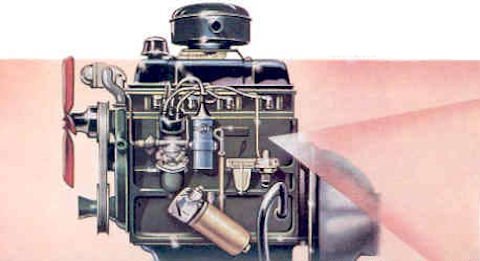
It received the basic body style changes of the new "Vignale" Vanguard in October 1958 — essentially, larger screen, larger rear window and different rear lamp treatment but the Ensign was not otherwise changed much until August 1961, when it Was finally discontinued.
The Ensign De Luxe, which was different in several ways, did not then appear until May 1962. By 1962 the Ensign De Luxe version came now also as an estate car with a larger 2138 cc engine. or 1.6 litre four-cylinder Perkins diesel for some markets .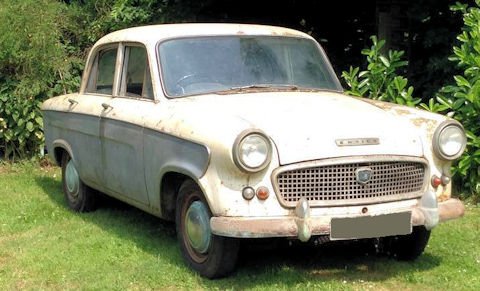
PERFORMANCE 2138CC Standard Ensign De Luxe
Engine capacity: 130.76 cu in, 2138 cu cm
Fuel consumption: 25 m imp gal, 20.8 m US gal, 11.3 1 x 100 km;
Max speed: 85 mph, 136.8 km h
acceleration: 0-50 mph (0-80 km/h) 12.7 sec
max power (SAE): 75 hp at 4100 rpm
max torque (SAE):126 1b ft, 17.4 kgm at 2500 rpm
max number of engine rpm: 5000
specific power: 35.1 hp/l
Production ceased by 1961 with 18,852 examples having been produced or the mk1 and 2 versions.
Standard Beaverette WWII
| 1940s | |
|---|---|
|
|
|
| Type | Armoured car |
| Place of origin | United Kingdom |
| Production history | |
| Manufacturer | Standard Motor Company |
| Specifications | |
| Weight | Mk I: 2 tonnes (2.2 short tons; 2.0 long tons) Mk III: 2.6 tonnes (2.9 short tons; 2.6 long tons) |
| Length | Mk I: 4.11 m (13 ft 6 in) Mk III: 3.10 m (10 ft 2 in) |
| Width | Mk I: 1.60 m (5 ft 3 in) Mk III: 1.73 m (5 ft 8 in) |
| Height | Mk I: 1.52 m (5 ft 0 in) Mk III: 2.16 m (7 ft 1 in) |
| Crew | 3 |
| Armour | Mk III: up to 9 mm (0.35 in) Mk IV: up to 12 mm (0.47 in) |
| Main armament | 0.303 (7.7 mm) Bren MG or twin Vickers machine gun |
| Engine | Standard 4-cylinder petrol engine 46 hp (34 kW) |
| Power/weight | 17-23 hp/tonne |
| Suspension | 4x2 wheel, leaf spring |
| Operational range | Mk III: 300 km (190 mi) |
| Speed | Mk III: 38 km/h (24 mph) |

Standard Car 4x2, or Car Armoured Light Standard, better known as the Beaverette, was a British armoured car produced during World War II.
History
The first version of the vehicle was built in 1940 by Standard Motor Company at the instigation of Lord Beaverbrook, then Minister of Aircraft Production (hence the name Beaverette). It was based on commercial car chassis, on which a simple riveted armoured hull was mounted. The 11mm of steel was backed by 3 inch thick oak planks. The hull was open at the top and at the rear. The armament consisted of Bren light machine gun which could be fired through a slot in the glacis armour. Subsequent versions received all-around protection and a machine gun turret - an enclosed one with Bren MG or an open-topped one with twin Vickers machine guns. Some vehicles also carried Boys anti-tank rifles. Some had No. 11 or No. 19 radio set. The production was stopped in 1942. About 2,800 units were delivered.

The Beaverette was used by the British Army and Royal Air Force for home defence service and training. The vehicle is said to have suffered from excessive weight and to be hard to handle.
Variants
- Mk I - original version.
- Mk II - had all-around armour and the radiator grill was moved from a vertical position to a horizontal one.
- Mk III Beaverbug - had shortened chassis, redesigned hull without curved front wings, with top armour and a machine gun turret.
- Mk IV - glacis armour was redesigned to improve visibility.
- A similar vehicle, known as Beaverette (NZ), was produced in New Zealand Railways workshops, Hutt Valley. The car used a Ford 3/4 or 1-ton truck chassis and plate salvaged from the ships Port Bowen and Mokoia for armour. They had a crew of 4 and 208 units were built.
Survivors
A Mark III Beaverette is displayed at the Imperial War Museum Duxford. Another Mark III is in the Cobbaton Combat Collection, a private collection of military vehicles in Umberleigh, Devon in the United KingdomA Mark IV Beaverette is displayed at the Museum Bevrijding Vleugels in the Netherlands.
Standard Vanguard Phase Six
 |
|
| Production | 1960–1963 9953 made |
|---|---|
| Body style | 4 door saloon 4 door estate car 2 door coupe utility (Australia) |
| Engine | 1,991 cc Triumph "Six" I6 |
| Transmission | Three or four-speed manual Overdrive optional automatic |
| Wheelbase | 102 in (2,591 mm) |
| Length | 172 in (4,369 mm) |
| Width | 68 in (1,727 mm) |
| Height | 60 in (1,524 mm) |
| Designer(s) | Giovanni Michelotti |
Introduced at the end of 1960, the last of the Vanguards featured a six-cylinder 1,998 cc engine with push-rod overhead valves: this was the engine subsequently installed in the Triumph 2000. The compression ratio was 8.0:1 and twin Solex carburettors were fitted giving an output of 80 bhp (60 kW) at 4500 rpm. Externally the only differences from the Vignale were the badging but the interior was updated.
The chassis was a integral type with front suspension independent, wishbones, anti-roll bar, coil springs and telescopic dampers the
rear suspension came with rigid axle, semi-elliptic leaf-springs and telescopic dampers.The distribution of weight with 56.5 % to front axle,and 43.5 at the rear axle.
PERFORMANCE:
- max power (SAE): 85 hp at 4500 rpm
- max torque (DIN): 16 kgm at 2500 rpm
- max number of engine rpm: 5000 rpm
- Engine Capacity 122.20 cu in, 1998 cu cm
- Fuel Consumption 25.7 m imp gal, 21.4 m US gal, 11 1 x 100 km;
- Max Speed 90 mph, 144.g km, h
- power-weight ratio: 30 lb/hP, 13.6 kg/hp
- useful load: 1058 1b, 480 kg
- acceleration: 0—50 mph (0— 80 km/h) 13.5 sec
- speed in direct drive at 1000 rpm: 18.0 mph, 29 km/h.
Standard Vanguard Vignale and Phase III face lift
 |
|
| Production | 1958–1961 26,267 made |
|---|---|
| Body style | 4 door saloon 4 door estate car 2 door coupe utility (Australia) 2 door panel van |
| Engine | 2088 cc Straight-4 |
| Transmission | Four speed manual Overdrive optional automatic |
| Wheelbase | 102 in (2,591 mm) |
| Length | 172 in (4,369 mm) |
| Width | 68.5 in (1,740 mm) |
| Height | 60 in (1,524 mm) |
| Designer(s) | Giovanni Michelotti |
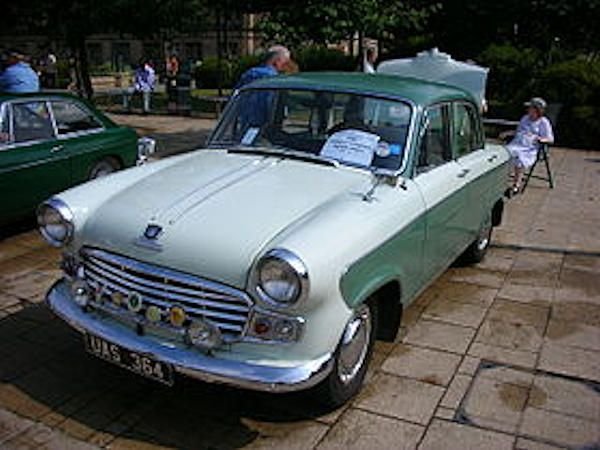
A face lift of the Phase III was designed by Italian stylist Giovanni Michelotti and coachbuilders Vignale in 1958 and introduced for the October 1958 Earls Court Motor Show. The windscreen and rear window were deeper and the door windows received stainless steel frames. There was a new front grille and rear light clusters. A floor change for the four-speed manual gearbox was now an option to the standard provision of a three-speed with column change. Either option could have an overdrive added.
The car had bench seats front and rear covered as standard in Vynide with leather as an option on the home market and cloth for export. A heater and, unusual for the time, electric screen washers were factory fitted but a radio remained an option.
A Vignale with overdrive was tested by the British magazine The Motor in 1959. They recorded a top speed of 82.8 mph (133.3 km/h), acceleration from 0–60 mph (97 km/h) in 20.8 seconds and a fuel consumption of 28.0 miles per imperial gallon (10.1 L/100 km; 23.3 mpg-US). The test car cost £1147 including taxes of £383.
Standard Vanguard Phase II
 |
|
| Production | 1953–1956 81,074 made |
|---|---|
| Body style | 4 door saloon 2 door estate car 4 door estate car 2 door coupe utility (Australia) 2 door panel van |
| Engine | 2088 cc Straight-4 2092 cc Straight 4 Diesel |
| Transmission | Three speed manual Overdrive optional. |
| Wheelbase | 94 in (2,400 mm) |
| Length | 168 in (4,300 mm) |
| Width | 69 in (1,800 mm) |
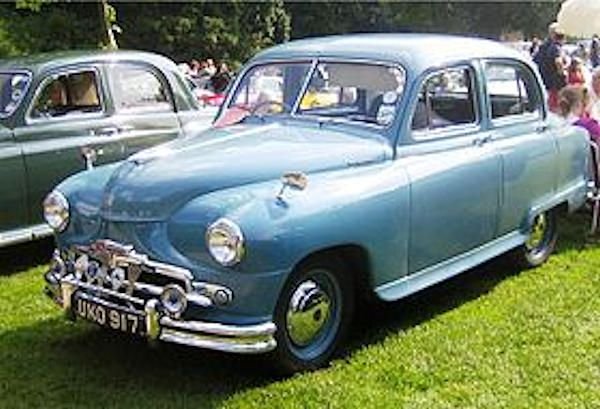
The Swiss importer for the Vanguard was an energetic firm called AMAG, which later took on the Swiss Volkswagen franchise. AMAG themselves assembled the Swiss market Phase I Vanguards,and it was at the Geneva Motor Show in March 1953 that an extensive re-design was unveiled: the Phase II Vanguard was of a contemporary Ponton, three-box design "notch-back" design. Boot/trunk capacity increased by 50% in comparison to that of the Phase I, and visibility was improved with a further enlarged rear window. Mechanically there were few changes but the clutch changed from cable to hydraulic operation and the engine compression ratio increased to 7.2:1. The previously fitted anti-roll bar was no longer used. Wider 6.00x16 tyres were fitted to improve road holding.
A car, without the optional overdrive, that was tested by The Motor magazine had a top speed of 80 mph (130 km/h) and could accelerate from 0–60 mph (97 km/h) in 19.9 seconds. A fuel consumption of 23.5 miles per gallon(imperial) was recorded.
In February 1954 Standard became the first British car maker to offer a diesel engine as a factory fitted option.The chassis was stiffened to take the weight of the heavier engine and performance suffered with 65 mph (105 km/h) about the top speed. Like the petrol engines, the diesel was a Standard-built "20C" engine developed for the Ferguson tractor. Whilst diesels fitted to the tractor were restricted to 2200 rpm and developed 25 horsepower (19 kW), road-going engines in Vanguards had no limiter and so produced 60 horsepower (45 kW) at 3800 rpm. However, they retained the tractor's "Ki-Gass", de-compressor and over-fuelling systems, all of which had to be manually operated when starting the engine from cold. 1973 diesel Vanguards were made.
In 1954 The Motor magazine tested the diesel version and recorded a top speed of 66.2 mph (106.5 km/h) acceleration from 0–50 mph (80 km/h) in 31.6 seconds and a fuel consumption of 37.5 miles per imperial gallon (7.53 L/100 km; 31.2 mpg-US). The test car, which had overdrive, cost £1099 including taxes.

