
Sunbeam-Talbot
- Details
- Parent Category: S
- Category: Sunbeam-Talbot
- Hits: 22
Sunbeam Talbot 80
 |
|
|
Manufacturer |
Rootes Group |
|
Production |
1948 to 1950 |
|
Class |
Motor Car |
|
Body style |
4-door saloon 2-door drophead coupé |
|
Engine |
1,100 c.c Straight-4 |
|
Transmission |
4-speed manual |
|
Wheelbase |
97.5 in (2,477 mm) |
|
Length |
167.5 in (4,255 mm) |
|
Width |
62.5 in (1,588 mm) |
|
Height |
59 in (1,499 mm) |
|
Related |
Sunbeam-Talbot 90 |
The Sunbeam Talbot 80 was a car built by the Rootes Group in Ryton Coventry under their Sunbeam-Talbot brand.
History
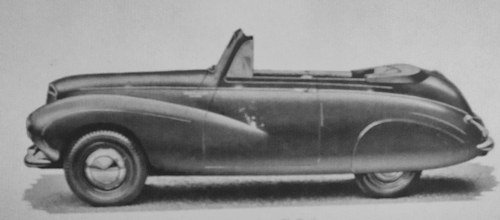
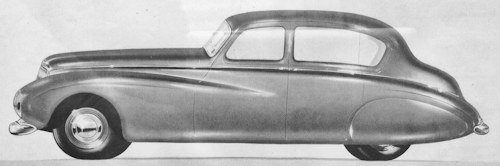
The Sunbeam Talbot 80 is a 4-door sedan that the Rootes Group released in 1948 as the successor to the Sunbeam Talbot Ten with the larger engine "90". The model was also available as a convertible. The Tourer, was no longer offered. The sedan had now in the fenders integrated headlights and a rear hinged hood. On this Model the rear wheels were covered with "Spats".
Known as the " 8O " the new models introduced in 1948, performance was raised by the introduction of overhead valve engine with 1,100 c.c. capacity and 47 b.h.p (34.5 kW) increases of 20 per cent, The vehicle reached a top speed of 117 km / h. over the powers obtained on the previous models. the new models have now been equipped with synchromatic gear Change, including a new steering-column control Vision is exceptional further increased by the low dash-rail and sloping bonnet—safety features.
the steering wheel permits direct, unobstructed vision of instruments. The new Air-duct dual ventilation system. an integral feature of the design, ensures that a flow of fresh. clean air is in constant circulation throughout the interior when required. The two controls are independently operated. and discreetly circulate the air without creating draughts.
Lockheed hydraulic brakes with two-leading shoes at the front, rearranged steering to give improved geometry and a better column rake, a redesigned chassis frame and various detailed mechanical refinements.
Inside the Stream styled control panel is yet another example of the perfect compromise between the purely aesthetic and strictly practical design which characterises the whole conception of these models. The instruments are grouped immediately opposite the driver. are always clearly visible through the unobstructed top of the attractive spring.
spoke steering wheel and can be read with the minimum of distraction from the vision ahead. Dials are specially calibrated to give both British and Metric readings.
All controls are situated in their logical order. i.e., the turning of the ignition key brings the driver's hand over the starter button and gear
lever. The spacious locker on the left of panel opens to provide a platform suitable for map reading and for this purpose a lamp is fitted inside. "His Master's Voice" Automobile Radio can be fitted as an optional extra and becomes an integral part of the design. When Radio is not required, the recess provided for the set Can be utilised as an additional pocket.
Engine laid out with the camshaft on the off side and the manifolds on the near side. The engine has a cast-iron cylinder head The forged steel crankshaft is provided with counterweights and is balanced It runs with steel-backed white-metal bearings, this type of bearing also being used for the big-ends of the forged light-alloy connecting rods the use of forged-steel connecting rods with their gudgeon pins clamped in the little ends the inlet valves are of slightly larger diameter than the exhausts good breathing via separate inlet ports are formed in the head for each cylinder, these ports mating with an inlet manifold. With Stromberg downdraught carburettor and for the front bearing of the camshaft. The other two camshaft bearings are formed in the cast iron of the cylinder block. the 9-in. Borg and Beck clutch and the new synchromatic gearbox. This type of box, with its layshaft alongside the main shaft to make an almost flat floor possible in the front compartment. Considerable changes have been made in the steering. Not only has the latest Burman worm-and-nut steering box been adopted, but it has been transferred to a mounting at the front end of the chassis side member. All 4 wheels were still suspended from semi-elliptic leaf springs. The Synchromatic finger-tip gear-control. in conjunction with the O.H.V. engine
The chassis includes a redesigned frame with box-section side members and one tubular and three boxed cross members. Luvax-Girling hydraulic dampers.
a large 10 gallons petrol tank with a separate breather arranged to prevent air-locks when filling for the coupé closely follows the styling of the saloon, with the important exception that it is of the two-door. type, access to the rear seats being via tip-up front seats. The space into which it folds being sensibly schemed so that it may be used for extra luggage space when not occupied by the hood.
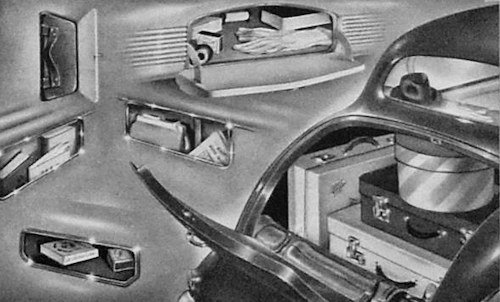
The interior of the car has more than adequate provision for carrying the smaller articles in more or less constant use. There is a spacious locker and central recess in the control panel and the front doors contain large pockets. Between the back seat and the rear window there is space for the accommodation of hats. sticks and incidental parcels.
Generous provision is made articles in for luggage and for carrying all the smaller more or less constant use.
The rear locker opens to reveal a spacious compartment capable to accommodating all the luggage normally required by the four occupants of the car. as well as golf clubs. When the lid is closed the luggage is completely protected from rain and dust, and when it is locked is safe from interference. the lid can be secured in the open position to permit the carrying of particularly bulky articles. The larger tools are located in a felt-lined receptacle within the lid and can be removed without disturbing any luggage; smaller tools arc carried in a sponge rubber casein a locker on the left of the front compartment.
Factory external colours Gun silver, Sapphire Blue, Beech Green, Black, Alpine Mist and Satin Bronze
In 1950, the model was discontinued without successor.

- Details
- Parent Category: S
- Category: Sunbeam-Talbot
- Hits: 32
Sunbeam-Talbot 90 MkII IIA
 |
|
| Manufacturer | Rootes Group |
|---|---|
| Production | 1950 to 1954 |
| Predecessor | Sunbeam-Talbot 2-Litre |
| Successor | Sunbeam MkIII |
| Body style | 4-door saloon 2-door drophead coupé |
| Engine | 1944 cc Straight-4 till 1952 2267 cc Straight-4 from 1952 |
| Transmission | 4-speed manual |
| Wheelbase | 97.5 in (2,477 mm) |
| Length | 167.5 in (4,255 mm) |
| Width | 62.5 in (1,588 mm) |
| Height | 59 in (1,499 mm) |
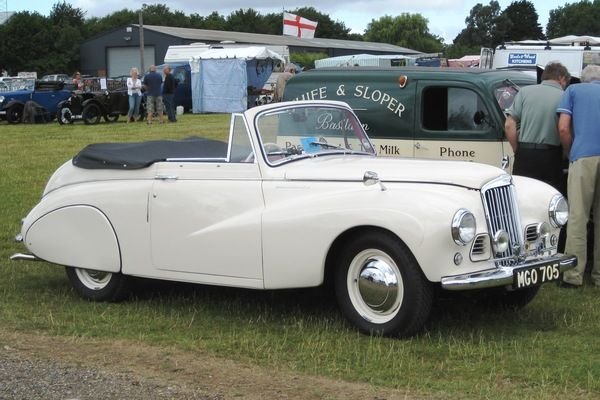
The Sunbeam-Talbot 90 MkII IIA was a British luxury car built from 1950 to 1954 by the Rootes Group.
History
The new Sunbeam-Talbot 80 and 90 models were introduced in the summer of 1948, and manufactured in the new Ryton factory. Both had the same streamlined new design with the flowing front fenders into which the headlights were integrated in a way reminiscent of the front of a fighter jet, a shape that would have been all too familiar to potential buyers of the car.90s continued to be produced, renamed 90 MK II, with a new chassis and independent front suspension . The headlights were raised three inches to meet US regulations, and the front running lights were replaced with a pair of small air intake grilles.
The 90 MK II also had an overhead valve engine increased to 2267 cc. The MK IIA arrived in 1952, The larger engine block capacity was shared with the company's 1950 Humber Hawk, although the Humber retained the original side-valve layout in the cylinder head (until 1954). The Sunbeam's cylinder head was modified to include overhead valves, resulting in a claimed power output of 70 bhp (52 kW), as opposed to the Humber's 58 bhp (43 kW). The Talbot's favourable power-to-weight ratio allowed it to be "geared pretty high" while still providing remarkable acceleration for "rapid overtaking."A top speed of 85.2 mph (137.1 km/h) and could accelerate from 0-60 mph (97 km/h) in 20.2 seconds. A fuel consumption of 22.5 miles per imperial gallon (12.6 L/100 km; 18.7 mpg-US) .In total 5493 were made.

The Mk IIA from 1952 to 1954 had a higher compression engine raising output to 77 bhp (57 kW). To cater for the higher speeds the car was now capable of, the brakes were enlarged and to improve brake cooling the wheels were pierced. The Talbot MkIIA coupe/convertible is regarded as the rarest of the Sunbeam Talbots.The rear wheel spats were no longer fitted. 10,888 were made.
A Mk II was driven by Stirling Moss to take second place in the 1952 Monte Carlo Rally. A Sunbeam Mk III was outright winner of the 1955 Monte Carlo Rally.A Sunbeam-Talbot 90 Coupe is Featured in Live And Let Die novel. Commander Strangways gives this car to Bond.

- Details
- Parent Category: S
- Category: Sunbeam-Talbot
- Hits: 50
Talbot Sunbeam Lotus
 |
|
| Manufacturer | Chrysler Europe PSA |
|---|---|
| Production | 1979 to 1981 |
| Assembly | Linwood, United Kingdom |
| Class | Sports |
| Body style | 3-door hatchback |
| Layout | FR layout |
| Engine | 2.2 liter |
| Transmission | 5 speed manual |
| Wheelbase | 2,413 mm (95.0 in) |
| Length | 3,829 mm (150.7 in) |
| Width | 1,603 mm (63.1 in) |
| Height | 1,395 mm (54.9 in) |
The Chrysler Sunbeam Lotus is a small sportssupermini 3-door hatchback manufactured by Chrysler Europe at the former Rootes Group factory in Linwood in Scotland and the Lotus facility in Hethel, Norfolk.
History
The Sunbeam Lotus was unveiled at the Geneva Motor Show in April 1979, but the road-going version of the rally car was not actually ready for deliveries to the public until after the rebranding, and thus became the Talbot Sunbeam Lotus. At first these were produced mostly in black and silver, although later models came in a moonstone blue and silver (or black) scheme.
Sunbeam Ti, a "hot hatch" variant of the Sunbeam, was introduced at the 1978 British International Motor Show and the Paris Motor Show to improve Sunbeam's image. It was based on the old Avenger Tiger (itself was derived from the Sunbeam Tiger), a sporty variant of the Sunbeam for which Chrysler commissioned Lotus, a sports car manufacturer and engineering business, to design a stringent rally version. The Sunbeam Lotus was created as a competition variant of the Sunbeam, which was only produced in limited numbers. Chrysler set the groundwork for the project, but Peugeot stuck to its guns after acquiring Chrysler's European operations.
The car was equipped with a 2.2 liter four-cylinder Lotus engine . Lotus had developed a cylinder head with 16 valves for the model. Together with a few other changes, the result was an output of 150 hp (110 kW). A special feature was a five-speed transmission from ZF , which was not available for any other Sunbeam model.
The production process was cumbersome. Basically, it was series production vehicles that were subsequently revised by Lotus. The starting model was a Sunbeam 1.6 GLS, which - apart from a tighter suspension - was equipped as standard. The vehicles were individually transferred to Lotus, where their own engine and five-speed gearbox were installed. The cars were then returned to Chrysler for the final touches.
The performance of the car was impressive. Acceleration from 0 to 96 km / h in 6.8 seconds, and an acceleration from 0 to 160 km / h was measured in just 19.8 seconds. The Talbot Sunbeam Lotus was successful in rallying. Talbot had a factory rally team in 1980 and 1981 that used several Sunbeam Lotus. Henri Toivonen , Guy Fréquelin and Stig Blomqvist won the 1981 World Rally Championship for Talbot. The car saw not only enthusiastic press reviews, but also much success in the World Rally Championship and in 1981 the Sunbeam Lotus brought the entire Manufacturer Championship to Talbot.
The Sunbeam Lotus was built on the Sunbeam 1.6 GLS, but with firmer suspension, a bigger anti-roll bar, and a bigger transmission tunnel. The drivetrain consisted of an enlarged 2172 cc version of the Lotus 1973 cc 907 engine, a 16V slant four engine (type 911, similar to Lotus 912), and a ZF gearbox, all of which were installed in the car at Ludham airfield near the Lotus facility in Hethel, Norfolk, where the nearly-complete cars were shipped from Linwood. The final inspection was held at Stoke, Coventry. The Lotus type 911 engine developed 150 horsepower (112 kW; 152 PS) at 5,750 rpm and 150 pound-feet (203 Nm) of torque at 4,500 rpm in road trim. In rallying trim this was increased to 250 bhp (186 kW; 253 PS).
The road cars built until 1981 with rally cars raced untill 1983.

- Details
- Parent Category: S
- Category: Sunbeam-Talbot
- Hits: 27
Sunbeam-Talbot Ten
 |
|
| Manufacturer | Rootes Group |
|---|---|
| Production | 1938-1948 |
| Predecessor | Hillman Minx |
| Successor | Sunbeam Talbot 80 |
| Body style | 4-door saloon cabriolet tourer |
| Engine | 1185 cc Straight-4 |
| Transmission | 4-speed manual |
| Wheelbase | 94 in (2,388 mm) |
| Length | 156 in (3,962 mm) |
| Width | 60 in (1,524 mm) |
The Sunbeam-Talbot Ten is a four-door saloon manufactured by the Rootes Group between 1938 and 1939, and then reintroduced after the Second World War and sold between 1945 and 1948.A cabriolet version was also available.
The Sunbeam-Talbot-Darraq business fell into the hands of Rootes in 1935, and the new owner's strategy was clearly to use the prestige of the Sunbeam-Talbot name for selling larger numbers of lower priced cars than hitherto. The Sunbeam-Talbot 10 was one of the first products of the Rootes strategy, being in effect a stylishly rebodied version of the company’s existing middle market saloon, the Hillman Minx.

The classic saloon featured the streamlining increasingly characteristic of mainstream British cars in the later 1930s, along with “stand-alone” headlights. Power came from a 1185 cc side-valve engine for which 41 bhp (30 kW) of power output was claimed. All four wheels were suspended using semi elliptical leaf springs. Top speed was quoted as 68 mph (109 km/h)

Visually the car was virtually indistinguishable from the faster Sunbeam-Talbot 2-litre, although the faster car was actually about 3 inches (8 cm) longer in wheel-base and overall body length.
In 1948 the Sunbeam-Talbot 10 was replaced by the more modern Sunbeam-Talbot 80 which was essentially a restyled version of the same car.


