
Sunbeam
Sunbeam Rapier Series V
| Production | 1965 to 1967 |
|---|---|
| Class | Motor Car |
| Produced | 3759 |
| Body style | 2 door saloon |
| Engine | cylinders: 4 1,725 cu cm |
| wheel base | 86 in, 2,184 mm |
| overall length | 156 in, 3,962 mm |
| overall width | 60.50 in, 1,537 mm |
| overall height | 52 in, 1,321 mm |
| dry weight | 2,091 1b, 948 kg |

The Sunbeam Rapier Series V was the last of the classic shape Rapier Series built in the 1960s from 1965 to 1967.
History
Rootes decided to have one more go at updating the well-liked old Sunbeam Rapier Pending completion of the new Fastback Rapier. In September 1965 they introduced the Series V version which looked exactly like the Series IV inside and out except for badges on wings and boot which now said "1725", revealing the presence of an important new engine.
Rootes had extensively redesigned their old four cylinder engine to increase its capacity to 1725 cc. Along the way it had acquired a new crankshaft with five main bearings, making the unit stronger and smoother. This was the strong engine that would power the Series V Rapier and be developed for many subsequent models.capacity 105.2 cu. in. (1 ,725 c.c.), push-rod operated, overhead valve unit, developing 91 gross b.h.p. at 5,500 r.p.m.5-bearing crankshaft; 3-bearing camshaft; aluminium head, aluminium alloy pistons with fully floating gudgeon pins; cooling by centrifugal pump and 4-blade fan; full pressure lubrication system by high efficiency eccentric lobe-type pump; full flow Oil filter Solex compound twin choke carburetter; mechanical fuel pump; 10 gal. fuel tank coil ignition, centrifugal and vacuum ignition control; 4-point 'cushion power' engine mountings.
To further update the car, they changed its polarity from positive to negative earth and fitted an alternator in place of the dynamo. They also devised a new twin pipe exhaust system so that the new engine could breathe more easily.The effect of these changes was to increase the Rapier's maximum speed to 95 mph (153 km/h) and reduce its time from rest to 60 mph (97 km/h) to 14.1 seconds.
Gearbox single dry plate in. diaphragm clutch with hydraulic operation; 4-speed gearbox, synchromesh on all forward gears, centre floor gear control; needle roller, reverse spline propeller shaft, hypoid final drive, ratio 3.89:1For the braking Lockheed hydraulic servo assisted disc front brake, drum rear the suspension independent coil spring front suspension, semi-elliptic rear springs; anti-roll bar at front,telescopic direct acting shock absorbers. Burman recirculating ball-type steering with triple track and linkage; all greasing points eliminated; 2-spoke adjustable steering wheel with horn ring; pressed disc wheels; 6.00-13 tubeless tyres; 4-corner jacking system; spare wheel, with cover and tools in luggage compartment.The electrics 12-volt lighting and starting equipment; built-in head lamps and separate side lamps; twin stop/tail lamps; separate flashing indicators; separate reflectors; independent rear number plate illuminations; reverse lamp.
Inside and body,indirect instrument lighting; dual 2-speed automatic park windscreen wipers; screen washer, interior lamp; cigar lighter; water temperature gauge, fuel gauge and ammeter, speedometer, rev. counter and warning lights on walnut veneered facia, the whole surmounted by foamed plastic crash roll. 2-door all-steel Body with integral' underframe; individual front seats adjustable fore and aft, with rake, side armrest on passenger's door and at rear;curved screen and wrap round backlight, lockable no-draught front ventilators and retractable rear quarter lights; fresh air heater and ventilation system with controls; push-button exterior door handles with private lock on each side; facia glovebox; rear parcel shelf and front parcel tray; ashtrays front and rear; 2 sun visors; balanced bonnet and spring-assisted boot lid; full width bumpers and overriders with generous wrap round; roof trimmed in special washable material.
Optional extras
as follows: Laycock de Normanville overdrive; clock; whitewall tyres; radio.
Unfortunately, for all its good features, the Series V just didn't sell. By the time it was discontinued in June 1967, only 3759 units had been built, making it the rarest of all the "Series" Sunbeam Rapiers.
PERFORMANCE
Engine capacity: 105.26 cu in, 1,725 cu cm
Fuel consumption: 28.5 m/imp gal, 23.8 m/US
Max speed: 102 mph, 164.2 km/h
max power (SAE): 100 hp at 5,500 rpm
max torque (SAE): 110 1b ft, 15.2 kg m at 3,700 rpm
max engine rpm: 6,400
specific power: 58 hp/l
power-weight ratio: 20.9 lb/hp, 9.5 kg/hp
acceleration:0—50 mph (0—80 km/h) 8.6 sec
speed in direct drive at 1,000 rpm: 17.8 mph,28.7km/h.
max speeds: 36 mph, 58 km/h in 1st gear; 57 mph, 91.8 km/h
in 2nd gear; 88 mph, 141.7 km/h in 3rd gear; 102 mph, 164.2 km/h in 4th gear

Sunbeam Twenty-Five
 |
|
|
Manufacturer |
Sunbeam |
|
Production |
1933 to 1935 |
|
Class |
Motor Car |
|
Body style |
4-door saloon,coupe,Limousine |
|
Engine |
Straight-6 ohc |
|
Transmission |
4-speed manual sliding-pinion |
|
Wheelbase |
10 ft. 10 ins. |
|
Length |
15 ft. 8 ins |
|
Width |
6 ft |
|
Weight |
2-ton 1cwt |
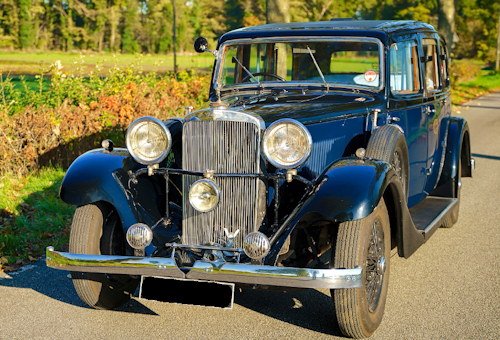
The Sunbeam Twenty-Five is a luxury saloon car introduced by Sunbeam in the 1930s.
History
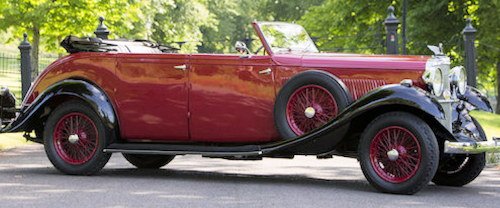
The Sunbeam Twenty-Five was an top of the range interwar car from the Sunbeam manufacturer only from 1934 to 1935. Built as a 4-door saloon or coupe at £875 and also the luxury seven-seater with options Limousine form £1.045 It was produced on two wheelbase lengths 130" and larger 136" with also coach built body options.Built as a more luxury car with notable features such as being Fast, silent, well-sprung and reasonably economical to operate, the " Twenty-five " is well sprung with a Wide Spring-base and chassis and body. From the manner in which the car behaves when running at high speed on good roads there is a marked steadiness entirely devoid of any sponginess gives a more luxury feel.
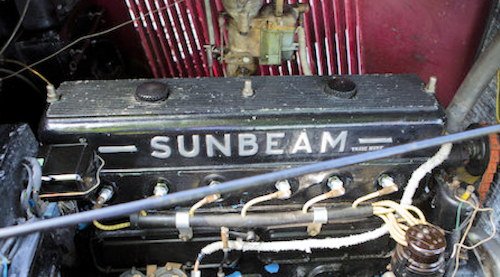
Fitted with a cleanly designed six-cylinder overhead-valve engine. To reach 40 m.p.h. from 10 m.p.h. requires little more than 13 secs. whilst a speed of a mile-a-minute can be achieved (from 10 m.p.h.) in under 25 seconds the throttle not more than half-way open the engine gives off sufficient torque for a speed of about 60 m.p.h. to be maintained as this Sunbeam model is capable of a sustained speed of 77 m.p.h. on level going, and over 80 m.p.h depending on body.
The car Quick and Easy Gear Change For emergency use, a low bottom gear (17.8 to 1) is provided, but for all practical purposes the second gear ratio of 9.8 to 1 suffices to get away, even when the car is standing on a moderate upgrade. (Both these gears are equipped with synchronizing clutches).
PERFORMANCE: Sunbeam Twenty-Five
- Max speed Top gear, 77 m.p.h.
- Third 51 mph
- Second 39 mph
- Acceleration From stand still to 70 m.p.h., 30 secs
- Maximum pull in lb. per ton: top gear, 250 lb.; third 340 lb.; second 489 lb.
- Petrol Consumption: 15.4 m.p.g.
Sunbeam Rapier Fastback coupe
 |
|
| Production | 1967–1976 46,204 produced including Alpine and H120. |
|---|---|
| Body style | 2 door fastback coupe |
| Engine | 1725 cc overhead valve Straight-4 |
By 1967 Rootes's "Arrow" range was ready. As well as the Hillman Hunter, the range also included a new generation of Sunbeam Rapiers, with fastback coupé bodies and a sporty image. Like the series models, it was a 2-door pillarless hardtop.
The Arrow Rapier – or Fastback, as it came to be known – launched in October 1967,was a smart four-seat coupé based on the chassis of the Hillman Hunter Estate. It was said to bear a resemblance to the contemporary Plymouth Barracuda, a product from Chrysler who by now had a considerable stake in Rootes. However, Rapier stylist Roy Axe insisted that this was not the case. Although the Rapier used the tail lamps and rear valance from the Hunter Estate, the rest of its superstructure was unique.
The Rapier used the Rootes four cylinder, 5-bearing 1725 cc engine, which was tilted slightly to the right to enable a lower bonnet line, in common with the other Arrow models. With its twin Stromberg 150CD carburettors the engine produced 88 bhp (net) at 5200 rpm. Overdrive was standard with the manual gearbox, and Borg-Warner automatic transmission was an optional extra. VARIATIONS AND OPTIONAL ACCESSORIES Borg-Warner 35 automatic gearbox, hydraulic torque convertor and planetary gears with 3 ratios (1 2.393, lever, 3.700 axle ratio.
PERFORMANCE
ENGINE CAPACITY 105.26 cu in, 1,725 cu cm
FUEL CONSUMPTION 31 m/imp gal, 25.8 mlUS gal, 9.1 1 X 100 km
MAX SPEED 102 mph, 164.2 km/h
max power (SAE): 94 hp at 5,200 rpm
max torque (SAE): 107 1b ft, 14.8 kg m at 4,000 rpm
max engine rpm: 6,200
specific power: 54.5 hp/l
power-weight ratio: 22.7 lb/hp, 10.3 kg/hp
max gradient in 1st gear: 44%; acceleration: 0—50 mph (0 — 80 km/h) 8.6 sec
speed in direct drive at 1,000 rpm: 15.6 mph, 25.1 km/h.
max speeds: 31 mph, 49.9 km/h in 1st gear,49 mph, 78.9 km/h in 2nd gear; 75 mph, 120.7 km/h in 3rd gear; 97 mph, 156.2 km/h in 4th gear; 102 mph, 164.2 km/h in overdrive/top

Sunbeam Rapier dashboard from 1971
The Fastback Rapier continued almost unchanged until 1976, when it was discontinued without replacement. During its lifetime it formed the basis for the more powerful Sunbeam Rapier H120, introduced in October 1968 and identifiable by its boot-lid spoiler and polished sill covers: it shared its Holbay Engineering-tuned 110 bhp engine (with twin Weber carburettors) with the Hillman Hunter GLS. The Rapier was also the basis for the slightly cheaper but similarly bodied, single-carburettor Sunbeam Alpine Fastback introduced in October 1969.Rapier running gear (though not the estate chassis) was also used in the Humber Sceptre, Hillman GT and Hillman Hunter GT models from the Arrow range.
Between 1967 and 1969, the Rapier was built at Ryton-on-Dunsmore, but from 1969 until its demise in 1976, it was built at the Imp factory at Linwood in Scotland. In all, 46,204 units were built (including Rapier, H120 and Alpine versions).
Maximum speed of the Rapier was 103 mph (166 km/h) and it could reach 60 mph (97 km/h) from rest in 12.8 seconds. In the United States, it was marketed as the Sunbeam Alpine GT.

The Sunbeam Alpine Fastback, introduced for 1970, was essentially a Rapier with a simplified specification, developed to plug a gap in the Arrow range above the Singer Vogue. It used the same 1725 cc engine as the Hillman Hunter which, fitted with a single Stromberg 150CD carburettor, developed 74 bhp (net) at 5500 rpm. Transmission options included overdrive on cars with a manual gearbox or a Borg-Warner automatic transmission.
The Alpine, though well equipped, was less sporty in style than the Rapier. It had a wooden dashboard with fewer instruments, instead of the Rapier's cowled plastic one, and wood instead of metal on the transmission tunnel; subjectively looking more luxurious rather than less sporty. There were also different wheel trims, no aluminium sill finishers (nor the polished ones of the H120) and no vinyl trim on its C pillars. Above all at GBP1086 in the UK it was significantly cheaper than the GBP1200 Rapier.
Maximum speed of the Alpine was 91 mph (146 km/h) and it could reach 60 mph (97 km/h) from rest in 14.6 seconds.
The Fastback Alpine was discontinued in 1975, before the Rapier and H120.
Sunbeam Rapier H120

To add to its sporty image, the H120 was given wider Rostyle wheels, broad side flashes, polished sill covers, a matt black radiator grille and a new boot lid incorporating a faired-in spoiler. To complete the package, H120 badges appeared on the front wings and in the centre of the grille.
Maximum speed of the H120 was 106 mph (171 km/h) and it could reach 60 mph (97 km/h) from standstill in 11.1 seconds.
The H120 was discontinued with the Fastback Rapier in 1976.

Sunbeam Rapier H120 From 1968
Sunbeam Alpine Series I to V overview
 |
|
| Production | 1959–1968 69,251 made |
|---|---|
| Successor | none |
| Body style | 2-door roadster |
| Engine | Series I: 91.2 cu in (1.5 L) I4 Series II, III & IV—1592 cc (1.6L) I4 Series V—1725 cc (1.7L) I4 |
| Wheelbase | 86 in (2,184 mm) |
| Length | 155 in (3,937 mm) |
| Width | 61 in (1,549 mm) |
| Height | 51 in (1,295 mm) |
| Related | Sunbeam Tiger |
Kenneth Howes and Jeff Crompton were tasked with doing a complete redesign in 1956, with the goal of producing a dedicated sports car aimed principally at the US market. Ken Howes contributed some 80 per cent of the overall design work, which bears more than incidental resemblance to the early Ford Thunderbird; Howe had worked at Ford before joining Rootes.
The Alpine was produced in four subsequent revisions through to 1968. Total production numbered around 70,000. Production stopped shortly after the Chrysler takeover of the Rootes Group.
Series I 1959–1960
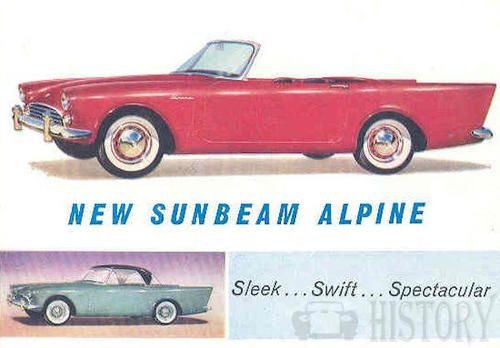
The "Series" Alpine started production in 1959. One of the original prototypes still survives and was raced by British Touring car champion Bernard Unett.
The car made extensive use of components from other Rootes Group vehicles and was built on a modified floorpan from the Hillman Husky estate car. The running gear came mainly from the Sunbeam Rapier, but with front disc brakes replacing the saloon car's drums. An overdrive unit and wire wheels were optional. The suspension was independent at the front using coil springs and at the rear had a live axle and semi-elliptic springing. The Girling-manufactured brakes used 9.5 in (241 mm) disc at the front and 9 in (229 mm)drums at the rear.
Coupe versions of the post-1959 version were built by Thomas Harrington Ltd. Until 1962 the car was assembled for Rootes by Armstrong Siddeley.
An open car with overdrive was tested by the British magazine The Motor in 1959. It had a top speed of 99.5 mph (160.1 km/h) and could accelerate from 0–60 mph (97 km/h) in 13.6 seconds. A fuel consumption of 31.4 miles per imperial gallon (9.00 L/100 km; 26.1 mpg-US) was recorded. The test car cost £1031 including taxes.
11,904 examples of the series I were produced.
In 1960 Sunbeam marketed a limited-production three-door variant of the Alpine, marketed as a shooting brake. With leather interior and walnut trim, its price was double that of its open counterpart.
Series II 1960–1963

The Series II of 1960 featured an enlarged 1592 cc engine producing 80 bhp and revised rear suspension, but there were few other changes. When it was replaced in 1963, 19,956 had been made.
A Series II with hardtop and overdrive was tested by The Motor magazine in 1960, which recorded a top speed of 98.6 mph (158.7 km/h), acceleration from 0–60 mph (97 km/h) in 13.6 seconds and a fuel consumption of 31.0 miles per imperial gallon (9.11 L/100 km; 25.8 mpg-US). The test car cost £1,110 including taxes.
Series III 1963–1964

The Series III was produced in open and removable hardtop versions. On the hardtop version the top could be removed but no soft-top was provided as the area it would have been folded into was occupied by a small rear seat. Also, the 1592 cc engine developed less power. To provide more room in the boot, twin fuel tanks in the rear wings were fitted. Quarter light were fitted to the windows. Between 1963 and 1964, 5863 were made.
Series IV 1964–1965

The lower-output engine option was now dropped with convertible and hardtop versions sharing the 82 bhp engine with single Solex carburettor. A new rear styling was introduced with the fins largely removed. Automatic transmission with floor-mounted control became an option, but was unpopular. From autumn 1964 a new manual gearbox with synchromesh on first gear was adopted in line with its use in other Rootes cars. A total of 12,406 were made.
Series V 1965–1968
The final version had a new five-bearing 1725 cc engine with twin Zenith-Stromberg semi-downdraught carburettors producing 93 bhp.There was no longer an automatic transmission option. 19,122 were made.
Competition
The Alpine enjoyed relative success in European and North American competition. Probably the most notable international success was at Le Mans, where a Sunbeam Harrington won the Thermal Index of Efficiency in 1961. In the United States the Alpine competed successfully in Sports Car Club of America (SCCA) events.
Vince Tamburo won the G-Production National Championship in 1960 using the 1492cc Series I Alpine. In 1961 Don Sesslar took 2nd in the F-Production National Championship followed by a 3rd in the Championship in 1962. For 1963 the Alpine was moved into E-Production facing stiff competition from a class dominated by the Porsche 356. Don tied in points for the national championship.
A championship for Don Sesslar finally was achieved in 1964 with 5 wins (the SCCA totaled the 5 top finishes for the year). Dan Carmichael won the Central Division Championship in 1964 and 65. Dan continued to race the Alpine until 1967, when he finished 2nd at the American Road Race of Champions.
Bernard Unett raced factory prototype Alpine (registration number XRW 302) from 1962 to 1964 and in 1964 won the Fredy Dixon challenge trophy, which was considered to be biggest prize on the British club circuit at the time. Unett went on to become British Touring car champion three times during the 1970s.
A six-car works team was set up for the 1953 Alpine Rally. Although outwardly similar to their production-car counterparts they reputedly incorporated some 36 modifications, boosting the engine to an estimated 97.5 bhp..
Notable film and television appearances
A Metallic Blue 1953 Sunbeam Alpine Mk.1 is driven by Grace Kelly in 'To Catch a Thief' (1955) with Cary-Grant.
- A red Series I Alpine is driven by Elizabeth Taylor in the film BUtterfield 8 (1960) and features in a number of scenes.
- A white Series 1 Alpine was the regular drive of Rod Taylor's character Glenn Evans, a crime fighting news reporter, in the early 1960s TV series, Hong Kong.
- A lake blue "Series II" Alpine roadster is amongst the first on-screen "Bond Cars" when it is rented and driven by James Bond in Dr. No of 1962, most notably in a scene where Bond drives it under a truck to escape from pursuing hit men. It was reportedly borrowed from a local resident, as the only suitable sports car available on the island used for filming.
- Michael Caine's character is rescued by a woman in a white 1968 Alpine roadster in the 1971 British crime film Get Carter. The car is later shunted into a dock with the owner locked in the boot.
- A Sunbeam Tiger (the V8 version of the Alpine) was also the vehicle of choice for spy Maxwell Smart in the 1960s TV comedy series Get Smart. An Alpine, outfitted to look like the Tiger, was used for the "gadget" shots, such as the cannon that comes up through the bonnet. The Alpine was used because the cannon would not fit under the bonnet of a V-8 car. The car was modified by noted American customizer Gene Winfield and was the subject of a 1/25th scale plastic model kit.
- A similar Alpine is seen in the Arnold Schwarzenegger film Commando, where it was destroyed.
- A Sunbeam Alpine was driven by Imogen Stubbs in the 1990s British TV series Anna Lee.
- A Sunbeam Alpine is driven by Michael Caine in the 1967 film Gambit. The film also starred Shirley MacLaine and Herbert Lom
- A powder blue Sunbeam Alpine is driven by Tuesday Weld and Anthony Perkins in the 1968 film "Pretty Poison".
- In the TV series Heartbeat, the character of regular characters|Jackie Bradley|, portrayed by Fiona Dolman, drives a green hardtop Series V Sunbeam Alpine, with red interior, bearing the original registration plate LVY 666F (1967). In Series 11, episode 12, Closing the Book two characters arrive at Scripp's Garage in a beige, hardtop Sunbeam Alpine, bearing the registration plate 836 FSH.
- In the Arnold Schwarzenegger film Commando, his co-star Rae Dawn Chong drives a 1964 Sunbeam Alpine Series IV until Schwarzenegger takes over for a major car-chase with a 1973 Datsun 240Z, ending with the Sunbeam’s destruction. As the 7th highest grossing film of 1985, Commando has to be the marque’s greatest media exposure.
The French Alpine
Alpine (pronounced Alpeen) was also a French car manufacturer producing various models until absorbed by Renault in a move unconnected with Renault's takeover of some of the commercial vehicle assets formerly belonging to Chrysler Europe.
In James Bond films

Sunbeam Alpine Series II Sports—Featured in Dr. No. Bond drives to Miss Taro's home in the Blue Mountains; he is pursued by Dr. No's thugs driving a LaSalle hearse. It is a Lake Blue example that was owned by a local resident in Jamaica where the scenes were filmed.
In the novel Dr. No, Bond drives the car that formerly belonged to Commander Strangways, the murdered agent in Kingston. It is also driven by Quarrel. In The Man with the Golden Gun novel Mary Goodnight uses the car and she hands it to Bond so he can use it while he is on assignment.
Sunbeam Alpine Mark I and II
 |
|
| Production | 1953–55 1.582 made |
|---|---|
| Assembly | United Kingdom Australia |
| Successor | Series Alpine |
| Body style | 2-door roadster |
| Engine | 2267 cc (2.3L) I4 |
| Wheelbase | 97.5 in (2,477 mm) |
| Length | 168.5 in (4,280 mm) |
| Width | 62.5 in (1,588 mm) |
| Related | Sunbeam-Talbot 90 |
The Sunbeam Alpine is a sporty two-seat open car from Rootes Group's Sunbeam car marque. The original was launched in 1953 as the first vehicle from Sunbeam-Talbot to bear the Sunbeam name alone since the 1935 takeover of Sunbeam and Talbot by the Rootes Group. A muscle-car variant of the later versions was also built, the Sunbeam Tiger.
The Alpine was derived from the Sunbeam-Talbot 90 Saloon, and has become colloquially known as the "Talbot" Alpine. It was a two-seater sports roadster initially developed by Sunbeam-Talbot dealer George Hartwell in Bournemouth as a one-off rally car. It had its beginnings as a 1952 Sunbeam-Talbot drophead coupé, and was supposedly named by Norman Garrad of the works Competition Department, who was heavily involved in Sunbeam-Talbot's successes in the Alpine Rally during the early 1950s using the saloon models.
The entirely new body is a two-seater pure and simple The curved single-pane screen with side extensions is readily detachable and a racingscreen of curved transparent plastic can be substituted The side screens are metal-framed and incorporate horizontally-sliding panels of heavy gauge transparent plastic.The top of the bonnet is louvered to reduce under-bonnet temperatures, but detachable blanking plates are provided to enable the apertures to be closed when not required. Inside separate seats shaped to give good individual support Each seat is adjustable for reach and, in addition, the height and rake of the driver's seat can be adjusted as well. In addition, there is a fixed centre arm rest, with further arm rests (shaped to act as door pulls) on the doorsprovision for a radio panel, heater installation and a rev. counter (centrally fitted below the facia), the luggage boot which measures 49 in, from front to rear, has a minimum width of 39in.
white wall tyres and a cockpit cover. available as factory-fitted extras. Along with alternative axle ratio (4.22 :1).

The car has a four-cylinder 2267 cc engine from the saloon, but with a raised compression ratio. However, since it was developed from the saloon platform, it suffered from rigidity compromises despite extra side members in the chassis. The gearbox ratios were changed, and from 1954 an overdrive unit became standard. The gearchange lever was column-mounted.
The Alpine Mark I and Mark III (no Mark II was made) were hand-built – as was the 90 drophead coupé – at Thrupp & Maberly coachbuilders from 1953 to 1955, and remained in production for only two years. Of the 1582 automobiles produced, 961 were exported to the USA and Canada, 445 stayed in the UK, and 175 went to other world markets. It has been estimated that perhaps as few as 200 have survived.The Alpine engine has a special head giving a compression ratio of 7.42 : 1, as opposed to 6.45 : 1.the ports have been modified to for gas flow shortening the valve guides and cutting away the surrounding metal they into the ports, whilst the machining of the ports themselves along with the use of a Lucas high-voltage sports coil, the fitting of an oil-bath air cleaner and the use of a four-row radiator block which increases the cooling capacity.
The maximum output around 80 b.h.p. at 4,200 r.p.m. The carburattor is a type DAA 36 downdraught Stromberg, with a hand-operated choke, and the manifold hotspot has been modified with insulating metal plate which conducts heat from the exhaust to the inlet.An over-riding manual control is provided for the ignition, enabling the total range of advance and retard provided by the automatic centrifugal and vacuum devices to be over a range of 14 deg. (on the flywheel). The control takes the form of a knob which is pulled out for advance.For the transmission, The oil capacity of the gearbox has also been increased to prevent surge from causing temporary bearing starva-
tion a new breather incorporated with the dipstick.
The chassis frame has a pair of side plates welded to each side member at the point where it is upswept at the front, these acting as stiffening for the undersideto provide a mounting for a 2-in, diameter tubular flanged mounting cross-member which passes below the engine. which can be detached for sump removal.
The front coil springs have been stiffened, the rate on this model being 104 lb./in. instead of the normal 68 lb.for roll resistance alon with the anti-roll bara higher steering ratio (17.5:1) is used to reduce the number of turns of the steering wheel from lock to lock.

In the 1953 Alpine Rally four Alpines won the Coupe des Alpes, one of which, finishing 6th, was driven by Stirling Moss; Sheila van Damm won the Coupe Des Dames in the same rally.
Very few of these cars are ever seen on the big screen. However, a sapphire blue Alpine featured prominently in the 1955 Alfred Hitchcock film To Catch a Thief starring Cary Grant and Grace Kelly. More recently, the American PBS show History Detectives tried to verify that an Alpine roadster owned by a private individual was the actual car used in that movie. Although the Technicolor process could "hide" the car's true colour, and knowing that the car was shipped back from Monaco to the USA for use in front of a rear projection effect, the car shown on the programme was ultimately proven not to be the film car upon comparison of the vehicle identification numbers.
Sunbeam Alpine mk1 in the 1955 Alfred Hitchcock film To Catch a Thief


