
Steyr
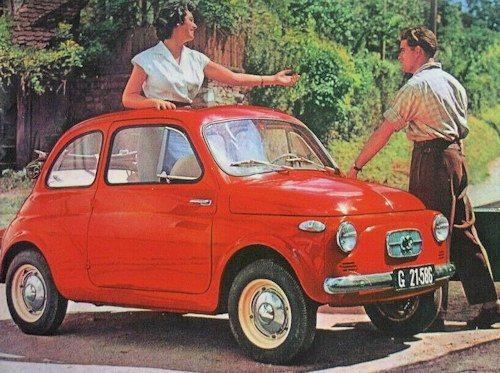
Steyr-Puch 500,650,700
 |
|
|
Make: |
Steyr-Puch |
|
Production period: |
1957 to 1973 |
|
Class: |
Motor Car |
|
Body versions: |
Saloon, Estate |
|
Engines: |
0.5–0.66 litres |
|
Length: |
2970-3054mm |
|
Width: |
1320-1374mm |
|
Height: |
1302-1325mm |
|
wheelbase: |
1840mm |
|
curb weight: |
470-580kg |
The Steyr-Puch 500 was a small car based on the Fiat 500 from the Puch works also as just Steyr 500 (Group of Steyr-Daimler-Puch AG in Graz).
History
In 1957 the Steyr-Puch 500 model Fiat was introduced. A 2 door, 4 seat rear-engine, rear-wheel drive car. For cost reasons, in-house body production was dispensed with and the body shell of the Fiat Nuova 500 was taken over. The air-cooled boxer engine for this vehicle with around 16 hp enabled good performance for the time, especially when driving uphill. The Steyr-Puch was clearly superior to the Fiat 500 with an in line engine, with the same fuel consumption and smoother running.
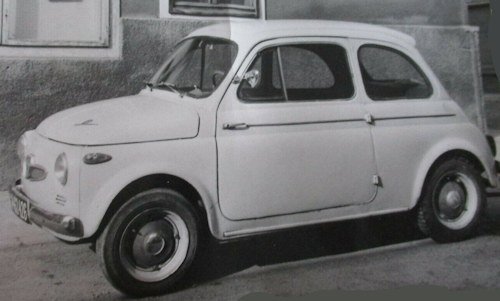
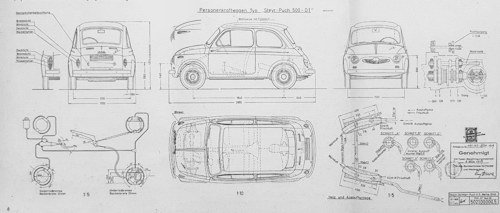
The gearbox, which was fully synchronized from the start, was also progressive and advantageous on mountainous roads. In the total braking surface of the drum brakes (total 66.98 sq in, 432 sq cm). However, the Fiat outperformed the Steyr-Puch by 18%.The chassis type was integral with the front suspension independent,wishbones, transverse leaf-spring lower arms and telescopic dampers, The rear suspension also independent, swinging trailing radius arms, coil springs and telescopic dampers.
The following models were made: The 493cc models 500,500d, 500DL.The 493cc model continued untill 1973
PERFORMANCE:493cc (1957-1973)
- engine capacity: 30.08 cu in, 493 cu cm
- fuel consumption:56.5 m/imp gal, 47 m/US gal, 5 1 x 100 km
- max speed: 65.2 mph, 105
- max power (DIN): 19.8 hp at 4,600 rpm
- max torque (DIN): 25 1b ft, 3.4 kg m at 2,800 rpm
- max engine rpm: 5,000
- specific power: 40.2 hp/l
- power-weight ratio: 57.8 lb/hp, 26.2 kg/hp
Built along with larger 643cc models 500 d and 700 E C (estates) in the 1960s
PERFORMANCE: 643cc (1961-1968)
- engine capacity: 39.24 cu in, 643 cu cm
- fuel consumption: 45.5 m/imp gal, 37.9 m/US gal, 6.2 1 x 100 km
- max speed: 67.7 mph, 109 km/h
- max power (DIN): 25 hp at 4,800 rpm
- max torque (DIN): 30 1b ft. 42 kg m at 3.000 rpm
- max number of engine rpm: 5,600
- specific power: 38.9 hp/l
- power- weight ratio: 51.2 lb/hp. 23.2 kg/hp
followed later in the 1960s with the 660cc models 650 TR and TR II and with the last version in the 1970s the 126 version. From 1959, Fiat took over the entire body including the roof (Puch 500 D). For rationalization reasons, from 1969 all the technology, including the transmission, came from Fiat and only the engine from Puch. From 1973, for a short time instead of the Fiat Nuova 500, the successor Fiat 126 was equipped with boxer engines.
PERFORMANCE: 650 TR 660cc (1964-1969)
- engine capacity: 40.27 cu in, 660 cu cm
- fuel consumption: 51.3 m/imp gal, 42.8 m/US gal, 5.5 1 x 100 km
- max speed: 79.5 mph, 128 km/h
- max power (DIN): 30 hp at 5,500 rpm
- max torque (DIN): 33 1b ft, 4.5 kg m at 3,500 rpm
- max engine rpm: 6,200
- specific power: 45.5 hp/l
- power-weight ratio: 36.8 lb/hp, 16.7 kg/hp
Steyr-Daimler-Puch AG
Automotive manufacturer Steyr, Austria from 1918 on

Steyr-Daimler-Puch AG was from 1894 armaments production gave way to the construction of bicycles and after 1918 to the manufacture of automobiles. From 1987 it was divided into numerous subgroups that are now independent.
History
Josef Werndl, son of the company founder, founded the Josef and Franz Werndl & Comp., Waffenfabrik und Sägemühle on April 16, 1864 and ran the company from 1869 as Österreichische Waffenfabriks-Gesellschaft (ÖWG). From 1894 armaments production gave way to the construction of bicycles and after 1918 to the manufacture of automobiles. In 1926 the ÖWG changed its name to Steyr-Werke AG.
The Steyr-Werke merged with the Austro-Daimler-Puchwerke AG in 1934. These were created in 1928 from the merger of Austro-Daimler, the Oesterreichische Flugzeugfabrik (Oeffag) and the Puch-Werke AG. The new company operated under Steyr-Daimler-Puch AG.
The designers who worked for the predecessor companies of Steyr-Daimler-Puch and are regarded as pioneers of Austrian automobile construction included: Ferdinand Porsche (from 1906-1923 at Austro-Daimler and 1929 at Steyr-Werke), Hans Ledwinka (1917-1921 at ÖWG) and Karl Jenschke (1922-1935 at ÖWG/Steyr-Werke).
Steyr's first truck was presented in 1920. Steyr built traditional bonneted trucks later in the post war years later to be under th MAN brand. Steyr automobiles became known far beyond the borders of Austria for their high quality and high-quality workmanship the automobiles initially included the large 6-cylinder types Steyr II (“weapons car”/from 1920, for the first time with a Monoblock engine) produced by the OEWG, Steyr V and VII and from 1925 the solid middle -class vehicle Steyr XII, which before the world economic crisis in for Austria large numbers were built. However, the mid -size car Steyr IV was not an economic success.
Sales problems meant that Steyr car production was suspended in 1929/30 and only restarted with the Steyr 30 (XXX) model designed by Ferdinand Porsche. Its conservative line was continued from 1933 with the types 430, 530 and 630. In 1932, Steyr attempted to fill its factory with the Steyr-Opel (“Stoppel”), a small car originally made by Opel, but had little success.
From 1934, the modern streamlined vehicle types Steyr 100 and 200 with four-cylinder engines were selling well. The small car Steyr 50/55 ("Steyr-Baby") presented in 1936 was just as successful. At the same time, 6-cylinder models based on the 200 models were also manufactured, the 120, 125 and 220 models. Luxurious cabriolets based on the 220 types were fitted with bodies in small series at the renowned Gläser-Karosserie GmbH in Dresden. Austrian companies such as Keibl or Armbruster rarely received individual orders. There were also trucks and vans, pickup trucks, taxis, rescue and fire engines derived from individual passenger car types were built in small numbers.

War Time
After the annexation of Austria to the German Reich, the Steyr-Daimler-Puch-Werke were quickly transformed back into an armaments group under the newly appointed General Director Georg Meindl, in the automotive sector achieved through the Schell Plan. During the National Socialist period in Austria, armaments production dominated the company, which was affiliated with Reichswerke Hermann Göring, employing around 32,000 people. New factories were built in Graz-Thondorf (Zweier-Werk) and in St. Valentin (Nibelungenwerk). In several sub- camps of the Mauthausen concentration camp, prisoners had to do forced labour for the Steyr works. Ball bearings were produced in the Steyr-Münichholz sub-camp and in Melk also took place in occupied Poland. After bombing raids on the Graz-Thondorf plant, parts of the production were relocated to tunnels in the Peggauer Wand as part of the so-called U-relocation. The production range was immediately expanded to include production of the standard German rifle, the Karabiner 98k, and development and production of the MG 42 machine gun and the StG 44 assault rifle began.

The types 250 and 640 developed for the Austrian army were continued to a small extent. The production of passenger cars – such as the Steyr 200 and Steyr 220 cabriolets, limousines and government vehicles – ended in 1940. The production of passenger cars was no longer taken up. In 1941 the production of the 1500 A type, a completely new Porsche construction of a light truck or heavy personnel carrier, with an air-cooled V8 engine, began. On this construction, which was also the basis for the new start after the Second World War, the Raupenschlepper Ost was also developed in 1942, which was licensed by various companies was built.
After the end of the Second World War there was a great need for commercial vehicles and tractors. Production of Type 370 trucks with V8 petrol engines began in 1946. In 1948 the first Steyr-Diesel 380 truck was presented. The production of Steyr tractors is also based on this diesel development. Since the demand for passenger cars also increased, a cooperation agreement was concluded with Fiat, and the Fiat models came onto the Austrian market as the Steyr-Fiat.
In the mid-1960s, the production range included cars, trucks, off-road vehicles, tractors, agricultural machinery, roller bearings, hunting weapons, tanks, motorcycles, bicycles and tools. About a third of production was exported. Well-known vehicles were the Haflinger and the Pinzgauer, which were mainly used by the Austrian Armed Forces but also by numerous foreign armies for many years. Steyr tanks are the Saurer armoured personnel carrier produced in numerous versions and used in many countries (Austria, Greece, Cyprus, Africa, etc.), Kürassier (Austria, Brazil, Morocco, Botswana, Tunisia, Argentina, etc.), Pandur (Austria, Belgium, Slovenia, USA, Kuwait etc.) and ASCOD-Ulan (Austria, Spain).
From 1980, Steyr-Daimler-Puch AG was the third largest industrial company in Austria with around 17,000 employees. Restructuring and the outsourcing of parts of the production to several successor companies let this number drop to 8,900 in 1991.In 1987, the company began filleting. Gradually, the individual production divisions were sold or spun off:
1987, the sale of the plant in Greece (since independently as ELBO) and moped division in the form of the Puch brand to the Italian Piaggio group. By the 1990s, sale of the truck division in the form of the Steyr brand to the German MAN group. The tractor production in the form of the Steyr brand to the US Case Group (later CNH), see Steyr (tractor manufacturer). Also bus production in the form of the Steyr brand to the Swedish Volvo group.
By 1998, sale of the two remaining divisions of vehicle technology and drive technology to the Canadian Magna group of Frank Stronach, with the division of drive technology being resold to the German ZF Friedrichshafen AG. The remaining Steyr-Daimler-Puch Fahrzeugtechnik AG & Co. KG (SFT) in Graz was merged with Magna Europa AG to form Magna Steyr in 2001 and positioned as an independent subgroup of Magna International. Steyr Motors split off from this in 2001 through a management buy-out. In September 2012, they in turn sold all shares to the Chinese investor group Phoenix Tree HSC.

Steyr-Daimler-Puch AG Timeline
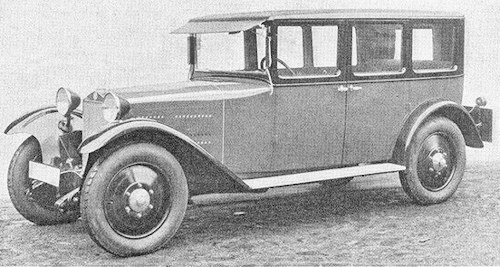
Here we take a look at Vehicle built by Steyr-Daimler-Puch .First with "Steyr" "Puch " "ÖWG" Brand names The Steyr-Werke merged in 1934 with the Austro-Daimler-Puchwerke AG These were created in 1928 from the merger of Austro-Daimler , the Oesterreichische Flugzeugfabrik (Oeffag) and the Puch-Werke AG . The new company was named Steyr-Daimler-Puch AG.By the mid-1960s, the production range included cars , trucks , off-road vehicles , tractors , tanks , motorcycles , bicycles and tools .
Passenger Cars
|
Construction period |
Type |
capacity |
|
1920-1924 |
II (12/40 hp) |
3325 cc |
|
1922-1924 |
IV (7/23 hp) |
1814 cm³ |
|
1922-1924 |
VI Klausen Sport (19/145 hp) |
4900 cc |
|
1922-1926 |
60 / VI (12/60 hp) |
3325 cc |
|
1924-1925 |
V (12/40 hp) |
3325 cc |
|
1925-1929 |
VII (12/50 hp) |
3325 cc |
|
1926-1929 |
XII (6/30 hp) |
1568 cc |
|
1928 |
VI Sport (15/80 hp) |
4014 cm³ |
|
1928 |
VI Sport (17/100 hp) |
4400 cc |
|
1928-1929 |
XVI (15/70 hp) |
4014 cm³ |
|
1929 |
Austria (21/100 hp) |
5295 cc |
|
1929 |
XX (8/40 hp) |
2070 cm³ |
|
1930-1932 |
30 / XXX / 130 (8/40 hp) |
2078 cm³ |
|
1930-1933 |
30 type 45 taxi(8/40 hp) |
2078 cm³ |
|
1932 |
30 S / 230 (8/45 hp) |
2078 cm³ |
|
1932 |
Steyr-Opel ("Stubble") |
1169 cc |
|
1932-1933 |
30 SL / 330 (8/45 hp) |
2078 cm³ |
|
1933-1935 |
430 |
2078 cm³ |
|
1934-1936 |
100 |
1385 cm³ |
|
1935-1936 |
120 awesome |
1990 cm³ |
|
1935-1936 |
530 |
2260 cc |
|
1936-1937 |
125 super |
2078 cm³ |
|
1936-1938 |
50 ("Steyr baby") |
984 cc |
|
1936-1940 |
200 |
1498 cc |
|
1937-1939 |
630 |
2260 cc |
|
1937-1941 |
220 |
2260 cc |
|
1938-1940 |
55 ("Steyr baby") |
1158 cc |
|
1953-1959 |
2000 |
1997 cm³ |
|
1956-1959 |
2300 sports |
2260 cc |
|
1957-1973 |
Steyr-Puch 500 |
493 cc |
Trucks
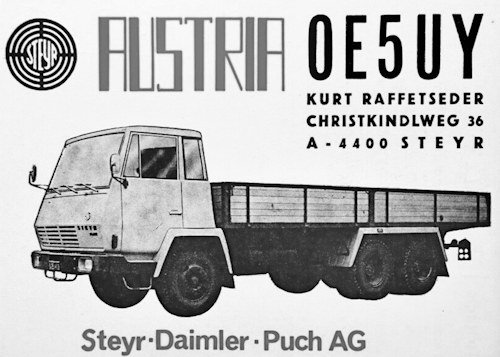
Steyr was also active in the construction of trucks buses from the 1920s on.
From the 1990s, the sale of the bus division to Volvo. and the truck division was sold to MAN
- Type XII
- Type XVII
- Type 40
- Type 6x4
- Haflinger
- Pinzgauer
- noric
- Type 270
- Type 260
- Type 370
- Type 380
- 380-480 series
- 580-586 series
- 680-880 series
- Type 680M
- Steyr 90-Plus series
- 590-690 series
- Type 91
- 591-691 series
- Type 92
- Type 12M1
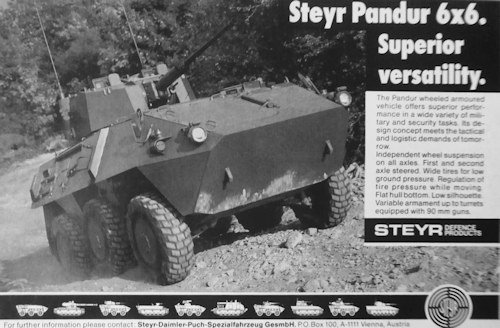
Armored vehicles
- Crawler tractors east
- cuirassier
- Pandur
- sour
- ASCOD
- Griff A1

