
Studebaker
- Details
- Parent Category: S
- Category: Studebaker
- Hits: 32
Studebaker Light Four
 |
|
|
Manufacturer: |
Studebaker Corporation |
|
Class: |
Motor car |
|
Body type: |
touring car, sedan and roadster |
|
Production period: |
1918 and 1919 |
| Engine | 3,176 cc Four cylinder |
| Gearbox | Three forward, one reverse |
| Tires | 32 x 3 1/2 inches |
| Horspower | 19.6 |
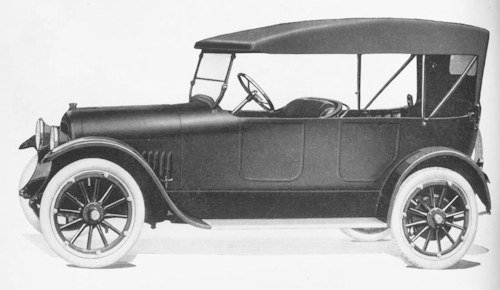
The Studebaker Light Four was a car from the late 1910s, manufactured by the Studebaker Corporation from 1918 and 1919
History
in South Bend (Indiana) for the model years 1918 and 1919. The Studebaker Light Four car was officially called Model SH Series 19 and it was avaliable as an touring car, sedan and roadster in Dark blue .
The Light Four had a wheelbase of 112 inches (2,845 mm) and was powered by a 3,176 cc four-cylinder in-line engine (bore × stroke = 88.9 mm × 127 mm) developing 40 bhp (29 kW) at 2,000 rpm. With Wood wheels and tyres 32 x 3 1/2 inches.
The engine power was transmitted via a leather cone clutch and a Selective sliding three-speed gearbox with shift lever in the center of the car to the rear wheels. The foot brake acted on outside band brakes on the rear wheels. Included in the price a top hood, wind-
shield, speedometer, battery indicator, electric horn and demountable rim.
In 1920, Studebaker let the Light Four expire and from then on only made six-cylinder cars.Because of its low production figures, the Light Four is considered by Studebaker collectors to be a rare model of its time.
- Details
- Parent Category: S
- Category: Studebaker
- Hits: 23
Studebaker Champion First generation
 |
|
|
Production |
1939–1941 |
|
Class |
Motor car |
|
Body style |
2-4 door sedan |
|
Engine |
164.3 cu in (2.7 L) I6 |
|
Length |
188.75 in (4,794 mm) |
The Studebaker Champion was a car provided by the Studebaker in South Bend (Indiana) . The production of this model began with the model year 1939 and was continued until 1958 when it was discontinued in favor of the successor Lark . Previously, Studebaker had to sign a comparison and was eager to make the production profitable again.
The success of the champion in the model year 1939 Studebaker needed after the weak sales figures of the previous year urgently to survive.
Like few other car models, the Champion was designed on a "white paper", meaning that there was no need to re-use older parts or later use the newly designed components in larger cars. Thorough market observations led to a specification , but the crucial design principle was the premise "The weight is the enemy!". For his size, the champion was the lightest car of his time; his biggest competitor in this regard was the Willys Americar which, however, was not subjected to such a deliberate design process. And the result was impressive: its ram-controlled engine was retained until the abandonment of automobile production in 1961 (albeit with a modified valve train as OHV ).The 164.3 cu in (2.7 L) I6 engine produced 78 horsepower (58 kW; 79 PS). In 1940, Studebaker claimed 27.25 mpg‑US (8.63 L/100 km; 32.73 mpg‑imp).
The champion was one of Studebaker's biggest sales successes due to its low price (only $ 660 for the 1939 business coupe), durable engine and styling. Styling was done by industrial designer Raymond Loewy , whom Studebaker had commissioned to design their models.
The Champion was introduced in 1939. , the grille and headlights were partially integrated Following the design trends of the time. Deluxe models came with arm rests and dual wipers. The last first generation in 1941, the bodies were given a more streamlined look with a wider, lower grille.
- Details
- Parent Category: S
- Category: Studebaker
- Hits: 40
Studebaker Champ
 |
|
|
Manufacturer: |
Studebaker Corporation |
|
Type: |
Commercial vehicle |
|
Body type: |
Pickup truck |
|
Production: |
1960 to 1964 |
The Studebaker Champ was a lightweight pickup model manufactured by the Studebaker Corporation from 1960 to 1964.
History
The Studebaker pickups had not undergone a major overhaul for more than ten years, the company was no longer doing well due to falling sales, so the new model had to be assembled from existing components.The champ was probably the first truck with a factory made fiberglass construction. It was still introduced in the very short model year of 1964 and only a handful of them were made.
Basically, the Chassis chassis and loading structure were the same for Studebaker's 1/2-t and 3/4-t trucks since 1949, but the cab clearly differed from its predecessor. The company's annual cash flow problems made it impossible to afford a brand new cab, so the engineers polished a car- based Lark- based design by cutting it off at the B-pillar and attaching it to the truck. Chassis adapted. The front of the Lark was also taken over, but they invested money in a new grille with horizontal bars that looked "tougher".
Studebaker equipped the champ with engines that had been in the program for a long time. In 1960, buyers could choose between the last side-steering six-cylinders: the smaller 2786 cc and 90 bhp (66 kW) and the larger "Big Six" 4015 cc and 110 bhp (81 kW). In 1961, the smaller machine was upgraded with overhead valves, giving it 22 bhp and now delivering 112 bhp (82.4 kW). Thus, Studebaker could take the old Big Six from the program.
The Champ was never offered with power steering in American pickups of the 1960s, despite the fact that this equipment was fitted to the heavier Studebaker Transtar and diesel models. The last 8E models from 1963/1964 had an improved steering system with reduced friction and thus lower steering forces, but not to the degree that power steering would have had. However, in the early 1960s, the power steering was not common in light trucks, and so it was no competitive disadvantage for Studebaker not to offer this special equipment
The new OHV slewing cylinder was indeed redesigned, but contained as much as possible components of the old, 1939 imported engine. The machine earned a bad reputation, as some copies of the cylinder head ripped. The problem that most often occurred with motors whose valves were not properly adjusted has never been completely solved. But with proper care, these engines have been able to last well over 40 years.
From the beginning there were two V8 engines, 4244 cc and 4736 cc, equipped with either double or quad carburettor. Both machines were not significantly changed during the production of the Champ.
For the Champ, there was also a large selection of gears, manual or automatic. The basic models had a steering wheel-connected three-gear transmission ("three on tree"). You could either choose an overdrive or have a four- or five-speed gearbox installed. In addition, the "Flight-O-Matic" from BorgWarner was available as an automatic transmission.
Despite the "cobbled together" construction, the truck sold in 1960 as a 5E series.In 1961 (6E series), a closed body over the entire vehicle width - the "Spaceside" - was additionally offered; the tools were purchased from Dodge . However, this did not boost the sales figures, nor did the new OHV version of the 2.8-liter engine, which became known for the cracks in the cylinder head.
In 1962 (7E series) and 1963 (8E series) Champ was continued without major changes, and the few copies, which were created in 1964, belonged to the 8E series of the previous year. In December 1963, management announced the closure of the South Bend , Indiana factory and the trucks were no longer manufactured at the Hamilton , Ontario, Passenger Cars plant .
It is little noticed that the Champ was the first to have a detail that almost every modern pickup today offers: The opening rear window, which already existed from the start of production in the Champ and was very popular with the buyers. It was later copied by the larger truck manufacturers.Although the Champ could not save Studebaker's truck production, this showed the way to a reasonably sized pickup truck, a feat Dodge attributed to the Dakota , a medium-sized truck. This model was introduced in 1987, 27 years after the Champ.
- Details
- Parent Category: S
- Category: Studebaker
- Hits: 28
Studebaker Avanti
 |
|
|
Production period: |
1962 to 1963 |
|
Class: |
sports car |
|
Body versions: |
Coupe |
|
Engines: |
Gasoline :4.7 litres (179-216 kW) |
|
Length: |
4888 mm |
|
Width: |
1788 mm |
|
Height: |
1368 mm |
|
Wheelbase: |
2770 mm |
|
Curb weight: |
1428-1500 kg |
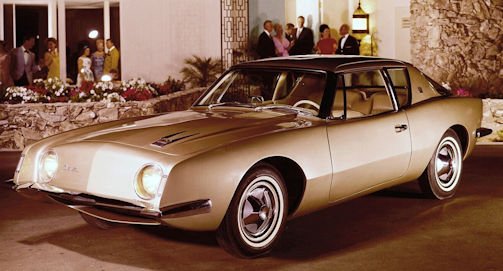
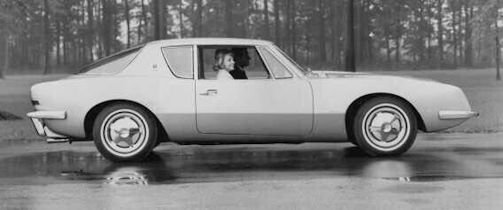
The Studebaker Avanti was a sports coupe. It was originally manufactured from June 1962 to December 1963 by the American automaker Studebaker Corporation. The production of the Group's self- branded Avanti Motor Corporation, with occasional revisions, continued into 2008.
The very advanced body line for the time was drawn by a designer team around the French industrial designer Raymond Loewy. Avanti in Italian means as much as forward or progress. In fact, the Avanti fell with the first on a US car standard used on all wheel’s disc brakes, smooth front without grille, optional safety belts, safety door locks and integrated roll bar and the great attention to good aerodynamics, the designers act, very much progressive.
The design of the Avanti originated in a five-week working session at a home in Palm Springs, near chief designer Raymond Loewy's home. The design gave the Avanti so many friends that the model survived the downfall of Studebaker and was still produced for decades by hand by successor companies as Avanti II.
Due to the tense financial situation Studebaker could invest in the Avanti development only little money. Therefore, the so modern appearing Avanti under the fiberglass shell on the frame of the Studebaker Lark convertible, which went back in its origins to the year 1953. In the engines, the factory resorted to the existing in-house 4.7-liter V8, which was available in several power levels.
Loewy further developed the design of the Avanti. In 1963 he designed a four-door sedan and a two-door hatchback coupe with design elements of the Avanti. The French body manufacturer Pichon-Parat built a prototype of each design; However, it did not come to mass production.
In the basic version mentioned R-1, the 4.7-liter V8 used in the Avanti made 179 kW (240 gross SAE-PS), the optionally available version R-2 came with a Paxton compressor to 216 kW (289 hp). The displacement equal Ford V8 made for comparison in the Mustang 147 kW (210 hp), or 156 kW (220 hp) with quadruple carburettor or 199 kW (271 hp) in the Hi-Po called high-performance version.
PERFORMANCE:
Engine capacity: 289.00 cu in, 4725.15 cu cm;
Fuel consumption: 17.1 m/imp gal, 14.2 m/US gal, 16.5 1 x 100 km;
Max speed: 124.2 mph, 200 km/h;
max speed in 1st gear: 48.4 mph, 78 km/h; max speed in 2nd gear: 80.1 mph, 129 km/h; max speed in 3rd gear: 124.2 mph, 200 km/h;
power-weight ratio: 15.0 lb/hp, 7.1 kg/hp
useful load: 706 1b, 320 kg.
With the help of race pilot Andy Granatelli, Studebaker also developed an R-3 engine for the Avanti. For the 4.7-liter engine was initially drilled to 4.9 litres, later to 5.0 litres. The R-3 featured special cylinder heads with much larger intake ports and valves, an aluminium intake manifold, sport exhaust manifold, sharper camshaft, Paxton supercharger and Carter AFB quad carburettor. Thus, the R-3 officially came to 250 kW (335 hp), measurements on the test bench should have yielded values around 295 kW.
The strongest version of the Studebaker V8 was the R-5, which was developed for experimental purposes only. With one compressor per cylinder bank, this engine came to no less than 429 kW (575 hp). The engine was used in Granatelli's Avanti Duecento called special car, with which he wanted to crack the limit of 200 miles per hour (323 km / h). However, Granatelli came in the record runs in Bonneville only to 316.36 km / h.
In the summer and autumn of 1963, Granatelli made record runs with a standard Avanti with R-3 engine on the Salt Lake near Bonneville. He reached a top speed of almost 275 km / h and set 34 US records, which allowed Studebaker at that time to promote the Avanti as "fastest production car in the world".
Production at Studebaker
Studebaker advertised the Avanti at an early stage, and many interested parties placed advance orders. However, there were delays in the development, which had a negative impact on the sales figures. The main reason for the delays were problems with the fit of some fiberglass body panels; In addition, the opening for the rear window proved too large for the disc. This came as a surprise, after all, the production of the body panels was given to the same company that had been producing the bodies of the Chevrolet Corvette since 1953. In the end, Studebaker was forced to make the panels himself - but by then, many customers had already cancelled their orders.
Studebaker renounced the Avanti on the marking of different model years, but rather let necessary changes in the current series flow. Early and late Studebaker Avanti’s is most easily distinguished by the headlight fairings. All Avanti’s between June 1962 and July 1963 had round panels. From August 1963, square panels were used.
In December 1963, Studebaker announced that it would stop car production at its headquarters in South Bend, Indiana and produce only in Hamilton, Canada. At the same time the Avanti, the Studebaker Hawk and all pickups and trucks fell out of the program; In Canada limousines, coupes and station wagons were built for a while.
Studebaker made 4643 copies until the setting of the Avanti. To the last Avanti, a white R-3 with all extras, Studebaker employees attached a letter in which they informed the future owner about the historic importance of the car.
Studebaker survived two more years, producing the Commander, Daytona and Cruiser models in Canada with General Motors engines.
Avanti II
Following the cessation of production at Studebaker's South Bend site, two Studebaker dealers, Nate Altman and Leo Newman, acquired the rights to the Avanti name and all existing tools, Molds, Avanti parts, etc. and part of the former Studebaker Factory to continue the production of Avanti. Altman and Newman first turned to Checker, known for building the Checker taxis, to clarify the possibilities to manufacture the Avanti there; Company owner David Markin is said to have replied that he has no interest in an "ugly car" like the Avanti. As a result, Altman and Newman took the matter into their own hands and hired numerous former Studebaker employees, who built the Avanti II by hand from then on; until the beginning of the 1980s, about 150-250 copies were produced annually.
However, it was no longer the Studebaker V8, but an eight-cylinder from the Chevrolet Corvette for use, first the 5.4-liter, later the 5.7-liter, the 6.6-liter and finally the five-Liter V8.
After the death of Altman and Newman, the realtor and Avanti client Stephen Blake took over the company. Blake went bankrupt in 1986, and the company passed into the hands of Michael Kelly. In 1987, production was relocated to Ohio. The new model was now based on the platform of the Chevrolet Camaro / Pontiac Firebird, which also four-door and convertible versions were possible. There have been a number of design changes, including wide bumpers painted in body colour.
A new Avanti
Tom Kellogg, who once belonged to the group around Raymond Loewy and was involved in the design of the original Studebaker Avanti, was commissioned in the late 1990s to revise the Avanti. The AVX designated new design is built by the company Avanti Motor Corporation since 2001, from 2004, Ford delivers the platform and apparently the 4.6-liter V8 with 227 kW (304 hp). For 2006, the company also announced an Avanti with four-Liter V6 (210 hp) and a supercharged version of the 4.6-liter with 348 kW (467 hp). Prices start at $ 62,000. Since 2006, the Avanti is manufactured in Cancun, Mexico.
VARIATIONS AND OPTIONAL ACCESSORIES:
axle ratio 3.31 -4.09-3.07: 1; power-assisted steering, 3.5 turns of steering wheel lock to lock; limited slip final drive; overdrive, ratio 0.70; Flight-o-Matic automatic gear box Paxton supercharger
- Details
- Parent Category: S
- Category: Studebaker
- Hits: 36
Studebaker Dictator
 |
|
|
Manufacturer |
Studebaker |
|
Class |
Motor Car |
|
Model years |
1927 to 1937 |
|
Assembly |
United States |
|
Class |
Luxury Car |
|
Layout |
Front-engine, rear-wheel-drive |
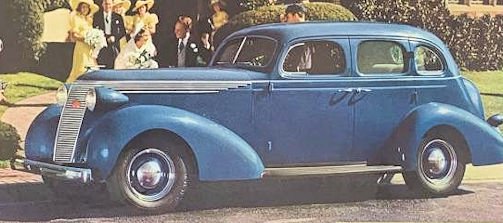
The Studebaker Dictator was a car manufactured by the Studebaker Corporation in South Bend, Indiana, from 1927 to 1937. The model year 1928 was the first full model year of this vehicle.The Dictator was another bizarre moniker of the Erskine presidency. It was one of series names which included associated titles like Commander and President Altogether, Studebaker offered 50 models among its three series. Prices ranged from $1,045 for a 2-passenger Dictator 6 Coupe to $2,495 for a President Limousine
7-passenger Sedan. .
Mid-1920s Studebaker began to rename his model range. Thus, the former Studebaker Standard Six in model year 1927 got the name Dictator. The internal name of this model was GE. The name was chosen to indicate that this Studebaker should "dictate the standard for the other car brands" that should follow him.
For 1931, Studebaker's "Dictator" and "Commander" models, like the "Presidents," were available only as straight-eights.The "Dictator" had 81 horsepower and was priced at $1095 and up, on a 114-inch wheelbase. For$1585,also was the adoption of freewheeling on all Studebaker models. freewheeling was available on the "Dictator Eight," and by January, 1931
The Dictator was the cheapest model in the Studebaker range, followed by the Commander and the President. There were Dictator and Commander Sixes and Eights, the Dictators on a 115-inch wheelbase, Commanders on a 120-inch. From 1929 the company offered eight-cylinder engines for the dictator. They were available with all possible constructions.
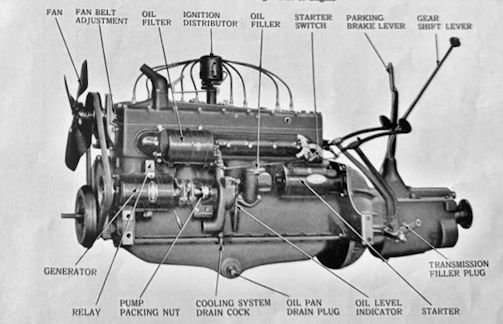
End of 1935 Studebaker hired the Commander and offered only the Dictator and the President. From 1937 Dictator was renamed Commander for the reasons described below.
with the introduction to Studebaker Dictator: "Of course, there were some political issues called Dictator were connected. A number of European monarchies, to which Studebaker delivered the car, were cautious with this designation. Diplomatically, Studebaker delivered his Standard Six model to these countries under the name Director. In the United States - so it seemed at first - the name should cause no problems. "Both Dictator engines was 221 cid, the eight producing 70 bhp and the six 68 bhp. The Commander six had 248.3 cid and 75 bhp, the Commander eight 250.4 cid .
Studebaker chose the name Dictator at a time when the only American dictator who came to mind was Benito Mussolini, widely admired in the United States for his image of chutzpah and strength - an image that successfully sold cars in the United States Contrast to well-known fascist violence (Alpers 2003). The rise of Adolf Hitlerian Germany, however, stained the word dictator, and Studebaker immediately and without much attention (or any surviving internal correspondence) the dictator at the end of the model year 1936 and replaced him in 1937 by the Studebaker Commander.

