Renault
Renault Mascott
 |
|
| Manufacturer: | Renault Trucks |
| Sales designation: | Mascott |
| Production period: | 1999 to 2010 |
| Class: | Commercial vehicle |
| designs: | Panel van , flatbed |
| Engines: | Diesel : 2.8-3.0 liters(63-115 kW) |
| Wheelbase: | 3130-4630 mm |
| Perm. Total weight: | 3.5-6.5 t |
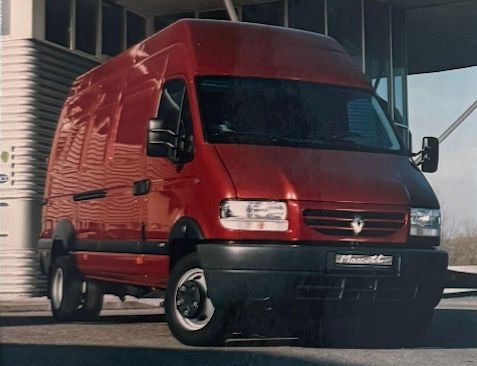
The Renault Mascott was a light truck produced by Renault Trucks . This replaced the Renault Messenger , which was based on the Renault Master I.
Despite the obvious external similarities with the Renault Master II, it differs significantly from this technically. The chassis and components of the Mascott are built on a rigid ladder frame from the Iveco Daily III. Then the slightly modified cab is built from the master. Here is the difference in the front grille due to the different position of the engine. This is installed longitudinally in the Mascott and distributes its power by means of rear-wheel drive or on both axles by means of all-wheel drive . The first versions were powered by a 2.8-liter diesel engine (the SOFIM 8140). 2004 was a facelift, with the front design and the interior have been changed, similar to the Master II. The Iveco engines were replaced by a Nissan 3.0-liter diesel engine from the Nissan Patrol , the Mascott 115 hp and 156 hp made. In 2007, the engine was revised and now made 130 hp and 150 hp.
Depending on the version, the gross vehicle weight of the mascot was 3.5 to 6.5 tonnes and four different wheelbases (3130 mm, 3630 mm, 4130 mm and 4630 mm) were possible. In addition to single or double cabs flatbed (automobile) was also a box van with 12 m³ loading volume ex factory available. On the chassis various bodywork companies made various bodies, especially as a minibus and fire engine .
Following Volvo's acquisition of Renault Trucks , Mascott was also offered by the Volvo Trucks sales network in some countries. As a Renault Master Maxi, however, some versions of the Mascott were also sold through the Renault car dealer network. End of 2010 replaced the Renault Master III with rear-wheel drive Renault Mascott.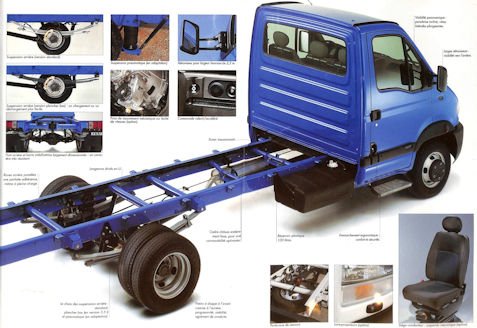
Renault Rapid Express
 |
|
| Make | Renault |
|---|---|
| Years of production | 1985 - 2000
Phase 1: 1985 - 1991 |
| Production | 1 730 000 |
| Classroom | Light utility |
| Assembly plant (s) | Maubeuge France Palencia Spain |
| Energy | Gasoline , diesel |
| Motor (s) | Petrol Cleon-Cast iron : 956 cc 1 108 cc 1 237 cc 1 390 cc (injection) 1 397 cc Energy : 1 390 cc engine D : 1 149 cc Diesel engine F : 1 596 cc 1,870 cc Electric 21 kW (30 hp) |
| Engine position | Before |
| Gearbox | Manual 4 or 5 speed |
| Unloaded weight | From 775 to 1,245 kg |
| suspensions | Mac Pherson / coil springs front, trailing arms and torsion bars at the rear |
| Direction | rack and assisted according to the models. |
| brakes | Discs in the front, drums in the back |
| Length | 3 982 mm |
| Width | 1,588 mm |
| Height | 1,790 mm |
| Trunk volume | From 710 to 2,600 4 dm 3 |
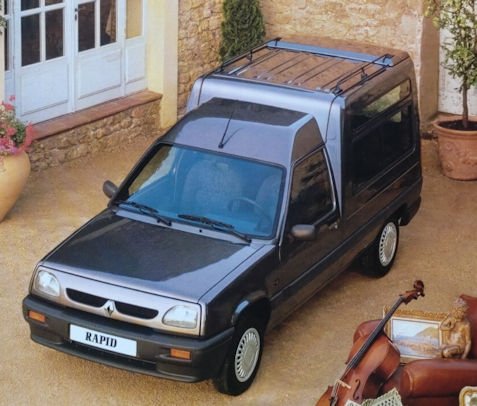
Appeared in November 1985 within the Renault range , the Renault Express (called Renault Rapid or Renault Extra on certain export markets such as Germany and the United Kingdom) was a light utility..was also sold as Renault Express (eg in France , Spain , Austria , Switzerland , Italy ) or Renault Extra ( United Kingdom and Ireland ).
Technically, the Rapid based on the second generation of the Renault 5 , the so-called "Supercinq" (France). With this model is also - except for a few stylistic changes - to the A-pillar same. Even the dashboard , chassis and the two front doors - from the five-door Renault 5 - were taken over unchanged.
Special features of the Rapid compared to the Renault 5 were on the one hand by about 15 cm extended wheelbase , the roof elevation above the cab and the box body behind the B-pillar . The vehicle was as a non- or partially glazed van version with up to two seats, as a combi with five seats, as pick-up as well as standard equipment as handicapped van or with various special bodies (refrigerated trucks, workshop vehicles available, etc.).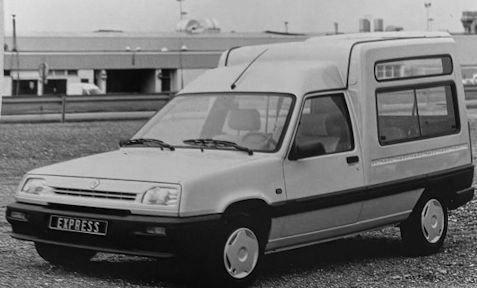
The Renault Rapid was available both as a panel van with two hinged side hinged doors in the rear , as well as a large, openable to the top tailgate . As with its predecessors Renault 4 F4 and F6, the Renault Rapid all wheels were suspended individually : on the front of MacPherson struts and wishbones and the rear of wings with torsion bars , while similar vehicles - such as the VW Caddy or Opel Combo etc. - often still equipped with a rear rigid axle to leaf springs.
The model maintenance took place - as usual with Renault - in several so-called phases.
The first version ( Phase 1 ) was built from mid-1985 to summer 1991. Renault offered for the first time a small van with a 1.6l diesel engine (40 kW / 54 hp), while the petrol engines from the Renault 5 were used. Visible is this model on the almost vertical headlights .
In the summer of 1991, there was a revision to Phase 2 . The engine range changed, since now partly machines were taken over by the Renault Clio . Added to this was, among other things, a 1.9-liter diesel engine with 47 kW (64 hp). This engine with the designation "F8Q" finds modified until today in various models of Renault and Nissan use. Visible was this model on the modernized grille , which was mostly held in gray plastic and aerodynamically slightly cheaper.
The phase 3 of the model was from early 1994 until its replacement by the Kangoo built. The biggest differentiators were high-quality looking materials, the body color grille and the slightly different taillights. An airbag was also available for this model at an extra cost . Not only the safety equipment was upgraded, also the comfort equipment z. B. by a central locking with remote control . In Phase 3, the 1.6l diesel engine fell away and was replaced by a reduced to 40 kW (54 hp) 1.9l diesel engine.
The Express is derived closely from the Renault five, o. However, for certain models, the four-bar rear suspension, found on the Super 5 GT Turbo or 9 and 11 Turbo sports versions and on the 9 and 11 equipped with the 1721 cm 3 ), the wheelbase, door-to-door false and the front face (front mask, wings and hood) are specific.
The body, steel structure self-supporting, designed to balance rigidity and lightness, could be paneled, semi-glazed to clear visibility 3/4 rear, glazed, be equipped with two hinged doors or a tailgate. It has existed in 2 and 5 seats, and a pick-up variant has been provided by the independent coachbuilders company.
The " Cléon-Fonte engines " (gasoline) were arranged transversely at the front, and coupled to a four or five-speed gearbox + reversing appeared on the Renault 9 and 11. The displacements were 956, 1,108 and 1,397 cc .
On the newer models, a 1.4-liter " Energy Engine " of 80 horsepower was also available, much more modern engine (overhead camshaft) and economical, as well as the " engine D " of 1.2 type D7F of 60 horses.
The 956 cc was quickly abandoned due to limited performance and high consumption. Renault also proposed diesel engines, a 1.6-liter F- type " F-engine ", derived from the F2N block of 1721 cc gasoline, the latter two already seen under the hood of the Super 5, 9 and 11, then the " engine F "type F8Q of 1.9 liter diesel, inaugurated by the Renault 19 .
The gearbox is type JB, 4 or 5 synchronized reports, identical to the boxes of 5, 9 and 11, but reports to the different staging. The steering is classic, rack-and-pinion, optional or series-assisted on the latest models.
This is a front wheel drive. The front suspensions are independent, with coil springs and shock absorbers and anti-roll bar derived directly from the 5; On some models, not all, the rear axle is "rigid deformable" also called "programmed", with 4 torsion bars and hydraulic shock absorbers.
The braking , of the hydraulic type dual circuit is mixed, solid disc at the front, rear drums, assisted by a vacuum brake booster. The parking and emergency brake is cable operated and operates the rear drum jaws.
This car has existed in electric variant, rare. It was also equipped with the entry level Super 5 dashboard , the latter being modified to receive the equipment relating to its mode of propulsion (battery gauge, for example).
In direct competition with the Citroën C15 and the Fiat Fiorino , the Express van was a great success among the light trucks, and eventually settled in succession to the Renault 4 Fourgonnette .
It was also available in five-seater version. This car has so many similarities with the Super 5 and Clio Diesel that it is possible to replace, relatively simply, the original engine with a larger engine of the same origin Renault, as the powerful 1.7 liter 120 hp turbocharged from Volvo 440 and 480 turbo, or the 2 liter Clio Williams / Megane, or even the 1.9 L Turbo Diesel R19, the F block is common to these engines . For gasoline versions, it remains the possibility of supercharged engine 1397 cc Super 5 GT Turbo and R9 and R11 Turbo . However, it should be noted that all these alternative fixtures are of course illegal and reserved for use in a closed circuit.
For export, mainly in Germany , the van was named Renault Rapid as well as the United Kingdom (the name is already used by Talbot for the twin brothers Citroën C25 - Peugeot J5 and Fiat Ducato I ); and was equipped according to legislation, the engine Cléon-Fonte ", also depolluted (presence of an EGR, a catalyst .) and often a much more abundant equipment (storage over the driver, digital clock, rear window defrost, fog lights, etc.). The latest models are also equipped, as an option or series, with power steering, tinted electric windows and more. far from the rustic apparatus of the beginnings.
It is from the presentation of the Renault Kangoo that the express van begins its end of career. In 1997 , only three versions of the Express remain: RN, RL and Extra. In 1998 , the 5-seater version disappears, only the 2-seater versions remain in the catalog. The Express disappears in July 2000 .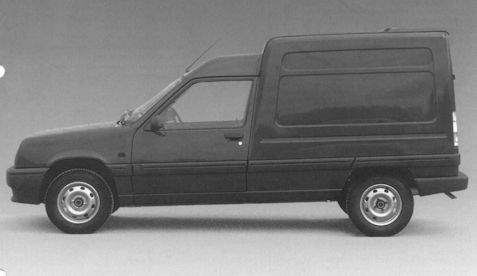
Renault Master II
 |
|
|---|---|
| Production period: | 1997-2010 |
| Class | Commercial vehicle |
| Body designs: | Panel van , flatbed , minibus |
| Engines: | Diesel engines : 1.9-3.0 liters (59-107 kW) |
| Length: | 4899-5899 mm |
| Width: | 1990-2361 mm |
| Height: | 2053-2717 mm |
| Wheelbase: | 3078-4078 mm |
| Payload: | 1.45-2.1 t |
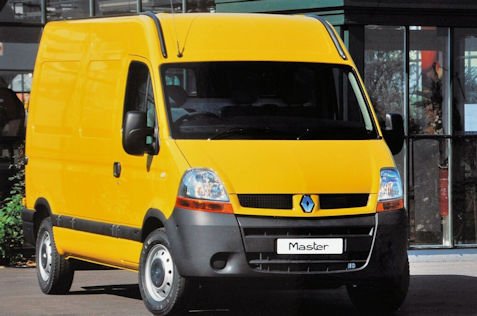
The new Renault Master series 2 the larger Brother of the traffic was updated in 1997 and continued until 2010.
The new Master has a diverse range to meet requirements. The combinatbn of different lengths and heights of a range of six useful load volumes from 8.0 cu.m to 13.9 cu.m. The drivers environment has been given particularly close scrutiny. resulting in a driving position with the same level of comfort as a passenger car and of extra soundproofing and absorbent material to limit engine noise.
The numerous stowage spaces provided also contribute to comfort. Features available in the new Master include; power-assisted steering. air conditioning. engine imombiliser activated by the remote-control central locking. electric windows. electrically operated and demisted exterior mirrors.
The development of the new Renault Master started in 1987, but was stopped because of the high costs. In 1989, Renault came to an agreement on the joint development of a transporter with Leyland DAF , which needed a successor to the Daf 400 and the development was now resumed together. After the bankruptcy of Leyland DAF in 1993 Renault took over the entire development process again.
In 1995, Renault signed an agreement with Iveco to develop a cab for the Master II, Mascott and Iveco Daily III models . Due to the increasing cost of the project, Renault decided to look for another partner, which was found in 1996 in General Motors Europe. It was agreed that Renault commercial vehicle models would be offered by badge engineering from the GM brands Opel and Vauxhall . The first result of this cooperation was the Vauxhall / Opel Arena .
The joint development project of the three automakers was completed in late 1997 with the presentation of the Master II, mid-1998 with the presentation of the Opel Movano A and 1999 presentation of the Iveco Daily III and Renault Mascott (successor to the Messenger).
In 1998, the Renault Master secured the title Van of the Year . In addition to the already known from the predecessor versions, there was now a minibus ex factory with 16 seats. The loading volume of the van was now 8 to 13.9 m³. There was only front-wheel drive, the rear-wheel drive variants were reserved for the Renault Mascott. As engines only diesel engines were used. At the start of production, these were a SOFIM 2.5-liter diesel engine with 59 kW / 80 hp and a 2.8 l-dTi with 84 kW / 115 hp. Later came a Renault self-developed 1.9 l-dTi with 59 kW / 80 hp added. Already in the development phase the environmental concept was taken into account with the result that almost 90% of the materials of the master can be recycled. To minimize costs for consumers, the lower body panels, which are often the victim of driving damage, were pressed separately and easily replaced by screwing / unscrewing.
In 2000/2001 Renault introduced newly developed dCi engines with common-rail injection . The 1.9 dTi was from 1.9 dCi with now 60 kW / 82 hp, the 2.5 from the 2.2 dCi with now 66 kW / 90 hp and the 2.8 dTi by the 2.5 dCi with also 84 kW / 115 hp replaced. 1999 began Renault-Nissan - Alliance . Therefore, from the beginning of 2002, various Renault trucks were also offered under the Nissan brand . For Master II came with the Nissan Interstar from the beginning of 2002, a second sister model added.
The Renault Master (and its sister models) was extensively revised in the fall of 2003. The design changed the front and the interior, also the chassis was improved. Furthermore, the 1.9 dCi engine has been redesigned. New added was a 3.0 dCi with 100 kW / 136 hp from Nissan, which was also installed in the Nissan Patrol . For the revised model was now optional ESP ( vehicle dynamics control ) available. Also included now from a brake assistant next to the previously built anti-lock brake system standard. In addition to the manual five-speed gearbox was now also an automated gearbox called Tec-Shift available.
In the following years, the engine range changed by further development of the 2.5 dCi. A 74 kW / 100 hp variant replaced the 2.2 dCi, the 84 kW / 115 hp variant rose to 88 kW / 120 hp. The 3.0 dCi was replaced by the 2.5 dCi with 107 kW / 145 hp.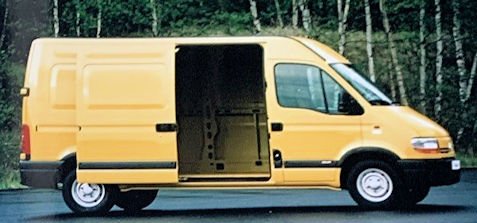
Renault Modus
 |
|
| Mark | Renault |
|---|---|
| Years of production | 2004 - 2012
Phase 1: 2004 - 2008 |
| Production | 665,339 copies |
| Class | Motor Car |
| Assembly plant (s) | Valladolid |
| Engines | Gasoline 1,2 75/100 hp 1.4 98 hp 1,6 110 hp Diesel 1,5 dCi 65/70/75/85/90/105 hp |
| Gearbox | Manual 5-speed Manual 6-speed Manual 5-speed automatic 4-speed |
| Unloaded weight | From 1,080 to 1,205 kg |
| Bodywork | 5 doors, 5 seats |
| Length | Phase 1: 3,790 mm Phase 2: 3,874 mm Large: 4,034 mm |
| Width | 1,695 mm |
| Height | 1,590 mm |
| wheelbase | Short: 2,482 mm Large: 2575 mm |
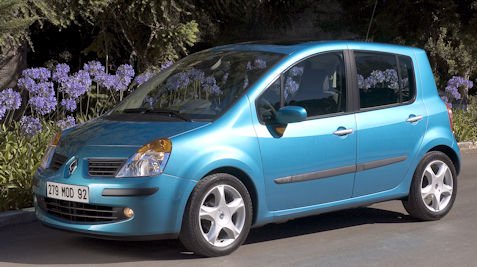
The Renault Modus is an automotive group Renault released in September 2004. Modus offers some of the space-efficiency of an MPV in a compact package. Its sliding two- or three-way split-fold rear bench, split tailgate and specially designed bike rack make it an user-friendly vehicle.
Having the same length as the Clio II, the Modus remains a small city car but, because of its height and the driving position, has a better habitability and visibility. On some versions, the rear seat is fully adjustable and can be advanced or retracted, the backs down or completely folded.By 2007, just before Phase II. There was a slight facelift of the front and rear lights. The turn signals are now transparent, instead of being opaque yellow.
In 2008, the Renault Modus has been restyled, this is especially visible on the front and rear. The front includes a new grille and a new shield, giving the Modus a more modern look. The front lights and air intakes are redrawn, the air intakes are drawn in continuity with the front lights. The tailgate is also redesigned and the taillights become oval. During the restyling, the mirrors become bigger. The Modus has grown 8cm compared to the original phase 1.In addition to the normal version, a version with an extended wheelbase, which has the wheelbase of the Clio III.This elongated version offers superior roominess and a larger trunk volume. The Grand Modus now exceeds 4 meters long . The "Grand Modus" represents the majority of sales of the model. The Modus is not replaced by a similar model , but by the Renault Captur Crossover type based on the chassis of the Clio 4 .In September 2004 , Renault hoped to sell 250,000 to 300,000 Modus a year, but only sold 400,000 copies in three years In 2004, During the restyling, Modus sales increased slightly but still remain below Renault's estimates.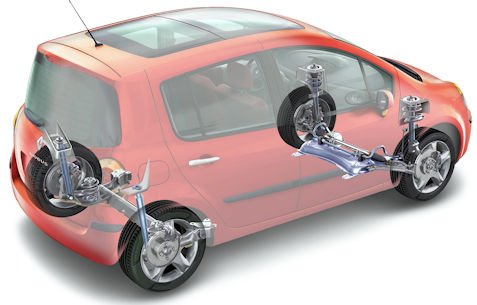
The front suspension, which employs MacPherson type geometry together with an L-shaped lower arm, ensures decoupling of longitudinal and transverse loads. It is therefore possible to provide the high lateral stiffness which benefits roadholding, while absorb-ing longitudinal shocks for the sake of comfort. The front suspension is mounted on a filtered sub-frame, which also contributes to comfort by limiting the transmission of vibration. The rear suspension consists of a programmed-deflection torsion beam together with coil springs. The flexible beam incorporates an anti-roll bar for optimum
control of body movement. The vertical dampers and the long suspension travel ensure good road-handling which combines precision control with comfort. The choice of elasto-kinematic materials for the front and rear suspensions helps to absorb external shocks and plays a part in smooth, efficient chassis performance.
Modus is equipped as standard with electric variable power-assisted steering calibrated to improve steering precision and allow a turning circle of only 9.9m between kerbs.
Petrol engines comprise three 16-valve units: 75hp 1.2, 98hp 1.4, and 113hp 1.6.diesel engine r include the 65hp and 80hp 1.5 dCi units, recognized for their efficiency and low noise levels.
The range of 5-speed manual gearboxes is taken from Mégane Il, with gear ratios adapted to Modus, while the 1.6 16V engine also drives through an automatic transmission.
All these engines operate through drive-by-wire throttle linkage and a motorized throttle valve. They conform with the Euro IV exhaust emission limits and are fitted with an On-Board Diagnostic (OBD) system which ensures that their emission control equipment will continue to function properly over time.
The manual gearboxes taken from the Mégane Il have been adapted for Modus. All the engines drive through manual 5-speed gearboxes of the JH or JR series. With a two-shaft layout, these have torque capacities of 160Nm and 200Nm respectively. These gearboxes are equipped with double-cone synchromesh on the lower two gears (except for the 1.2 16V and 1.4 16V engines) and with a cable type gearshift linkage. Automatic transmission is an option with the 1.6 16V engine: the 4-speed proactive transmission includes flick-shift selection mode. With this system, the driver controls gear selection with a single forward or aft flick of the lever, after moving it sideways into manual mode from the "Drive" position. In this mode upward or downward shifts that would
cause the engine to exceed its operating limits are inhibited. When slowing down, the ratio best-adapted to the vehicle's speed is automatically engaged what- ever the selected mode. It is therefore impossible either to overspeed the engine or to force it to run at less than normal idling speed.
Modus is equipped as standard with Bosch 8.0 ABS system with EBD electronic brake proportioning and emergency brake assist. In an emergency stop, Modus' hazard warning lights automatically switch on. This model is also equipped with dynamic driving control (ESP) with understeer control. This system corrects trajectory by lowering engine torque output and braking to reduce speed. Understeer is controlled by braking two wheels on one side or all four wheels, depending on the degree of understeer.
A traction control function (ASR) for starting from rest or accelerating in low-grip conditions, completes the features of the ESP system. It should be noted that this system can be inhibited below 50kph via a switch on the dashboard for easier starting from rest on loose or uneven surfaces. The system is automatically reset every time the engine is started or when speed exceeds 50kph. Finally, MSR control of engine torque on the overrun prevents the driven wheels locking when the accelerator is released, or when decelerating in low-grip conditions. 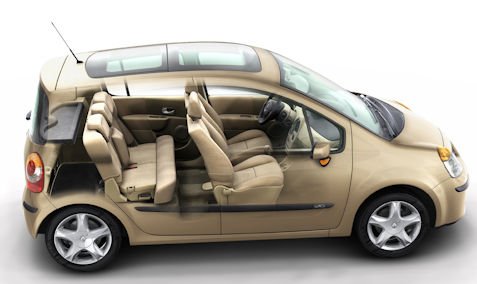
Modus is equipped with SRP3. It includes up to six airbags of which four are side airbags (two thorax side airbags built into the front seats, and two curtain airbags for front and rear head
protection) and two twin-stage adaptive front airbags. in a frontal impact, these safety features are triggered according to the size and position of the front seat occupants. The front seats also with double pretensioners and load limiters. The latter have a 400 daN setting to protect the thorax. A warning buzzer and a pictogram on the dashboard warn the driver should he or she forget to buckle up. 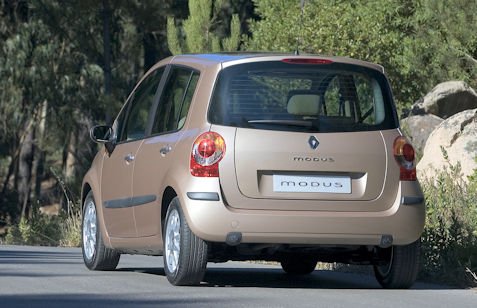
Renault 4CV
 |
|
| Mark | Renault |
|---|---|
| Years of production | 1947 to 1961 |
| Production | 1,105,547 copies |
| Class | Motor Car |
| Assembly plant(s) | Billancourt, Flins |
| Fuel | Petrol |
| Engine(s) | Billancourt 760cc 747cc |
| Engine position | Rear |
| Maximum power | SAE - 18 to 35 hp |
| Gearbox | 3 gears |
| Unloaded weight | 610 kg |
| Bodywork | Hatchback |
| Brakes | Drum brakes |
| Length | 3663mm |
| Lenght | 1430mm |
| Height | 1450mm |
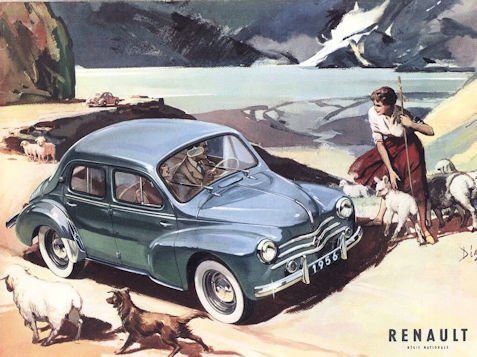
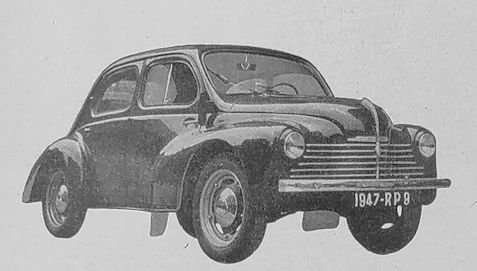
The Renault 4CV , from the French manufacturer Renault , is a car designed during the ending reign of Louis Renault and under the responsibility of two talented engineers, Fernand Picard and Charles-Edmond Serre. It is first presented in following the development of three prototypes , two of them secretly during the Occupation. It's a small car, but it's particularly spacious for its era and its exterior dimensions.
The Renault 4CV symbolizes the return of peace and prosperity because it is the first car accessible to the greatest number of people . The 4CV was the best-selling car in France until 1955 . It is the first French to reach a production of one million copies .
Production begins and will be mainly carried out in Billancourt , but part will also be done at the Flins factory ( Seine et Oise ). It will last from 1947 to 1961 , from year of release of the final 1,105,547 and copys . Along with the Dauphine , the 4CV was, for nearly fifteen years, the main model marketed by Renault . The Renault 4CV was designed in near-secret, in full secrecy, during the Second World War , at a time when French companies in the occupied zone were under German control . Two Renault executives, Serre and Picard, opposed to collaboration with the occupier and who would later join the Resistance , in to Obegin designing this popular small car in anticipation of post-war .
Charles-Edmond Serre, 58, is one of Louis Renault's early companions; an industrial designer, he became a director of the company and director of studies and research . Fernand Picard, one of his main assistants, joined the car manufacturer in 1935 and was then the director of the design office .Fernand Picard works with a very restricted group of collaborators . Known under the code name "106 E", the prototype was only completed after two years, in . Its general structure could suggest that its designers were inspired by the Volkswagen Beetle , particularly for its rounded front , but this hypothesis is not always accepted and even seems surprising. Indeed, in 1946 , Marcel Paul , Communist Minister of Industrial Production invited Ferdinand Porsche , at that time a prisoner in France , to give his opinion on the future Renault 4CV. Nevertheless, Pierre Lefaucheux is furious with this initiative and very quickly expresses his dissatisfaction to the Prime Minister :“I agreed to submit a file to Professor Porsche concerning the 4CV, we are currently carrying out the tools. We will of course study with the greatest attention the remarks which could be made but it is understood that we will remain the only judges of the advisability of following or not following its possible suggestions” . The Minister insisted, nine meetings will take place, but the intervention will have no influence on the 4CV. “We estimate that the 4CV can be launched in series within a year ,” Porsche told the minister's representatives.
Made of aluminum, this prototype has only two doors and its style is rather unattractive. Miraculously escaping a bombardment aimed at the Renault factories, the prototype made its first laps on, around Meudon. With a displacement of 760 cc , it reaches 84 km/h . Two events accelerated the evolution of the model: the Liberation and the arrest of Louis Renault for acts of collaboration and, subsequently, the appointment of Pierre Lefaucheux at the head of the National Board of Renault factories as temporary administrator in and CEO in . This one seizes the interest of the project and imposes to improve the model. Very soon after taking the helm of Renault, Pierre Lefaucheux carried out a few tests on a Renault 4CV prototype. He is therefore convinced to resume the design of this model, while making some modifications. He then decided to replace the two-door with a four-door version, having had difficulty due to his tall stature entering the rear of the prototype . Lefaucheux has no particular affection for the automobile in general. .
It is therefore in that the third and last prototype, close to the production version, is born. Unlike the two previous ones, this prototype is equipped with four doors, thus orienting the vehicle towards the family category . In 1946, the engineers realized that the height of the headlights was not legal. However, the machine tools are already manufactured. This is how Fernand Picard managed to get the National Automobile Commission to propose changing the height of the headlights to 550 mm .
The production of the Renault 4CV did not start until the summer of 1947 , due to the damage suffered by the industries during the war and the delays necessary for the restoration of the machines, in the form of a series of 300 copies intended for the dealers who will thus ensure the promotion of the car . The 4CV becomes the only new post-war Renault model (the Juvaquatre station wagon continues to be produced). The first production 4CV comes down from the assembly lines on Île Seguin on . The 4CV was a success : daily production was 15 vehicles in 1948 to reach 375 units in 1950, an impressive number for the time.The 4CV evolved over the years: the most striking changes were, on the 1954 models , the abandonment of the six-bar "mustache" on the front face, in favor of a simpler one with three bars , then the adoption, together with the Dauphine and a few years before the end of production, of wheels with solid rims instead of the previous wheels with removable star rims.
Its main technical characteristics are a " Billancourt engine " placed in a rear overhang with three levels, of 760 cm 3 (for the first models), then 747 cm 3 from , four-cylinder, overhead valves and side camshaft , developing 17 then 21 hp ; a three-speed manual gearbox , with non-synchronised 1st.The radiator , located between the engine and the rear bench seat, although weakly supplied by the two air vents located at the bottom and in front of the rear fenders, cools the engine sufficiently, to the point that a curtain controlled from the interior makes it possible to limit cooling , which is excessive in winter. In this same season, it was on the other hand difficult to heat the uninsulated cabin, the windows were adorned with fog from the first cold snap. However, hot air vents were provided at the base of the windscreen and, from 1958, the 4CV was equipped, like the Dauphine, with an excellent Sofica heater which definitively solved the problem .
From the 1956 models, a Ferlec brand electromagnetic clutch was offered , which would be used on the Dauphine . Presented at the 1954 Paris Motor Show , the Ferlec automatic clutch, studied and developed by Ferodo , was offered in the catalog the following year. However, series production will only take place in and concerns approximately three hundred vehicles per month. This device can be fitted to all models, as an option only. The removal of the clutch pedal from a small production car marks an important step in the practical evolution of the automobile. The tightening of the friction disc between the two plates is carried out thanks to the action of an electromagnet powered by the dynamo. The clutch pedal is removed in favor of a switch, placed under the gear lever, which automatically controls the clutch. An inverter button, placed on the underside of the dashboard support, allows you to connect the clutch to the battery to take advantage of the engine brake during a prolonged descent or to immobilize the car on a slope. Externally, the signature " Ferlec automatic clutch " appears on the rear cover.