
Reliant
Reliant Rialto 2
|
|
|
|
Manufacturer |
Reliant |
|
Production |
1983 to 1998 |
|
Predecessor |
Reliant Robin |
|
Class |
Three-wheeled car |
|
Body style |
3-door hatchback, 3-door estate |
|
Layout |
FMR layout, with single front wheel |
|
Engine |
0.85 L OHV I4 |
| Wheel base | 85 in, 216 cm |
| Width | 57 in, 145 cm |
| Ground clearance | 5 in, 12.7 cm |
| Weight | 962 1b, 436 kg |

The Reliant Rialto Mk. II was a three-wheeled car that the Reliant Motor Company manufactured from 1981 to 1998 as the successor to the Robin model.
History
Reliant Rialto Mk. II was the second version of the Rialto with the improved aerodynamics of the new body style only two years after the first relase, the car was a much more stable vehicle at speed.
As early as March 1983, the Rialto Mk. II came with an "HT-E" engine increased in compression to 10.5:1, which was more economical than its predecessor ("E" stood for Economy), It was powered by Reliant's 850 cc aluminium water-cooled engine but still only with 37.5 bhp (27.6 kW). The Rialto was made in three different body types: saloon, estate and panel van the bestselling being the estate version. With a galvanised chassis and a fiberglass body, the Rialto was very resistant to corrosion. New to the Rialto was the single windscreen wiper, centrally located to clear the whole screen.
The car had the well-known 40 bhp (29 kW) engine The yellow painted rocker cover which gave the engine the nickname the yellow top model. Despite these measures, the factory had to realize that the fan community was not as enthusiastic about the Rialto as it was about the Robin. This gave the car a scary higher top speed of 100 mph, and a fuel economy figure of 72mpg at 56 mph helped by the changes to the rear axle ratio to 2.78/1 bur was later found to be poor for local town driving.
PERFORMANCE: Reliant Rialto Mk2
- max power (DIN): 37 hp (28 kW) at 5,000 rpm
- max torque (DIN): 49 1b ft, 6.8 kg m (67 Nm) at 3,000 rpm
- max engine rpm: 5,500; 43.6 hp/l (33 kW/l)
- power-weight ratio: 26 lb/hp (34.4 lb/kW), 11.8 kg/hp (15.6 kg/kW)
- acceleration: standing 1/4 mile 20.9 sec, 0-50 mph (0-80 km/h) 11.4 sec
- fuel consumption: 73.3 m/imp gal, 60.3 m/US gal at 56 mph, 90 km/h.
The cheapest models came with vinyl seats, on the sportier GLS models better cloth seats along with GLS black plastic bumpers. In September 1986 there was a Newley released the Rialto SE a cheaper model than the rereleased Robin version.
The Rialto was discontinued in 1998 while production of a new Robin model, introduced in 1989, continued and later in 1989, the factory brought out a new Robin, which was placed alongside the Rialto. The Rialto production along with the much sought-after Robin continued until 1998 and was then discontinued.
Reliant Scimitar GT SE4
 |
|
| Manufacturer | Reliant |
|---|---|
| Production | 1964 to 1970 |
| Class | Sports car |
| Body style | two door coupe |
| Engine | 2553 cc I-6 (1964 - 1966) 2495 cc V-6 1967 - 1970 2994 cc V-6 (1966 - 1970) |
| Transmission | 4 speed manual |
| Wheelbase | 92 in (2,337 mm) |
| Length | 167.5 in (4,255 mm) |
| Width | 62 in (1,575 mm) |
| Height | 51 in (1,295 mm) |
| Kerb weight | 2,380 lb (1,080 kg) |
| Designer | Ogle Design |
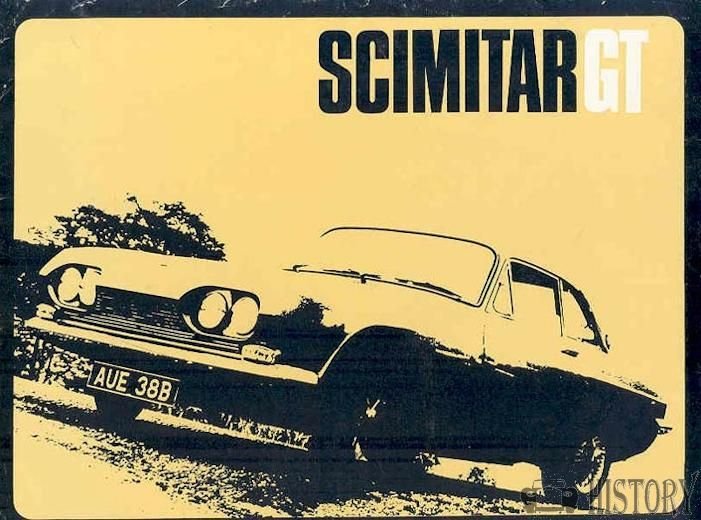
The Scimitar GT SE4 was a British sports car first built in the 1960. It was produced between spring 1965 and 1970.
History
The Scimitar GT SE4 was introduced at the 1964 Earls Court Motor Show. At first the car was a success, with also the presentation of the GTE combi-coupé, which was produced at the same time for a time. Technically, the GT SE4 was based on the chassis of the Saber. As with all Reliant models, the body was made of plastic.
The first Scimitar GT SE4 was a 2+2-seater sedan coupé designed by Tom Karen for Ogle Design. The design was based on a draft that Karen had developed shortly before for an ultimately unrealized successor to the Daimler SP250. Daimler didn't use the design, so Reliant approached Ogle and asked to buy the rights for it. Some subtle changes were made to the bodyshell and it was further modified to fit the Reliant Sabre chassis and running gear with a box-type ladder frame. The proportions of the design quoted the well-known sports car pattern: a long bonnet was followed by a narrow passenger compartment and a short rear section.
In the period from 1965 to 1970, four versions of the GT were created, which differed from each other primarily in technical aspects.
2.6 litre straight six engine version (SE4) (1965)
The base model was the Scimitar GT (SE4). It was powered by a 2.6 litre straight - six engine derived from the Ford Zephyr/Zodiac that had been used in the AC Greyhound a few years earlier fitted with triple SU type HS 4 carburettors as standard it produced a good 120 bhp. In order to keep cost down, other components from cars existing at the time were also used. 59 examples of this the early basic model were built in the first year of production but as with many first run cars they had their faults.
2.6 litre update (SE4) (1965-1966)
In the summer of 1965, the chassis was changed. The rear axle received two parallel thrust struts; furthermore, the Watt's linkage was modified and a different differential was introduced the front suspension was independent, wishbones. coil springs and telescopic dampers the
rear suspension came with rigid axle a modified Watt linkage. coil springs and telescopic dampers. From then on, the model was called SE 4a internally and was produced until the summer of 1966. Optional extras included a ZF gearbox and De Normanville overdrive unit on 3rd and 4th gears, also sunshine roof with manual or electric open, in total Reliant produced around 300 straight-six Scimitar GTs Price new from around £1,292 inc.
PERFORMANCE: 2.6L (SE4)
- Engine Capacity 155.78 cu in, 2,553 cu cm
- Fuel Consumption 20.9 m/imp gal, 17.4 ml US gal
- Max Speed 121 mph, 194.8 km/h
- Max power (DIN): 120 hp at 5,000 rpm
- Max torque (DIN): 140 1b ft, 19.3 kg m at 2,600 rpm
- Max number of engine rpm: 5.000
- Specific power: 47 hp/l
- Power- weight ratio: 18.3 lb/hp, 8.3 kg/hp
- Speed in direct drive at 1,000 rpm: 18.6 mph, 29.9 km/h.

3.0-litre Ford Essex V6 engine (SE4a) (SE4b) (1966-1970)
In the summer of 1966, it was further revised. The heavy all steel, unsportsmanlike 2.6-litre powerplant was replaced by a 3.0-litre Ford Essex V6 engine that produced 128 hp used in the large Ford Zodiac MK IV. Cars of the last two years received the front suspension of the Triumph TR6 along with anti-roll bar was fitted to obtain best performance and handling for the heavy engine that was now, moved further back in the bulkhead to help improve weight distribution a higher-ratio rear axle was needed with 3.58:1. The interior was also updated with black interior and improved ventilation. Options wire wheels; various axle ratios; electrically or manually controlled sunshine roof; overdrive on 3rd and 4th (0.820 ratio)
This version, which received the designation SE4b, the 3 litre versions had a small badge on the boot (trunk) and was produced from 1966 to 1970.Scimitar Coupe with 3 Litre V6 Essex engine (approx. 600 built)
PERFORMANCE:3-litre Scimitar (SE4a) (SE4b)
- Engine Capacity 182.69 cu in, 2,994 cu cm
- Fuel Consumption 25 ml imp gal, 20.8 ml US gal
- Max Speed 125 mph, 201.2 km/h
- Max power (SAE): 144 hp at 4,750 rpm
- Max torque (SAE): 192 1b ft, 26.5 kg m at 3,000 rpm
- Max engine rpm: 6,200
- Specific power: 48.1 hp/l
- Power-weight ratio: 15.4 lb/hp, 7 kg/hp
- Acceleration: standing 1/4 mile 17 sec, 0—50 mph (0—80 km/h) 7.1 sec
- Speed in direct drive at 1,000 rpm: 20.2 mph, 32.5 km/h.
2.5L version of the Essex engine (SE4c) (1967-1970)
The Final version released, in September 1967, the cheaper Scimitar GT SE4c, which received a slightly less powerful Scimitar GT.2.5L version of the Essex engine. It was £105 cheaper than the SE4b, which was further produced in parallel but the car could still reach speeds of over 110 mph. It was equipped with an alternator, while the Ford Zephyr 6 had to make do with a DC dynamo. Apart from that, the SE4c technically fully corresponded to the SE4b. It was on sale from 1967 to 1970 Just over 1000 SE4s were produced.
PERFORMANCE: 2.5-litre Scimitar (SE4c)
- Acceleration standing 1/4 mile 18.1 sec, 0—50 mph (0—80 km/h) 8.1 sec
- Max speed 110 mph, 177 km/h
- Fuel consumption 30 m/imp gal, 25 m/US gal
- Max power (SAE) 119 hp at 4,750 rpm
- Max torque (SAE) 146 1b ft. 20.1 kg m at 3,000 rpm
Reliant Kitten
 |
|
| Manufacturer | Reliant |
|---|---|
| Production | 1975-1982 4074 made |
| Predecessor | Reliant Rebel |
| Successor | Reliant Fox |
| Body style | 2-door saloon 3-door estate car/van |
| Engine | 848 cc light alloy I4 |
| Wheelbase | 84.5 in (2,146 mm) |
| Length | 131 in (3,327 mm)Saloon |
| Width | 56 in (1,422 mm) |
| Height | 55 in (1,397 mm) |
| Curb weight | 1120 pounds |
| Designer(s) | Ogle |
The Reliant Kitten is a small economy car which was manufactured from 1975 to 1982 by the Reliant Motor Company in Tamworth, England. It has a glass fibre body and an 848 cc all-aluminium inline-four engine, providing economical performance.
PERFORMANCE
- max power (DIN): 40 hp (29.4 kW) at 5,500 rpm;
- max torque (DIN): 46 1b ft. 6.3 kg m (61.8 Nm) at 3,500 rpm
- max engine rpm: 5,500; 47.2 hp/l (34.7 kW/l)
- power-weight ratio: 29.4 lb/hp (40 lb/kW). 13.3 kg/hp (18.1 kg/kW)
- acceleration: standing 1/4 mile 20.4 sec, 0-50 mph (0-80 km/h) 11.1 sec
- consumption: 60 m/imp gal, 50 m/US gal
The rear section of the Kitten's chassis is essentially the same as the Reliant Robin or Reliant Rialto, however from the middle forwards the car is significantly different, with the engine moved forward to where the Robin's front wheel is, and a Reliant-designed (but Lotus inspired) double wishbone front suspension. Moving the engine forward, compared with the three-wheeled cars, made a lot more room inside for the driver and front passenger. The Kitten's chassis, engine, and running gear are shared (with minor modifications), with the Reliant/MEBEA Fox pickup introduced in 1979.
In October 1976, a year after introduction, a new de luxe version of the Kitten, branded as the Kitten DL, was announced.Improvements included revised springs and dampers and a changed anti-roll bar. The engine received carburettor and air filter modifications, claimed to give better cold start characteristics, while interior improvements included more comfortable seats, modified door trims incorporating a map pocket, and a new style tray to cover the luggage space behind the back seat.

On 1 December 1976, a van version of the Reliant Kitten was announced, sharing the profile of the Kitten Estate but with blank panels in place of the windows behind the B-pillar.
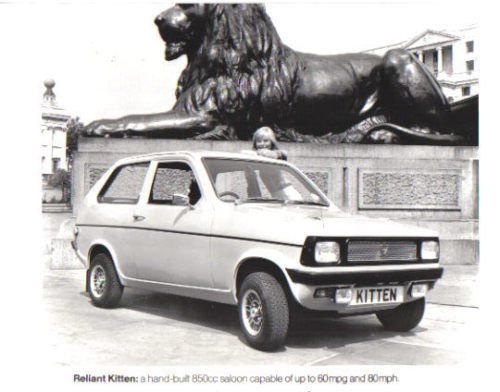
In 1982 the Kitten was axed due to not being able to compete on price with other models such as the Mini, due to its hand-made fibre glass shell. The corrosion of monocoque steel bodied competitors (the absence of which providing a strong selling point of the Kitten), which had been such a problem in the 1970s, was coming under control with advances in rustproofing. Also, the Kitten's rear-wheel drive layout was being abandoned in mass-market cars at this time in favour of a trend for transverse front wheel drive. Because it had four wheels, the Kitten also did not share the advantage of a lower UK road tax rating with the three-wheeled Robin.
OPTIONAL ACCESSORIES light alloy wheels laminate windscreen.Kitten Estate Car rear window wiper-washer.

Reliant Kitten Saloon sales
Reliant Ant TW9
 |
|
| Manufacturer | Reliant |
|---|---|
| Also called | Reliant Ant |
| Production | 1967-1987 |
| Body style | 3-wheel light commercial suitable for a variously configured load area |
| Engine | 700 cc OHV light alloy Straight-4 |
| Designer(s) | Tom Karen of Ogle Design |
The Reliant Ant, also known as the Reliant TW9 (Three Wheeler 9) is a small three-wheeler pickup truck produced by the Reliant Motor Company in Tamworth (England) between 1967 and 1987.
The Ant possessed a box section metal chassis. At the front, directly behind the single front wheel, a 700 cc four-cylinder four-stroke engine was installed, delivering a claimed 27.5 bhp (20 kW) of power. Above the front wheel and engine was a glass-fibre cabin with space for two and an aerodynamic front and two round headlights. Despite its apparent simplicity the cabin design incorporated gentle curves and creases to enhance structural strength. The rear wheels drove the vehicle to a maximum speed of 54 mph (86 km/h) and overall fuel consumption of 8.1 lt./100 km was quoted.
The left-hand drive version offered a load capacity of 500 kg and was intended to compete in Mediterranean countries with vehicles such as Piaggio's Ape (bee). Early on, Reliant's Greek partner MEBEA ordered 250 of the Ants. For the right-hand drive domestic market a more challenging load capacity of 800 kg was envisaged, but without a more powerful engine the vehicle struggled to handle this load weight. Target customers in the UK were mostly local government agencies. Reliant sold the TW9 as a chassis/cab and a wide range of uses was found for it. A flat-bed truck, various closed delivery van bodies, a small water tanker, a refuse truck, a street drain clearer and a snow plough all appeared. There was even a road sweeper and an articulated tractor-unit. The price for a chassis and cabin was quoted as £451.
In 1972 engine capacity was increased to 748 cc (although some later 848 cc Reliant engines may have been retro-fitted) and claimed output rose to 32 bhp (23.5 kW). Performance benefitted. By this time Greek partner MEBEA was building the vehicles under license.
Despite all its advantages, only 1,229 of the little trucks were sold during its initial four years. The more powerful version released in 1972 managed only 659 additional sales, giving a total output of 1,888 units. That figure does not include the vehicles built under license in Greece, however.
Reliant Rebel
 |
|
| Manufacturer | Reliant |
|---|---|
| Production | 1964 to 1973 |
| Produced | 2600 |
| Body style | 2-door saloon 2-door estate car van |
| Engine | 598 cc/700 cc/748 cc Straight-4 |
| Transmission | 4 speed manual |
| Wheelbase | 89 in (2,261 mm) |
| Length | 138 in (3,505 mm) |
| Width | 58 in (1,473 mm) |
| Height | 55.5 in (1,410 mm) |
| Curb weight | 538.8-603.3Kg |
The Reliant Rebel was a small car produced by Reliant between 1964 and 1973.
History
conceived as an alternative to the Austin Mini and Hillman Imp. It was produced in saloon, estate and van variants.The Rebel had a body made of fibreglass. Because of this, the car's body did not rust, and it was proclaimed in advertising to be "its own garage".

Reliant Rebel car interior
Engines
The car was launched with a 598 cc engine which was increased to 701 cc in time for the October 1967 London Motor Show and at the 1972 Motor Show to 748 cc (although sometimes later 848 cc Reliant engines are retro-fitted) and the maximum speed was around 70 mph (110 km/h).
Reliant Rebel engines were of a higher compression than those that powered the Reliant Regal and the Reliant Robin.
Even the 748 cc engine introduced in 1972 offered only a claimed power output of 35 bhp (SAE) and published fuel consumption figures also indicated a car significantly more frugal than similarly sized metal bodied contemporaries.
PERFORMANCE:598 cc
- Engine Capacity 36.49 cu in, 598 cu cm
- Fuel Consumption 61.6 m/imp gal, 51.1 mlUS gal
- Max Speed 73.5 mph, 118.3 kmh
- Max power (DIN): 27 hp at 5,250 rpm
- Max torque (DIN): 31 1b, 4.3 kg m at 3,000 rpm
- Max number of engine rpm: 5,250
- Specific power: 45.2 hp/l
- Acceleration: standing 1/4 mile 25.5 sec, 0—50 mph (O 80 km/h) 23 sec
- Speed in direct drive at 1,000 rpm: 14 mph, 22.5 km/h.
PERFORMANCE:700cc
- Engine Capacity 42.71 cu in, 700 cu cm
- Fuel Consumption 58 m/imp gal, 48 m/US gal
- Max Speed 68 mph, 109.5 km/h
- Power-weight ratio: 38.8 lb/hp, 17.6 kg/hp
- Max power (DIN): 31 hp at 5,000 rpm
- Max torque (DIN): 38 1b ft, 5.2 kg m at 2,500 rpm
- Max engine rpm: 5,700
- Specific power: 44.3 hp/l
Chassis, suspension and steering
The chassis was similar to that of the three-wheeled Reliant Regal, but the Rebel featured a conventional four wheel configuration which involved a significantly larger section to its rails and conventional steering. In the Rebel's case this used the steering box from a Standard Ten with wishbones, trunnions and ball-joints from the Triumph GT6 / Vitesse. The standard 12" steel wheels have a PCD of 4x4" (4x101.6mm).

The Reliant Rebel 700 car
Gearbox
The car was introduced with a four-speed gearbox which featured synchromesh on the top three ratios. By 1972 synchromesh had been extended to all four forward speeds. The light-weight body material and the aluminium engine block meant that the car was some 15% lighter than the (slightly shorter) Mini and 35% lighter than the early Renault 5 introduced in 1972.
Only 2,600 Rebels were made in saloon, estate and van variants.

The Reliant Rebel 700 Estate

