
Rover
Rover P4 (95 and 110)
 |
|
|
Manufacturer |
The Rover Co. Ltd. |
|
Production |
1962 to 1964 |
|
Class |
Motor car |
|
Body style |
Saloon |
|
Engine |
2638 cc |
|
Layout |
FR layout |
|
Wheelbase |
111 in (2,819 mm) |
|
Length |
178.72 in, 4537 mm |
|
Width |
65.59 in, 1666 mm |
|
Height |
63.74 in, 1619 mm |
|
Ground clearance |
7.10 in, 180 mm |
The last models in the Rover company P4 were the Rover 95 and Rover 110 only from 1962 to 1964 .
History
The Rover P4 series was a group of saloon automobiles produced by the Rover Company from 1949 The Rover P4 was a sedan manufactured from 1949 to 1964. It was then replaced by the much more modern Rover P6 .All P4 models had 4 doors. The designation P4 was a manufacturer code that designated the model group, but was not used colloquially by customers. These called their cars. e.g. “Rover 95” etc.
The last models in the P4 family were the Rover 95 and Rover 110 . When they were introduced in 1962, they looked a bit old-fashioned a 4 door saloon with single front seat so 5-6 seats. Later they got door panels made of sheet steel (instead of aluminum) and electric windscreen washers.The list price for the 110 was £1,143 or for the 90 £1,023 (plus tax). An overdrive was standard equipment; the “Roverdrive” automatic was no longer available.The distribution of weight was 56% to the front axle, 44 % at the rear axle

Both models had the same change-controlled engine with a displacement of 2625 cm³. The old engine produced 123 bhp (92 kW) with a more powerful engine the Weslake head 110 and overdrive was standard on the 110 on the less range model the 95 this had 102 bhp (76 kW) and was fitted with a higher final drive ratio at 3.9:1.
PERFORMANCE:
- Rover P4 110
Engine capacity: 160.54 cu in, 2625 cu cm;
Fuel consumption: 22.0 mil imp gal, 18.4 m US gal, 12.8 1 x 100 km;
Max speed: 106.0 mph, 170.7 km, h
max power (DIN): 123 hp at 5000 rpm
max torque (DIN): 142 1b ft, 19.6 kgm at 3000 rpm
specific power: 46.9 hp/l
max speed in overdrive: 106.0 mph, 170.7 km/h
power-weight ratio: 26.7 lb/hp, 12.1 kg/hp
acceleration: standing 1/4 mile 20.1 sec, 0—50 mph (0 —80 km/h) 11.3 sec - Rover P4 95
Engine capacity: 160.54 cu in, 2625 cu cm;
Fuel consumption: 22.0 m imp gal, 18.4 m US gal, 12.8 1 x 100 km;
Max speed:94.0 mph, 151.3 km h
max speed in 4th gear: 94 mph, 151,3 km/h
power-weight ratio: 31,5 lb/hp,14.3 kg/hp
acceleration: standing 1/4 mile 21.0 sec,
max power (DIN): 102 hp at 4750 rpm
max torque (DIN):140 1b ft. 19.3 kgm at 1500 rpm
max number of engine rpm: 4800
specific power:38.9 hp/l

The interior is virtually the same for both models. It is roomy, attractively appointed and finished in true Rover style. Seats are upholstered in fine quality hide, thick pile carpets cover the floor and selected Walnut is used for facia and window garnishings. The wood-panelled facia is in keeping with the tasteful design of the interior as a whole. Instruments and controls are placed in front of the driver in the most practical andconvenient positions. All switches can be operated by a flick Of the finger and there are indicator lights to warn that oil pressure is low, that the cold start control should be returned to its normal running position, that the handbrake has been inadvertentlyleft on or the fluid in the braking system needs replenishment.
Both models were replaced after 1964 by the much more modern new Rover P6 . In total 3,680 model 95) and 4,620 model 110 were produced

Rover 10 P1 (1933-1938)
 |
|
|
Manufacturer |
Rover |
|
Production |
1933 to 1938. |
|
Class |
Motor Car |
|
Produced |
9202 |
|
Body style |
saloon, coupé, open tourer |
|
Engine |
1.4 L straight 4 |
|
Transmission |
4-speed manual |
|
Wheelbase |
105 in (2,700 mm) |
|
Length |
152 in (3,900 mm) |
|
Width |
61 in (1,500 mm) |
|
Designers |
Maurice Wilks and Robert Boyle |
The Rover 10 P1 was a Motor car built in the 1930s by the Rover company in Great Britain. From 1933 to 1938 with the 4-Cylinder 1389 cc 1.4 litre engine .
History
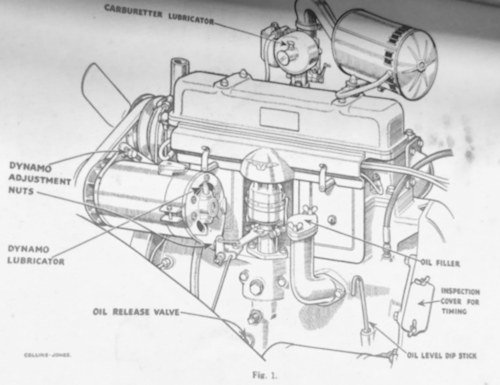
The new range for 1933 replacing the previous 10 and 10/25 model included a more upmarket Ten with also a new chassis that was also available to external coachbuilders and with now only Pressed Steel body built at the New Meteor Works, in Coventry England and fitted with a 1.4 litre engine. The Engine flexibly mounted, 66.5 mm. bore x 100 mm. stroke (with Treasury rating of 10.9 h.p.) this has overhead valves pump water circulation with automatic thermostat the lubrication by pressure from gear type pump.
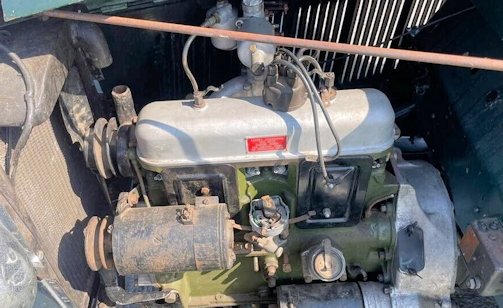
The new chassis automatically lubricated by Bijur system the underslung chassis has a wheelbase 8 ft. 9 in. and track 4 ft. 3.5 in the saloon body with flush-fitting sliding roof Triplex glass throughout; finished green, green wheels.
For the electrics coil and battery ignition; ventilated dynamo; Lucas electrical equipment chromium-plated head, side and tail lamps; electric dual windscreen wipers and electric horn.
The transmission 4 speed and reverse easy-change gearbox with silent engagement, freewheel controlled from dashboard incorporated with gearbox operates on all forward gears; central remote gear control; single-plate clutch and open propeller shaft with spiral bevel final drive
For the steering and brakes, wheels and suspension a worm and nut steering system and Girling balanced mechanical brakes on all 4 wheels; 18 x 4.75 Avon Duo-Tread tyres on
detachable wire wheels; half-elliptic springs front and rear with also hydraulic shock absorbers front and rear.
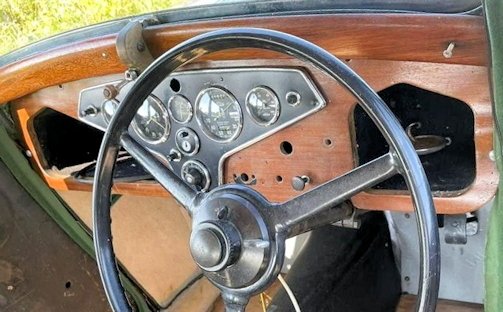
The saloon version features Inside green upholstery the equipment includes: centrally controlled windscreen, ventilating louvres at top of doors with built-in direction indicators with automatic return trip-speedometer The gauges include, clock; ammeter; combined electric petrol and oil gauge inside interior sun visors; mirror in near-side visor; interior light; driving mirror; roof parcel net; central folding and side arm rests to rear seat; body pulls; selected soft hide seating; specially improved seating springs; smokers' ash trays; driver-operated rear window blind; harmonic stabiliser; bumpers front and rear; folding luggage grid combined with rear bumper; spare wheel and tyre concealed by 1-piece cover; simplified jacking system; rear stop light and tool kit. Price, complete at £255
The "Ten" 4-Cylinder ROVER coupé came as a 4-seater coupé body with fixed head and flush-fitting sliding roof; finished maroon, maroon wheels and Upholstery soft hide seating; specially improved seating springs central folding and side arm rests to rear seat.
Equipment includes: chromium-plated head, side and tail lamps; electric dual windscreen wipers; centrally controlled windscreen; Triplex glass throughout; ventilating louvres at top of doors; built-in direction indicators with automatic return; electric horn; trip speedometer; clock; ammeter; combined electric petrol. and oil gauge;
interior sun visors; mirror in near-side visor; interior light; driving mirror; selected driver. operated rear window blind; smokers' ash trays; harmonic stabiliser; bumpers front and rear; built-in luggage compartment at rear; spare wheel and tyre; simplified jacking system; rear stop light; tool kit.
Price, complete, £280.
By 1935 the Rover programme comprised of the 10. 12 and 14 HP models. as well as Speed Fourteen and Speed Twenty Sports type cars. Prices ranged from £248 up to £495 .This model 10 was built up to 1938 .
Rover M1 prototype coupe
 |
|
|
Year: |
1947 |
|
Class : |
prototype |
|
Body design : |
Coupe |
|
Engine: |
Gasoline :0.7 liter (21 kW) |
|
Length: |
3454 mm |
|
Width: |
1422 mm |
|
Wheelbase: |
1956 mm |
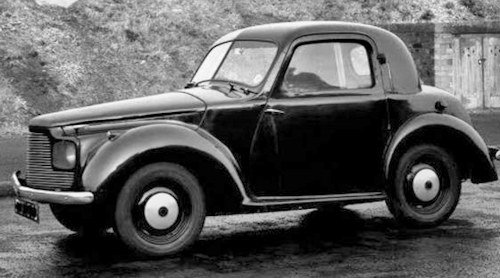
The Rover M1 was a small 2-door prototype coupe that Rover developed in 1947.
History
The Rover M1 series production did not take place; it stayed with the prototype. Made for use after the war as a light small engine car needed for good fuel consumption for the post war time.
The body was from light-alloy sheets the engine Solex carburettor-equipped in-line four-cylinder engine ( overhead inlet / side exhaust ) had a displacement of 699 cc and developed 28 bhp (21 kW) at 5000 rpm. The car had a wheelbase of 1956 mm and a track width of 1168 mm the frame as entirely from light-alloy sheets. this was 3454 mm long and 1422 mm wide. All 4 wheels had coil springs independent front suspension and a coil-sprung rigid axle at the rear located by radius arms and a Panhard rod.
This vehicle was the first development of Rover after the Second World War .
Rover 600 Series
 |
|
|
Production period: |
1993 to 1999 |
|
Class : |
motor car |
|
Body versions : |
Saloon 4 door |
|
Engines: |
Gasoline : 1.8-2.3 liters (85-147 kW) |
|
Length: |
4645 mm |
|
Width: |
1950 mm |
|
Height: |
1380 mm |
|
Wheelbase : |
2720 mm |
|
Curb weight : |
1255-1380 kg |
The Rover 600s models were built in the 1990s by the British automaker MG Rover Group between 1993 and 1999.
History
The MG Rover Group brought out the 600 series in the summer of 1993, which, like other Rover models at the time was the result of cooperation with Honda.
The bodywork was based on the contemporary Honda Accord 5th generation , and the 1.8-liter SOHC, 2.0-liter SOHC and 2.3-liter DOHC four-cylinder petrol engines also came from Honda . Real rover engines, however, were the 2.0-liter turbo diesel and the 2.0-liter DOHC 16V turbo petrol engine of the T-series, which already had a reputation through its use in the Rover 220 Coupé.

From summer 1994, the Rover 620 became as a top model of the series. With its Garrett turbocharger and intercooling his performance was 147 kW (200 hp) that helped the vehicle to a top speed of over 142mph (230 km / h) and an acceleration of about 7.3 s for 0-60 (0-100 km / h). The suspension developed by Honda was comfortable, but not sporty. Only the 620ti had a standard sports suspension All models had power steering.
In the interior of the 600 there were wood and chrome applications and other luxurious features details, but the insufficient footwell in the rear was criticized for space All models had electric front windows , remote central locking with alarm and immobiliser . The interior was also derived from the Japanese Honda Accord . The only difference was the offered front passenger airbag for the models from spring 1996.The first revisions were also in 1996, which included a revised interior.The last revisions came in 1997, just over a year later,now with matching and body parts such as strips, door handles and door mirror cover.

Range was determined by engine size and trim
- 618, 620, 623, 620ti and 620 SDi extra
The selling prices were substantially lower than those of higher competition models. The production of the Rover 600 was discontinued in early 1999. As a successor, the Rover 75 came with a new more retro look on the market, which also replaced the larger Rover 800 series .

Rover T4 gas turbine saloon
 |
|
| Manufacturer | Rover |
|---|---|
| Production | 1961 |
| Assembly | United Kingdom |
| Predecessor | Rover P4 Rover P5 (concurrent to 1973) |
| Body style | 4-door saloon |
| Layout | Front engine front wheel drive |
| Engine | twin shaft gas turbine |
| Top speed | 115 mph (185 km/h) |
The Rover T4 gas turbine saloon was a prototype built by Rover in 1961.
History
Shortly after the start of the Second World War in 1939, the British government approached Rover and asked for support in the manufacture of secret, innovative propulsion systems that Frank Whittle had developed for propelling aircraft, but was unable to produce. Various gas turbines were built up to 1942, partly based on Whittle designs and partly on Rover's own design. Rover was a pioneer in gas-turbine technology for road vehicles for the time.
The T4 saloon was the fourth and last prototype for a road going turbine car although in 1963 they co-operated BRM in constructing a racing car for Le Mans.They also produced a small series gas-turbine lorries from 1968 to 1969 in co-operation with Leyland Vehicles from the time. Before development of the engines was finally dropped.
A completely practical vehicle in a clean modern design. The car is powered by a single-stage turbine with separate compressor turbine, the shaft output being 140 bhp. The car has front wheel drive, disc brakes and independent suspension on all four wheels. The air intakes surround the four head lamps and the air filters are concealed in the front wings. Variable pitch blades are used for the compressor turbine so as to obtain rapid acceleration, and a static primary surface heat exchanger integral with the engine is said to have affected an important reduction in fuel consumption.
The T4 was based on the 2000 P6 prototype and was unveiled two years before the conventional P6 2000 production model actually reached the market. The four-door T4 already had the body and floor pan of the P6 model with slightly amended shape and slightly flatter front. One of a line of earlier gas turbine prototypes built by Rover in the 1950s and 1960s The Kerosene consumption is in the range of 16-20 miles per gallon. Unusually the 2S/140 turbine engine drives the front wheels and rear suspension is independent with swing axles. unlike the later P6 that is rear wheel drive.
Rover claimed that the T4 could be produced in three years to go to market, but production of a turbine car would be at a premium price. advantages expected would be freedom from engine maintenance for long periods and exhaust gases much less toxic than on a piston engine. But would the public be ready to accept it, at an expensive price of around £3,000-£4,000. The most expensive Rover in production at the time cost £1,948 so almost twice the price. The gas turbine engine was never used for the production vehicle. In fact, Rover had already abandoned any hope of putting a turbine engine car into production because of this.


