
Plymouth
Plymouth Deluxe Model PD
 |
|
|
Production period: |
1933 |
|
Body versions: |
Saloon, Coupé, Cabriolet |
|
Engines: |
Gasoline engine: |
|
Length: |
4534 mm |
|
Wheelbase: |
2845 mm |
|
Curb weight: |
1126-1198 kg |
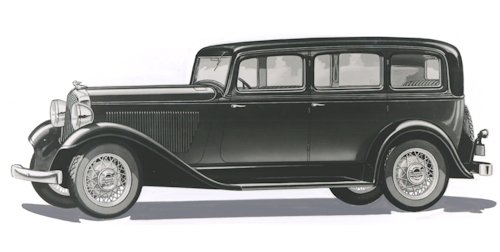
The Plymouth Deluxe PD was a large car that Chrysler produced under the Plymouth brand in the model year 1933.
History
This year, Plymouth offered its first six-cylinder car, the standard (model PC). Together with the more luxurious equipped model PD (Deluxe) it replaced the New Finer Plymouth of the previous year with only 4 cylinders. It was developed from the Dodge model DP, on whose chassis with longer 2844 mm wheelbase.
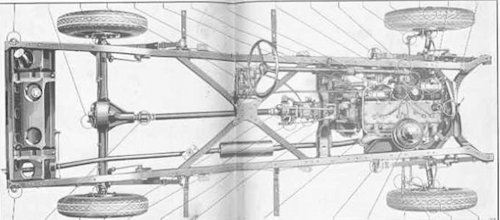
In addition to a 4-door sedan and various 2-door models were available. There was also a chassis with no bodywork for customers who wanted to get a "custom" bodywork construction.
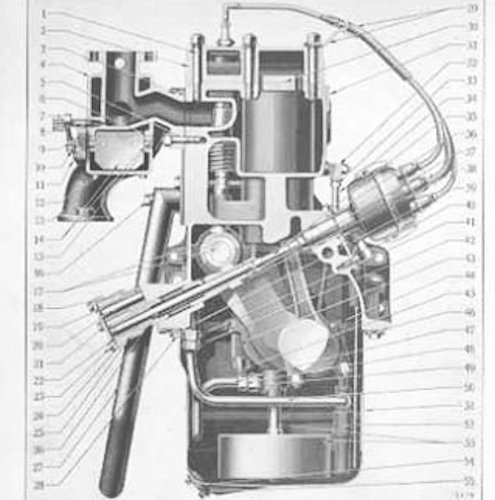
The new cars were powered by a six-cylinder in-line engine with side valves and 3110 cc capacity, which made 70 bhp (51 kW) at 3600 / min. Through a single-disc dry clutch and a 3-speed gearbox with middle circuit, the engine power was forwarded to the rear wheels. All four wheels, which were hydraulically braked.
Plymouth Deluxe PJ, P2, P4 and P6
 |
|
|
Production period: |
1935 to 1939 |
|
Body versions: |
Saloon, Pullman sedan, station wagon, coupé, convertible |
|
Engines: |
Gasoline engine: |
|
Length: |
4684-5440 mm |
|
Wheelbase: |
2845-3353 mm |
|
Curb weight: |
1216-1490 kg |
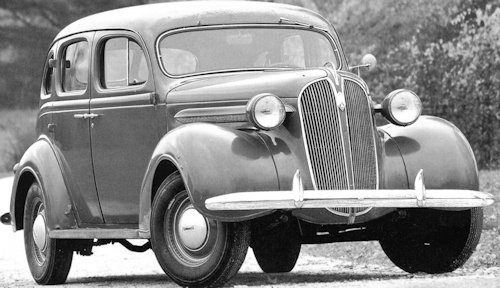
The Plymouth Deluxe Models PJ, P2, P4 and P6 produced under the Plymouth brand in the model years 1935-1939.
History
The model PJ - a model name for all equipment lines this year - was completely redesigned. The wheelbase of the new X-frame was uniformly 2870 mm. The bodies were rounder and there were now also limousines with separate trunk, called "touring limousines". The doors were now hinged in front rather than behind. The performance of the 3.3-liter engine increased to 82 bhp (60 kW).
1936 appeared the Deluxe, model P2. The car was again redesigned - chassis and sheet thicknesses differed fundamentally - but looked similar to the model PJ of the previous year. So, the customers felt this only as a facelift.
The 1937 model P4 had a 1 "smaller wheelbase (2845 mm), but the bodies were longer than last year. The radiator grille was a bit more rounded and looked with his centre bar not dissimilar to the contemporary BMW models.
1938 appeared the model P6, whose fenders were pulled even further forward. Overall, the vehicles made a squat impression, which did not go down well with the audience. Just in this jubilee year (10 years Plymouth) broke the sales figures, although the new model now safety glass around and in the dashboard for security reasons countersunk switch offered.
Plymouth Barracuda First generation
 |
|
|
Production |
1964 to 1966 |
|
Designer |
Elwood Engle |
|
Class |
Sports car |
|
Body style |
2-door fastback coupe |
|
Platform |
A-body |
|
Drive |
Rear wheel |
|
Related |
Plymouth Valiant |
|
Engine |
|
|
Wheelbase |
106 in (2,692 mm) |
|
Length |
188 in (4,775 mm) |
|
Width |
70 in (1,778 mm) |
|
Height |
52.5 in (1,334 mm) |
|
Curb weight |
3,100 lb (1,406 kg) |
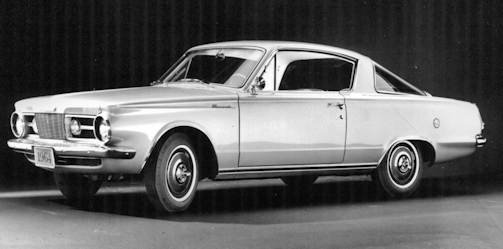
The Plymouth Barracuda 1st generation is a two-door car that was manufactured by Plymouth in the 1960s.
History
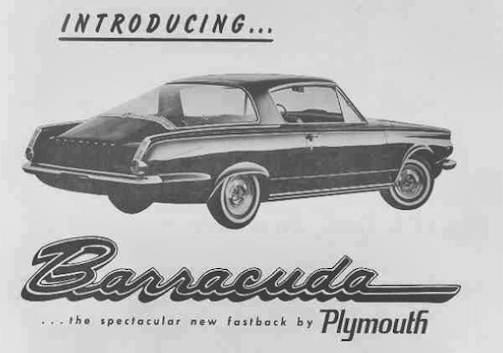
All automakers in the US brought sports compact cars on the market in the early to mid-1960s. Chrysler chose as the basis for the model Plymouth Valiant. The Ford Mustang, which eventually sold significantly better than the Barracuda, made the designation of this vehicle class as a " pony car ", but the Plymouth Barracuda Fastback appeared two weeks earlier, on April 1, 1964. The management of Plymouth actually wanted the car Call "Panda" what the designer did not like. Finally, John Samsen prevailed with his proposal "Barracuda".
The Barracuda had the wheelbase of the Valiant Chrysler A-body with 2,692 mm, the hood, the frames of the headlights, the windshield, the front triangular windows, the fenders and the bumpers; all other sheet metal parts and windows were new. This approach reduced the cost of development, tools, and development time for the new model.
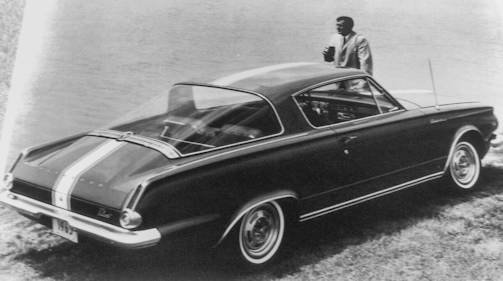
The hatchback was designed with a 1.3 m² panoramic rear window, which was pulled up to the B-pillar. This largest window to date used in passenger car series production was manufactured by Pittsburgh Plate Glass (PPG). In model year 1965, the fenders and taillights of the 1964 Barracuda for the Valiant were taken (except for the station wagon, which got its own taillights).
The fastback styling is accentuated by the Largest rear window. 14. 4 square feet, ever installed in a production automobile. The window is of tinted glass. With the rear seat-back folded forward, there is ample cargo space for luggage, picnic baskets, even water skis. Cargo may be easily loaded through the opened deck lid. in addition, the Plymouth Barracuda has a security panel which creates the concealed locked storage compartment. It can be released to fold flat from inside the trunk.
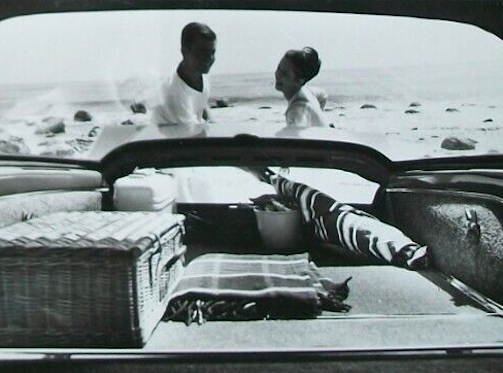
The mechanics corresponded to those of the Valiant parts and bodywork except for the distinctive wraparound rear glass with a chrome band across the rear window base, including two versions of the Chrysler Slant-6 engine, a 2.8-liter engine with 75 kW in the basic configuration and an optionally available 3.7-liter with 108 kW.
- Performance: 225 cu in
- Torque (SAE): 215'b ft. 29.1 m at 2,400rpm
- Max engine rev: 4.600
- Specific power: 39.3 hp/l
- Power-weight ratio: 19.2 lb/hp. 8.7 kg/hp:
A brand new 4.5-liter Chrysler LA-V8 with 134 kW and a twin carburettor was the largest engine for 1964; the performance was initially quite low.
The base price for the Barracuda was $ 2,512, the Barracuda debuted in fastback form on April 1, 1964 this was not only the first year for the Barracuda, but also the last year when the Torque flite push-button automatic was offered; Thus, the VV1-P 1964 Barracuda was the only one with this equipment. The 1964 Barracuda sales totalled 23,443 units Standard equipment included bucket front seats; bucket shaped rear bench seat with folding back rest.
In model year 1965, the 3.7-liter engine became the base engine for the US; in Canada, this remained the 2.8-liter. As the competition in the "pony-car" segment tightened, there were new optional extras: a Commando version of the 4.5-liter engine with quad carburettor, a compression ratio of 10.5: 1, a sharper camshaft and other improvements introduced, which made 175 kW. In addition, there was the Formula-S package, which included except the Commando V8 a reinforced suspension, larger wheels and tires, special emblems and a tachometer. Disc brakes and factory air conditioning were introduced at the beginning of the model year.
In 1966, The 1966 Barracuda was redesigned towards the front and largely unchanged at the rear with new taillights, a new front and a new dashboard. The latter provided space for oil pressure gauge and tachometer. The front of the vehicle, with the exception of the radiator grille, shared the 1966 Barracuda with the Valiant of the same year, giving the front fenders a more angular shape. The deluxe models also had flasher-mounted indicator lights in the fins a vinyl top was a new option. The bumpers were larger and the grille had a solid grid. For the first time there was a centre console on request. The 225 cubic inch 145 horsepower Slant SIX was standard in the BVI-P Series Barracuda.
Although the first Barracudas looked very similar to the contemporary Valiant, they wanted Plymouth to be understood as a separate model series. So, they gave the "Valiant" lettering, which still appeared on the trunk lid of the 1964 models, 1965 on. In 1966, the cars were equipped with a Barracuda-specific, stylized fish logo, only in export markets such as Canada and South Africa, where Valiant was marketed as a separate car brand, remained the name Valiant Barracuda until the A-Barracuda was set in 1969.
The Barracuda also influenced the design of other Chrysler vehicles. Across the Atlantic, the Chrysler company in the UK, the former Roots Group, developed the Hill beam Hunter- based Sunbeam Rapier hatchback coupe in 1967, which showed striking parallels with the 1964-1966 Barracuda, though styling-responsible design Director of Roots, denied any direct connection.
Plymouth Fury 2nd generation
 |
|
|
Model years |
1960 to 1961 |
|
Body style |
4-door sedan |
|
Class |
Luxury car |
|
Engine |
225 cu in (3.69 L) slant-6 |
|
Transmission |
2-speed PowerFlite automatic |
|
Wheelbase |
118 in (2,997 mm) |
|
Length |
209.5 in (5,321 mm) |
|
Width |
80 in (2,032 mm) |
|
Height |
54.6 in (1,387 mm) |
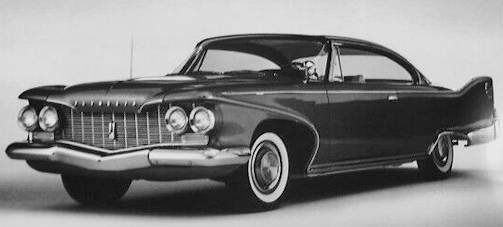
The Plymouth Fury from the 1960s in the second generation, was built from 1960 to 1961
History
The Fury was still the top model of the brand and the most expensive version of the full-size models of Plymouth, which also included the Plymouth Savoy and the Belvedere. The three top-of-the-range series, like all full-size models of the Chrysler Group, were given a self-supporting unibody construction in 1960, which had been redesigned to support a subframe.As in previous years, there was once again different lengths wheelbases, with the models of Plymouth uniform (mm 2997; 118 inches) the shortest wheelbase used.
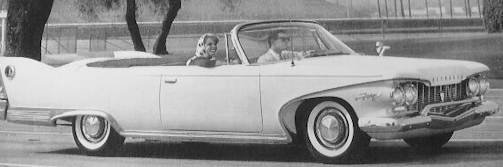
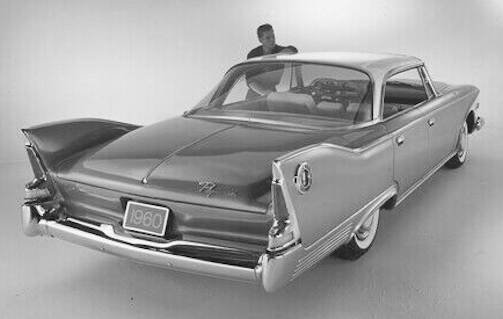
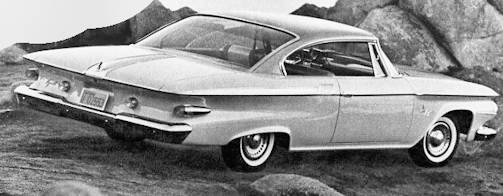
The body design of the 1960s vintage was redesigned, but followed in the roofline still the forward look of Virgil Exner. The front end of the Plymouth was independent. The Fury had twin headlights, which were covered by an extension of the fenders. From there, a sweeping bead passed into the car's flanks, which also included the front wheel cut-out. At the rear end, there were again high tail fins whose design housings are chrome plated corresponded to that of the previous year. Tailfins were removed for the 1961 model year. The design of the 1960s Fury vintage is considered unsuccessful.
The Plymouth Fury with its ability to carry six or seven people and a huge volume of luggage. There is no lack of all-round vision, however, and in wet weather variable-speed electrical wipers do a fine job of keeping the wind-screen clean.
The front compartment front seat is a one-piece bench Upholstered fabric woven from man-made fibres added upgraded upholstery full-length beltline trim;
Fury signatures behind the front wheel openings the seats with the inevitable limitations of its kind no lateral support can be provided, and the passenger must accept the driver's dictates concerning legroom but it is genuinely comfortable. Makes three people quite comfortable in spite of a high and broad hump over the gearbox and the rear compartment, which suffers much less from intrusion by the transmission cover A rear-seat passenger enjoys ample headroom and knee-room, can accommodate four people without much feeling of discomfort. The Plymouths was handling extremely stabile at all speeds.
A small glove box useless for stowing maps or anything else No pockets or other stowage or oddments are provided inside the still roomy body. Speedometer Instruments are simple, comprising uncalibrated indicators for fuel level and for engine heat, and a strip-type speedometer The heating and de-misting as standard equipment is powerful. Also fitted as standard is a push-button radio, and there is a separate speaker. extras such as backup lights and an electric clock.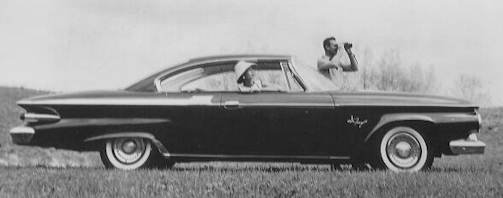
An automatic transmission which is Known as the Torque-flite and incorporating a torque converter as well as three automatic gears, this Chrysler two- pedal transmission is one of the very best of its kind. From a row of five buttons (which are illuminated internally at night) the driver must press the Neutral one before starting the engine and will then normally press either Drive (forward) or Reverse button as required. Two other buttons serve merely to make extra engine braking available in 2nd or 1st ratios down steep hills, or to engage first gear for push-starting a car with a flat battery. when maximum acceleration is needed, and can be obtained by kick-down pressure on the accelerator pedal at 25 m.p.h. up to in excess of 105 m.p.h. with- out a trace of wheelspin
After just one year, the body in the front and rear area was redesigned. For model year 1961 disappeared the curved bead in the front fenders and the tail fins. The waistline of the car was now almost horizontal. The taillights were in free-standing tubes in the car flanks.
The Fury was offered in 1960 and 1961 respectively as a convertible, as a four-door sedan with fixed B-pillar and as a two- and four-door hardtop without B-pillar. The range of body versions was thus wider than that of the Savoy and the Belvedere.
The engine output changed from 1959. The standard engine in both years was a 3687 cc (225 cubic inch) version of the newly designed six-cylinder (Slant Six) with 145 SAE-PS. Optionally the first year for Chrysler's ram induction system, 1960 were two eight-cylinder V-engines with 5.2 and 5.9 litres displacement available, 1961 there was also a 6.3-liter V8 engine The 383 was rated at 330 hp (250 kW).
Of the three luxury-class series of the brand Plymouth sold the Fury, which was also the most expensive line, the worst. In the model year 1960 created about 54200 vehicles (more than 23000 less than the Savoy), in the model year 1961 there were only 38000 furies. The Polara, the sister model of the Dodge brand, however, was sold in both years even less often: in 1960 there were about 16,000 Polaras, 1961 only 14,000.
Plymouth Deluxe Models P10, P11, P11D and P12 (1940-1941)
 |
|
|
Manufacturer |
Plymouth |
|
Production period: |
1940 to 1941 |
|
Type: |
Motor car |
|
Body versions : |
Various |
|
Engines: |
Gasoline:3.3 liters |
The Plymouth Deluxe was a large car that Chrysler produced under the Plymouth brand in the model years 1933-1942 and 1946-50. this replaced the New Finer Plymouth From 1941, an even better equipped Plymouth Special Deluxe was offered. there was finally the urgently needed new body, which had received the other brands in the Chrysler Group in the previous year.
Plymouth Deluxe History 1940 to 1941
The wheelbase of the model P10 was now 2972 mm. As the engine moved forward and the rear axle rearward, the passenger compartment increased significantly in volume. All models have now been equipped with heating or ventilation. Despite the completely new bodies, the cars did not look like the previous year's models; only the radiator grille received chrome stripes. The power of the two engines increased to 84 bhp (62 kW) and 87 bhp (64 kW).
The 1941 models looked quite similar to the previous year's models, but came up with significant changes: The split, in the middle of battered hood of the previous year made a battered "Alligator hood" place. The engines mounted below now produced 87 bhp (64 kW) and 92 bhp (68 kW) respectively.
In addition to the normal Deluxe models P11 and P11D, the even better equipped Special Deluxe models P12 were offered. They had two-tone paint and the "Woody" combo could be ordered according to customer requirements in two different shades of wood (the wood came in any case from the ash ). Cabriolet and station wagon were only available as a Special Deluxe.
General Specification
- Body versions :Saloon , Pullman sedan , station wagon , coupé , convertible
- Engines: Gasoline:3.3 liters
- Power: 62-68 kW
- Length: 4940 to 5609 mm
- Wheelbase:2972 to 3493 mm
- Curb weight: 1266 to 1536 kg


