
Panther
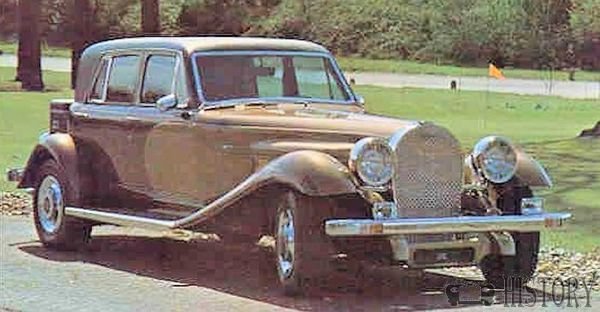
Panther De Ville
 |
|
|
Manufacturer |
Panther Westwinds Ltd |
|
Class |
Luxury Car |
|
Production |
1974 to 1985 |
|
Produced |
60 |
|
Assembly |
Weybridge, England UK |
|
Body style |
4-door saloon, 2-door coupé,2-door convertible, 6-door limousine |
|
Layout |
FR layout |
|
Engines |
(Jaguar) 4.2 L XK6 ,5.3 L V12 |
|
Transmission |
3-speed Borg-Warner 12J automatic and later 4-speed automatic |
|
Wheelbase |
142.0 in (3,607 mm) |
|
Length |
204.0 in (5,182 mm) |
|
Width |
71.0 in (1,803 mm) |
|
Height |
61.0 in (1,549 mm) |
|
Curb weight |
4,360 1b, 1,977 kg |
|
Designer |
Robert Jankel |
The Panther De Ville is an Luxury automobile by British car manufacturer Panther Westwinds, which was produced in small numbers by hand from 1974 to 1985.
History
The neo-classic style is based on the design of the 1930s. Robert Jankel, the owner of Panther Westwinds, was clearly inspired by the Bugatti T41 "Royale". However, the Deville is not an accurate copy of the original, but represents a very free interpretation of this version with aluminium coach built body on ladder tube chassis.
The De ville rests on a ladder tube chassis that Panther developed specifically for this larger vehicle. The drive technology comes largely from Jaguar; this applies to the engine as well as to the automatic transmission and other components. Both the 4.2-litre six-cylinder and the 5.3-litre twelve-cylinder with octane rating of 97RM carburettors: 4 Stromberg with 2 S.U. electric reciprocating fuel pump and AUF406 and oil filter: Tecalemit full flowfrom Jaguar were available; the six-cylinder, however, was far more widespread. The use of Jaguar engineering necessitated a prominent bulge on the right-hand side of the bonnet, which was detrimental to appearance but unavoidable in terms of engine placement.
Most De Ville models were produced as four-door sedans. The saloon/sedan had 4 doors 4 seats, separate front seats, reclining backrests with built-in headrests, leather upholstery, felt head lining; deep pile carpet floor covering,tinted glass, electrically-heated rear window electrically-controlled windows, air-conditioning. and optional electrically-controlled sunshine roof. water valve type with thermostatic control interior heater inertia reel safety belt
Triplex laminated windscreen; Flihtkote underseal underbody protection; Frigiking air conditioning screw cantilever type jack; 4 jacking points.
There were also individual specimens that were built as a two-door coupe and as a cabriolet. The passenger compartment of the four-door sedan was taken over by the Austin 1800 "Landcrab" this can be seen in the wide doors that were characteristic of this model (and some other derivatives). On the other hand, the doors of the coupé came from the Jaguar XJC with also Jaguar suspension with independent, wishbones coil springs, anti-roll bar, telescopic dampers and at the rear independent, wishbones (trailing links), 4 coil springs transverse linkage bar, 4 telescopic dampers.The power steering and early cars had the Borg-Warner 12J automatic transmission the final drive a Salisbury hypoid bevel with Powr-Lok limited slip differential and 3.31:1.Also fitted with 6" wide Avon safety wheel, 6JK in. wide steel 15" rims with Avon SP sport/radial ply tubeless tyres: 235/70 VRx 15 and Girling dual circuit discs all round, ventilated at front with Girling supervac 100 servo.
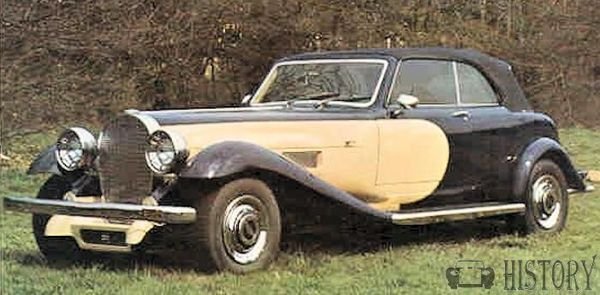
A total of 60 Deville’s was built between 1974 and 1985, 46 as sedans and 11 as convertibles. One example was produced in 1984 as a stretched six-door sedan; The customer was a prince from Malaysia A Stretched De Ville The De Ville commissioned by Prince Sualman of Malaysia and finished in his colours is the last to be built and the largest 3 ft longer than the original. Of Its 6 doors. 4 give access to the finely-trimmed rear compartment with TV-video drinks cabinet and caw-conditioning controls The bonnet opens Vintage-style to reveal a 6-cylinder Jaguar XK engine and reflects the 18 ct gold eagle perching on its front. At the time the car was Britain's most expensive listed production Interiors often featured a TV and found celebrity owners such as singer Elton John and actor Oliver Reed fitted with the inevitable drinks bar.
PERFORMANCE
- V12
max speed: 128 mph, 206 km/h
max power (DIN): 253 hp at 6,000 rpm
max torque (DIN): 302 1b ft, 41.7 kg m at 3,500 rpm
max engine rpm: 6,500; 47.3 hp/l
power-weight ratio: 17.2 lb/hp, 7.8 kg/hp - 6 cylinders
max power (DIN) 190 hp at 5,000 rpm
max torque (DIN) 200 1b ft, 27.6 kg m at 2,000 rpm
The Panther De Ville in film
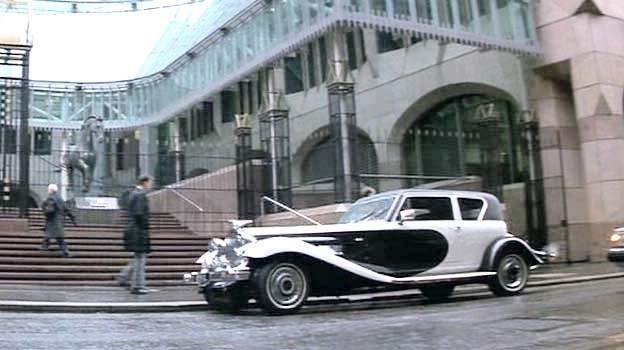
In the (live-action) Disney's 1996 film 101 Dalmatians, Glenn Close as Cruella de Vil drove a two-door, black-and-white Panther De Ville convertible The engine in the car was replaced with a small-block Chevrolet V8 for a louder sound for the film.
In the 1979 British feature film The Golden Lady, private agent Julia Hemmingway, played by Christina World, drives a dark blue Panther De Ville.
Panther 6 six wheel car history
 |
|
|
Manufacturer |
Panther Westwind’s Ltd |
|
Production |
1977 to 1978 |
|
Produced |
2 |
|
Assembly |
Weybridge, England |
|
Body style |
2-door convertible |
|
Layout |
RMR layout |
|
Engine |
V8 8.2L Cadillac |
|
Transmission |
3-speed automatic |
|
Wheelbase |
105.0 in (2,667 mm) |
|
Length |
192.0 in (4,877 mm) |
|
Width |
80.0 in (2,032 mm) |
|
Height |
48.0 in (1,219 mm) |
|
Curb weight |
2,870 lb (1,302 kg) |
|
Designer |
Robert Jankel |
The Panther 6 was an unusual road sports car produced by the British car manufacturer Panther from the 1970s.
History
The Panther 6 was primarily designed and built to draw public attention to the company. It was largely self-constructed in 1976 by Robert Jankel, the company's owner. its most striking feature that had six wheels with cabriolet body type and only a three-seater. Other eye-catching design features were a body-coloured front bumper with wide embedded lighting units. The main headlights could be folded out. Features included a detachable hard top and convertible soft top, hi tech electronic instruments, air conditioning, electric seats and windows and even an automatic fire extinguisher, The car had a large panoramic window and sunken wipers. Inside, two telephones were installed in the doors, and there was a television set in the dashboard.
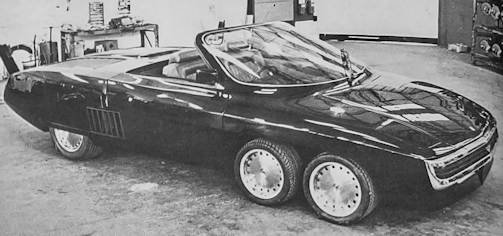
The Panther 6 was presented to the public at the 1977 London Motor Show in Earls Court and it unique looks caused a great stir there. A total of only two examples of the Panther 6 were built within eight years. Both were painted differently over the years.
The first vehicle was a right-hand drive, painted black. It had a single bench seat with three seats and featured a column shifter. The vehicle took up the design concept of the Tyrrell P34, which caused quite a stir in the Formula 1 World Championship from 1976, and implemented it in the field of road vehicles.
The second vehicle was left-hand drive with two individual seats and a centre shift. Panther began building the second car in 1978; However, the company soon ran into financial difficulties and was initially unable to complete the car. The second 6 was not completed until Panther was already in receivership. It primarily served to develop additional funds for the company through the sale of the car. The car was sold in 1985 for £150,000 later painted white and black.
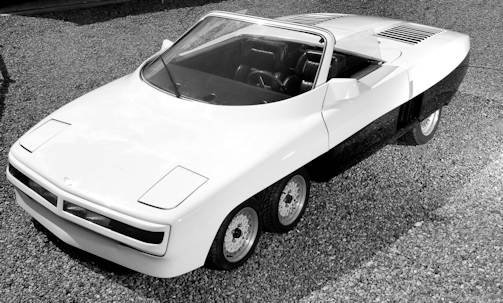
The car had two steered front axles with four small 205/40 VR13 tires and one rear axle with two significantly larger tires. The front suspension was independent with wishbones and coil springs fitted with anti-roll bar and telescopic dampers at the rear also independent, wishbones, coil springs, anti-roll bar and telescopic dampers.
The wheelbase from the second front axle to the rear axle is 2667. The vehicle is 4877 mm long, 2032 mm wide and 1219 mm high. The curb weight is given as 1302 kg.
The vehicle was powered by an 8.2-litre, twin-turbocharged with 2 Airesearch T04 turbochargers to a Holley downdraught carb the eight-cylinder engine sourced from Cadillac mid-mounted above the rear axle. The factory specified the power of the engine as 600 hp; the top speed should be 200 miles per hour (about 320 km/h). A General Motors three-speed automatic transmission served as power transmission gearbox Turbo-Hydramatic 425 automatic with hydraulic torque converter and 3 ratios with possible manual selection.
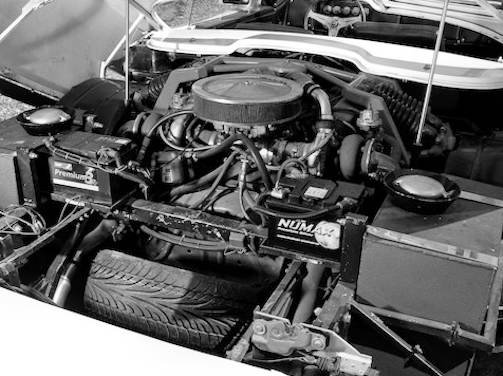
Claims for the top speed of this vehicle suggested it was capable of over 200 mph (322 km/h); however, these claims are so far unsubstantiated.
It is doubtful whether series production was planned. A major problem along the way was the small front tires that Pirelli had made exclusively for this vehicle and which would have been very expensive to produce.

