
Panhard
Panhard & Levassor DS
 |
|
|
Make |
Panhard & Levassor |
|
Production |
1929 to 1937 |
|
Class |
Motor car |
|
Type |
Luxury |
|
Fuel |
Petrol engine |
|
Engine |
6-8 cylinder |
|
Engine position |
front |
|
Body |
four-door sedan |
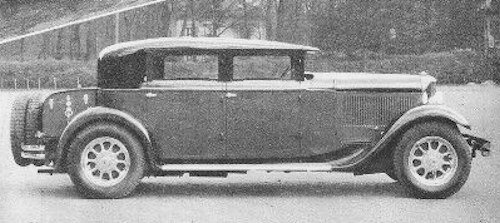
The Panhard & Levassor DS is a four-door luxury sedan launched by the French car manufacturer Panhard & Levassor in 1929. The letter S stands for the French word "surbaissé", which refers to a frame that is lowered between the axles in order to achieve a lower vehicle height (low frame).
The initially manufactured model 6 DS had a slide-controlled 6-cylinder in-line engine with 3507 cc, corresponding to 19 CV. There was a classic, 6-seater sedan with a long interior without a luggage compartment (see photo above left) and a 4-seater sedan with a shorter interior and rear luggage compartment (Berline, see photo above right), and various coupe and convertible versions , In 1929 only 4 copies were produced. Until the replacement of this model in 1932 there were a total of 509 pieces.
Parallel to this first model, there was a 1929 prototype 8 DS with the more powerful 8-cylinder inline engine of the previous model 35 CV. This had 6350 cc capacity. The following year ran the series production of the 6-seater sedan with a slightly smaller engine of 5084 cc displacement (29 CV). From 1935 the car was called simply 8 cylindres . From both versions of this top model until 1938 only a total of 43 pieces were made.
In 1932, the 6 DS was replaced by the 6 DS RL , whose engine had 4080 cc displacement (23 CV). RL stands for "roue libre" . The 6-seat long version was launched as 6 DS RL2 . In 1932, only a prototype with the designation 6 DS 23 CV was manufactured, only in the following year began mass production. From 1935 the car was called simply DS . Like its predecessor, it brought it to the setting of the model 1938 to 509 copies.
In 1934, the bodies were reworked: The "Panoramique" versions announced as a major improvement had three-part windshields, which in addition to the now narrower main disk had two small disks in the area of the A-pillars. At the same time, these vehicles had a further enlarged engine with 4783 cc displacement (27 CV). The cars were sold as 6 DS RL-N Spécial . From 1935 they were called simply DS Spécial and were built 142 times until 1937.
Also in 1934 was a DS à Gazogène . In this prototype, a gas generator already known from commercial vehicle construction was added to a 4-seater sedan . The wood gas was processed in an engine from the smaller model 6 CS with 2861 cc displacement (16 CV). In 1936, four more copies were made in the same pattern. This DS Gazogène 19 CV had the engine of the model DS Spécial with 4783 cc (contrary to the designation 27 CV).
From 1937 the Panhard & Levassor Dynamic 160 replaced the DS series.
Panhard M3 Armored personnel carrier
| Panhard M3 from 1971 to 1986 | |
|---|---|
 |
|
| Type | Armored personnel carrier |
| Place of origin | France |
| Production history | |
| Designed | 1969 |
| Manufacturer | Panhard |
| Produced | 1971–1986 |
| No. built | 1200 |
| Specifications | |
| Weight | 6,100 kilograms (13,400 lb) |
| Length | 445 centimetres (175 in) |
| Width | 240 centimetres (94 in) |
| Height | 248 centimetres (98 in) |
| Crew | 2 |
| Passengers | 10 |
| Armor | 8-12 millimetres |
| Engine | Panhard 4 HD 90 horsepower |
| Power/weight | 14.75 hp/t |
| Payload capacity | 1,360 kilograms (3,000 lb) |
| Ground clearance | 35 centimetres (14 in) |
| Fuel capacity | 165 litres (44 US gal) |
|
Operational
range |
600 kilometres (370 mi) |
| Speed | 90 kilometres per hour (56 mph) |
The Panhard M3 VTT (French: Véhicule de Transport de Troupes), armoured personnel carrier was designed as a private venture with the first prototype completed in 1969. The prototype had a single door in each side of the hull and twin doors in the hull rear. Mounted on the top of the hull was a Giat Industries one-person manually operated turret armed with a 7.5 mm AA-52 machine gun.
The first production vehicle, had a redesigned hull incorporating three hatches on either side of the troop compartment, and was completed in 1971. The Panhard M3 armoured personnel carrier shares 95% of its working parts with the Panhard AML armoured car, encouraging many countries to employ both the M3 and the AML in order to reduce operational costs.
The M3 VTT was subsequently replaced in production by the Panhard VCR. It remains one of the most common Western-built wheeled armoured personnel carriers in the world.
Description
The hull of the Panhard M3 is made of all-welded steel armour. The driver is seated at the front of the vehicle and has a single-piece hatch cover that opens to the right and in which there are three day periscopes. The centre one can be replaced by an image intensification periscope for night driving. The Panhard 4 HD engine is behind the driver.
The suspension at each wheel station consists of coil springs and hydropneumatic shock-absorbers acting on the suspension arms of the wheel mechanism. The tyres have puncture-proof Hutchinson inner tubes.
There are four doors in the M3, one in each side of the hull and two in the rear. The rear doors both have a circular firing port. Along the upper part of each side of the hull are three hatches hinged at the top that can be locked open. The Panhard M3 can carry 10 troops in addition to its crew of two, or it can carry 1,360 kg of cargo.
There are two circular hatches in the roof, one behind the engine compartment and a second one at the rear with a single-piece hatch cover. A wide range of armament installations could be mounted on the forward position; typically these are a 7.62 mm or a 12.7 mm machine gun, but some users have fitted a turret-mounted 20 mm cannon.
The basic M3 is fully amphibious without preparation. It is propelled in the water by its wheels at a speed of 4 km/h, but it can operate only in lakes and rivers. Steering, when afloat, is by turning the front wheels as on land. Optional equipment includes an air conditioning system and smoke grenade dischargers.
Upgrades
Saymar M3 APC
The Israeli company of Saymar have completed development and testing of a new automotive upgrade package for the Panhard M3. Saymar have replaced the old petrol engine with a more fuel-efficient Toyota 2L-T diesel engine developing 102 hp. Other sub-systems upgraded include the manual transmission, new engine cooling system, new and improved electrical system, new disc braking system all round, hydraulic powered steering, new turret electrical system, communications and intercom system. All new electrical components include more reliable electrical wire bundles, electric voltage regulator, 24 V 65 A generator, 24 V starter, new drivers panel and new instrumental panel. This upgrade can be carried out in the user's own facilities with the aid of kits provided by Saymar or the company could carry out the work in its own facilities. This upgrade package could also be combined with a general overhaul of the vehicle to bring it up to an almost new build standard.
Irish army upgrade
In 1983 Irish army tested a M3 fitted with a 140 hp Peugeot V6 petrol engine. The test was successful, and 14 Irish Panhard M3s were rebuilt with the new engine as well as a new Citroën braking system, a 6-speed manual gearbox and new electrics.
Armament
- TL.2.1.80 turret with twin 7.62 mm FN MAG machine guns.
- TL.52.3.S turret with one 7.62 mm machine gun and three LRAC F1 anti-tank rocket launcher.
- TL.52.S turret with one 7.62 mm machine gun and one LRAC F1 anti-tank rocket launcher.
- CB.127 ring mount for 12.7 mm M2 Browning machine gun.
- STB ring mount where hatch opens forward to form a shield with one 7.62 mm machine gun.
- CB.20 M621 ring mount with 20 mm autocannon.
- HOT: Equipped with four HOT long-range anti-tank missile.
- MAS T 20.13.621 turret with AME 20 mm autocannon.
Combat history
Middle East
At least 60 M3 VTTs were delivered to the Lebanese Army in 1970-73 and saw considerable action during the Lebanese Civil War (1975–1990), with some being loaned to the Internal Security Forces (ISF) in 1976. Following the collapse of the Lebanese Armed Forces (LAF) in January that year, a significant number of these vehicles fell into the hands of the competing militias, notably the Lebanese Arab Army (LAA), the Army of Free Lebanon (AFL) Al-Mourabitoun, Kataeb Regulatory Forces (KRF), and the Tigers Militia.A few M3 VTTs were again captured by the Lebanese Forces (LF) militia from the Lebanese Army during the Elimination War in 1988-90, and remained in service with the LF Military Police corps until the end of the Civil War in October 1990.
Panhard 178
| Panhard 178 1937 to 1964 | |
 |
|
|
Type |
Armoured car |
|
Place of origin |
France |
|
In service |
April 1937–1964 |
|
Used by |
France |
|
Wars |
World War II |
|
Designer |
Panhard |
|
Designed |
1933–1937 |
|
Manufacturer |
Panhard |
|
Produced |
February 1937 — ~October 1940 |
|
No. built |
729 "A" versions, 414 B version |
|
Variants |
Panhard 178B |
|
Specifications |
|
|
Weight |
8.2 metric tonnes |
|
Length |
4.79 m with gun |
|
Width |
2.01 m |
|
Height |
2.31 m |
|
Crew |
4 |
|
Armor |
20 mm |
|
Main |
25 mm SA 35 cannon |
|
Secondary |
7.5 mm Reibel machine gun |
|
Engine |
Panhard SK |
|
Suspension |
leaf spring |
|
Ground clearance |
0.35 m |
|
Operational |
300 km |
|
Speed |
72 km/h |
The rear of the same vehicle, showing the position of the second driver; the hull, despite having been repainted with a number belonging to the third production batch, is in fact that of a Panhard 178B. The APX3B turret is of the latest type with a rear episcope
The Panhard 178 (officially designated as Automitrailleuse de Découverte Panhard modèle 1935, 178 being the internal project number at Panhard) or "Pan-Pan" was an advanced French reconnaissance 4x4 armoured car that was designed for the French Army Cavalry units before World War II. It had a crew of four and was equipped with an effective 25 mm main armament and a 7.5 mm coaxial machine gun.
A number of these vehicles were in 1940 taken over by the Germans after the Fall of France and employed as the Panzerspähwagen P204 (f); for some months after the armistice of June production continued for the benefit of Germany. After the war a derived version, the Panhard 178B, was again taken into production by France.
Development
In December 1931, the French Cavalry conceived a plan for the future production of armoured fighting vehicles. One of the classes foreseen was that of an Automitrailleuse de Découverte or AMD, a specialised long range reconnaissance vehicle. The specifications were formulated on 22 December 1931, changed on 18 November 1932 and approved on 9 December 1932. They called for a weight of 4 metric tons (4.0 t), a range of 400 kilometres (250 mi), a speed of 70 km/h, a cruising speed of 40 km/h, a turning circle of 12 metres (39 ft), 5–8 mm armour, a 20 mm gun and a 7.5 mm machine gun.
In 1933, one of the competing companies — the others being Renault, Berliet and Latil — that had put forward proposals, Panhard, was allowed to build a prototype. The other companies also were ordered to build prototypes: Renault constructed two vehicles of a Renault VZ, including an armoured personnel carrier variant, Berliet constructed a single Berliet VUB and Latil belatedly presented a design in April 1934. The Panhard vehicle was ready in October 1933 and presented to the Commission de Vincennes in January 1934 under the name Panhard voiture spéciale type 178. It carried a Vincennes workshop (Avis) 13.2 mm machine gun turret, as the intended one was not ready yet. After testing between 9 January and 2 February 1934 the type, despite having larger dimensions than prescribed and thus being a lot heavier than four tons, was accepted by the commission on 15 February under the condition some small modifications were carried out. Of all the competing projects it was considered the best: the Berliet VUB e.g. was reliable but too heavy and traditional; the Latil version had no all-terrain capacity. In the autumn the improved prototype, now lacking the bottom tracks of the original type, was tested by the Cavalry. In late 1934 the type was accepted under the name AMD Panhard Modèle 1935. The type was now fitted with the APX3B turret.
After complaints about reliability, such as cracking gun sights, and overheating, between 29 June and 2 December 1937 a new test programme took place, resulting in many modifications, including the fitting of a silencer and a ventilator on the turret. The ultimate design was very advanced for its day and still appeared modern in the 1970s. It was the first 4x4 armoured car mass-produced for a major country.
Production
The final assembly and painting of the armoured cars took place in the Panhard & Levassor factory at the Avenue d'Ivry in the 13th arrondissement of Paris. There however, only the automotive parts and lesser fittings were built in: the armoured hull was in its entirety prefabricated by forges serving as subcontractors. At first the main supplying company was Batignolles-Châtillon at Nantes, that could supply a maximum of about twenty per month; in 1940 the forge at Firminy became dominant. Likewise the turret, fitted with its armament by the Atelier de construction de Rueil (ARL) was as such again made by subcontractors, mainly the Société française de constructions mécaniques (or "Cail") at Denain.Production of the turrets tended to trail behind that of the hulls; on 1 September 1939 this order backlog had grown to 35; that there was little hope of solving this problem is shown by the production planned on 28 October 1939 for the spring of 1940: fifty hulls as against forty turrets per month.
At the time of acceptance in 1934, already fifteen had been decided to be ordered on 25 April 1934 and fifteen more on 20 May at a price of ₣ 275,000 per hull, more expensive than a French light infantry tank of the period. The actual orders were made on 1 January and 29 April 1935 respectively, and the notification sent on 27 May, with a planned delivery between January and March 1936. Due to strikes, the first vehicles of these orders were only delivered from 2 February 1937 onwards; nineteen had been produced by April, the last delivered in November. The two first orders together can be seen as a separate preseries of thirty, that differed slightly in many details from later produced vehicles.
A third order for eighty vehicles was made on 15 September 1935 but only notified on 11 August 1937. They were scheduled to be delivered between January and July 1938, but due to strikes and delays in the production of the turrets, the actual dates were 24 June 1938 and 10 February 1939.
There were another three orders of which deliveries started before the war: one of forty dated 11 January 1938 and delivered between 13 February and 31 July 1939; a fifth of 35 cars made on the same date but delivered between July and December 1939 (six before the war) after a sixth order for eighty vehicles made on 18 January 1938 and delivered between June and November 1939 (57 before 1 September 1939).
On 1 September 1939, 219 vehicles had been delivered including prototypes, 71 behind schedule. However, production increases soon allowed Panhard to reduce the backlog — at least for the hulls. From December vehicles were produced from two later orders: a seventh of forty, made on 18 January 1938 and completed between December 1939 and April 1940; and an eighth of eighty vehicles delivered from January until the middle of May 1940. The monthly deliveries were: nine in September 1939, eleven in October, eighteen in November, twenty-two in December, twenty-five in January 1940, eight in February, sixteen in March, thirty-four in April and a final thirty in May 1940. The total production of completed vehicles of the standard version of the AMD 35 for France was thus 339.
However, the total manufactured of all vehicles of the larger Panhard 178 family was much higher as there were several non-standard versions — and not all production was completed for France. Firstly there was a radio command variant, twelve of which had been ordered in 1937 and again in 1938, the notification of which was issued on 9 December 1938, the 24 vehicles being delivered between October and December 1939. The next variant was a colonial version, eight of which were produced. The most important addendum consisted of an order for 128 modified vehicles destined for North-Africa. Furthermore, there were two last orders of the standard version, one of twelve notified on 22 July 1939, the second for a hundred made on 27 September 1939, of which both only fourteen hulls would be made for France.
Of all these orders, at the time of the armistice in June, 491 had been completed. On 7 June 52 hulls had been in stock for which no turret was as yet available; probably until 22 June another ten hulls were made for a total production of 553: thirty in 1937, 81 in 1938, 236 in 1939 and 206 in 1940. Total hull production of all versions had been: 24 in September 1939, 26 in October, 27 in November, 33 in December, 36 in January 1940, 40 in February, 32 in March, 42 in April, 32 in May and 24 until the interruption in the middle of June. After the armistice another 176 were completed, from prefabricated parts, for the German occupier, for a total of 729.
These actual production numbers can be compared to the production plans. Before the war it had been intended that war manufacture would be thirty per month. When war really broke out, it was soon realised that the need to raise new units, the replacement of older worn out vehicles and the creation of a matériel reserve to compensate the loss of about 20% of the cars of a combat unit per month during a campaign, would necessitate a much higher production level, even when resorting to the expedient of fitting surplus hulls with older turrets. It had been planned on 10 October 1939 to bring production to forty per month in March, fifty in July, fifty-five in September and sixty from November 1940 for the duration of the war. Later projections were even more pessimistic: accordingly on top of the 657 vehicles notified at that date, on 15 April 1940 another 450 were ordered, a third of them of the radio version, bringing total orders to 1107. The desired peak rate of sixty vehicles was put forward with two months to September 1940; on 1 October 1018 vehicles had to be completed. However, the planned production was now limited to March 1941; as supreme commander Maurice Gamelin had concluded on 27 February 1940 from the events during Fall Weiss that lightly armoured vehicles could not survive on the modern battlefield, from the spring of 1941 the Panhard 178 had to be replaced on the production lines by the heavy AM 40 P armoured car, that was to be much more heavily armoured and armed.
In order to function as an effective long-range reconnaissance vehicle, the Panhard 178 had been kept as light as possible. The vehicle was thus rather small, only 4.79 m (15 ft 9 in) in length, 2.01 m (6 ft 7 in) wide and 2.31 m (7 ft 7 in) in height (1.65 m for the hull per se). Also the tapering engine compartment, where a Panhard ISK 4FII bis V4, 6332 CC, 105 hp at 2000 rpm motor had been installed, was built very low, giving the vehicle its distinctive silhouette, with a protruding fighting compartment. Both compartments were separated by a fireproof bulkhead. The use of a large turret with 26 mm frontal armour and 13 mm side armour, combined with 7 mm (bottom), 9 mm (top and glacis), 13 mm (back, sides and front superstructure) and 20 mm (nose) bolted and riveted armour plate for the hull, had compromised weight considerations however, so the vehicle still weighed 8.2 metric tonnes. However the mobility was rather good for a French AFV of the period: a maximum speed of 72.6 km/h (45.1 mph), a cruising speed of 47 km/h (29 mph) and a practical range of about 300 km (190 mi), made possible by two fuel tanks of 120 and 20 litres, the main one located at the extreme back of the hull.
Rough terrain capacity was somewhat limited however: though all four road wheels were actuated, the leaf spring suspension confined the off-road speed to 42 km/h and the possession of just four wheels allowed for a wading and a trench crossing capacity of only sixty centimetres; it could overcome a thirty cm vertical obstacle, assisted by two small bottom wheels in the front hull.
The driver was in the front, using an eight-speed gear box and a normal steering wheel. Steering could be switched into reverse immediately to allow the assistant-driver, facing the rear and seated to the left of the engine (or, from his point of view: the right), to drive the vehicle backwards in case of an emergency, using all four off-road gears, with a maximum speed of 42 km/h. This "dual drive" capacity is common for reconnaissance vehicles. The second driver had a separate entrance door at the left side of the hull. He doubled as a radio operator in the platoon commander or squadron commander vehicles, operating the short range ER29 or medium range ER26 set respectively. To make long range communications possible, one out of twelve armoured cars was a special radio vehicle.
The APX3 turret, having a large double hatch on the back, was rather large and could accommodate two men, like with the AMC 35; this was at the time exceptional for French AFVs. In the electrically traversed APX3, the commander on the right and gunner on the left benefited from a rudimentary turret basket, and sufficient vision devices including one periscope (which were of the Gundlach type on late examples) per man and PPL.RX.168 episcopes. Armament was first intended to be a newly developed 20 mm gun; when this failed to materialise it was considered to use a 37 mm Modèle 16 gun, standard for armoured cars, but this was rejected because of its poor anti-armour capacity. Instead the 25 mm SA 35 was chosen, a shortened L/47.2 derivation of the standard French antitank gun, the 25 mm Hotchkiss modèle 34. It was fitted with the L711 sight. To compensate for the shorter barrel, the rounds use heavier charges, giving even a slightly superior muzzle velocity of 950 m/s. The gun had a maximum penetration of about fifty millimetres when using a tungsten round; the light 380 gram projectile was easily deflected by sloped armour though, even a 45° angle giving about 100% extra protection over the armour thickness measured along the horizontal plane. German tanks had many vertical plates however, and were vulnerable up to about 800 metres; on the other hand the light round, even when penetrating, often failed to set fire to an enemy vehicle; it sometimes took fifteen shots to achieve this; 150 rounds of ammunition were stored.
The secondary armament was an optionally coaxial Reibel 7.5 mm machine gun, with 3,750 rounds, 1,500 of which were armour-piercing. A reserve machine gun was carried to the right of the driver that could be mounted on top of the turret for anti-aircraft defence. Its magazines were carried on the inner walls of the fighting compartment, including the large main entrance door on the right.
Experience showed that the type had several shortcomings: a weak clutch, slow turret rotation, a cramped interior, unreliable radio sets, poor cross-country drive and very noisy brakes. On the other hand, it was reliable, easy to drive on roads and the engine as such was rather silent; all desirable qualities for a reconnaissance vehicle.
During the production run several modifications would be made, such as the fitting of lifting hooks. The first thirty vehicles had two more primitive periscopes on the turret roof, a Chrétien diascope on its front and simple vision slits with armoured shutters on its sides; their drivers too had to use vision slits instead of an episcope. They also lacked a silencer and had semi-circular cut-outs at the wheel plate edges. From about the 111th vehicle (or fourth production batch) onward, several changes were introduced, including the fitting of an armoured ventilator covering on top of the turret, a factory plate with the name "Panhard" on the nose and a new softer factory camouflage pattern with the brown and bronze green spots no longer separated by black lines. From the 270th vehicle onwards stowage boxes were constructed on the back fenders, obscuring the pointed form of the engine compartment. The last turrets produced also had a backward pointing episcope for the commander, instead of a vision slit.

Operational history
The first nineteen vehicles were in April 1937 taken into service by 6e Cuirassiers.
At the outbreak of the Second World War 218 vehicles were fielded with eleven squadrons.
In the spring of 1940, 21e Escadron d'AMD 35 was first destined for Finland and the Winter War but then sent to Narvikto assist Norway during Weserübung. It was in fact the renamed 4e GRDI (that would be replaced by a new unit of the same name in its former parent 15th Mechanised Infantry Division on 5 May) and was equipped with thirteen Panhard 178s.
During the Battle of France from 10 May 1940, on which date about 370 completed vehicles were available, the Panhard 178s were allocated to reconnaissance units of the mechanised and motorised forces. At the time the Panhard 178 represented one of the best armoured cars in its class in the world.
The three armoured divisions of the Cavalry, the Divisions Légères Mécaniques, had a nominal organic strength of forty armoured cars, plus four radio vehicles and an organic matériel reserve of four vehicles. This would make for a total of 144 in these mechanised light divisions. The Light (i.e. motorised) Divisions of the Cavalry, the Divisions Légères de Cavalerie, had a squadron of twelve Panhards plus a radio car and a matériel reserve of four in their Régiment de Automitrailleuses (RAM). The total in the Cavalry Light Divisions would thus be 85.
Not only the Cavalry but the Infantry also employed the type, in the GRDIs or Groupes de Reconnaissance de Division d'Infanterie, the reconnaissance units of the Divisions d'Infanterie Mécaniques, that despite their name were largely motorised infantry divisions. These were 1er GRDI for 5e DIM, 2e GRDI for 9e DIM, 3e GRDI for 12e DIM, 4e GRDI for 15e DIM, 5e GRDI for 25e DIM, 6e GRDI for 3e DIM and 7e GRDI for 1e DIM. Their organisation was basically identical to the units of the DLCs, but the strength was sixteen, making for a total of 112 vehicles.
The actual strength of above units might differ, but if all were on strength 24 vehicles were present in the matériel reserve or used for driver training, as apart from colonial vehicles, exactly 378 exemplars had been delivered on 10 May 1940.
After the start of the invasion several emergency ad hoc units were formed; these included the 32e GRDI for the regular 43e DI, having five Panhards. The 4e DCR, the armoured division of the Infantry hastily assembled in May, got 43 Panhard 178s.
The DLMs used their Panhard units for strategic reconnaissance. In the case of 1DLM this entailed a movement well in advance of the main body of the division as it was supposed to maintain a connection with the Dutch Army during the Battle of the Netherlands. Within 32 hours the armoured cars of the group Lestoquoi covered a distance of over 200 kilometres reaching the environment of 's-Hertogenbosch in the afternoon of 11 May. After some successful skirmishes with German armoured cars belonging to the reconnaissance platoons of the German Infanterie Divisionen, they withdrew, as the Dutch were already in full retreat. They were asked by the Dutch to assist an infantry attack on the southern bridgehead of the strategic Moerdijk bridges, held by German paratroopers. As the cars were not suitable for such a task the commander hesitated after incorrectly concluding the bridgehead was strongly defended. While thus being immobile, this group of Panhards was surprised in open polder landscape by a Stuka-attack with one vehicle disabled and quickly withdrew to the south.
The other two DLMs hurried forward to stop the advance of 3 and 4PD after the surprisingly swift fall of Fort Eben-Emael, their Panhards fighting a successful delaying battle against their German counterparts until the Battle of Hannut, the largest tank battle of the campaign. In general they had little trouble in dispatching the lightly armoured German armoured cars, whose 20 mm main armament was not very effective against the Panhard frontal armour.
As the type was well-suited to German tactics, at least 190 Panhards, most of them brand-new, were issued to German reconnaissance units for use in Operation Barbarossa in 1941 under the designation of Panzerspähwagen P204 (f); 107 would be lost that year. Among these were some radio vehicles, designated Panzerspähwagen (Funk) P204 (f). Thirty Panhards were listed as in use on the Eastern Front on 31 May 1943. Some of these were fitted with spaced armour.
After the liberation of France, the 1e Groupement Mobile de Reconnaissance would, among a bewildering variety of types, also use some Panhard 178s, some of these modified.
Modified Panhards
Radio vehicles
The Panhard units were intended for deep strategic reconnaissance and thus could be expected to operate well in advance of the main forces. To fulfil their task of relaying information, long range radio connections were necessary. Therefore, one in twelve vehicles had to be of a special radio "command" version (Poste Commande) with the turret fixed in place and without armament but equipped with the ER27 set, giving a range of 80 - 150 kilometres, and two ER26ter sets with a range of sixty kilometres for communications within the squadron.
Already in both 1937 and 1938 a dozen each of the "PC vehicle" had been ordered, the number of 24 being notified on 9 December 1938. The first was planned to be delivered in February, but only materialised in October 1939, followed by seventeen in November and six in December. They were rebuilt with the ER 27 set in the Fort d'Issy. As this number was clearly insufficient to equip all units, on 15 April 1940 an additional 150 PCs were ordered, bringing the total to 174; none of the new order had been built before the armistice.
North African version
From 14 to 29 October 1936, the original Panhard 178 prototype, leaving Bordeaux on 15 September, was tested by the 6e Cuirassiers in Morocco, successfully negotiating about three thousand kilometres of desert and mountain tracks, resulting in an acceptance of the type for desert use on 15 January 1937, though a suitable modification was advised, including the fitting of a lighter turret.
The North African forces were in need of two reconnaissance armoured car types: a light one, for which rôle the Laffly S15 TOE was envisaged, and a heavy one, the automitrailleuse lourde, for which the Panhard 178 was chosen. Initially it was planned to uparm the vehicle, at first with a 37, then a 47 mm gun, but on 14 January 1939 the quickly deteriorating international situation forced the acceptance of a variant, the AMD 35 type Afrique française du Nord, not very different from the standard version: apart from small internal fittings changes, the main difference was the installation of a heavy duty radiator, better adapted to the hot desert climate of the North African colonies.
Already two orders had been made on 3 June 1938, one of twenty and another of twelve vehicles. A third order of 96 cars was dated 3 February 1939; it was intended to raise eight squadrons in Africa of sixteen vehicles each. The first of these orders was only notified on 26 May 1939. Construction on the vehicles started in December but had to be halted due to a lack of the special radiators, 161 of which had only been ordered on 10 October; eventually they were manufactured from the second week of May 1940, at this time forming the main bulk of Panhard 178 production: 78 were delivered that month. On 7 June of the 128 ordered 71 had been delivered, two were present in a completed form in the factory stock, and 39 hulls were ready lacking a turret. Until the armistice at least another 41 were delivered, for a minimal total of 112 AMD 35 AFNs. None of these vehicles would in fact be shipped to North Africa; they were used by newly raised (especially 10e Cuirassiers, part of Charles de Gaulle's 4e DCR), reconstituted or ad hoc-units in France.
Colonial version
On 14 September 1938 an order was notified of four vehicles for colonial use in Indo-China, equipped by ARL with the smaller one-man APX5 turret, as used on the AMR 35 ZT2, armed with a 25 mm gun and 7.5 mm machine-gun. The crew thus consists of three men. Two of these were delivered in June 1939, the other two the next month. These first four left for Indo-China on 12 October; at least one was captured by Japan. A second order of four for colonial Panhard 178s was notified on 10 June 1939; one was delivered in December 1939; the last three in January 1940, bringing the final total for this version to eight. The last four vehicles were still in France at the time of the German invasion, were in June issued to the army lacking their turrets, and some, probably still without their turrets, were after the armistice clandestinely incorporated by the Vichy forces.
Tank Destroyer variant
Though sufficient at a short range, the effectiveness of the 25 mm gun was far from optimal. On 14 January 1939 it was in principle decided to arm the Panhard with the 47 mm SA 35 gun but as this ordnance was in short supply priority had to be given to uparming tank types still equipped with the SA 34 gun, such as the Char B and the first Char D2 series. Already in the autumn of 1939, the building of a number of tank destroyers was being considered, as too few units had a motorised anti-tank capacity. Panhard in April 1940 proposed its Voiture spéciale 207, basically a Panhard 178 fitted in the back with a rearward-facing powerful 47 mm SA 37 gun.
This type was still in development when the crisis in May and the lack of APX3 turrets — Cail had been overrun and it had been decided to deliver most vehicles as "turretless AMDs" to the troops — led to an emergency programme to fit the surplus hulls with a new turret type. On 29 May 1940 Renault was contacted and quickly initial ideas of improvising an open-topped turret for a 25 mm gun grew into a new closed turret, a design by Engineer Joseph Restany, capable of holding the much more powerful standard 47 mm SA 35 tank gun, a first version of which was finished on 31 May. To provide enough room to operate the larger gun the back of the new octagonal turret was raised, resulting in an extreme wedge-shaped profile. The armour consisted of welded 25 mm plates all-around, reinforced on the front with a spaced appliqué 13 mm plate. The turret had a single rather narrow top hatch and lacked the rear hatch that had been usual for French designs. The turret had to be rotated by hand, an electrical drive being absent. Also a machine-gun was lacking. A single vehicle was tested on 5 June and completed on 6 June, but plans to build forty vehicles of the type from 11 June at a rate of four a day came to naught, despite an official order on 13 June, and an intention to attain a monthly production of thirty-five from August onwards, as Paris was declared an open city on 10 June and the factory evacuated on 12 June. The single vehicle, provisionally called the Voiture 47, was allocated to 1er RAM on 6 June and defended on 15 June a bridge near Etignie, destroying two German "heavy tanks" (of an unspecified type) and a column trying to force a crossing. On 17 June, 10:00, it was destroyed by its own crew at Cosnes-sur-Loire when their unit was unable to cross the Loire river with its heavy equipment.
It was on 2 June hoped to mount a 47 mm SA 34 or a 25 mm gun on the "turretless AMDs", protected by a superstructure made of 16 to 20 mm armour plate. Photographic evidence proves that at least a single vehicle was fitted with a superstructure but not whether this was armed. Additionally, a few could probably be equipped with a gun shield for a machine gun, most being issued as pure hulls.
Modifications by Germany, Vichy France and Italy
After 1941 the Germans modified 43 cars as railway-protection vehicles (Schienenpanzer); they could drive on the tracks themselves by means of special wheels and were fitted with large radio frame aerials.
Under the armistice conditions the Vichy regime was allowed to use 64 Panhards for police service. These vehicles, mainly taken from the May–June production batches, had their guns removed and replaced with an additional machine gun. On orders of the Army, the Camouflage du Matériel branch, Engineer J. Restany, using the false name "J-J. Ramon", from April 1941 clandestinely produced 45 new turrets, fitted with a 47 mm SA 35 (about twenty) or a 25 mm gun in order to equip an equal number of hulls hidden from the Germans; some were eventually combined with the hulls for trial purposes. The turrets were of a new design but strongly resembled Restany's 47 mm turret of June 1940. They used twenty millimetre armour plates for the vertical surfaces and ten millimetre plate for the top. To the top hatch a rear hatch was added. On 28 January 1942 all turrets had been finished. Later, to the right of the main armament a 7.5 mm FM 24/29 machine-gun was fitted. These hulls and cars were partly hidden or dumped in lakes when the whole of France was occupied in November 1942. Some vehicles however, were used by the Germans in the Sicherungs-Aufklärungs-Abteilung 100. In the summer of 1944 some were perhaps taken into use by the resistance.
In 1944 some of the 34 Panhards captured by the Germans when they overran Vichy-France in November 1942, were rebuilt with the 50 mm L/42 or L/60 gun in an open-topped turret and used for occupation duty. In November 1942, the Italian Army also captured two Panhards, which would be used by them until September 1943.
Panhard 178B

In late 1944, a new turret was designed by Fives Lille, the FL1. It had a cylindrical "camembert" form allowing for more space to install the larger 75 mm SA 45 L/32 gun. The type with the new turret, a new four cylinder engine and the EM3/R61 radio set was named Panhard 178B and taken into production at Firminy; a first order of 150 was made on 5 January 1945 and confirmed on 31 July 1945. Before actual manufacture started however, it was decided to fit the smaller 47 mm SA35 gun and a machine gun. In total 414 vehicles were manufactured, making for a grand total of Panhard 178 cars of 1143. In contradistinction to this Panhard 178B, older vehicles are sometimes designated Panhard 178"A", though this designation is not contemporary. The B-version was used in France and the colonies, such as Syria, Tahiti, Madagascar and Vietnam. The last French use was in Djibouti in 1960 by the 15e Escadron Blindé d'Infanterie de Marine; Syria still used the type in February 1964 during the uprising in Damascus.
Panhard AML Armoured Scout Car
| Panhard AML Armoured Scout Car from 1961 to 1987 | |
 |
|
|
Type |
Armoured Scout Car |
|
Place of origin |
France |
|
Designed |
1959 |
|
Manufacturer |
Panhard |
|
No. built |
4,000 |
|
Weight |
5.5 tonnes (6.1 short tons; 5.4 long tons) |
|
Length |
5.11 m (16 ft 9 in) |
|
length |
3.79 m (12 ft 5 in) (hull) |
|
Width |
1.97 m (6 ft 6 in) |
|
Height |
2.07 m (6 ft 9 in) |
|
Crew |
3 (commander, driver, gunner) |
|
Main |
90mm D921/GIAT F1 (20 rounds) |
|
Secondary |
7.62 mm MAS coaxial machine gun (2400–3800 rounds) |
|
Engine |
Panhard 1.99 l (121 in3) Model 4 HD flat 4-cylinder air-cooled petrol |
|
Power/weight |
16.36 hp/tonne (11.9 kW/tonne) |
|
Suspension |
Wheeled 4x4 |
|
Ground clearance |
0.33mm |
|
Fuel capacity |
156 litres |
|
Operational |
600 km |
|
Speed |
100 km/h |
The Panhard AML (Auto Mitrailleuse Légère, or "Light Armoured Car") is a fast, long-ranged, and relatively cheap first-generation armoured car with excellent reconnaissance capability. Designed on a small, lightly armoured 4X4 chassis, it weighs an estimated 5.5 tonnes—much lighter than a tank—and is therefore more suited to rapid airborne deployments. Since 1959 AMLs have been marketed on up to five continents; several variants remained in continuous production for half a century. These have been operated by fifty-four national governments and other entities worldwide, seeing regular combat.
The AML-245 was once regarded as one of the most heavily armed scout vehicles in service, fitted with a low velocity DEFA D921 90mm (3.54 in) rifled cannon firing conventional high explosive and high explosive anti-tank shells, or a 60mm (2.36 in) breech loading mortar with 53 rounds and dual 7.5mm MAS AA-52 NF-1 machine guns with 3,800 rounds, all mounted coaxially in the turret. An AML is capable of destroying targets at 1,500 meters with its D921 main gun. In this configuration it is considered a match for second-line and older main battle tanks.
AMLs have appeared most prominently in Angola, Iraq, and the Falkland Islands, where they were pitted against British FV101 Scorpions by Argentine forces, as well as in the Lebanese Civil War between 1975 and 1990.
History
During World War II, the French Army and their Free French successors used a wide variety of vehicles for reconnaissance duties, ranging from the compact Laffly S15 to the Panhard 178, which could mount the same 75mm armament as contemporary heavy tanks, and multi-wheeled designs such as the Type 201. After the war it became less desirable to maintain this plethora of armoured cars. In July 1945 Paris issued a requirement for a postwar design combining those features of previous assets - especially the Type 201 - that had shown potential both during and prior to the Battle of France. This led to the 8x8 Panhard EBR (Type 212) which entered service in 1950. Similarly, in 1956 the French Ministry of Defense was persuaded to commission a replacement for the Daimler Ferret scout car. Also manufactured by Panhard, the successor was the AML (Type 245) which entered service in 1961.
As with much postwar hardware based on the experience of subsequent colonial theatres, the AML was recognized for its outstanding ruggedness, dependability, firepower-to-weight ratio, and adaptability to the numerous minor conflicts waged since 1945. This reputation has led to export success in over forty countries, Africa being one of its biggest markets.
Development
An early AML's typical armament: two machine guns on the left and a 60mm mortar on the right. The gunner's roof-mounted sights are visible above the mortar.
The Panhard AML was birthed as a private venture by the Société de Constructions Panhard et Levassor, a military subsidiary of PSA Peugeot Citroën. It was derived in part from the Daimler Ferret, offering important similarities in external design. The first prototype appeared in 1959 and the vehicle was put into production in 1960, with more than 4,000 examples constructed by the time production ended.
In the late 1950s, the French Army successfully operated a number of Ferret scout cars in Algeria. Impressive as they were from a conventional standpoint, the rest of France's existing light armour—such as the Panhard EBR and M8 Greyhound—were not suitably equipped for counter-insurgency; battles of the Algerian War often involved short, sharp, skirmishes which required indirect fire support weapons such as mortars rather than solid shot and shell. In addition, the North African conditions demanded a lighter, less sophisticated, vehicle which would be simpler to maintain and operate. As an interim measure France had purchased two hundred Ferrets from the United Kingdom. These were light enough but carried only a single general-purpose machine gun, which was inadequate for offensive purposes. Nevertheless, they were sufficiently successful that there was a possibility of producing the Ferret under licence in France. However, Saviem, Berliet, and Panhard petitioned for bidding on a home-grown vehicle, and in 1956 the Ministère de la Défense issued specifications for an indigenous wheeled armoured car of similar dimensions and layout to the Ferret but mounting a breech-loading mortar. By 1959, this had emerged as the Auto Mitrailleuse Légère, designated Model 245 "B" by Panhard. Early prototypes were completed in mid-1959 and by the end of 1961 at least one regiment in Algeria was receiving them. The AML was equipped with a 60mm Brandt gun-mortar and two medium MAS AA-52 NF-1 machine guns. Until Panhard's acquisition by Citroën later in the 1960s, it was manufactured at a single plant near the Porte de Choisy in the 13th arrondissement of Paris.
The AML was immediately successful, but as the Algerian conflict diminished so did the need for a light mortar carrier deployed in anti-guerrilla operations. A more primary concern was the conventional threat posed by Soviet airborne fighting vehicles in the event of a Warsaw Pact invasion. Meanwhile, South Africa, an AML customer which had considered adopting the British Alvis Saladin, also charged Panhard technicians to look into the development of an AML variant with equal or superior fire support capability. This and the adoption of a highly effective 90mm rifled cannon led to all new AML-245 "C"s being refitted with the H-90 turret sporting the new gun. It fired fin-stabilised, shaped charge, projectiles boasting a muzzle velocity of 760 m/s and more than capable of penetrating 320mm of rolled homogeneous armour. In consequence, the later AMLs could even engage main battle tanks. In addition to its high explosive anti-tank (HEAT) shells the H-90 also carries fin-stabilised high-explosive (HE) projectiles, the total number of rounds stored being 20, compared with the 53 of the original 60mm mortar version.
To provide a complete family of wheeled armoured cars, Panhard used AML components to engineer a small personnel carrier, the Véhicule Transport de Troupes, better known as the Panhard M3. The M3 consisted of a boxy, all-welded, hull with an engine relocated behind the driver in order to provide a large troop compartment at its rear. Its wheelbase was also increased from the AML's 2.5m to a higher 2.7m. and the track from 1.62 to 2.5m. In spite of this, maintenance alongside the AML fleet is rather simplified, given that both vehicles share a 95% interchangeability in automotive parts. The export success of the AML and M3 led directly to the development of the Panhard ERC 90 Sagaie and Panhard VCR, respectively, which were six-wheeled and could carry a wider range of heavy weapon systems.
Mass production of the AML likely ceased at some point prior to the early 1980s. However, AMLs continued to be sold from French Army surplus stocks as late as 1999, when the final export orders were placed by Yemen and Tunisia. They were also marketed by a number of other second-hand suppliers, including South Africa, Israel, and Saudi Arabia.
Specifications
Fitted with coil spring suspension and drum brakes, the AML lacks hydraulic assist on either brakes or steering; only front wheels steer. Consequently, the steering wheel requires considerable strength to turn while the vehicle is in motion—while stationary it remains effectively locked. Much like the Ferret, rear wheel drive is transmitted directly to epicyclic hub reduction gears, also known as bevel boxes. The motor and gearbox have been harnessed via a centrifugal clutch with electromagnetic control, eliminating the need for a clutch pedal. This type of clutch is automatically engaged by gripping the knob of the gearshift lever, which is located behind the driver's seat in the hull floor. The gearbox assembly consists of two separate gearboxes, one for high and the other for low gear. The low-range gearbox is designed for off-road use and has a reverse gear and a top gear, while the high-range box is for operation on roads and has three low gears and one overdrive. There is a hydraulic dual-circuit handbrake operating on the gearbox output shaft.
An AML's crankshaft is carried in three ball bearings to reduce motor friction. Powerplant design was inspired by the Panhard EBR and incorporates an air-cooled 1.99 litre four cylinder engine developing 67 kW (90 hp). The Panhard engine was somewhat underpowered for the five to six tonne armoured car,and remained prone to mechanical failure in humid climates. Under temperate conditions it was capable of providing good operational service up to 26,000 kilometres before needing replacement. AMLs may also be fitted with a variety of liquid-cooled engines, although as demonstrated by its Eland Mk7counterpart this requires a costly reconstruction of the rear hull to accommodate the new cooling apparatus.
AML hulls are assembled from only 13 welded pieces, with a driver seated at the front of the hull and the turret to his immediate rear. Above both doors the hull widens into a circular flange onto which the turret is bolted. This makes the turret basket extremely cramped, and little space is available above an AML-90's turret ring due to the massive gun breech and somewhat haphazard ammunition stowage. There are optical ring sights in front of both turret seats for quick laying of the main armament. AML turrets have a two-man crew, with the commander seated on the left and the gunner on the right. Depending on the variant, either may operate the roof-mounted searchlight. Seven periscopes are provided for the turret crew and three for the AML's driver. One of the three driving periscopes may be substituted with an infrared or image intensification periscope for night operations.
On either side of the hull below the turret ring is an access door, one for the driver on the right and one intended for emergency purposes on the left. The left hull door, on which a spare wheel and tyre or fuel cans may be mounted, opens to the rear while the right hull door opens to the front. The engine housing at the rear of the hull is accessed through two access panels, and is insulated from the crew compartment by a removable bulkhead. Two sand channels resembling those on the Ferret are bolted to the hull front for crossing ditches and other obstacles.
The AML uses nitrogen inner tubes (in this case Hutchinson V.P.-P.V.s) adopted from the EBR, providing run flat capability on 41 cm (16 in.)-diameter wheels; its 280mm (11 in.) wide Michelin tyres can be deflated to reduce ground pressure to as low as 70 to 110 kPa (10 to 16 psi). These have been replaced in some Anglophone armies by the Dunlop Trak Grips also favoured in Bedford and Alvis military vehicles.
AML-60
Known more formally as the AML HE 60-7, or by its manufacturer's code AML-245B, the AML-60 was Panhard's initial production model and included a rounded turret with twin 7.62mm machine guns on the left and a breech-loaded 60mm (2.36 in.) mortar on the right, with 3,800 stored rounds of 7.62mm ammunition and 43 to 53 mortar projectiles, respectively. The mortar can still be muzzle loaded from outside the vehicle, but is unique in its opening breech locked by a falling block much like direct fire artillery. It has an elevation of +80° and a depression of −15°. Two types of mortars are available: a Hotckiss-Brandt CM60A1 or, in later production models, a Cloche Spéciale (CS) 60 designed by the French government's Direction technique des armements terrestres (DTAT), which was distinguished by its ribbed barrel. The ergonomic dimensions of the CS 60's ammunition allow ten more mortar bombs to carried for a total of 53, as opposed to the CM60A1's 43. Both can be fired on a flat trajectory and are effective at no more than 300 metres in the direct role, or 1,700 metres in the indirect role. Separate combat and command variants of the AML HE 60-7 turrets were manufactured, the latter being fitted with additional radio equipment and therefore possessing comparatively limited stowage.The number of stored ammunition is reduced to 32 mortar bombs and 3,200 7.62mm rounds, respectively.
An AML-60's crew commander acquires targets, directs the gunner, and makes a series of ranging and ordnance calculations to ascertain firing angles.Sighting is optical, and carried out through an M112/3 combined monocular telescope and binocular periscope. Elevation aiming control is linked to the mortar but provision made for manual scanning. In late production models, the micrometre markings on the sights could be illuminated for night firing.
AML 60-20
Known as the AML HE 60-20, the AML 60-20 replaced both co-axial 7.62mm machine guns with an M621 20mm autocannon with 500 stored rounds. The 20mm autocannon was based on the MG 151 and has an elevation of +50° and a depression of −8°, allowing it to engage low-flying aircraft as necessary. It fires both armour-piercing and high-explosive rounds with a muzzle velocity of 1040 m/s. An optional 7.62mm pintle-mounted machine gun can be mounted on the turret roof as necessary, although only 1,000 rounds of ammunition may be stored.
AML 60-20 Serval
The AML-60-20 Serval mated an AML-60 chassis to the much larger and more sophisticated Serval turret designed by Hispano-Suiza CNMP, with considerable improvements to the firepower, sights, and ammunition stowage of the original AML 60-20 concept. Two types of 20mm autocannon were offered: the M693, or the Oerlikon KAD B-16 (Hispano-Suiza HS.820). The original CS DTAT or CM60A1 mortars were replaced by the long-barelled Brandt 60mm LR gun-mortar, which more than doubled the range of the main armament. The Brandt LR also fired a unique armour-piercing projectile. Due to interior space taken up by the larger mortar, the autocannon and a 7.62mm machine gun were shifted to a new position at the rear of the turret.
AML 60-20 Servals were the first AML-60 variants to be fitted with an electrical fire control system developed specifically for gun-mortars. The apparatus consisted of two separate control units, one for the gunner and commander, and a new rangefinder. It also included an inclinometer and was designed to allow the main armament to be fired while the AML was parked on sloping ground, without compromising accuracy. A gunner could make the appropriate corrections to bearing aim, based on the altitude according to the horizontal.
AML 60-12
Known as the AML HE 60-12, the AML 60-12 was identical in every manner to the AML 60-20 but replaced the 20mm autocannon with a single 12.7mm heavy machine gun. Its turret had an ammunition capacity of 1,300 rounds of 12.7mm and 3,800 rounds of 7.62mm.
AML-90
Formally known as the AML H-90, or by its manufacturer's code AML-245C, the AML-90 was designed for carrying out rearguard duties and substituting for the heavier tanks and armoured fighting vehicles deployed in a more linear fashion at the front. Its major feature was its DEFA low-pressure 90mm rifled gun, which permitted the anti-tank and reconnaissance elements of French territorial units to be combined into a new component capable of knocking out the heaviest vehicle likely to be ranged against it, the Soviet ASU-57 and ASU-85. This was a direct response to Soviet airborne doctrine—Moscow's tacticians then attached great significance to the deployment of paratroopers, with their own artillery and armour, deep behind enemy lines.
The DEFA D921 was the first 90mm low-pressure gun to be mass-produced in France. It was specifically designed for vehicles weighing under ten tonnes in mind, and the successful mating of such a large calibre weapon on the five tonne AML chassis was then considered a major engineering achievement.This made an AML-90 exceptionally well-armed in proportion to its weight, and offered the advantage of easier recoil loads over conventional tank cannon.The weapon was developed by the Etablissement d'Etudes et de Fabrications d'Armement de Bourges (EFAB) in the 1950s and partly modelled after the Mecarseries of lightweight 90mm KEnerga guns from Belgium. Unlike the Belgian guns however, the DEFA D921 lacked a smoothbore barrel, instead utilising shallow rifling with a rather slow twist to impart a low rate of spin to the discharging projectile. Its ammunition was also fin-stabilised, but improved on the Mecar ammunition by incorporating the fins as a direct extension of the individual shell, making it much shorter.
As mounted on the AML-90, the D921 has an elevation of +15° and a depression of −8°. It is provided with a co-axial 7.62mm machine gun to the left of the main armament. The turret is traversed by rotating the gunner's handwheels, which are not power assisted. Cranking the turret through a full 360° takes approximately twenty-five seconds. A total of 20 90mm shells and 2,400 rounds of machine gun ammunition are carried. The 90mm high-explosive anti-tank round possesses a muzzle velocity of 750 m/s and will penetrate 320mm of armour at an incidence of 0°, or 120mm of armour at 60°. The high-explosive round has a muzzle velocity of 650 m/s. These rather low velocity performances, although suitable for close combat, make hit probability poor at extended ranges and proved to be a serious handicap when fighting tanks. Combat experience during the South African Border War and the Six Day War proved that the AML was decisively outranged by both the T-34/85 and the M48 Patton, respectively. Its rather austere fire control, with optical ranging based on the crew commander's estimates, was also problematic. The vehicle is unable to fire on the move, since its transmission cannot absorb the recoil of such a large gun while in forward motion and suffers excessive wear as a result. Nevertheless, during at least three conflicts the AML proved capable of knocking out main battle tanks, often by attacking from the flank or rear. The heaviest armour destroyed by an AML-90 was likely a Libyan T-62 during the Toyota War, in March 1988.
The D921 recoils approximately 58 cm and is then returned to the firing position by a hydropneumatic recuperator. It is fitted with a double-baffle muzzle brake which reduces the magnitude of the firing impulses and consequently, the average recoil forces. However, the deflection of propellant gases rearward and the resulting overpressure may cause whiplash to the crew. During runout the breech is opened and an empty shell casing ejected; the breech then remains open for reloading.
AML-90 Lynx.
Also known as the AML D-90 Lynx, the AML-90 Lynx was a heavily upgraded and modernised AML-90 fitted with a sophisticated turret and ranging system. Like the H-90, the D-90 Lynx turret mounted the same D921 90mm gun on the right and a co-axial 7.62mm machine gun on the left. The main armament now had an improved elevation gear and could be elevated from −8° to +35°. Other modifications included the replacement of the unlit optical sights with TJN2-90 combined day/night sights. The new sights were designed around a light intensifier tube with automatic gain control to enable sighting in the darkness without the need for artificial illumination, and had a range of nearly 2,000 metres. They could be fitted with additional features such as slope compensation or tachometry facilities. A menagerie of other sights and sighting equipment were also offered with the AML-90 Lynx for export customers, including the same CANASTA night sights package and electronics suite as fitted to the AMX-10RC. The CANASTA system included a low-light television camera and display units for the AML's gunner and commander, along with a moving electronic reticle with sight angle corrections. This somewhat compensated for low hit probability from the first 90mm round at long range, allowing for the automatic engagement of moving targets.
One of the defining characteristics of the AML-90 Lynx was the large searchlight mounted co-axially with its 90mm gun, a domed commander's cupola with vision blocks reminiscent of the Eland Mk7, and a boxlike laser rangefinder on the gun mantlet. Two types of French laser rangefinders were available as standard, although several foreign designs such as the Avimo LV3 could also be fitted: the TCV 107 and the TCV 29. Both rangefinders automatically calculate the range to target and feed this information to the crew commander, eliminating the need for rough estimation as before.
AML-90 Lynxes were offered with a variety of new power plants, namely a Peugeot XD 3T diesel engine developing 71 kW (95 hp) for an extended range of 1,000 km. In 1979, one AML-90 Lynx prototype was showcased with a Mercedes-Benz OM617 developing 86 kW (115 hp) but it remains unclear if this model entered production. The armament as fitted to the D-90 Lynx turret could be also configured greatly, including the modification of the D921 gun to fire APFSDS ammunition with a muzzle velocity of 1,350 m/s, or its replacement with the considerably more powerful Cockerill Mk. III medium pressure 90mm gun as mounted on the EE-9 Cascavel. Many of these turrets were equipped with hydraulic traverse, eliminating the necessity for manual operation. Traversing a powered Lynx turret through a full 360° takes less than fifteen seconds.
The first export sales of the AML-90 Lynx were to Burundi, which ordered 12 in 1982. Morocco purchased 20 in 1988, and another 23 were accepted by the Chadian National Armed Forces (FANT) as military aid during the final stage of the Chadian–Libyan conflict. Small quantities were also donated by the French government to Senegal, Togo, and Guinea. An undisclosed number of Lebanese and Kenyan AML-90s have been upgraded with Lynx turrets as well.
AML S530
Designed as a self-propelled anti-aircraft weapon, the AML S530 was developed solely for export and is operated by the Venezuelan Army. It carries twin M621 20mm autocannon, with 600 stored rounds. The autocannons have an elevation of +70° and a depression of −10°. Ranging is optical and carried out by a roof-mounted periscopic sight very similar to that installed on the AML HE 60-7. The sight has been modified for anti-aircraft purposes and has a vertical field of view of 20°. It has a sun filter, a collimator with an adjustable illumination feature for night firing, an adjustable display lead for tracking fast or slow moving targets and aircraft either flying horizontally or diving, and automatic fire range estimation effective up to 1,300 metres. More specialised anti-aircraft sights, as well as sights designed solely for engaging ground targets, could also be installed when necessary. Both 20mm guns are equipped with an ammunition feed mechanism storing 260 rounds each. They can fired either on semi-automatic, fully automatic, or in short bursts, with a cyclic rate of fire of 750 rounds per minute per barrel. One barrel may also be selected at a time. The ammunition feed is housed in the turret's elevating module, and fed from an ammunition bin in the turret basket. The 20mm armour-piercing round possesses a muzzle velocity of 1,000 m/s and will penetrate 23mm of armour at an incidence of 0°. The high explosive and incendiary rounds have a muzzle velocity of 1,026 m/s.
An AML S530 prototype was first showcased at Satory in 1971 and twelve were immediately ordered by Venezuela. They were produced and delivered by 1973, but no further export sales followed. A smaller, more rounded variant of the same S530 turret with improved sights was later mounted on an ERC 90 Sagaie chassis for a Gabonese military requirement.
AML-20
The AML H-20 had a turret with full power traverse and elevation and was armed with a single 20mm M693 F2 autocannon; a 7.62mm machine gun was also mounted co-axially with the main armament and a similar weapon could be fitted to the turret roof for anti-aircraft defence. The M693 could be elevated from −8° to +50°. Unlike the M621 mounted on the AML 60-20 and AML S530, this weapon employed cartridges with mechanical priming and was paired to a dual-feed ammunition supply system, allowing more than one type of ammunition to be loaded at once, with gunners being able to switch between the two. It can fire all Hispano-Suiza HS.820 20mm rounds as well as a specially developed French Type 693 sub-calibre armour-piercing round. The armour-piercing ammunition will kill any other light armoured car at ranges of up to 1,000 metres, and also damage the sides of an older main battle tank. Like the M621 single shots, limited bursts, or continuous bursts can be fired.
Two separate turrets were offered for the AML-20: the French TL-120 SO by the Societe d'Applications des Machines Motrices (SAMM), and the South African LCT-20 by Denel Land Systems, which was originally designed for the Ratel-20 infantry fighting vehicle. The TL-120 SO turret was open-topped and 1,000 rounds of 20mm ammunition were carried. It was one of the most well-protected turrets fitted to the AML chassis to date, with a maximum armour plate thickness of 20mm. This turret was also hydraulically powered and could be rotated through a full 360° in ten seconds or less. The gunner's optical sights were adopted from the AML S530 and a secondary periscope optimised specifically for anti-aircraft purposes also fitted. No sights were provided for the crew commander, leaving the gunner responsible for acquiring targets.
The LCT-20 turret was considerably more sophisticated, incorporating a range of night vision equipment and a laser rangefinder. About 300 rounds of 20mm and 1,000 rounds of ready use 7.62mm ammunition were carried. The LCT-20 was not open-topped, although for observation purposes there was a domed cupola with four direct observation windows. Denel sights provided for both the gunner and commander were effective up to 4,000 metres.
AML-30
A prototype trialled during early 1970s, the AML H-30 mated an AML-90 chassis and turret to a single 30mm Hispano-Suiza HS.831 anti-aircraft gun and was the first AML to be offered with powered turret controls. The 30mm cannon could be fired on semiautomatic, in bursts, or fully automatic. A co-axial 7.62mm machine gun could be mounted to the left of the main armament. Stored ammunition was 200 30mm rounds, and 2,200 7.62mm rounds for the machine gun.
AML NA-2
Due to the increasing obsolescence of low pressure, direct fire weapons in the anti-tank role, Panhard manufactured at least one dedicated anti-tank guided missile carrier variant of the AML-90—the same chassis with its turret removed and replaced by a launching system for four SS.11 or two SS.12/AS.12 missiles. Two 7.62mm machine guns were mounted to the centre of the new system for self-defence.
Other variants
Over a dozen variants of the Panhard AML were developed to meet a wide range of mission requirements, including border patrol, airfield security, light raiding duties, and liaison purposes. At some point Panhard developed four other vehicles for these roles based on the AML chassis but designated them EPF, EPA, ERA, and EPR, respectively. The liaison model, the EPR, was turretless and carried only a ring-mounted 12.7mm heavy machine gun. The ERA marketed for the role of raiding and harassing larger armoured or mechanised forces was similar to the AML-20, but could also carry a mount for six MILAN missiles in place of the 20mm autocannon. The EPF and EPA carried up to three 7.62mm general-purpose machine guns apiece. Yet another variant, the AML Eclairage, was identical to the AML-20 and ERA.
The AML-30 and AML-90 spawned amphibious models, which bore propellers and form-fitting, watertight boxes over their hulls. These were then inflated with polyurethane, allowing the armoured car to float. The polyurethane lining had the advantage of being self-extinguishing if ignited by flame, and of providing a detonation point for a hollow charge shell before it could reach the armour plate. Amphibious AMLs were propelled through the water at 7 km/h and were steered by their front wheels. The amphibious box increased the weight of the chassis by about ten percent.
Individual armies have also retrofitted existing AMLs with new armament adopted from other armoured vehicles, such as the complete turret and 30mm RARDEN autocannon of the FV107 Scimitar light tank.
The Eland Mk7 is an AML derivative built under licence in South Africa with a number of major modifications.Although the vehicle fulfills a similar role to its Panhard counterpart, it differs both in design and construction. The engine at the rear of the Eland is water-cooled whilst the French vehicle's engine is air-cooled, necessitating a different rear hull. An Eland's hull is also somewhat longer.
Several companies currently offer upgrades or comprehensive rebuild packages for AMLs, particularly with regards to the elderly Panhard Model 4 HD engine, for which spare parts are difficult and expensive to source.Saymar, an Israeli firm, has proposed replacing it with a two-litre Toyota diesel engine developing 76 kW (102 hp). Another extensive AML modernisation programme is being marketed by a subsidiary of the Saudi Military Industries Corporation. Overhauled Saudi AML engines are supported on a horizontal sliding frame, allowing them to be replaced by a trained maintenance team in twenty minutes.
In popular culture

Panhard AML 90 in The Living Daylights
The Panhard AML has made some major film appearances, most notably in The Living Daylights, when two Moroccan army AML-90s were mocked up as Soviet reconnaissance vehicles pursuing Afghan Mujahadeen. These examples included mounted RPK machine guns and communications not dissimilar to those in the BRDM-2.
AMLs were first portrayed in the 1973 French thriller The Day of the Jackal, and 1974 Italian war film While There's War There's Hope, which featured an AML-90 of the Portuguese Armed Forces during the Guinea-Bissau War of Independence.
Two AML-90s erroneously presented as German scout cars serving with the Afrika Korps appear in the 1984 French war film Les Morfalous.
Petit Véhicule Protégé
| Petit Véhicule Protégé from 2008 to 2012 | |
 |
|
|
Type |
Light armoured vehicle |
|
Place of origin |
France |
|
Manufacturer |
Panhard |
|
No. built |
1133 |
|
Weight |
4,390 kg |
|
Length |
4,599 mm |
|
Width |
2,277 mm |
|
Height |
2,170 mm |
|
Crew |
2 to 4 |
|
Armour |
STANAG 4569 (6 to 10 mm) |
|
Main |
Medium machine gun |
|
Engine |
IVECO 8140 2.8litre turbo-diesel |
|
Power/weight |
34 hp/tonne |
|
Suspension |
Wheeled 4 x 4 |
|
Operational |
800 km |
|
Speed |
120 km/h |
The Petit Véhicule Protégé "Small Protected vehicle"is a light, general-purpose armoured 4-wheel drive vehicle used by the French Army, made by Panhard. It is also designated as Auverland A4 AVL(Armoured Vehicle Light). Built by Auverland, it is the successor to the Peugeot P4. It is intended mostly as personnel carrier, weapon carrier, and for reconnaissance, detection and communications purposes.
In 2004, the first batch of 314 vehicles was ordered. The first vehicles were delivered in February 2008 and production ended in July 2012. 100 vehicles will be fitted with the WASP light RWS. It is expected that the French DGA will order an additional 300 PVP vehicles. The 2009-14 military budget originally called for a total of 1500 PVPs, but this was reduced to 1233 in 2010 and 1133 in 2012. In the end 1073 were delivered to the Army at a total cost of €242.7m (~US$325m) for a unit cost of €167,000 (~US$220,000), or €226,000 (~US$300,000) including development costs.
Design
The PVP is modular, allowing extra seats to be added for more personnel, or to be used as a light truck. The armour, made of steel and aluminium, offers level 2 protection (STANAG 4569) for the crew and the engine. The floor is protected against antipersonnel mines (type DM 31).
Variants

PVP XL (Extra Large)
- PVP HD(Heavy Duty) – larger version, based on the same architecture but with level 3 armour. With 5 doors and more cargo area (2T payload, total internal volume of 7.9 m³). Gross vehicle weight is 7.6 tonnes.
- PVP XL(Extra Large) – with a total internal volume of 9.4 m³ and a gross vehicle weight of 12 tonnes (max. payload: 3 tonnes). The maximum number of seats is 10. The basic armour of the XL model also offers a level 3 protection.
- PVP APC– Based on the French Army's PVP but with a 150mm higher roofline to provide room for 6 troops. Developed in 2010.
- Gavial– Unbuilt 5-door version with pneumatic suspension, to be licence-built by Rheinmetall. Offered to the Bundeswehr but they chose the LAPV Enok
- Colt– License-built by Ashok Leyland, first revealed in 2012.Variants of the original PVP as the Colt Light Tactical Vehicle, the PVP HD as the Colt Light Armoured Vehicle and the Colt Airmobile.

