
OSI
OSI Ford 20 M TS
 |
|
|
Production period: |
1967 to 1968 |
|
Class: |
sports car |
|
Body versions: |
Coupe |
|
Engines: |
Gasoline 2.0-2.3 litres (66-79 kW) |
|
Length: |
4670 mm |
|
Width: |
1808 mm |
|
Height: |
1340 mm |
|
Wheelbase: |
2705 mm |
|
Curb weight: |
1150 kg |
The OSI Ford 20 M TS is a coupe of the Italian car manufacturer Officine Stampaggi Industriali (OSI) in the 1960s.
History
Sergio Sartorelli, who also designed the VW Karmann Ghia Type 34, was responsible for the design in 1965. The vehicle was technically based on the Ford 20M and was manufactured between 1967 and 1968.In a few months of work, OSI presented the definitive prototype, with a typically Italian livery designed by Sergio Sartorelli , which was immediately approved by Ford executives and exhibited at the 1966 Geneva Motor Show.
It is a four-seater coupe whose performance, despite its aggressive line, does not differ particularly from that of the model from which it descends, above all for the quality of road holding, affected by an unusually large wheelbase for a sports car. Given the success, at the Turin Motor Show in November 1967, an elegant cabriolet version accompanied the "Ford-Osi Coupé" on the Ford stand and this too attracted a favourable consensus among visitors and the specialized press.
There were 870 cars with two-litre V6 engine Front 4-stroke engine 6 cylinders Vee-slanted at 60° with engine capacity 121.92 cu in, 1,998 cu cm and 9 compression ratios, with max power (SAE) 101 hp at 5,300 rpm and max engine rpm 5,400, 50.6 hp/l specific power. These engines cast iron cylinder block and head 4 crankshaft bearings,1 Solex 32 DDIST downdraught twin barrel carburettor with cooling system by water and driving the rear wheels, via 4-speed fully synchronized mechanical gearbox and central gear lever.
chassis was integral type and independent front suspension, rigid axle on rear suspension, telescopic dampers, recirculating ball steering gear
front disc brakes, rear drum, with servo. Also 409 made with 2.3-liter V6.
1967 appeared at the Paris Salon a convertible version of the OSI Ford, which remained a single piece later went bankrupt in 1968 which ended the production. Financially weakened by the huge costs incurred for the concept cars built in previous years, at the end of 1968 the OSI decided to close the automotive sector and continue exclusively in the field of industrial moulds. The production of the "Ford-OSI Coupé" stopped, therefore, in the same year after 2 200 units built and the cabriolet version remained a one-off.

Officine Stampaggi Industriali SpA (OSI) History
Officine Stampaggi Industriali SpA was an Italian manufacturer of automobiles from Turin, Italy in the 1960s.
History
Arrigo Olivetti and Luigi Segre founded the company in Turin in 1960. The goal was the development and production of bodies and complete automobiles. From 1963 complete vehicles were marketed under the brand name OSI. In 1968, the company went bankrupt.
Several well-known automotive designers worked for OSI in the course of the existence, partly as employees, partly on a freelance basis, including Virgil Max Exner jr., Tom Tjaarda , Giovanni Michelotti , Giorgio Batistella , Sergio Coggiola , Sergio Sartorelli , Werner Hölbl and Paul Breuer . Another person who was repeatedly associated with OSI was Pietro Sibona, who was a co-owner of Carrozzeria Sibona-Basano from 1962 until the end of 1966. In the early 1960s, he worked as a metalworking and processing master at Ghia, where he ran several Supervised prototypes, which then went into series production at OSI; At the end of 1966, he gave up his self-employment and, at the suggestion of Sergio Sartorelli, took over as head of the prototype workshop in the Centro Stile e Esperienze, which had meanwhile been created by OSI.

Despite other notable achievements based on production models and some important prototypes, such as the " Bisiluro " and the " Scarabeo ", OSI had a short life in the panorama of Italian coachbuilders.
Corporate disputes caused the resignation of Eng. Bianco and the closure of the company style centre, in December 1967. The production of series cars and prototypes continued, entrusted to the management of Sartorelli, in order to complete the orders received, but from January 1968 a fast diaspora of workers began. highly qualified. In 1968, on the advice of Sartorelli, Dante Giacosa decided to absorb the OSI technicians and designers into the FIAT style centre. OSI stopped working on body shops, continuing its activity in the industrial moulding sector.
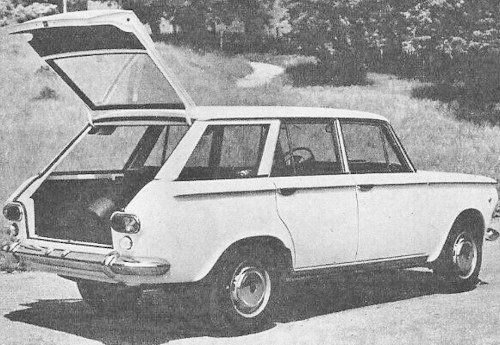
Initially, different bodies for models of Alfa Romeo, Fiat and Innocenti.
These included the Alfa Romeo 2600 Berlina de Luxe, the Fiat 2300 S Coupe, the Fiat 1300 station wagon, the Fiat 1500 station wagon and the Innocenti Spider.
As OSI 1200 S appeared in 1963, the first OSI marketed vehicle. This was a convertible based on the Fiat 1100, with four-cylinder engine, 1221 cc displacement and 58 hp Power.
The most widely used model was the Ford Anglia Torino 105E with about 10000 pieces. Also known is the OSI Ford 20 M TS. The coupe was presented at the Geneva Motor Show in 1966. The basis was the Ford 20M.
1968 ended production. The Spectacular Prototype Bisiluro Silver Fox attracted much attention to the company at the 1967 Motor Show in Turin, but was unable to stop the company's demise.

