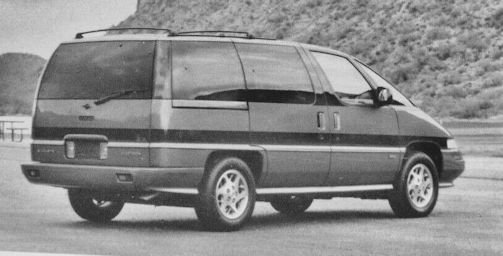
Oldsmobile
- Details
- Parent Category: O
- Category: Oldsmobile
- Hits: 39
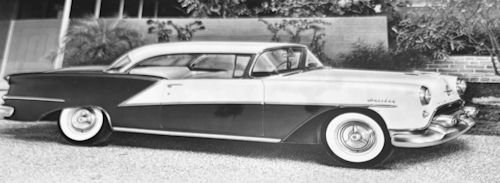
Oldsmobile 98 Fourth generation
 |
|
|
Model years |
1954 to 1956 |
|
Assembly |
U.S.A |
|
Designer |
Harley Earl |
|
Body style |
2-4 door Holiday hardtop |
|
Layout |
Front-engine, rear-wheel-drive |
|
Platform |
C-body |
|
Engine |
324 cu in (5.3 L) Rocket V8 |
|
Transmission |
3-speed synchromesh manual |
|
Wheelbase |
126.0 in (3,200 mm) |
|
Length |
1954: 214.3 in (5,443 mm) |
|
Width |
78.3 in (1,989 mm) |
|
Height |
60.5 in (1,537 mm) |
|
Curb weight |
4,000–4,400 lb (1,800–2,000 kg) |
In 1954, Oldsmobiles were now redesigned and the Ninety-Eight series at the top of the range. The low silhouette body is a full three inches lower than 1953, with overall height cut to 59 1/4 inches, maintaining adequate road clearance.
The Oldsmobile has had a panoramic windscreen and a 5.3-liter V8 engine since last year, and the Hydramatic Dual Range transmission since 1952.
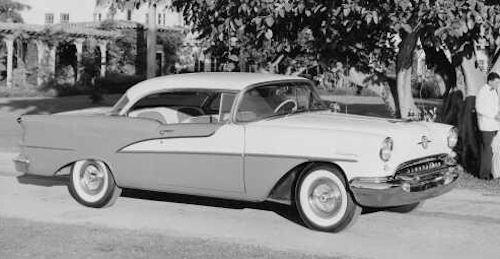
It was only slightly modified for 1955; this year's model can be recognized by the somewhat odd arrangement of the chrome side trim. The Oldsmobile is still considerably larger than most other American cars from the time.
What lies beneath the hood, which is unlocked not from the driver's seat but from the outside under the grill. The engine with improved higher horsepower 324 cu in (5.3 L) Rocket V8 8-cylinder engine shared with the Super 88 series. The engine quiet and completely vibration-free for its size. Its valves are arranged overhead, controlled by a chain-driven camshaft located centrally between the cylinders, via pushrods and rocker arms. This 8-cylinder engine with bore 3 7/8 in. and stroke 3 7/16 in Capacity 5,318cc with maximum BHP 202 at 4,000 p.m. and compression ratio 8.5:1 fitted with Quad type downdraught carburettor centrifugal type water pump driven by fan belt permanently lubricated and sealed ball bearings a Delco-Reny coil ignition 12-Volt 60-amp battery and Delco-Remy dynamo with optional air conditioning unit.
The fully automatic "Hydramatic Dual Range" transmission differs from the previous Hydramatic transmission in that a third gear, called "Super Performance" and marked with an "S," can be selected between "Drive" and "Low" for forward travel. Most of the time, you'll drive the Oldsmobile in Drive mode, where all four gears are available and automatically engaged depending on the load. As long as you apply the accelerator moderately, the car will roll off very smoothly from a standstill. The transmission consists of a fluid clutch and a four-speed planetary gearbox. The selector lever is located just below the steering wheel, with its five possible positions all on one level. The 4-speed hydromantic transmission of four fundamental elements A fluid coupling replaces the conventional clutch, planetary type gears and provides four forward gears and reverse, a governor automatically determines when the gears will be shifted and a hydraulic system automatically dose the work of shifting the gears which provides ratios of 3.8195:1, 2.6341:1 ,1.45:1 1:1 forward and 4.3045:1 in reverse.
Fitted with Bendix Duo Servo hydraulic four-wheel brake, internal expanding single type, Equipment includes five wheels with 7.60 x 15 4-ply white sidewall tyres 8.0 x 15 on Starfire.
Inside Heater and defroster power steering Standard Ninety-Eight equipment along with dual horns, courtesy light package, electric clock, cigarette lighter, parking brake light, on the super deluxe power-seeking radio, electric operated antenna, rear seat speaker, back-up lights, power brakes, glare proof mirror. autronic eye, electronically operated head lamp control. Front seats and side windows electrically operated. Upholstery choices were the basic nylon along with pattern cloth and also the option for leather, in a variety of colours to complement external paint.
- Details
- Parent Category: O
- Category: Oldsmobile
- Hits: 113
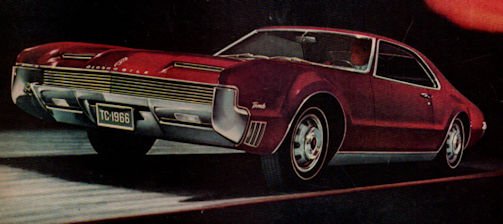
Oldsmobile Toronado First generation
 |
|
|
Model years |
1966 to 1970 |
|
Designer |
David North, Bill Mitchell |
|
Layout |
FF layout |
|
Engine |
425 cu in (7.0 L) 385 hp (287 kW) Rocket V8 |
|
Transmission |
3-speed TH-425 automatic |
|
Wheelbase |
119.0 in (3,023 mm) |
|
Length |
211 in (5,359 mm) (1966–67) |
|
Width |
78.5 in (1,994 mm) |
|
Height |
52.8 in (1,341 mm) |
|
Curb weight |
4,496 lb (2,039 kg) |
The Oldsmobile Toronado 1st Generation was built from 1966 to 1970.
History
The Oldsmobile Toronado was offered by the American car manufacturer General Motors under the brand Oldsmobile from autumn 1965 to mid-1992 front-wheel drive coupe of the upper class. The model was manufactured in four different series.
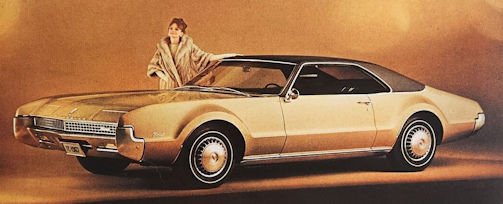
The model’s name is a term derived from the term tornado. When the Toronado was introduced in the fall of 1965, it differed in many ways from the then-usual offer in the US market. There was, on the one hand, the body shape of this large luxury coupé. In addition, the car was equipped with front-wheel drive. It was the largest front-wheel drive car ever built, and the first front-wheel drive car in America for almost 30 years Sharing the GM E platform introduced by the rear-wheel drive Buick Riviera in 1963 and adopted for the front-wheel drive.
A 7-litre, 385 b.h.p. Super Rocket V8 engine driving the front wheels? the Toronado is one of the biggest, fastest, quietest, most powerful and thirsty machines These things make it a very impressive car. With the 7.0-liter V8 reached a top speed of 217 km / h. Sceptics doubted whether the front-wheel drive made sense for such a big car, but the tests proved that the Toronado also had an above-average road holding compared to other American cars from that time. General Motors, like practically every other major manufacturer in the world, have been experimenting with front-wheel drive prototypes for many years. Everyone now recognizes the advantages of having the engine and transmission at the same end as the driving wheels whether they be front or back. Either way offers better traction, simplification in design The Tornado’s basic structure a three-quarter length perimeter sub-frame cloaked with an integral body customers want the Toronado, despite its radical engineering, it is still much like any other big American saloon to drive.
- PERFORMANCE 425 cu in
Max power (SAE): 385 hp at 4,800 rpm
max torque (SAE): 475 1b ft,65.5 kg m at 3,200 rpm
max engine rpm: 5,200
specific power: 55.3 hp/l
Engine capacity:425 cu in, 6,964.47 cu cm
Fuel consumption: 12 m/imp gal, 10 m/US gal, 23.5 1 x 100 km
Max speed: 133 mph, 214.1 km/h
max speeds: 55 mph, 88.5 km/h in 1st gear; 92 mph, 148.1 km/hin 2nd gear; 133 mph, 214.1 km/h in 3rd gear
power-weight ratio: 11.5 lblhp, 5.2kg/hp
acceleration: standing 1/4 mile 16.7 sec,
0—50 mph (0 —80 km/h) 6.3 sec - PERFORMANCE 455 cu in
Engine capacity: 455 cu in, 7,456.08 cu cm
Fuel consumption: 12.3 m/imp gal, 10.2 m/US gal, 23 1 x 100 km
Max speed: 131 mph, 210.9 km/h
power-weight ratio: 11.7 lb/hp, 5.3kg/hp
max power (SAE): 375 hp at 4,600 rpm
max torque (SAE): 510 1b ft,70.4 kg m at 3,000 rpm
max engine rpm: 5,200
specific power: 50.3 hp/l
Also, the technology of the big Olds was unusual, torque converter and gearbox were connected with a unique chain drive. However, the space in the rear and the overview to the rear were somewhat limited by the sloping coupe form. The front seats, the rear bench has been moulded for only two people but there is comfortable room for a third
without a prop shaft tunnel to get in the way of his feet. optional press-button air conditioning. capable of providing any amount of hot or cold air in any direction
There is a rectangular theme for the instruments which are clustered in front of the driver and viewed through a steering wheel with four
spokes in the middle are an unusual revolving speedometer—a calibrate drum which rolls its numbers past a fixed horizontal indicator It looks good but we did not consider it as easy to read. The steering column levers for the indicators, gears and steering ordinary dial. Adjustments are within finger-tip reach but the facia for lights, wash-and-wipe, fan speed, de-mister, air-condition the strongest safety point but there are also coil-up lap straps, easy to clip on and automatically tensioned supplied as standard fittings for all seats.There is also a dipping mirror and swivelling sun visors.
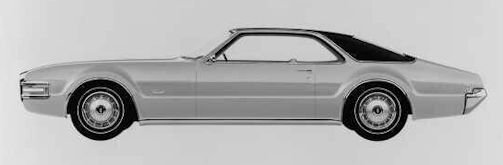
A special option code called W-34 was available on the 1968 to 1970 Toronado. This included a cold air induction system for the air cleaner, a special performance camshaft and a "GT" transmission calibrated for quick and firm up-shifts and better torque . Dual exhaust outlets similar to the 1966–67 model years with cutouts in the bumper, were included with W-34. The models also had dual exhaust systems, but single hidden outlet running from the muffler exiting rearward on the right side. For 1970 only, the W-34 option also included special "GT" badges on the exterior of the car.
The W-34 Toronado was capable of 0–60 mph in 7.5 seconds and the standing 1/4 mile in 15.7 seconds at 89.8 mph (144.5 km/h).
VARIATIONS AND OPTIONAL ACCESSORIES
separate front seats; cleaner air system; air conditioning system adjustable tilt of steering wheel; front disc brakes (diameter 11.30 in, 287 mm) 235R x 15 tyres; separate front seats, central selector lever; 55 Ah alternator
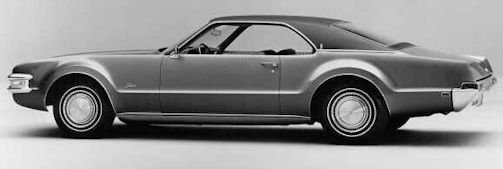
The car was popular with American car buyers. In 1966, more than 40,000 Tornados were sold. At the time it was technically one of the most impressive vehicles on the American market.
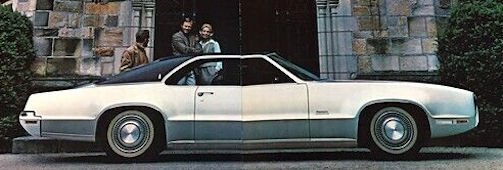
End of 1967 was a facelift, which approximated the shape of the Toronado with notchback and in the greatly enlarged grille integrated pop-up headlights the mainstream design in 1969, and the elimination of hidden headlights. The first-generation Toronado with the usual annual facelifts through 1970 The seven-Liter was replaced by a new 7.5-liter V8 with 375 or 400 hp. The deluxe model was renamed Toronado Custom.
In this form, the Toronado remained in production until the summer of 1970. Altogether 143.134 copies were made.
The Toronado shared drive technology with the Cadillac Fleetwood Eldorado, introduced in late summer 1966.
- Details
- Parent Category: O
- Category: Oldsmobile
- Hits: 22
Oldsmobile Super 88
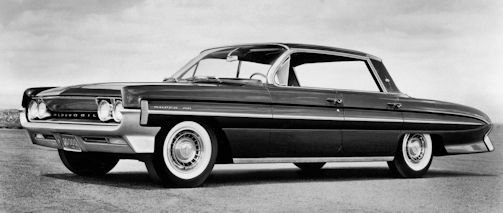 |
|
|
Production period: |
1961 to 1964 |
|
Body versions : |
Saloon , station wagon , coupé , convertible |
|
Engines: |
Gasoline engines :6.5 liters (239-243 kW) |
|
Length: |
5385-5565 mm |
|
Wheelbase : |
3124-3150 mm |
|
Curb weight : |
1677-1963 kg |
The Oldsmobile Super 88 model year 1961 had, like his sister models, no more tail fins, but a tapered rear end. The panoramic windows were gone. The round double headlights limited the wide grille, in the lower third of which was the word "Oldsmobile" to read. This scenery was framed by the smooth front bumper and bonnet. The 6.5-liter engine, now also available with lower power in the 88, increased in the Super 88 to 325 bhp (239 kW).
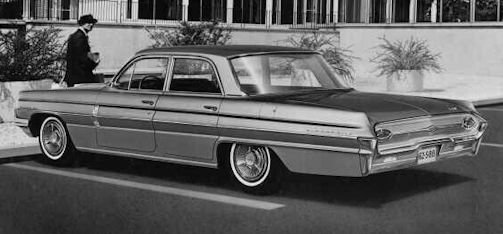
In 1962 there was a simpler grille and convertible and the station wagon with 7 seats were discontinued. Engine output once again rose slightly to 330 bhp (243 kW).
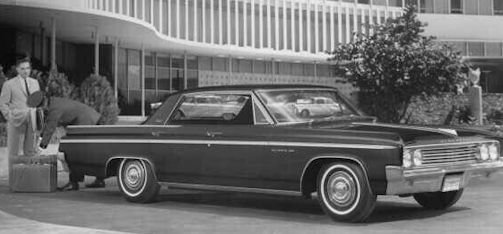
In 1963, the radiator grille was contoured so that the centerline and the fender ends protrude slightly, while the twin headlights sat deeper in the radiator grille.
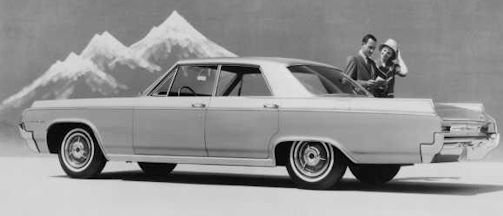
In 1964, there were hardly any changes. The Dynamic 88 was an entry-level model called Jetstar side set, so that the Dynamic 88 largely took over the role of the Super 88. From the Super 88 remained in the last year of production only the 4-door sedan and the 4-door hardtop sedan left.
- Details
- Parent Category: O
- Category: Oldsmobile
- Hits: 46
Oldsmobile Starfire Second generation
 |
|
|
Model years |
1975 to 1980 |
|
Assembly |
Canada .United States |
|
Class |
Motor car |
|
Body style |
2-door Hatchback |
|
Layout |
Front-engine, rear-wheel-drive |
|
Platform |
GM H platform |
|
Engine |
140 cu in (2.3 L) I4 |
|
Transmission |
4-5 speed manual |
|
Wheelbase |
97.0 in (2,464 mm) |
|
Length |
179.3 in (4,554 mm) |
|
Width |
65.4 in (1,661 mm) |
|
Height |
50.2 in (1,275 mm) |
|
Curb weight |
2,800 lb (1,300 kg) |
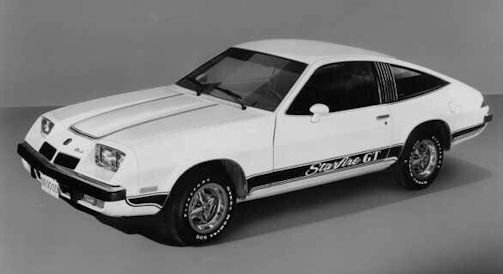
The second-generation Oldsmobile Starfire automobile which was introduced in September 1974, and produced to 1980.
The name Starfire, once used for the most expensive model in the Oldsmobile program, resurfaced in model years from 1975 to 1980, but this time for the cheapest model. The coupe was based on the H platform from GM, which had been introduced in 1971 for the Chevrolet Vega (from 1974 as Pontiac Astre) in the lower middle class.
Following the oil crisis of 1973, a fuel-efficient model was quickly sought. GM therefore expanded the H-series considerably. So created the Chevrolet Monza, Pontiac Sunbird, Buick Skyhawk and the Oldsmobile Starfire. The GM Body Department Fisher Body Co. prepared three variants: a 2 + 2-seater hatchback coupe, a similarly coupe with notchback and a 2-door station wagon.
H-bodies have rear-wheel drive, front longitudinally mounted engines and a wheelbase of 97.0 in (2464 mm). While the front wheels are suspended on conventional double wishbones, the rigid rear axle is guided on the lower longitudinal and upper trailing arms. The trailing arms are omitted in 1976, whereas in the case of the "torque arm rear suspension" the axle is braced with a bolted front carrier on the transmission lateral guide is a Panhard rod. Coil springs and telescopic shock absorbers act at the front and rear. A further development of this came later in the 3rd and 4th generation of the F-Bodies (Chevrolet Camaro and Pontiac Firebird / Trans Am). Front was a curve stabilizer as standard. The design should also be able to accommodate a planned by GM Wankel engine, but which was never ready for production.
The Starfire had a length of 179.3 inches (4554 mm), a width of 65.4 inches (1661 mm) and a height of 50.2 inches (1275 mm); the length may differ by a few millimetres for the other H-bodies.
According to the American version, these quite stately vehicles were classified as " subcompacts " by European standards (like Chevrolet Chevette or Opel Kadett) because they were slightly smaller than compacts, i.e. cars like GM's X-Bodies (Chevrolet Nova, Pontiac Ventura, Buick Apollo and Oldsmobile Omega). In advertising Oldsmobile coined the term supercoupe for the Starfire ...
GM used rectangular twin headlamps for the H-Bodies and some full-size models as they came into fashion back then.
Which were manufactured H-Bodies in the factory Lordstown, Ohio and Sainte-Thérèse in Québec (Canada). They were from the beginning of 1975 at the dealers (the Pontiac Sunbird in the fall of 1975), although not all body styles were offered by all brands. The vehicles of the different brands looked almost the same, they differed primarily in the front.
With the built since 1986 H-series with front-wheel drive, the version from 1971 to 1979 is not related.
The models Vega and Astre were provisionally further developed in parallel and did not expire until 1977. Unlike these, the new H-Bodies were occasionally also available with V8 engines except with 4- and V6-cylinder engines. The weight was, depending on the version, between 1'270 and 1'360 kg. H-bodies are marked in the FIN by the letter "H" in the 4th position.
The lower middle class market segment was less important to Oldsmobile than, for example, Chevrolet or Pontiac. Accordingly, the commitment of the brand was more or less limited to the mere presence. This was expressed in the fact that only the hatchback coupe was offered and that there were only two trim levels. The Starfire's share of total brand production during that period was eventually around 6%.
Model History
1975
The Starfire was available in the first model year exclusively with a Buick-developed V6 engine. The V8-derived engine with 90 ° fork angle (factory code LD5, for California LC6) had a displacement of 231 ci (3785 cm 3) and made 110 hp (82 kW) at 4'000 / min. As standard, double carburettor and a four-speed gearbox. Five-speed manual gearbox and three-speed automatic GM "Turbo Hydramatic THM200" was available at extra cost.
Offered were the trim levels Sport (base) and Coupe S, to spring from a GT package with trim, sports wheels, sports instrumentation including tachometer, five-speed gearbox and rear stabilizer. The Coupé S was recognizable by a narrow ribbon on the flank. All had standard front disc brakes and drum brakes at the rear. Servo support for the brakes was also standard, but for the steering as extra charge as a steering wheel adjustment.
There were five standard or metallic colours available. The interior equipment included as standard with leatherette-covered high-back single seats and a console in front and a folding rear seat. An adjustable backrest for the driver's seat was extra charge. Four colour tones for the interior were available; Leather covers in three different were optional.
For reasons of space, there was only one emergency spare wheel housed in a side compartment of the luggage compartment.
|
model year |
model name |
Model no. |
List price |
production |
|
1975 |
Starfire S |
D07 |
$ 4,144 |
2,950 |
|
1975 |
Starfire |
T07 |
$ 3,873 |
28'131 |
Totally 31'081 Starfire left the factory in the model year 1975.
1976
For 1976, minimal changes were required. Nominally made the V6 105 hp (78 kW). The five-speed gearbox came from Borg-Warner. The fifth gear was still designed as an overdrive and served more to reduce fuel consumption than the sportiness. The model SX replaced the version coupe S. It received a similar ribbon with the model’s name. The SX was slightly lower than the S of the previous year, while the prices for the basic version were raised slightly.
|
model year |
model name |
Model no. |
List price |
production |
|
1976 |
Starfire SX |
D37 |
$ 4,062 |
20'854 |
|
1976 |
Starfire |
T07 |
$ 3,882 |
8'305 |
29'129 vehicles were built.
1977
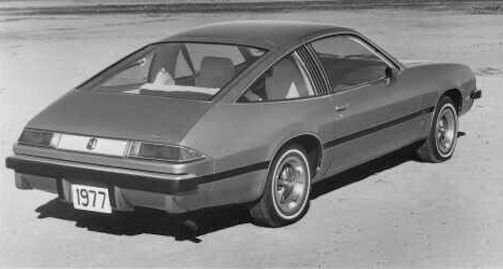
The Starfire received a new front. The two horizontal slots gave way to vertical bars. The basic / SX / GT equipment levels have been retained. The new version of the base version received the technically interesting OHC in -line four-cylinder engine with 140 ci (2294 cm 3) and double carburettor, known from Vega and Astre. He made 84 hp (61.8 kW). The engine block was injection moulded from aluminium, but the cylinder head made of cast iron. For simplification, the timing belt of the camshaft also powered the water pump, which also served as a belt tensioner. The oil pump sits on the crankshaft and is shaped so that it also serves as a front cover of the engine.
The previous V6 was still available at extra cost (standard in the GT package). The prices were raised slightly.
PERFORMANCE 140 cu in
max speed: about 96 mph, 155 km/h
max power (DIN): 84 hp at 4,400 rpm
max torque (DIN): 117 1b ft, 16.1 kg m at 2,400 rpm
max engine rpm: 4,800; 36.6 hp/l
power- weight ratio: Starfire 32 lb/hp, 14.5 kg/hp - Starfire SX 32.2 lb/hp, 14.6 kg/hp
speed in direct drive/top at 1,000 rpm: 20.1 mph, 32.3 km/h
fuel consumption: 28.8 m/imp gal. 24 m/US gal, 9.8 1x km.
|
model year |
model name |
Model no. |
List price |
production |
|
1977 |
Starfire SX |
D37 |
$ 4,140 |
14'181 |
|
1977 |
Starfire |
T07 |
$ 3,942 |
4'910 |
The production collapsed on only 19'091 pieces.
1978
The production of the 2.3-liter four-cylinder ended at the end of the model year 1977. It was replaced by a slightly larger, built by Pontiac four-cylinder (code LS6, LS8). The engine nicknamed Iron Duke made 85 hp (63 kW). Optionally, there was still the well-known V6. Was postponed during the model year, a surcharge five-Liter V8 from the Chevrolet shelf (305 ci, code LG8) with 145 hp (106 kW). However, the combination of this high-torque engine with the weight-optimized THM200 automatic transmission proved to be prone to breakdown. For the SX there was new a so-called "Firenza" package. Apart from pretty eye-catching visual accents like a contrasting flank with additional trim and colour accents on the hood, it included the tighter "Special Rally "suspension, front bumper, spoiler, flared wheel arches, sport wheels and more details.
Thus, the customer could choose between basic version, SX, SX Firenza GT and SX GT. The latter had the V6 as a standard engine instead of the four-cylinder.
The prices rose again slightly; the base model cost over $ 4,000 for the first time.
|
model year |
model name |
Model no. |
List price |
production |
|
1978 |
Starfire SX |
D37 |
$ 4.306 |
k. A. |
|
1978 |
Starfire |
T07 |
$ 4,095 |
k. A. |
With 17,351 vehicles, production reached the second-lowest level of all years of construction.
1979
A facelift brought the hood to the same height as the fenders. For the front, the brand-typical theme of two groups of two was further developed with vertical bars. New were also simple instead of the double headlights. Overall, the new design was more harmonious but less characterful. The four-cylinder was now available with 85 or 90 hp (63 or 67 kW). The V6 made 115 hp (84 kw), the V8 but only 130 hp (95 kW). Whether this was a consequence of the stricter emission regulations or the reaction to the automatic problems in connection with the V8 is unclear. In some cases, even stronger THM250-C seem to have been incorporated.
The equipment levels remained unchanged. Unlike in the first model years, the basic version sold significantly better than SX and derivatives. Oldsmobile decided not to offer a developed for the H-Bodies version of the 3.2-liter V6 for the Starfire because they offered virtually the same performance as the "Iron Duke".
|
model year |
model name |
Model no. |
List price |
production |
|
1979 |
Starfire SX |
D37 |
$ 4,475 |
7'155 |
|
1979 |
Starfire |
T07 |
$ 4,275 |
13'144 |
After all, the production recovered slightly: 20'299 vehicles left the factory.
1980
After the facelift of the previous year, the Starfire experienced little visual changes. The V8 engine accounted for throughout the H-series as well as the five-speed gearbox. The power of the four-cylinder dropped to 86 hp (63 kW). It is unclear whether the 90-PS version remained in the program. Oldsmobile also decided not to offer the latest version of the 4.1-liter V6 and 125 hp (93 kW) at 4000 rpm as a replacement for the Starfire V8. The 3.8-liter V6 engine still made 110 hp (81 kW).
|
model year |
model name |
Model no. |
List price |
production |
|
1980 |
Starfire SX |
D37 |
$ 4,950 |
k. A. |
|
1980 |
Starfire |
T07 |
$ 4,750 |
k. A. |
Fewer model refinements and less performance at significantly higher prices are bad prerequisites for high sales figures. When the production of the Starfire ended on December 29, 1979, only 8,237 copies had left the production line.
In order to secure a higher production share of the new, more promising X-Bodies with front-wheel drive and transverse engine (Chevrolet Citation, Pontiac Phoenix, Buick Skylark and Oldsmobile Omega) Oldsmobile stepped down its share for 1981 at the H-program at Chevrolet and Pontiac. This meant that for the model year 1981, a gap in this (for Oldsmobile but not crucial) market segment was created. It could only be closed from the spring of 1981 (model year 1982) with the new J-platform with front-wheel drive. Their best-selling model was the Chevrolet Cavalier, the Oldsmobile variant was called Firenza.
OPTIONAL ACCESSORIES
limited slip differential: Turbo-Hydramatic 250 automatic transmission , 3.420 axle ratio,
central lever: 5-speed fully synchronized mechanical gearbox (1 3.400, Il 2.080. Ill 1.390. IV t. V 0.840, rev 3.050); power steering; servo brake; heated rear window: heavy-duty battery; air-con.
From the beginning of 1975 to the end of 1979 Oldsmobile produced a total of 125,188 Starfire - just over half of the first-year production of the sister model Monza of Chevrolet (without Vega).
- Details
- Parent Category: O
- Category: Oldsmobile
- Hits: 36
Oldsmobile Silhouette First Generation
 |
|
|
Production period: |
1990 to 1996 |
|
Body versions: |
station wagon |
|
Engines: |
Gasoline: 3.1-3.8 litres(88-136 kW) |
|
Length: |
4933-4945 mm |
|
Width: |
1877 mm |
|
Height: |
1656-1669 mm |
|
Wheelbase: |
2789 mm |
|
Curb weight: |
1630-1766 kg |
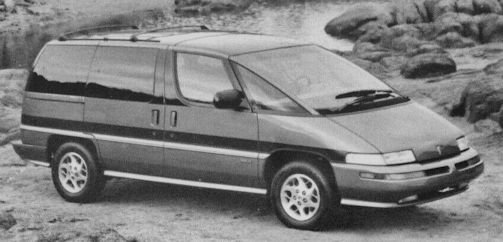
The production of the first generation of the Oldsmobile Silhouette began on 1 August 1989 in Tarrytown (New York). The cars were built on the GM-U platform and consisted of a space frame made of galvanized steel and carried a body made of GRP, which was insensitive to rust and minor damage. This production technique was developed on the Pontiac Fiero and also used for most Saturn cars. The silhouette had seven seats; The five rear seats each weighed about 15 kg and could be removed individually.
History
The Oldsmobile Silhouette and its sister models Pontiac Trans Sport (later Pontiac Montana) and Chevrolet Lumina APV (later Chevrolet Venture) were three vans that were presented in the 1990 model year. After giving up the brand Oldsmobile 2004, the silhouette was replaced in the following year 2005 by the Buick Terraza.
The concept car Pontiac Trans Sport was presented to the public in 1986 and received very well. It had a futuristic styling, individually convertible seats with built-in stereo speakers, a rear door wing door and large glass surfaces, including a large glass roof.
Due to the positive response, the production of the Pontiac Trans Sport was recorded, but the styling and the equipment details of the concept vehicle were only partially taken over in the series production. Especially the hinged door would have been too expensive in production. The glass roof was also too heavy and also too expensive, and so it was left in the production vehicle at a steel sunroof, which was painted in high-gloss black, reminiscent of the glass roof of the concept vehicle.
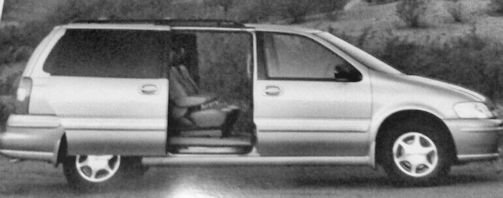
Also, Chevrolet and Oldsmobile received modified versions of the Trans Sport to serve the largest possible clientele. The Chevrolet Lumina APV should be the cheapest version, the Trans Sport was designed for customers with a sense of "style & sport", and the silhouette should be the van for the market of luxury vehicles.
There was a self-levelling system with a supercharged compressor and rear gas pressure dampers so you could adjust the vehicle level regardless of the load. In addition, there was a switch combination and a set of air hoses, so that one could inflate with the compressor also the tires, air mattresses and other sports equipment.
The styling of the Vans was discussed very controversial. When the Oldsmobile Silhouette and its sister models hit the market, no one had ever tried to market an elegant or sporty van, and GM thought they had discovered a great deal of market potential. These vans have been built lower and slimmer than any other vans so far. The extremely long and flat windshield and the resulting large distance from the driver to the bottom of the window made for a peculiar driving feel, until the driver had got used to the "slightly different" proportions. Automobile magazines called the car "Dust buster" because it looked similar in its side silhouette to this hand vacuum cleaner.
STANDARD EQUIPMENT:
GL Base: 3.4-liter V-6 engine, 4-speed automatic transmission, driver-and passenger-side air bags, front side-impact air bags, anti-lock brakes, daytime running lights, front air conditioning, interior air filter, power steering, tilt steering wheel, cruise control, reclining front bucket seats w/lumbar adjustment and folding armrests, 4-way adjustable driver seat, second-row 2-passenger split-folding bench seat, third-row 3-passenger split-folding bench seat, front storage console, under-passenger-seat storage drawer, overhead console w/map lights, cupholders, heated power mirrors, power windows,power door locks, tachometer, coolant-temperature gauge, trip odometer, AWFM/cassette, integrated antenna, digital clock, intermittent wipers, rear wiper/washer, rear defogger, automatic head-lights, visor mirrors, rear reading lights, auxiliary power outlets, floor-
mats, sliding driver-side door, solar control windshield, deep-tinted glass, theft-deterrent system, fog lights, roof rack, 215/70R15 tires,wheel covers.
GS adds: remote keyless entry, power sliding passenger-side door,6-way power front seats, overhead storage console (includes compass, outside temperature indicator, driver information center), illuminated visor mirrors, deletes under-passenger-seat storage drawer.
GLS adds: leather upholstery, second-row captain's chairs, leather-wrapped steering wheel w/radio controls, rear-seat radio controls,215/70R15 touring tires, alloy wheels.
Premiere Edition adds: traction control, LCD color screen/video-cassette player, input jacks for video games or video camera,AM/FM/cassette w/two CD players, rear air conditioning and heater, touring suspension w/automatic load leveling, air inflation kit.
The first engine for this van was a slightly weaker 3.1-liter V6 with only 120 bhp (88 kW), which did not give this fairly heavy car sufficient performance.
In 1992, the Silhouette and its sister models got a 3.8l V6 with 170 bhp (125 kW) on request, which gave the van a much better torque and better acceleration and made them the strongest and handiest vans of their time.
In response to the criticism (and very modest sales figures) attributed to avant-garde styling and the reaction of potential customers, car magazines and even a 1994 Chrysler ad, the Trans Sport and the Lumina APV got a facelift by: her nose was shortened by 3 "(76 mm) and the car's front bent down, giving it a more conventional look. In addition, an edge was attached to the dashboard to visually shorten the distance to the bottom edge of the windshield.
The European customers, who were already used to slim Vans by the Renault Espace, took the futuristic styling well, and the sales figures were handsome. The Oldsmobile Silhouette, manufactured from 1994 for the European market, became Pontiac Trans Sport models through Pontiac logos and wheels. The sales figures in Europe were good - at least for a US import car - but did not economically justify a separate, fourth model.
The production of the Silhouette (including Lumina APV and Trans Sport) of the first generation expired in 1996 and the plant in Tarrytown, where the cars were manufactured and operated since 1900, was cancelled. The last Oldsmobile silhouette of the first generation left this factory on 17 May 1996.
Engines
- 1990-1995: 3130 cm³ V6-60 °, 120 bhp (88 kW)
- 1992-1995: 3785 cm³ V6-60 °, 170 bhp (125 kW)
- 1996: 3392 cm³ V6-60 °, 170-185 bhp (125-136 kW)
Model History
1990
- A brand-new model - The Silhouette as a luxury model is available with leather seats on request, a trim detail that its sister models cannot offer, but the Chrysler Town and Country.
1991
- Customer complaints due to reflections of the huge dashboard in the windscreen are answered by the exchange of bright plastic parts of the previous year for black carpet.
1992
- New this year is the 3.8L V6 engine in conjunction with a Hydra-Matic 4T60 four -speed automatic transmission with electronic control.
- The fixed radio antenna mounted on the bulkhead is abandoned in favour of an integrated roof antenna. It is installed between the roof and the headliner.
- The side mirrors are now foldable and larger.
- The brakes are enlarged and combined with ABS as standard.
- On request there is a lifting roof.
- On request, there are control levers for the stereo system on the steering column.
1993
- The design of the taillight’s changes from a mesh design to red lamps that run to the edge of the black. This equipment was previously only in Trans Sport.
- There was a new centre console with large, recessed controls for the air conditioning and large shelves.
1994
The silhouette received a facelift with reaching around the corners of the vehicle, combined flashing and parking lights and standard installed fog lights.
In addition, there was an electric sliding door with remote control and the rear side windows got a darker tint.
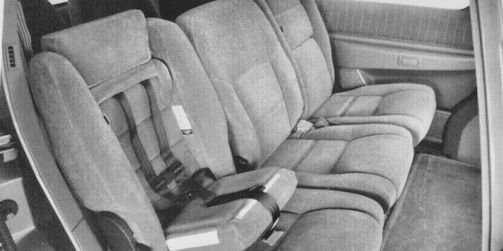
Until 1995, an ESP was offered in combination with the 3.8 -Liter engine and there was also an optional traction control and a standard driver's airbag. Optional built-in child seats were available, which could be installed between two of the rear adult seats. To visually reduce the large distance to the lower edge of the windshield, you brought an additional edge on the dashboard.
1995
- There were automatic door locks that locked the doors when the auto selector was pushed out of park and unlocked when the car was parked.
1996
- Last year of production. In August, the series will be replaced by a newly developed car of the same name.
- Both the 3.1-liter V6 and the 3.8-liter V6 are eliminated, but there is the 3.4-liter V6 engine.
- The traction control is eliminated.