
Nissan
Nissan Primera First Generation P10
 |
|
|
Production period: |
1990 to 1997 |
|
Class: |
Motor Car |
|
Body versions: |
Sedan, hatchback, station wagon |
|
Engines: |
|
|
Length: |
4400-4510 mm |
|
Width: |
1695-1700 mm |
|
Height: |
1390-1500 mm |
|
Wheelbase: |
2550 mm |
|
Curb weight: |
1110-1358 kg |
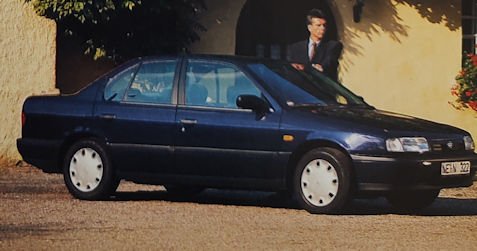
The Nissan Primera in the first series P10 came in the fall of 1990 as a direct successor to the Nissan Bluebird on the market to replace it in Europe. Available was a sedan or hatchback and a station wagon. This model was also sold in the US as the Infiniti G20.
The Primera was developed and produced as the first model by Nissan specifically for the European market. This first appeared in October 1990 at the Paris Motor Show.
The Primera achieved has been redeveloped, whereby a very good handling could be achieved. The front suspension of the Primera sedan is a hybrid construction. The sedan and the combination variants are built on different platforms and have little in common except for the name. In fact, the Traveler (W10 series) is based on the Japanese Nissan Avenir and therefore does not have the same chassis design as the saloon. Already in June 1993, the Primera received a small revision, in which the safety equipment was expanded and the engines were revised.
In January 1995, all variants of the Primera received a comprehensive facelift. The safety equipment was further improved; driver airbags were now standard on board. Additional passenger airbags as well as belt tensioners were also available and in higher quality equipment (SE, eGT) part of the series.
Visible were the face-lifted sedan models on a modified grille with chrome inserts and modified, lower-drawn front and rear bumpers. Also, the taillights a more modern look. In the front apron now two fog lights were integrated. The last Primera models of the P10 series met the emission standard Euro 2, but it was partly retrospectively a conversion of the Euro-1 engines with a cold run control (KLR) possible.
The estate version received a modified front bumper, another grille and standard ABS. In June 1996, the Traveler was again slightly revised to produce it as a gap filler until the fall of 1997. A detachment model has only appeared after the facelift of the next generation of Primera as WP11-120. This second facelift is recognizable by a modified radiator grille and additionally has passenger airbags and belt tensioners.
- LX: basic version, manual windows, no electric mirrors
- SLX: comfort version with 4 × eFH, electric and heated mirrors, central locking, power steering, optional air conditioning available as a dealer upgrade.
- Sri (sports package in optics of the Primera GT): Front spoiler, side skirts and rear wing (in body colour), characteristically the writing "Sri" at the tail, at the sides and at the speedometer. Hand brake lever, gear knob and steering wheel in leather edged, sports seats with better lateral support. Delivered in the colours Gemini Blue, Cherry Red, Tundra Green or Black. Mineral effect paint for an additional charge. Motorization in Germany: only 1.6 l with 90 hp.
- eGT: the sports version of the Nissan Primera: SR20DE 2-liter engine with 150 hp, 0-100 in 8.4 s and a top speed of 220 km / h. Optically emphasized sportiness through rear spoiler, side skirts, sports seats, alloy wheels u. v. m., Such as an oil pressure gauge in the tachometer instrument
- SE: the luxury version of the Nissan Primera, only available with 2.0-liter engine. Externally recognizable by the alloy wheels with 195er tires, chrome door handles and the lettering "SE" at the rear. Optionally available for the SE were leather seats with integrated seat heating. Gear knob, steering wheel and hand brake lever leather-coated as with the Sri and eGT, centre console with burl wood application, integrated cassette box included.
For the market launch in October 1990, three different gasoline engines with an output between 66 kW and 110 kW and a diesel engine without turbocharger with 55 kW were available. The gasoline engines were equipped depending on the version with carburettor or port injection, but were all provided in a revamp of the engine range in June 1993 with a multipoint injection. The two-Liter 16V with 85 kW was offered from April 1991 with four-wheel drive, but only in the two sedans. As an engine only Nissan engines were offered, which were designed as a four-cylinder. The gasoline engines have 16 valves, which are driven by a timing chain via two overhead camshafts, these engines were extremely sturdy and mileages of well over 300,000 km were not uncommon. The diesel engine, however, has only eight valves, which are operated by an overhead camshaft. The valve is controlled by a toothed belt.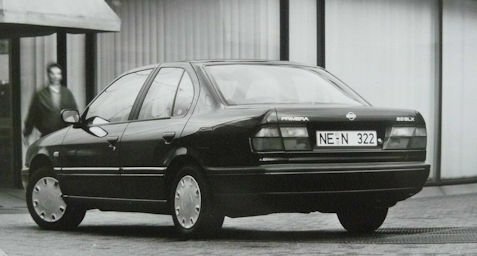
Nissan Titan 1st generation
 |
|
|
Production period: |
2004 to 2015 |
|
Class: |
Commercial vehicle |
|
Body versions: |
Pick up |
|
Engines: |
Gasoline :5.6 Liters |
|
Length: |
5695-6205 mm |
|
Width: |
2002-2019 mm |
|
Height: |
1895-1948 mm |
|
Wheelbase: |
3551-4049 mm |
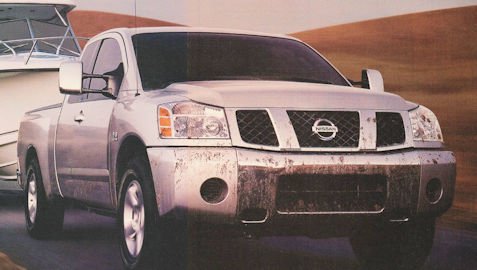
The Nissan Titan is a pickup from the manufacturer Nissan, which is sold exclusively in North America. It was introduced in 2004 and shares the platform with the Nissan Armada and Infiniti QX.
The first-generation Titan has a 5.6-liter V8 with 227 kW (309 hp) at 4900 rpm and 514 Nm torque at 3600 rpm. For model year 2007, the engine power increased to 236 kW (321 hp) at 5200 / min and 522 Nm at 3400 / min. The vehicle is available with either rear or four-wheel drive. Like all pickup trucks, the Titan in extended cab and crew cab versions rests on a longitudinal chassis with a solid rear axle (for better towing capacity).
The transmission is a 5-speed automatic transmission It's also the only full-size pickup from the time to offer a standard limited-slip rear differential. It also features a transfer case for off-road use.
Interior space is the Titan's best selling point but Compared to its rivals, the Titan falls short in terms of interior finish, where the materials feel cheap. Build quality is also imperfect, with several parts rattling inside the cabin. But no other crew-cab pickup offers as much passenger room. You can easily accommodate five passengers with ample head, leg and shoulder room. And for easier access, the doors on the extended-cab version open 168 degrees, providing plenty of clearance. When the rear bench seat isn't in use, it folds up against the back wall, and the flat floor maximizes interior storage space behind. The interior of the bed, the exterior tool box housed in the driver-side rear fender, the flat load floor when the rear bench seat is raised, and the factory-sprayed bed liner that prevents the rust and warping associated with standard drop-in liners. Furthermore, the optional navigation system allows vacationers to tow a trailer without the risk of getting lost, while the standard traction control system and optional lateral stability system (VDC) ensure safer driving.
It is available with two wheelbases and Crew Cab (double cab) or King Cab (with 2 m long cargo area), partly it was criticized because no two-seater cab (regular cab) was offered, this has changed with the appearance of the second generation.
Nissan challenged its engineers to fit the highest-performing engine of the time under the hood. After a few months of work, a new dual overhead cam engine dubbed the VK56 was born. For marketing purposes, this engine bears the more evocative name "V8 Endurance." This V8 engine produces 305 horsepower, and its more-than-generous torque peaks at 379 lb-ft Nissan tuned the exhaust system differently to distinguish the Titan from the Armada on the road . It is also worth noting that the torque kicks in at 2,500 rpm; consequently, the beast is quick off the mark. All this power is delivered through a 5-speed automatic transmission.
Options
Overhead Console
Park Distance Control (Rear)
Power Adjustable foot pedals
Power Moonroof
Privacy Glass
Sliding rear Window
split Front Bench Seat
Trailer Hitch
Nissan Urvan Caravan First Generation (E20)
|
|
|
|
Manufacturer |
Nissan Datsun |
|
Also called |
Urvan, Homy |
|
Production |
1973 to 1980 |
|
Engine |
|
|
Wheelbase |
2,350 mm (92.5 in) |
|
Length |
4,690 mm (184.6 in) |
|
Width |
1,690 mm (66.5 in) |
|
Height |
1,905 mm (75.0 in) |
|
Curb weight |
1,425 kg (3,142 lb) |
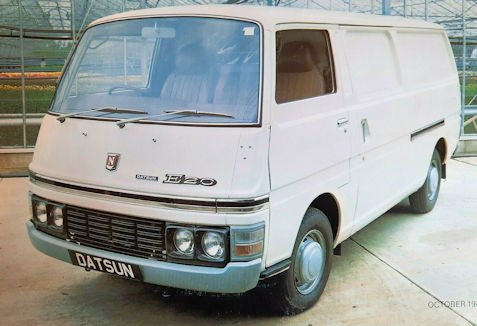
The Nissan E20 Caravan (Urvan) was a truck that Nissan had offered as a minivan or normal type box van since the 1970's .
History
The development of the caravan was based on a change in the road traffic regulations of Japan in 1970, according to which minibuses in the future only up to a passenger number of 11 people with the normal car normal driving license were allowed. Thus, Nissan needed a different model with a development of Nissan after acquired the Prince Motor Company and was designed for a passenger capacity of 15 people. So, this built on the truck chassis of the larger Prince Homer was based, the model was technically and visually revised and presented as a 1973 Nissan Caravan.
The Datsun Urvan E 20 was also built with 3, 5, 7 or 9 seats. This was especially popular in Europe, and as fire departments and ambulance versions in certain countries. Its handling is a bit difficult as it requires high steering power and these early versions did not come with power steering. The centre shift lever was slightly bent. It was almost 80 cm long, so there were long gearshifts, but the transmission in the petrol models had five gears, which was not common in Europe at the time. There were in-line four-cylinder gasoline engines with 1,596 cc, 1,798 cc and 1,998 cc and a 2,200 cc diesel engine. From 1976, the Homy was then also largely the revisions of the caravan almost identical. As Datsun Urvan, the caravan was offered outside of Asia for export.
After Nissan decided to discontinue the Datsun brand, the model became the Nissan Urvan. In Australia and other markets, this was sometimes offered as Nissan Kingvan. 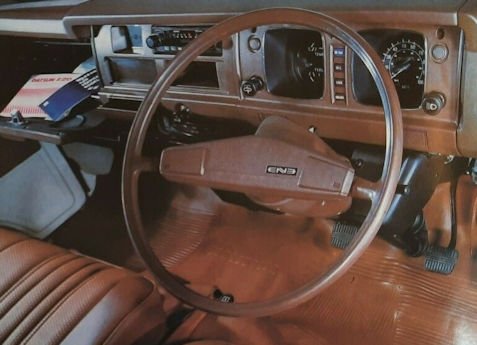
Nissan Urvan Caravan E24 Third Generation
|
|
|
|
Also called |
Homy, Escapade, Shuttle, Caravan, Homy |
|
Production |
1986 to 2001 |
|
Assembly |
Japan, Philippines |
|
Engine |
|
|
Transmission |
4/5-speed manual |
|
Wheelbase |
2,375–2,645 mm (93.5–104.1 in) |
|
Length |
4,420–5,100 mm (174.0–200.8 in) |
|
Width |
1,690 mm (66.5 in) |
|
Height |
1,950–2,395 mm (76.8–94.3 in) |
|
Curb weight |
1,375–1,930 kg (3,031–4,255 lb) |
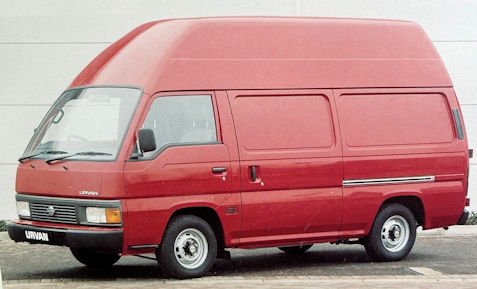
The E24 version was built from 1986 It remained in production until 2001 and longer in some markets under various licenced brand and model names and received two major facelifts.
This was the last version of the Urvan’s offered in Europe. It was only available with turbo diesel engines in some markets; the Van version was no longer available in Europe. Instead of the 2.3 L SD 23 of the predecessor, there was the 2.7L TD 27. After the 2nd major facelift in 1996, the QD32 from the Nissan Patrol was installed in the Urvan where he made 100 hp (74 kW) from 3,153 cc and replaced the LD 30 TD. From 2002, the Nissan Interstar replaced the Urvan in Europe.
SPECIAL FEATURES OF THE URVAN HI-ROOF
• Height: With Standard 1955mm With Hi-Roof 2591 mm
• 1873mm (73.8 ins) internal height
• 8.1 cubic metres (288.5 cubic feet) estimated cargo volume providing over 30% increase on standard cargo volume
• Colour impregnated glassfibre shell with high gloss exterior finish available in red, white and blue to match standard Nissan body colours
• Double skinned roof with 12mm core of polyurethane foam for insulation and strength
• Sandwich construction sides for added strength
• Useful storage area over cab
In Kenya, the Nissan Urvan E24 is still manufactured by the Kenya Vehicle Manufacturers in Thika for the African market.
Nissan Urvan Caravan second generation
|
|
|
|
Make |
Nissan Datsun |
|
Also called |
Homy,Yulon Homer |
|
Production |
1980 to 1986 |
|
Class |
Commercial vehicle |
|
Engines |
Petrol: 1.6 L J16 OHV I4 1.8 L Z18S I4 2.0 L H20 OHV I4 2.0 L Z20S I4 Diesel: 2.0 L LD20T turbo I4 2.2 L SD22 I4 2.3 L SD23 I4 |
|
Wheelbase |
SWB: 2,350 mm (92.5 in) LWB: 2,690 mm (105.9 in) |
|
Length |
SWB: 4,350 mm (171.3 in) LWB: 4,690 mm (184.6 in) |
|
Width |
1,690 mm (66.5 in) |
|
Height |
1,950 mm (76.8 in) |
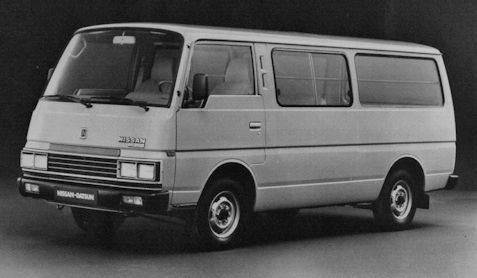
The second generation of the Datsun Urvan / Caravan (type E23) was introduced in August 1980. The engines were the well-known J16, Z20 S and H20 Nissan petrol engines. Also, The SD22 diesel has been redesigned and has since been supplied with a five-speed manual transmission. There was a new Van version the so-called luxury GL version, which had an optional "Nissanmatic" automatic transmission and power steering, sliding rear seats and air conditioning.
At the Tokyo Motor Show in 1981, two concepts were introduced - designed to provide limousine-style mobile accommodation for business people - the Royal and Elgrand Royal Line. The name Elgrand is now used by Nissan for a range of luxurious minivans.
In May 1982, the caravan experienced a slight facelift, the removal of ventilation windows in the front doors, a new dashboard was introduced and the SD23 diesel engine replaced the previous SD22. Radial tires became the standard for all models. For more power, the LD30 turbo diesel was available.
In April 1983, there was another light facelift, the SGL and GL versions got a new look with four square headlights.
In January 1985, the diesel versions received an improved heating system and the safety equipment was improved on all Urvan’s. a new dashboard was introduced and the SD23 diesel engine replaced the previous SD22. Radial tires became the standard for all models. For more power, the LD30 turbo diesel was available A ten-seater version has also been added. At the same time Datsun Urvan became the Nissan Urvan in Europe due to the discontinuation of the brand name Datsun.

