
NSU
NSU automobiles timeline

NSU, was a German manufacturer of automobiles This is the production timeline.
NSU automobiles 1905-1910
|
Type |
engine |
Displacement in cm³ |
Max. Power in hp |
construction time |
|
NSU pipe 34 hp |
4-cylinder four-stroke |
3768 |
34 |
1905-1906 |
|
NSU pipe 50 hp |
4-cylinder four-stroke |
8290 |
50 |
1905-1906 |
|
NSU pipe 15/24 hp |
4-cylinder four-stroke |
3768 |
24 |
1906-1910 |
|
NSU pipe 25/40 hp |
6-cylinder four-stroke |
6494 |
40 |
1908-1909 |
NSU automobiles 1905-1918
|
Type |
engine |
Displacement in cm³ |
Max. Power in hp |
construction time |
|
NSU Sulmobil type II / IV |
1-cylinder four-stroke |
451 |
3.5 |
1905-1909 |
|
NSU Sulmobil type III |
2-cylinder four-stroke |
795 |
5.5 |
1909 |
|
NSU 6/8 hp |
1-cylinder four-stroke |
451 |
8th |
1906 |
|
NSU 6/10 hp |
4-cylinder four-stroke |
1420 |
12 |
1906-1907 |
|
NSU 6/12 hp |
4-cylinder four-stroke |
1540 |
13 |
1907-1909 |
|
NSU 6/14 hp |
4-cylinder four-stroke |
1560 |
14 |
1910-1911 |
|
NSU 6/18 hp |
4-cylinder four-stroke |
1560 |
18 |
1911-1914 |
|
NSU 10/20 PS |
4-cylinder four-stroke |
2608 |
20 |
1907-1910 |
|
NSU 10/22 hp |
4-cylinder four-stroke |
2608 |
22 |
1910-1911 |
|
NSU 10/30 hp |
4-cylinder four-stroke |
2608 |
30 |
1911-1916 |
|
NSU 5/10 hp |
2-cylinder four-stroke |
1105 |
10 |
1910 |
|
NSU 5/11 hp |
2-cylinder four-stroke |
1105 |
11 |
1911-1913 |
|
NSU 5/10 hp |
4-cylinder four-stroke |
1132 |
10 |
1910-1911 |
|
NSU 5/11 hp |
4-cylinder four-stroke |
1132 |
11 |
1911-1913 |
|
NSU 8/15 hp |
4-cylinder four-stroke |
1750 |
16 |
1907-1910 |
|
NSU 9/18 hp |
4-cylinder four-stroke |
2208 |
18 |
1910-1911 |
|
NSU 9/22 hp |
4-cylinder four-stroke |
2208 |
22 |
1911-1912 |
|
NSU 9/27 hp |
4-cylinder four-stroke |
2208 |
27 |
1911-1912 |
|
NSU 8/24 hp |
4-cylinder four-stroke |
2110 |
24 |
1911-1918 |
|
NSU 13/40 hp |
4-cylinder four-stroke |
3397-3768 |
40 |
1911-1912 |
|
NSU 13/35 hp |
4-cylinder four-stroke |
3397 |
35-40 |
1912-1914 |
|
NSU 5/12 hp |
4-cylinder four-stroke |
1132 |
12 |
1913-1914 |
|
NSU 5/15 hp |
4-cylinder four-stroke |
1232 |
15 |
1914-1918 |
|
NSU 1¼-tonner |
4-cylinder four-stroke |
3397 |
35 |
1914-1918 |
|
NSU 2½-tonner |
4-cylinder four-stroke |
3380 |
42 |
1914-1926 |
NSU automobiles 1919-1931
|
Type |
engine |
Displacement in cm³ |
Max. Power in hp |
construction time |
|
NSU 8/24 hp |
4-cylinder four-stroke |
2110 |
30 |
1921-1925 |
|
NSU 14/40 hp |
4-cylinder four-stroke |
3606 |
54 |
1921-1925 |
|
NSU 5/15 hp |
4-cylinder four-stroke |
1231 |
21 |
1921-1925 |
|
NSU 8/32 hp vans |
4-cylinder four-stroke |
2088 |
32 |
1925-1927 |
|
NSU 5/25 hp |
4-cylinder four-stroke |
1307 |
25 |
1925-1928 |
|
NSU 8/40 hp |
4-cylinder four-stroke |
2088 |
40 |
1925-1927 |
|
NSU 5/15 hp (supercharged racing car) |
4-cylinder four-stroke |
1232 |
40-50 |
1923-1925 |
|
NSU 6/60 hp (supercharged racing car) |
6-cylinder four-stroke |
1482 |
60 |
1925-1926 |
|
NSU 6/30 hp |
6-cylinder four-stroke |
1567 |
30 |
1928 |
|
NSU 7/34 hp |
6-cylinder four-stroke |
1781 |
34 |
1928-1931 |
NSU automobiles 1946-1977
|
Type |
engine |
Displacement in cm³ |
Max. Power in hp |
construction time |
|
NSU Prince I / II |
2-cylinder four-stroke |
583 |
20 |
1958-1960 |
|
NSU Prince 30 / 30E |
2-cylinder four-stroke |
583 |
30 |
1959-1960 |
|
NSU Prince III |
2-cylinder four-stroke |
583 |
23 |
1960-1962 |
|
NSU Prince 30 (III) |
2-cylinder four-stroke |
583-598 |
30 |
1960-1962 |
|
NSU sports prince |
2-cylinder four-stroke |
583-598 |
30 |
1959-1967 |
|
NSU Prince 4 / 4S / 4L |
2-cylinder four-stroke |
598 |
30 |
1961-1973 |
|
NSU Wankel Spider |
Single-discrotary engine |
498 |
50 |
1964-1967 |
|
NSU Prinz 1000 / 1000L / 1000S |
4-cylinder four-stroke |
996 |
40-43 |
1964-1972 |
|
NSU Prinz 1000 TT / TT |
4-cylinder four-stroke |
1085-1177 |
55-65 |
1965-1972 |
|
NSU type 110 / 110S / 110SC |
4-cylinder four-stroke |
1085-1177 |
53-60 |
1965-1967 |
|
NSU TTS |
4-cylinder four-stroke |
996 |
70 |
1967-1971 |
|
NSU 1200 / 1200C |
4-cylinder four-stroke |
1177 |
55 |
1967-1973 |
|
NSU K 70 |
4-cylinder four-stroke |
1567 |
90 |
1969 |
|
NSU Ro 80 |
Two-disc rotaryengine |
2 × 498 |
115 |
1967-1977 |
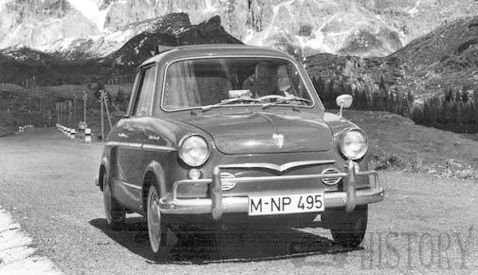
NSU Prinz III and Prinz 30 (Type 40)
| prinz III / prinz 30 | |
|---|---|
 |
|
| Production period: | 1960-1962 |
| Body versions : | limousine |
| Engines: | Gasoline engines : 0.58 liters (17-22 kW) |
| Length: | 3145 mm |
| Width: | 1420 mm |
| Height: | 1370 mm |
| Wheelbase : | 2000 mm |
| Curb weight : | 520-540 kg |
The version Prinz 30E was now called Prinz 30 and was taken over motor unchanged, but also benefited from the modernization described above. He had a heat exchanger heating and longer suspension travel than the normal prinz III.
Overall, the versions of prinz I-III (including prinz 30 and prinz 30 E) in four years 94.549 copies.

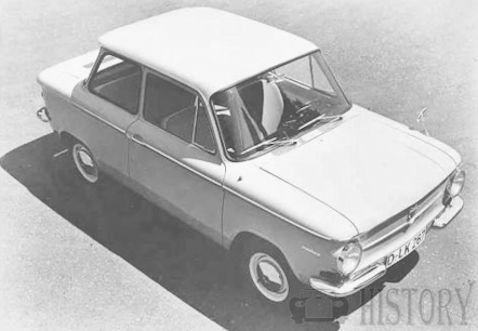
NSU Prinz 4, Prinz 4S and Prinz 4L (Type 47)
| Prinz 4 / Prinz 4S / Prinz 4L | |
|---|---|
 |
|
| Production period: | 1961 to 1973 |
| Class: | Motor Car |
| Engines: | Gasoline : 0.60 liters (22 kW) |
| Length: | 3440 mm |
| Width: | 1490 mm |
| Height: | 1360 mm |
| Wheelbase : | 2040 mm |
| Curb weight : | 570 kg |
Chassis and gearbox corresponded to those of Prinz III. Speculation for the first use of the Wankel engine was not fulfilled.The conventional engine now made 30 hp (22 kW) from 598 cc. This allowed a top speed of 116 km / h. The Prinz 4 weighed only 570 kg and had a maximum permissible weight of 1000 kg.with this layout the distribution of weight was 44% to front axle,and 56% at the rear axle.
PERFORMANCE
- engine capacity 36.49 cu in, 598 cu cm
- fuel consumption 49.5 mlimp gal, 41.3 m/US gal, 5.7 1 x 100 km
- max speed 74.6 mph, 120 km/h
- max power (DIN): 30 hp at 5,500 rpm
- max torque (DIN): 33 1b ft, 4.5 kg m at 3,250 rpm
- max engine rpm: 6,500
- specific power: 50.2 hp/l
- power-weight ratio: 40.8 lb/hp, 18.5 kg/hp
- acceleration: standing 1/4 mile 23.6 sec, 0—50 mph (0—80 km/h) 15.8 sec
The rarely purchased "Prinz 4" was the simple version (corresponding to the earlier Prinz I), while the "Prinz 4S" represented the normal version (corresponding to the earlier models Prinz II and III). These two versions were offered unchanged until March 1969.

From September 1965 came the version "Prinz 4L" with again improved equipment and sunshine roof option, which was built almost unchanged until April 1973. There were only minor changes, such as the front panel molding. Front disc brakes was now a option.
The vast majority of vehicles from the last years of production were sold to Italy, in the years 1968-1970 these were 123,338 of 170,080 manufactured copies, ie 72.5%. In total, about 570,000 NSU Prinz 4, Prinz 4S and Prinz 4L were created in twelve years.
In Egyptian Cairo, the NSU Prinz 4 was assembled for the local market by the Egyptian Light Transport Manufacturing Company as Ramses II . In Montevideo This rolled off the line at Nordex SA as P-1000 .The Prinz 4 is considered a stylistic model of the Soviet SAS-966 "Saporoshez" , which was built in 1966.

NSU sports prinz
 |
|
| Overview | |
|---|---|
| Manufacturer | NSU |
| Production | 1958 to 1967 |
| Class | Sports |
| Layout | Rear engine, rear drive. |
| Engine | Air-cooled 2-cylinder |
| Transmission | Four-speed manual |
| Wheel base | 79.13 in, 2,010 mm |
| Length | 140.16 in, 3,560 mm |
| Width | 59.84 in, 1,520 mm |
| Height | 48.62 in, 1,235 mm |
| Dry weight | 1,246 1b, 565 kg |
The NSU Sport Prinz was a Air-cooled rear engine rear wheel drive 2-cylinder 2+2 two door coupe. Built in Neckarsulm, Germany, from 1958 to 1968 in different variants.
History
The NSU Sport Prinz was a Air-cooled rear engine rear wheel drive 2-cylinder 2+2 two door coupe.It is not going too far to suggest that the little NSU Sport Prinz was really a sheep in wolf's clothing, as its very stylish fastback Bertone coupe body concealed nothing more dramatic and effective than a two-cylinder 598cc engine.
PERFORMANCE:583cc
- max power I(SAE): 36 hp at 5500 rpm
- max torque (DIN) 33 1b ft, 4.5 kgm at 3250 rpm
- max number of engine rpm: 6500
- specific power: 61.7 hp/l
- engine capacity 35.66 cu in, 583 cu cm
- fuel consumption 45.5 m imp gal, 37.9 m US gal,
- max speed 80.8 mph, 130 km h;
- max speed in 1st gear: 18.6 mph, 30 km/h; max speed in 2nd
- gear: 37.3 mph, 60 km/h; max speed in 3rd gear: 62.1 mph, 100 km/h
- max 80.8 mph, 130 km/h
- power-weight ratio: 34 lb/hp. 15.4 kg/hp
- acceleration: O 14.8 sec; speed in top at 1000 rpm: 11.8 mph, 19 km/h. 0—50 mph (0—80 km/h)
For all that, it was still quite a notable little car, which found its own limited but steady market. Initially, the sports prince had the air-cooled twin-cylinder engine of Prince II, but with an increased output of 20 to 30 hp (22 kW) and a maximum torque of 4.5 mkg (44 Nm) at 3500 / min. This performance remained unchanged, as the beginning of 1961, the displacement increased from 583 to 598 cc. The maximum speed of the 565 kg heavy car was about 120 km / h.
PERFORMANCE: 598CC
- engine capacity 36.49 cu in, 598 cu cm
- fuel consumption 53.3 m/imp gal, 44.4 m/US gal, 5.3 1 X 100 km
- max speed 80.8 mph, 130 km/h
- max power (SAE): 36 hp at 5,500 rpm
- max torque (DIN): 33 1b ft, 4.5 kg m at 3,250 rpm
- max engine rpm: 6,500
- specific power: 60.2 hp/l
- power-weight ratio: 34.6 lb/hp, 15.7 kg/hp
- acceleration: standing 1/4 mile 23.3 sec, 0—50 mph (0—80 km/h) 14 sec
- max speeds: 20.5 mph, 33 km/h in 1st gear; 37.9 mph, 61 km/h in 2nd gear; 59.7 mph, 96 km/h in 3rd gear; 80.8 mph, 130 km/h in 4th gear
The Prinz itself was NSU's own minicar design of the 1950s and, in the manner of the day, had a rear-engine layout. The Prinz, however, had its parallel twin-cylinder water-cooled engine mounted transversely behind the line of the final drive. The original car was an ugly little beast, and the Corvair-styled Prinz IV of 1961 came along after the Bertone coupe was finished. It was therefore quite remarkable that Bertone even took the trouble to make this silk purse out of what was undoubtedly a sow's ear.
The car's engineering was in steel, based on the pressed-steel floorpan of the at first. saloon, and included four-wheel independent suspension. Front wheel disc brakes were added to the specification from 1965.The chassis of the sports prince first came from Prince II . In autumn 1960, however, the coupe received the Prinz III chassis with longer suspension travel, front stabilizer and rubber extension springs the distribution of weightwas 44% to front axle,and 56% at rear axle. In 1964, it was adjusted to the Prince 4 and received at the front axle disc brakes instead of the previous drum brake Although not commercially important itself, it was significant because Bertone developed a spider version, and this was given the single-cylinder NSU Wankel engine to become the world's first Wankel-engined car to be sold commercially.
20,831 were built by then, of which 2,715 at Bertone.

Specification overview
Engine and transmission: Two-cylinders, in-line, with single-overhead-camshaft cylinder head. Bore, stroke and capacity 76 x 66mm., 598cc. Maximum power 30bhp (DIN) at 5500rpm.; maximum torque 331b.ft. at 3250rpm. Four-speed gearbox in unit with engine and transaxle.
Chassis: Rear engine, rear drive. Unit-construction bodyshell, styled by Bertone. Independent front suspension by coil springs and wishbones. Rack and pinion steering. Independent rear suspension by coil springs, swing axles, and supplementary air suspension units. Front wheel drum brakes (discs from 1965), rear drums.
Bodywork: Pressed-steel coupe unit-construction bodyshell, with 2 + 2 seating. Length llft. 8.1in.; width 5ft. Oin.; height 4ft. 0.6in. Unladen weight 12251b.
Performance: Maximum speed 75mph. 0-60mph 27.7sec. Standing IA-mile 23.5sec Typical fuel consumption 42mpg.

NSU Ro 80
| NSU | |
|---|---|
 |
|
| Ro 80 | |
| Production period: | 1967 to 1977 |
| Class : | Luxury |
| Body versions : | Large Saloon |
| Engines: | Wankel : 1.0 liter (85 kW) |
| Length: | 188.19 in, 4,780 |
| Width: | 69.29 in, 1,760 mm |
| Height: | 55.51 in, 1,410 mm |
| Wheelbase : | 112.60 in, 2,860 mm |
| Dry weight : | 2,668 1b, 1,210 kg |
The NSU Ro 80 was a sedan of the upper class of NSU engine works AG (from 1969: Audi NSU Auto Union AG ), which was produced from summer 1967 to mid-1977.
History
The Ro 80 appeared in October 1967 with a streamlined body , which seemed unusual at the time. As one of the few production vehicles he had a Wankel engine , which made 115 hp (85 kW). This engine made in the initial phase by frequent seal defects, but the manufacturer met with a fine engine replacement. Nevertheless, the reputation of the new model and the Wankel engine suffered considerably.
This is the first car to be designed and manufactured to exploit the rotary piston engine. Before this, NSU had only mounted the Wankel engine on a car that was already in production with traditional mechanical elements the Spider Print Sport. However, the history of the rotary piston already goes back more than fifteen years. Herr Wankel was director of the Lindau Institute of Technical Research when, in 195% he first got into touch with NSU for studies on a new engine. In 1954 the first experiments were carried out with a hepicotroid. that is to say an eight-sided, combustion chamber. Wankel demonstrated that a three-lobe rotor moving in this chamber completed a four-stroke cycle. In 1957 the new engine was built and bench tests Were carried out. In 1962 it was tried out on some boats and fire-engines. The first car with a Wankel engine was presented at the 1963 Frankfurt Motor Show.Since then. hundreds of vehicles have been produced by NSU and their performance on the road has fully satisfied their drivers. The Wankel engine left the experimental stage behind it and has become of interest to the most important motor manufacturers in the world.
In Japan the Mazda Cosmos was presented with a rotary piston engine. But this car too was adapted for use of the new engine and not designed expressly for the Wankel. The first car purposely designed for the Wankel is the NSU Ro 80. It is a very aerodynamic car, with a penetration coefficient of 0.35 wide, roomy and comfortable. Provided with all the most functional solutions, such as servo-assisted and remote controlled clutch, servo steering, servo brake, hydraulic torque convertor, and brake pedal pressure modulator. Everything. that is to say, that goes to make a car comfortable and restful. This is one of the advantages, too, of the rotary piston engine which ensures great freedom from noise and vibrations. In the Wankel engine. the piston does not slide up and down: that is to say there are no "alternating masses" since the piston rotates on its own axis. As far as power is concerned too, the advantages of the Wankel system are clear: it is enough to point out that in the Ro 80 a twin rotor engine with an engine capacity of less than 500 cu cm per rotor develops more than 113 hp. But one of the most important advantages of the Wankel engine is the very small amount of room it takes up. In theory.
The realized in the design of Claus Luthe wedge shape was style-defining in the automotive design of the 1980s. Especially at Audi, the appearance of the Ro 80 was decisive for entire vehicle generations. The vehicle offered plenty of space on the inside with a width of 1475 mm at the front and rear, legroom was great - knee room at the back 170-280 mm, with a seat depth of 475 mm. The trunk could be extended by separately removable backrests. The 83-liter fuel tank was installed outside the crumple zone in front of the rear axle. The interior noise was low (73 phon at 100 km / h). The distribution of weight was 54% to front axle,and 46% at rear axle.

From the Ro 80 until July 1977 only 37,406 copies were produced. This remained, technically, without successors. .The oldest surviving NSU Ro 80 carries the chassis no. 80 001 061, production date Thursday, October 19, 1967, color saguntoblau.The last Ro 80 was assembled in 1985 by Heinrich Afflerbach in Kreuztal-Eichen from a body shell and individual parts and in 1992 with manufacturer entry "Afflerbach" newly registered.The "ro" in the name stands for "rotary piston" as opposed to "K" as "piston" or "reciprocating" at Volkswagen K70 .Options include alloy wheels; sunshine roof.
PERFORMANCE
- engine capacity 30.36 x 2 cu in, 497.50 x 2 cu cm
- fuel consumption 25.2 m/imp gal, 21 m/US gal, 11.2 1 x 100 km
- max speed 111.9 mph, 180 km/h
- max power (DIN): 115 hp at 5.500 rpm
- max torque (DIN): 117 1b ft, 16.1 kg m at 4,500 rpm
- max engine rpm: 6.500
- power-weight ratio: 23.2 lb/hp, 10.5 kg/hp
- acceleration: standing 1/4 mile 20.1 sec; speed in top at 1,000 rpm: 18.8 mph, 30.3 km/h.
- max speeds: 46.6 mph, 75 km/h in 1st gear; 80.2 mph, 129 km/h in 2nd gear; 111.9 mph, 180 km/h in 3rd gear

Problems with the Wankel engine
In the first series engines, there was an increase in engine damage due to a design error. If the engines had held over 200,000 km in the test, they often lost in customer's hand quickly to compression . Soon a wrong combination of materials was recognized as the cause. Altered materials and a modified division of the sealing strips could solve the problems for the time being. In conjunction with a Ferro-TiC middle part and a harder Elnisilschicht with higher silicon carbide content was later returned to the original sealing pitch. From the beginning of 1970, the new Ferro-TiC sealing strips were introduced into the series. Also problematic proved the double ignition with two spark plugs per chamber, on the one hand by the setting and on the other hand because of the high burnup of the breaker contacts , which led to their damage by the shift of the ignition in the direction of pre-ignition to engine damage. This has been resolved by using only one spark plug per chamber in conjunction with high voltage capacitor ignition (HCC) at the expense of fuel consumption. The obliging exchange practice led at times to the fact that over 35% of the allegedly defective engines were fine. After the ignition and the carburetorwere reset and the engine had undergone a test run on the test bench, these engines were again delivered as replacement engines.
A significant proportion of engine damage was due to the torque converter , which was built against the Schieberuckeln (caused by the peripheral inlet) and was partly responsible for the additional consumption of the Ro 80. Since the Wankel engine was able to turn very high due to a lack of speed limitation, the torque converter often expanded radially so far that the pump and the turbine wheel collided. Since the converter was also part of the engine oil circuit, thereby metal chips came into the engine, which immediately led to engine damage. Also, a small needle bearing provedIn the converter as vulnerable, whose frequent failure also led to chips in the engine oil and thus indirectly to a defective engine. This was fixed by a reinforced converter. From autumn 1971, an acoustic speed monitor was introduced in conjunction with the new HKZ from Bosch and the thermal exhaust gas decontamination and the electric fuel pump switched off at too high engine speed, which prevented further engine damage.
First of all, an oil change was necessary every 20,000 km , which later disappeared. So many drivers believed that they no longer had to refill oil, leaving some engines without oil. This type of engine damage was encountered with a modified double-flow oil pump. The inlet for the converter circuit was set higher. Before the engine oil circuit got no more lubricant, the converter circuit sucked air, whereupon the converter oil pressure dropped and the oil pressure indicator lit up. If the driver ignored the warning lamp, the converter no longer transmitted power to the transmission and the car stopped. By now, the careless driver knew he had forgotten to control the oil level.
Another problem that also directly led to engine damage was an oil metering pump without a zero stop. This meant that if the pump was set incorrectly at idle, no oil was supplied to lubricate the combustion chamber (Trochoid) . Then a modified oil metering pump was used, which could not be set to zero.
It was also problematic to introduce several previously untried methods in connection with the Wankel engine. So it was said by the Elnisilverfahren jokingly, it only works in the south wind, which alluded to the weather sensitivity. Also, there were initially problems with the dosage and grain size of the embedded silicon carbide and the dosage of saccharin (which is used in electroplating as a leveler for nickel layers). Some of the workshops were overwhelmed with the technology around the engine. Some customers also developed criminal energy: shortly before the warranty expired, they deliberately provoked an engine failure in order to obtain a replacement engine at no cost.
When the sealing strip problem seemed solved, it came back to heaped engine damage. This time, however, this was not due to a design flaw, but to a supplier who did not comply with the manufacturing regulations.
In the last versions of the motors, the sealing strips consisted entirely of Ferro-TiC. These aggregates proved to be extremely robust. This last version had a long service life and operation with the lead-free fuel imported in other countries was easily possible for the Ro 80's Wankel engine.In 1971, the study Ro 80 2 Porte +2 was presented at the Motor Show Turin . This designed by Pininfarina model should be the successor to the Ro 80, but did not go into series. The technical data were taken over from the Ro 80 as far as possible. A special feature was the rear doors, the opposite, so at the C-pillar , were struck. These popularly called suicide doorsKnown doors have been banned in Germany since 1961, because they are not closed by unintentional opening while driving through the wind, but are suddenly torn open. For this reason, the rear doors of the Ro 80 2 Porte +2 were partially overlapped by the front ones so that they could only be opened with the front doors open. Another special feature was the roof, which could be folded back to a large extent and placed on the boot lid. This construction was a forerunner of today's retractable hardtop . To improve the side impact protection, the doors were specially reinforced. Volvo took this idea in 1991 with its Side Impact Protection Systemup again. In 1971, however, the vehicle was too futuristic, so the development was discontinued.
Overview
- Engine : Two-disc rotary engine (System Wankel) 497.50 cc per chamber, compression 9.0: 1.
- Ignition : from 1967 to 1969 dual ignition (two candles per chamber), from 1969 to 1977 high voltage capacitor ignition (HKZ) with a candle
- Mixture preparation : 2 Solex-type Regulator Type 18/32 HHD or Double Dump Solex 32 DDITS
- Power : 85 kW (115 hp) at 5500 rpm, max. Torque 165 Nm at 4500 rpm
- Body : Self-supporting, front-wheel drive, front MacPherson strut axle , rear semi-trailing axle with spring-damper units and rubber extension springs
- Brakes : hydraulically operated with brake booster and load-dependent brake power regulator on the rear axle, four disc brakes, front on the inside of the gearbox; Handbrake: mechanical inner brake acting on rear wheels, 160 mm diameter. Front discs: 284 mm, rear: 272.5 mm diameter. Dual-circuit brake system, first brake circuit on all wheels, second brake circuit acting only on the front wheels
- Transmission : Three-speed gear change gear, lock-locked with parking lock. Hydraulic Fichtel & Sachs torque converter with single-disc disconnect clutch, electro-pneumatically operated


