Nash
Nash 660 (Six-Sixty)
 |
|
|
Production |
1931 |
|
Assembly |
United States |
|
Class |
Motor Car |
|
Body |
|
|
Engine |
3,299 cc |
|
Transmission |
3-speed manual |
|
Drive |
Rear wheel |
|
Wheelbase |
2,902 mm |
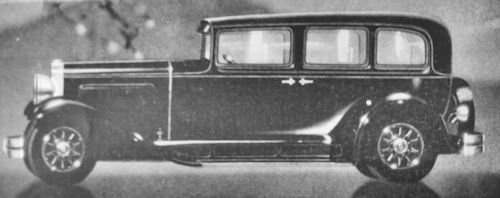
The Nash 660 (pronounced Six-Sixty ) was a series of six-cylinder cars of the Nash Motors Company in Kenosha . This was replaced with his more powerful eight-cylinder sister model 870 the Single Six and was made only in the model year 1931. The following year, the series was renamed Nash 960 (pronounced: Nine-Sixty ).
The 660 took over the chassis with 2,902 mm wheelbase from its predecessor.
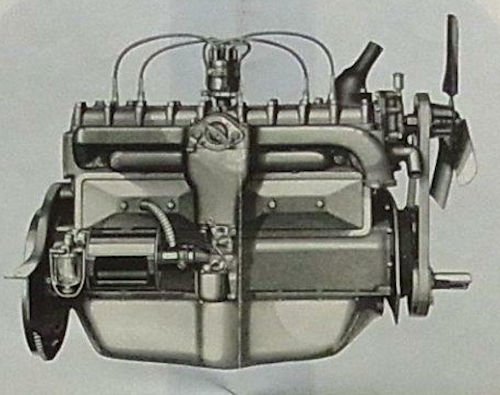
The side-controlled six-cylinder inline engine with 3,299 cc displacement (bore × stroke = 79.4 mm × 111.1 mm) came from the previous year. However, he now made 65 bhp (48 kW) at 3,200 rpm. The motor is the powerful Nash, high-turbulence type. It has big main bearings, instead of the customary 3 or 4 bearing on each side or each connecting rod and runs smoother, quieter and longer lived. Aluminium alloy (Invar strut) pistons are used, instead of the cast-iron type Six connecting rods are drilled for feed lubrication to the piston pins and cylinder Crankshaft flywheel and clutch are balanced. And a torsional vibration still further smoothed the action of this quiet running motor.
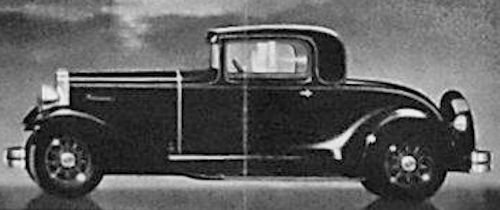
The drive and brake components (single-disc dry clutch, 3-speed mid-range gearbox, rear-wheel drive, mechanical brakes on all four wheels) also came from the previous year's model. There was ac, two different 2-door coupes and a 4-door sports Phaeton.
Equipment .Three-spoke steering Wheel/ with steel core encased in hard rubber, giving clear vision of all operating instruments; throttle and lighting switch on steering wheel with horn button in centre. Heat indicator, hydrostatic gasoline gauge, speedometer, oil pressure gauge, ammeter, carburettor heat control button and choke button on indirectly-lighted instrument panel. Starter button on dash. Coincidental lock on steering post bracket. Twin ventilators on top of cowl with operating levers directly underneath instrument board. Automatic windshield wiper; rear view mirror. Chromium-plated head lamps. Combined stop and tail light. Interior hardware, silver finished; exterior hardware, chromium plated. Front dash board insulated against heat, cold and noise. One-piece fenders.
Coupes are upholstered in mohair (leather optional at no extra charge), have adjustable driver's seat, crank Operated windshield, curtain on rear window and lock type door handle on rear deck door. Coupe with rumble seat has an adjustable rear window. Sport Phaeton is upholstered in leather has a folding windshield, folding top boot, side curtains that open with doors, large pockets in doors, foot rest and robe rail in rear tonneau.
Sedan models are upholstered in mohair, have adjustable driver's seat, crank operated windshield, arm rests, dome light. foot rest, and curtains on back and rear quarter windows. The '4-door Sedan has smoking set, robe rail an assist cord. The 2-door Sedan also has a shirred door pocket.
The 1932 model was introduced on June 1, 1931, showed no major changes and was now the 960 . As with the larger 990 , 980 and 970 models , the grille got a slight V-shape and the main headlights got a more elongated (rocket) shape. Instead of the two superimposed front bumper parts, there was a one-piece bumper.
Already on March 1, 1932 replaced the Big Six Model 1060 model series.
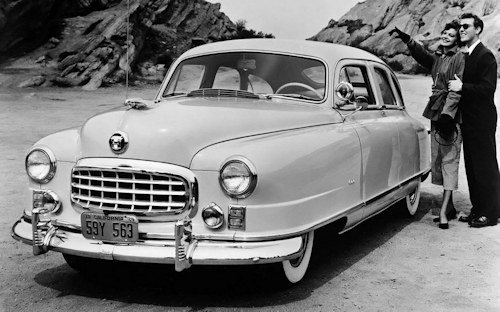
Nash Ambassador 1949 to 1951
 |
|
|
Type |
motor car |
|
years |
1949 to 1951 |
|
Layout |
Longitudinal front-engine, rear-wheel drive |
|
Engine |
236.6 cu in (3.8 L) I6 |
|
Wheelbase |
3,073 mm |
|
Length |
5,105 mm |
|
Width |
1,968 mm |
|
Height |
1,613 mm |
Nash continued to use the name Ambassador post war from 1949 to 1957 for its best-equipped models.
History
George Mason, president of the Nash-Kelvinator Corporation, was a staunch proponent of aerodynamics in vehicle manufacturing, and so the post-war Ambassador is particularly known for its front faired wheels. As Nash his new Airflyte Design, the Ambassador sales increased significantly, with only 2- and 4-door sedans were offered in the years 1949-1951.
The Airflytes had also completely convertible seats, with which you could make such a car for a sleeping place for 3 adults. This gave the car but also the dubious reputation of becoming the first choice for teenagers in the 1950s.
The Ambassador of 1950 was the first car that did not come from GM and was equipped with a GM-Hydramatic automatic transmission.A six 3.8 L cylinder engine (234.8 cu).The Ambassador series continued to have a 121 in (3,073 mm) wheelbase.
Mason thought Nash's biggest market opportunities lay in a range of products that was not aimed at the market segments cared for by other US automakers - the compact car. The sales figures of the big Nash models were higher than before the war and Mason launched a program for smaller cars, such as the Nash Rambler , which revived the traditional brand Rambler .
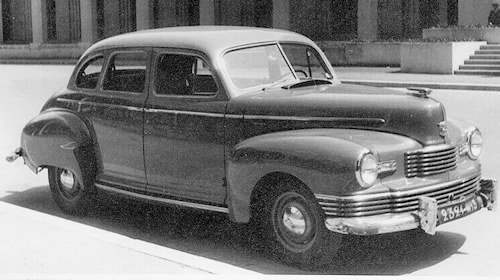
Nash Ambassador 1932 to 1948
 |
|
|
Type |
motor car |
|
years |
mid 1932 to 1948 |
|
Layout |
Longitudinal front-engine, rear-wheel drive |
|
Engine |
straight 6 and 8 |
|
Wheelbase |
3175-3607 mm |
Mid-1932 Nash introduced the Ambassador Eight as a separate model, which was offered in a number of body styles - also as a coupe and Victoria.
History
The Nash Ambassador with a wheelbases of 3378 mm and 3607 mm and costly equipped, these vehicles were named for their high quality, durability, styling and high speed . They were part of the second series that Nash released in 1932 and had completely new bodies and technical improvements on all vehicles manufactured by the company fitted with a large 5.3 L straight-eight engine. Except for General Motors Nash was the only US automaker to make a profit in 1932. In 1934, Nash introduced a new styling - called "Speedstream" - which included extensive adornments on body parts and fenders in Art Deco style . The Ambassador Eight offered only a few 4-door sedan versions this year. In 1935, another facelift was carried out with even more ornaments and offered in addition to a 2-door sedan. The car now had a smaller wheelbase of 3175 mm and the smaller engine of the earlier model Advanced Eight . The huge classic forms of 1930-1934 were forever gone for Nash.
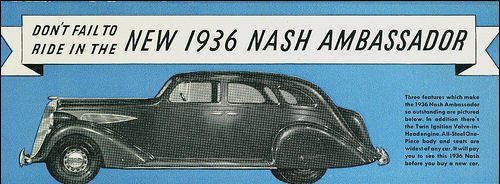
While the Ambassador was offered from mid-1932 to 1935 only with Nash's inline eight-cylinder engine, there was in the Ambassador Six of 1936, the largest straight-six from Nash, in a model with 3073 mm wheelbase, which previously knew as Advanced Six. 1937 Nash merged with the Kelvinator Corporation and Charlie Nash's handpicked successor George W. Masonbecame president of the new Nash-Kelvinator Corporation. In the same year, the coupes and convertibles returned to the Ambassador series. Since 1935, the big Nash models had had similar bodies built on the longer chassis, as well as the same bonnets, fenders (and certain ornaments) that distinguished the more expensive eight-cylinders from the cheaper six-cylinders.
In early 1937 even the cheap LaFayette was included in this scheme. This principle was used until the last AMC Ambassador 1974, with the exception of the years 1962-1964, when the Rambler Ambassador and the Rambler Classic hadthe same chassis and the same vehicle front.
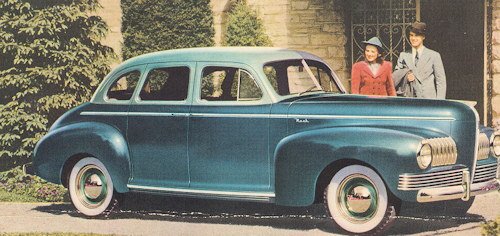
Only in the model year 1941 all Nash models with long and short chassis bore the name Ambassador. The Nash Ambassador 600 with a wheelbase of 2845 mm was the first mass-produced automobile with monocoque construction. From 1941 to 1948, the Nash Ambassadors were made with this monocoque construction (frame and body welded) built on a conventional second frame, making them incredibly stiff and solid automobiles. The Ambassador 600 of 1941 was also the only Ambassador, which was powered by a side-drive engine (L-Head). In the (war-related) short model year 1942 Nash remained with this construction, whereby the 600 was no longer called Ambassador.
As ordered by the US government, Nash ceased passenger car production during the Second World War (1942-1945). When production was resumed after the war, there were no more eight-cylinder models in the model range. The 1946 Ambassador Six was now the largest model of Nash.In the area of the Soviet occupation zone, a copy of an Ambassador 1948 is said to have served as a template for an in-house development (Horch 920 S). However, only two prototypes were created in 1950 ("IFA factory VEB Horch").
Nash Ambassador 1952-1957
 |
|
|
Type |
motor car |
|
Body style |
2-door sedan ,4-door sedan ,2-door hardtop |
|
Layout |
Longitudinal front-engine, rear-wheel drive |
|
Engine |
|
|
Transmission |
|
|
Wheelbase |
121.25 in (3,080 mm) |
|
Length |
204.25 in (5,188 mm) |
|
Width |
78 in (2,000 mm) |
|
Height |
62.25 in (1,581 mm) |
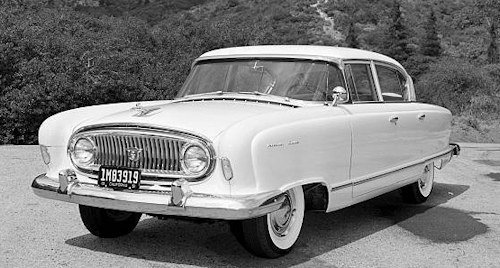
The Nash Ambassador was last changed in 1952 .It received a complete restyle for that 50s look.
History
in 1952 Ambassador was available in "Super" and "Custom" series Standard with the Super Jetfire 4.1 L 252.6 cu in with 120 hp straight 6 engine.By 1953 the Ambassador received minor changes.
In 1954 there was only a small facelift. The Golden Anniversary Pininfarina Nash - designed by Pininfarina - has received several design awards. Because of the material shortage caused by the Korean War , the sales figures of Nash as well as those of other automakers in 1952 fell significantly. The 1954 Cheers between Fordand Chevrolet damaged many independent automakers, including Nash. The Airflytes launched in 1955 under Director Edmund E. Anderson vigorously redesigned in their last sales season. Panoramic windshields, who were walking around the A-pillars, showed themselves with brand-new vehicle fronts and backs that showed more from the front wheels than Nash had revealed since his 1949s. The Ambassador Super Jetfire was now 130hp and was now for the first time with the 5.2 L 320 cu in V8 engine that produced 120 hp. It came from Packard and was interlocked with the Packard Ultramatic automatic transmission.
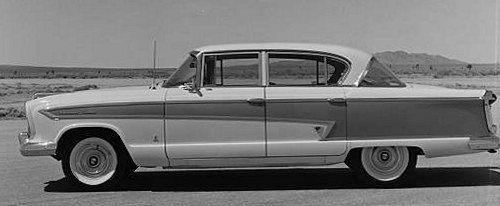
Nash in 1956/1957offering a range of two- and three-color finishes. The 1957 models had double headlights as standard for the first time. While the Ambassador's styling might have suffered a bit, Nash could offer the car with the oft-announced "Weather Eye" heating and ventilation system, to which Nash's state-of-the-art air conditioning system could also be connected. Other automakers in the US also offered air conditioning in some models, but they had large boot-mounted relaxation units and heat exchangers that supplied air to the interior of the vehicle through clear plastic pipes and roof-mounted fans. Nash's air conditioning was cheap, space-saving and fitted under the hood.The V8 engine, a overhead valve type design with 327 cu in (5.4 L). It featured a forged steel crankshaft, and a 4-barrel carburetor.
Nash-Kelvinator merged with the adjoining Hudson Motor Car Co. in April 1954 and formed the American Motors Corporation(AMC). Both Nash and Hudson dealers now sold identical ramblers, which differed only by different logos. Likewise, the large model series of Nash and Hudson were resold, while the Rambler represented the new company in the lower market segment. As the Rambler's sales increased, so did the big Nash models, including the Ambassador.
The last Ambassador left the factory in Kenosha in the summer of 1957. Nevertheless, the name Ambassador still existed - as a term for the top models - at Rambler and AMC until 1974.
Nash Rambler
 |
|
|
Body style |
|
|
type |
motor car |
|
Engine |
172.6 cu in (2.8 L) I6 |
|
Years |
1950 to 1956 |
|
Wheelbase |
100 in (2,540 mm) |
|
Length |
176 in (4,470 mm) |
|
Height |
59.75 in (1,518 mm) |
|
Curb weight |
Approximate: 2,500 lb (1,134 kg) |
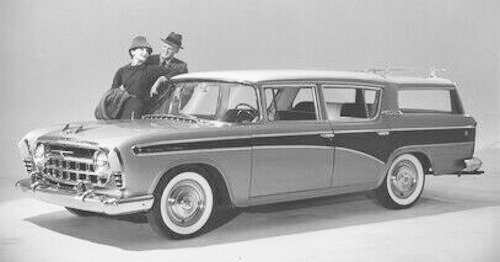
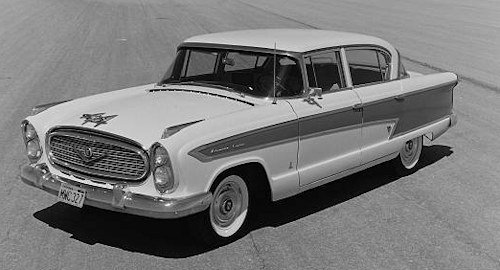
The Nash Rambler was a US automobile manufactured by Nash Motors , automobile division of Nash-Kelvinator Corporation , from 1950 to 1956.
History
Nash-Kelvinator Corporation's CEO, George Walter Mason , recognized that the company needed to launch more competitive models and insisted that a new car had to be different from existing models on the market. The Rambler was constructed smaller than most contemporary American cars, but also provided enough space for five people. The Nash Rambler created a new segment in the automotive market and is widely regarded as the first modern American compact car .
During development, the vehicle was originally given the name Diplomat at Nash . This name would have fit well with the previous models, since the "600" from 1950 Statesman was called and the Ambassador was the flagship of the brand. But Dodge had already reserved this name for a planned two-door coupe, and so Nash remembered his past and revived the name Rambler from 1902 again. The Rambler was then one of the most popular American cars. Likewise, the new Nash Rambler was highly respected during its entire production period 1950-1956.
1950-1952
The Nash Rambler was introduced to the 1950 model year. It was the brand's contribution to the so-called low-price segment dominated by models from Chevrolet , Ford and Plymouth . The Rambler was lighter and smaller than other popular cars. This allowed Nash to save on production material, and customers had the benefit of lower gas mileage. The car had 2540 mm wheelbase and was from a proven inline six-cylinder engine with 2.83 ltr. Displacement and L-Head (side valves) driven, which developed 82 SAE-PS (61 kW).
The new Rambler was also introduced as a noble 2-door convertible - referred to as " Landau ". The decision to offer this car model in a higher market segment with better equipment had been well thought out by Mason. First and foremost, he wanted to give the new Rambler a positive image. Mason knew the car would fail customers if they saw in it only a "cheap little car." He already knew what Crosley had just discovered in his mini-car series, and the Kaiser-Frazer Corporation had yet to learn on its Henry J model : Americans would rather buy a nice used car than a new car that is said to be of low standard ,
Other factors that played a role in Rambler's marketing strategy were the reduced supply of steel from the Korean War and Nash's profit maximization strategy. The desire to achieve the highest possible profit in sales meant that the Rambler in the initially expected low production figures in the price was significantly higher than the base models of the competition. To increase the value for the buyers, the cars were very well equipped. As with whitewall tires , electric timer and an AM radio with push buttons.
Just like the larger Nash models, the compact Rambler had rounded shapes and a pontoon body with complete wheel covers that also included the front wheels. However, this equipment did not affect the tropic of the car too much. Contrary to the customary practice of frameless side windows for convertibles, the Rambler had a fixed roof structure above the doors and side window frames. These metal structures served as guide rails for the opening, waterproof top. This design allowed Nash to use his monocoque body for the new compact car. She made the Rambler very torsionally stiff for an open car, without the additional body stiffeners required on other convertibles.
In 1951, the Rambler series was extended by a 3-door station wagon and a 2-door hardtop coupe. This was called Country Club .
1953-1955
In 1953, the Rambler was redesigned for the first time, looking very much like the larger Nash models that received the new "Airflyte" styling last year. A 2-door sedan was offered from 1953 additionally. 1954 came a 4-door sedan and a 5-door station wagon - called "Cross Country" - in addition. The 4- and 5-door had a wheelbase of 1743 mm. From 1955 the front wheel cutouts were no longer covered.
On January 14, 1954, Nash merged with the Hudson Motor Car Co. to American Motors Corporation (AMC). As a result, the Rambler were also offered as Hudson Rambler at the dealers of this brand. Both models were identical.
1956-1957
For 1956, American Motors designed a brand new Rambler. They chose a wheelbase of 2743 mm, and the vehicle got longer. Again, the Rambler was sold as Nash and Hudson. It only came with 4 and 5 doors. In addition to the sedan and the station wagon also a new, 4-door hardtop sedan was offered. In addition, the Rambler was the first car that existed as a hardtop station wagon. Rambler became an independent brand in 1957 ; the names Nash and Hudson fell away. Also from 1957 V8 engines were available in the Rambler. It was AMC 's self - developed 4.1 - liter engine that was introduced the previous year in the Nash Ambassador Special and the Hudson Hornet Special. Only in 1957 was a special high-performance hardtop sedan called Rambler Rebel . This car had the new 5.4 - liter V8 engine from AMC. In the larger cars of the group, the Nash Ambassador and the Hudson Hornet this year, this machine was also used. It was planned to equip the Rebel with a port injection , but cold start problems prevented this use in the last minute. The Rebel, which was made only in small numbers (1,500), was a precursor of the muscle cars that became popular in the 1960s.
From 1958 Rambler was the only brand of American Motors Corporation, after the brands Nash and Hudson were abandoned. The smaller model was now offered as Rambler American , the larger, introduced in 1956 model was first Rambler Six (or Rambler V8), from 1961 then Rambler Classic .