
Mitsubishi
- Details
- Parent Category: M
- Category: Mitsubishi
- Hits: 56
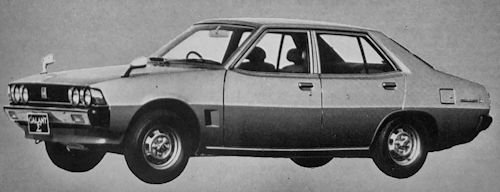
Mitsubishi Galant Sigma Third generation (A120)
 |
|
|
Also called |
|
|
Production |
1976 to 1982 |
|
Class |
Motor Car |
|
Body style |
|
|
Layout |
Front-engine, rear-wheel-drive |
|
Engine |
|
|
Wheelbase |
2,515 mm (99.0 in) |
|
Length |
4,300–4,450 mm (169.3–175.2 in) (sedan) |
|
Width |
1,655 mm (65.2 in) |
|
Height |
1,360 mm (53.5 in) (sedan) |
|
Curb weight |
970–1,270 kg |
Introduced in mid-1976 and named in Japan Galant Σ (Sigma) third Galant was also offered in Europe in February 1977 under the name Mitsubishi Galant , while the station wagon was sold in North America as Dodge Colt. In Australia, where the model was assembled in a Chrysler plant, it ran under the name Chrysler Sigma.
This generation existed only as a four-door sedan and five-door station wagon. As a coupe variant of Mitsubishi Sapporo introduced in the fall of 1975 , which was called in Japan Galant (lambda) and in Australia Chrysler Scorpion.
The main technical feature of this series were the MCA jet engines with "Jet Valve", an additional intake valve per cylinder, which made it possible to reduce exhaust emissions without having to thoroughly rework the cylinder head, as well as the patented balance shafts to increase smoothness.
PERFORMANCE
- 1,597 cc
max power (JIS): 86 hp at 5,000 rpm
max torque (JIS): 98 1b ft, 13.5 kg m at 3,000 rpm
max engine rpm: 5,700; 53.8 hp/l - 1,855 cc
max power (JIS): 97 hp at 5,700 rpm
max torque (JIS): 107 1b ft, 14.7 kg m at 3,800 rpm
max engine rpm: 6,200; 52.3 hp/l - 1,995 cc
max power (JIS): 105 hp at 5,400 rpm
max torque (JIS): 119 1b ft, 16.5 kg m at 3,500 rpm
- Details
- Parent Category: M
- Category: Mitsubishi
- Hits: 170
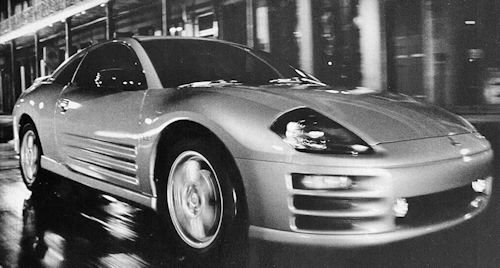
Mitsubishi Eclipse Third generation
 |
|
|
Model years |
2000 to 2005 |
|
Assembly |
United States |
|
Body style |
3-door lift back coupé ,2-door convertible |
|
Layout |
Front-engine, front-wheel-drive |
|
Engine |
2.4 L 150 hp (110 kW) 4G64 I4 |
|
Transmission |
4-speed automatic |
|
Wheelbase |
2,560 mm (100.8 in) |
|
Length |
2004–05: 4,491 mm (176.8 in) |
|
Width |
1,750 mm (68.9 in) |
|
Height |
Coupe: 1,311 mm (51.6 in) |
|
Curb weight |
2.4 coupe: 1,280 kg (2,822 lb) |
In the spring of 2000, the third generation of the sports coupe came on the market. This Eclipse was almost exclusively offered only in the US. In the last year of production, a limited number of units went to Japan for sale as a coupe and as a Spyder.
Mitsubishi Eclipse 3rd Generation History
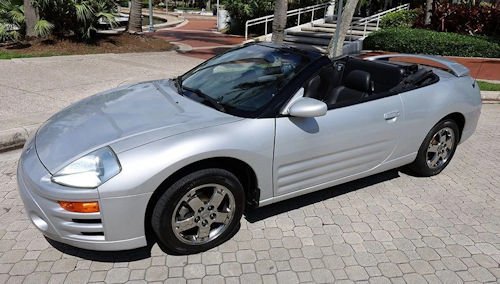
The Eclipse comes as a hatcback coupe and Spyder convertible. Both body styles come in GS and GT trim, also the RS coupe. GTS have a standard V6, other Eclipses a 4-cylinder engine.
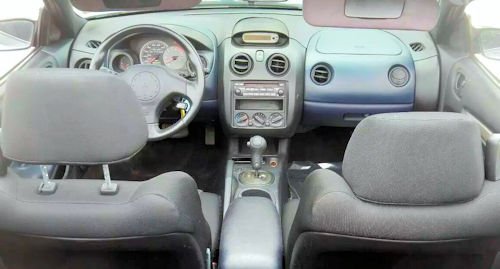
standards include alloy wheels, air conditioning, CD stereo, power windows and locks, and engine immobilizer. Manual transmission is standard for all, with automatic optional; the GT automatic has a separate gate for manual shifting. Spyders include a power soft top with glass rear window. The driving position is low-slung, but all models have seat-height adjustment. Gauges and most switchgear are clear and handy. Luggage space is generous in coupes with the rear seat folded, limited in Spyders.
The basis for the engine was a 2.4-l four-cylinder (D50) with about 114 kW / 154 hp, which was available in the model variants GS and RS . The turbo version known from its predecessor was replaced by a 3.0l V6 engine (D53a) with 151 kW / 205 hp for the GT model. The RS has 15-inch wheels and tires, GS models 16s, and GTS add 17-inch wheels, lower-body skirts, and rear disc brakes instead of drums.
Front side airbags are available only for GTS in a Premium Package option along with antilock brakes and, with automatic transmission, traction control. Antilock brakes are standard on the GT Spyder. Leather upholstery is available for GTS and the GS Spyder.
For 2001, coupes add rear child-seat anchors, and the GS and GT gain a standard rear spoiler. Also new is a GS coupe Sun and Sound package comprising sunroof and premium audio; a similar Sun, Sound and Leather package with leather upholstery is available for the GT coupe. From spring 2003 there was a small facelift for the Eclipse with modified front bumper and the modified fuel cap. The GT got the name GTS, and the 3.0l V6 engine came now due to a modified intake (variable intake manifold) to 154 kW / 210 hp.
The offered engines were available in two different emission standards: Fed-Spec (Federal Specification) and Cal-Spec (California Specification). In the Cal-Spec, the V6 engine of the GT / GTS, compared to the Fed-Spec, has two pre-catalytic converters that ensure earlier and better exhaust aftertreatment.
In Europe, this car was available only as a gray import . The spare parts usually compensated by equivalent spare parts from the Mitsubishi Galant V6 24V.
STANDARD EQUIPMENT:
RS: 2.4-liter 4-cylinder engine, 5-speed manual or 4-speed automatic transmission, dual front airbags, variable-assist power steering, tilt steering wheel, air conditioning, interior air filter, cloth upholstery, front bucket seat w/driver height adjustment, center console, cupholders, folding rear seat, power windows, power door locks, AWFWCD player, digital dock,tachometer, variable-intermittent wipers, map lights, auxiliary power outlets, remote hatch release, visor mirrors, rear defogger, cargo cover, automatic-off headlights, floomats, theft-deterrent system, dual outside mirrors, 195/65HR15 tires, alloy wheels.
GS hatchback adds: 5-speed manual or 4-speed automatic transmission w/manual-shift capability, cruise control, leather-wrapped steering wheel, power mirrors, split folding rear seat, rear spoiler, 205/55HR16 tires.
GS convertible adds: Infinity sound system, remote keyless entry, non-folding rear seat, power convertible top, fog lights.
GT adds to GS hatchback or GS convertible: 3.0-liter V6 engine, 4-wheel disc brakes, power antenna (convertible), sport suspension, fog lights, 215/50VR17 tires.
The top speed is 240 km / h (electronically limited), and the acceleration from 0 to 100 km / h takes place in 7.2 s.
In the spring of 2005, the 3rd series was discontinued.
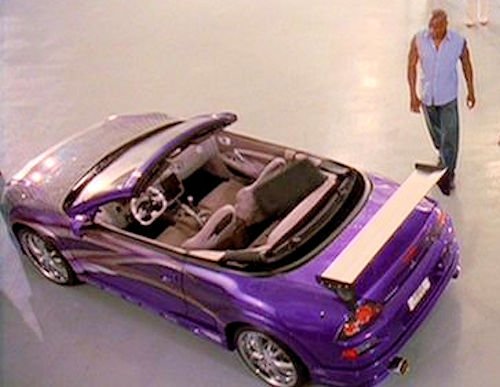
2003 Mitsubishi Eclipse Spyder GTS in 2 Fast 2 Furious, Movie, 2003
- Details
- Parent Category: M
- Category: Mitsubishi
- Hits: 315
Mitsubishi Eclipse 2nd generation
 |
|
|
Model years |
1995 to 1999 |
|
Assembly |
United States: |
|
Body style |
3-door lift back coupé |
|
Layout |
Front-engine, front-wheel-drive |
|
Platform |
Mitsubishi D/Chrysler PJ platform |
|
Engine |
|
|
Transmission |
4-speed automatic |
|
Wheelbase |
2,510 mm (98.8 in) |
|
Length |
1995–96: 4,370 mm (172.2 in) |
|
Width |
1,740 mm (68.7 in) |
|
Height |
1995–96: 1,280 mm (50.2 in) |
|
Curb weight |
RS/GS: 1,235 kg (2,723 lb) |
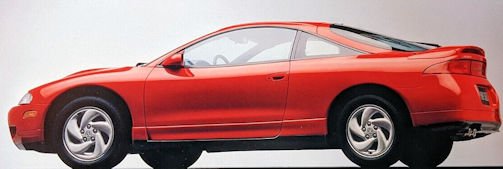
In autumn 1995, the second generation came on the market, which in the US as a basic model (without turbocharger) another engine of Chrysler (2.0 l DOHC, engine code: D420A) possessed. In the GS-T and GSX remained in the US, the 4G63 engines (which were also installed in the Mitsubishi Lancer Evolution) as the predecessor largely the same. Eclipse comes in hatchback and Spyder convertible form, all with 4-cylinder engines.
History
The RS and GS coupes use a 2.0 Liter, the GS Spyder a 2.4. A turbocharged 2.0 powers the GS-T coupe, Spyder, and GSX coupe. The GSX has all-wheel drive;
other models are front drive. All offer manual transmission or optional automatic. Convertibles have a power top and glass rear window. For the EU, again only the basic model with 4G63 engine (up to 1996: emission classification Euro 1 with 107 kW and Euro 2 with 104 kW) was available for sale, externally only with the standard double pipe exhaust on the older Euro 1 Version recognizable.
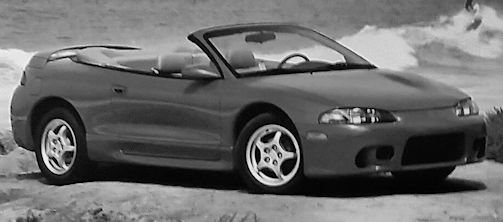
In contrast to the previous model, there was also a "Spyder" convertible version. This full-top convertible with soft top was offered on the 2.4-liter 4G64 105 kW (143 hp) naturally aspirated engine as well as in the 2.0-l GS-T turbocharged version with the 157 kW (214 hp) 4G63T engine. However, Mitsubishi did not sell the Spyder in Europe.
1996 Updates
Eclipse GS Powered by a 2.0-liter, 140-horsepower, double overhead camshaft (DOHC), 16-valve engine, with 4-speed automatic transmission receives a new on-board diagnostic system (OBD II) 5-speed Eclipse GS has met OBD Il requirements since the 1995 model year and the Mitsubishi HomeLink System. Mitsubishi HomeLink enables the driver to control as many as three radio frequency devices (such as garage door opener, home security system, and an available home lighting system), providing safety and convenience. Three bold new exterior colours improve the appearance of '96 Eclipses: Oslo Green Pearl; Monarch Green Pearl and Celtic Blue Pearl. Standard features on Eclipse GS include: split fold-down rear seat; height-adjustable steering column; driver- and front passenger-side air bags; integrated fog lamps; full instrumentation and waning lights; 6-speaker AM/FM stereo cassette player; power remote-control sideview mirrors; and 16-inch wheels and tires.
New for 1996 features on Eclipse GSX include: the Mitsubishi HomeLink System, which enables the driver to control as many as three radio frequency devices (such as garage door opener, home security system, and an available home lighting system); a new Mitsubishi 'infinity' premium audio stereo system with optional 10-disc compact disc auto-changer, and a new panic button feature for the Remote Keyless Entry and Security System option. Standard features on Eclipse GSX include: diver- and front passenger-side air bags; full leather seating areas on front seats, with power driver's seat; power windows and door locks; integrated fog lamps; and 16-inch alloy wheels.
In the summer of 1998, the Eclipse received a facelift (modified bumpers, side skirts, headlights / fog lights, colour of the interior and fabric of the seats). In addition, the ABS supplied by Bosch was overhauled, which very often failed in the years of construction 1995 to 1997 (splashing water damage in the ABS hydraulic block). With the introduction of a new ABS, the passenger footwell became deeper because the control unit was integrated into the ABS hydraulic block for this purpose. This year, anti-lock brakes are newly standard on the GSX; they remain optional for other Eclipses except the RS. The GSX also gets a limited-slip rear differential as standard, while the GS-T coupe adds a power moonroof and keyless-entry security system. White-face gauges are newly standard on GSX and both GS-Ts, and are included in a new Sports Value Package option that dresses up the GS coupe with a GSX-style rear spoiler, air conditioning, the security system, leather front-seat surfaces, in-dash CD player, and power windows, locks, and moonroof. A CD player is newly standard on the RS.
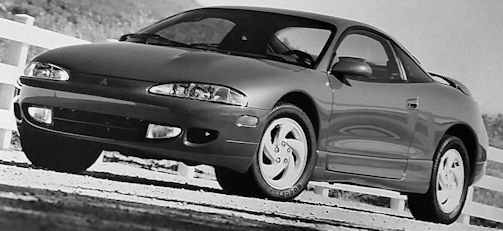
The base 2.0-liter engine is the same Chrysler-designed 4-cylinder used in the Dodge and Plymouth. Acceleration with automatic is ok for a sports coupe. Progress is livelier with the slick-shifting 5-speed. Eclipse GSX is the ultimate Eclipse model with its 210-horsepower (hp) with optional automatic 4-speed electronically controlled transmission, Eclipse GSX's turbocharged, intercooled, double overhead camshaft (DOHC), 16-valve engine revs freely as Mitsubishi Motors' advanced full-time All-Wheel Drive (AWD) system grips the road firmly. Four-wheel disc brakes with optional anti-lock braking system (ABS) bring the vehicle to a halt decisively.
- 2.0 l, 1997 cc, R4, 107 kW (146 hp) until 1996
Acceleration 0-100 km / h in 9.4 s, top speed 220 km / h.
- 2.0 l, 1997 cc, R4, 104 kW (141 hp) from 1996
Acceleration 0-100 km / h in 9.5 s, top speed 217 km / h.
Mitsubishi Eclipse GS Spyder
- 2.4 l, 2389 cc, R4, 105 kW (143 hp)
Mitsubishi Eclipse GS-T Spyder
- 2.0 l, 1997 cc, R4 Turbo, 157 kW (214 hp)
Mitsubishi Eclipse GSX and GS-T
- 2.0 l, 1997 cc, R4 Turbo, 157 kW (214 hp)
GST accelerates from 0-100 km / h in 6.8 s.
GSX accelerates from 0-100 km / h in 6.5 s.
The maximum speed was 220 km / h for the GSX and GS-T.
STANDARD EQUIPMENT:
- RS: 2.0-liter DOHC 4-cylinder engine, 5-speed manual or 4-speed automatic transmission, driver- and passenger-side air bags, variable-assist power steering, tilt steering column, cloth upholstery, reclining front bucket seats, 5-way adjustable driver seat w/memory recline feature, front storage console w/cupholders, folding rear seat, tachometer, coolant-temperature gauge, trip odometer, AM/FM/cassette w/6-speakers, digital clock, map lights, remote fuel-door release, rear defogger, remote hatch release, cargo light, tinted glass, dual outside mirrors, 195/70HR14 tires, wheel covers.
- GS adds: 4-wheei disc brakes, 6-way adjustable driver seat w/memory feature, split folding rear seat, power mirrors, universal garage-door opener, rear wiper/washer, cargo cover and net, bodyside cladding, low rear spoiler, fog lights, 205/55HR16 tires.
- Spyder GS adds to RS: 2.4-liter 4-cylinder engine, air conditioning,6-way adjustable driver seat w/memory recliner feature, power mirrors, power windows, power door locks, AM/FM/CD player, power insulated soft top with glass rear window, vinyl tonneau cover, alloy wheels.
- GS-T adds to GS: 2.0-liter DOHC 4-cylinder turbocharged and intercooled engine, air conditioning, cruise control, oil-pressure gauge, turbo-boost gauge, Infinity 8-speaker AM/FM/cassette/CD player w/amplifier and CD changer controls, power windows, power door locks, dual bright exhaust outlets, high rear spoiler, sport suspension, 205/55HR16 tires, chrome alloy wheels.
- Spyder GS-T adds: leather-upholstery, leather-wrapped steering wheel and shift knob, remote keyless entry, theft-deterrent system, power insulated soft top with glass rear window, vinyl tonneau cover,205/55VR16 tires.
- GSX adds to GS-T: all-wheel drive, leather upholstery, leather-wrapped steering wheel and shift knob, power driver seat, power moonroof, remote keyless entry, theft-deterrent system, 215/50VR17 tires, plain alloy wheels.
- Details
- Parent Category: M
- Category: Mitsubishi
- Hits: 186
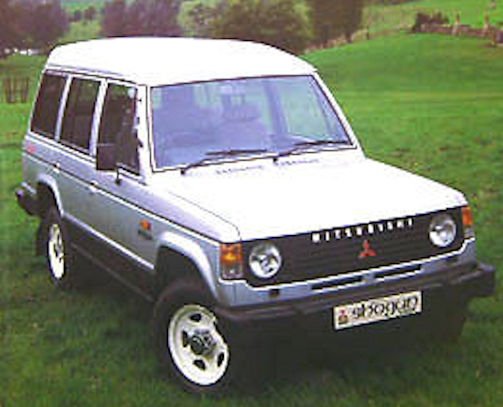
Mitsubishi Pajero Shogun 1st generation (L040)
 |
|
|
Production period: |
1982-1991 |
|
Body versions: |
wagon, Cabriolet |
|
Engines: |
Petrol engines: 2.6-3.0 litres (76-104 kW) |
|
Length: |
3995-4650 mm |
|
Width: |
1679 mm |
|
Height: |
1849-1890 mm |
|
Wheelbase: |
2350-2695 mm |
|
Curb weight: |
1510-1935 kg |
The first Pajero came on the European market in early 1983, while in Japan it was introduced about half a year earlier.
The Mitsubishi Pajero 1st gen is a SUV of Japanese Mitsubishi Motors, which was in production from the spring of 1982 to 1990. From the beginning of 1983 this was also now available worldwide. Since then, the car was built in four generations.
The name was borrowed from Leopardus Pajero’s, which lives in rough mountainous areas of South America. The Pajero came to public fame with its numerous successes in the world's toughest motorsport rally, the Paris-Dakar Rally.
In the United Kingdom, the model is called Shogun while In Spanish-speaking countries, as well as in North America, the Pajero has the name Montero.
The first generation had the same chassis as the pickup L200 and the minibus L300 and was later reissued by Hyundai as a Hyundai Galloper with a light facelift.
Already in the 1980s Mitsubishi and Chrysler worked together. In America, the Pajero was also available from Dodge and was then called Dodge Raider.
It was equipped as standard with switchable four-wheel drive. There is also an off-road gear and surcharge for a differential lock. The front wheels are individually hung on double wishbones, at the rear of a rigid axle with semi-elliptic leaf springs. The Pajero is the first off-road vehicle equipped with ventilated disc brakes at the front.

For outdoor lovers, the short version of the Pajero was also offered open at the same retail price as the closed version. The original shred roof with three plastic windows has many opening options. So, you can roll up both sides and the rear window independently. Some manufacturers also offered hardtops in different versions. The Pajero successfully participated in the Dakar Rally.
Today, the vehicles of the first generation in Europe have almost completely disappeared from the streets, especially due to rust problems.

Engines
Initially Type 4D55 2.3 L Row 4 cylinder SOHC Diesel engine Same as (75 ps) turbo With, G63B type 2.0 L series 4 cylinder SOHC Gasoline engine (110 ps) was installed. A G63B type 2.0 L series 4-cylinder SOHC gasoline turbo (145 ps) was added to the minor change.
The diesel turbo changed to 2.5 L and expanded to type 4D56 (85 ps), and the gasoline engine was also Type 6G72 3.0L V-type 6 cylinder The SOHC 12 valve (150 ps) also appeared. Later, the 4D56 type of Intercooler With turbo (94 ps).
Suspension
suspension Initially the front Double wishbone and Tortion bar spring independent suspension, rear Semi-elliptical leaf spring type Axle suspension Adopted. Later super sports and wagon rear 3 links and Changed to coil spring axle suspension.
Four-wheel drive system Based on rear wheel drive, transfer FR-based 4WD system that conveys drive to the front wheels Integrated with transfer Side transmission A part-time drive method with a built-in is adopted. Therefore, the front wheel is equipped with a manual free hub that has manually ON OFF for the drive. There are also many models that later carry the AUTO free hub on the front wheel axle, mainly for passenger use (a hub that is automatically locked when the forward rotation drive is on the axle. On the contrary, even if the vehicle was shifted to 4WD, there was a drawback that the lock would come off FR if the vehicle revered back).
- Details
- Parent Category: M
- Category: Mitsubishi
- Hits: 42
Mitsubishi Colt 800
 |
|
|
Manufacturer |
Mitsubishi Motors |
|
Production |
1965 to 1968 |
|
Body style |
2-door fastback |
|
Layout |
Front-engine, rear-wheel drive |
|
Engine |
843 cc 2-stroke I3 |
|
Wheelbase |
2,200 mm (86.6 in) |
|
Length |
3,620–3,740 mm (142.5–147.2 in) |
|
Width |
1,450 mm (57.1 in) |
|
Height |
1,365–1,420 mm (53.7–55.9 in) |
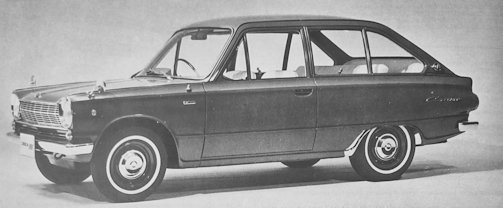
The Mitsubishi Colt 800 is a small fastback design passenger car manufactured in the 1960s and sold by Mitsubishi Heavy Industries, the predecessor of Mitsubishi Motors Corporation.
History
Mid-1965 Mitsubishi replaced the 600 by the much larger Colt 800 This was technically designed completely different. Instead of the two-cylinder four-stroke rear engine in the Colt 600, this had a water-cooled three-cylinder two-stroke front engine with 843 cc displacement and a power of 33 kW / 45 hp top speed was 120 km/h (75 mph). The car was available as a three-door hatchback coupe, later as a four-door hatchback a "Ute" utility version in Australia and van in Japan.
The 800 engine a three-cylinder two-stroke of 843 cc capacity. Mitsubishi introduced the three-cylinder two-stroke engine at a time when DKW and Saab said goodbye to this design. But even in Japan, the two-stroke engine did not meet with undivided approval. From autumn 1966 there was therefore also the Colt 1000F with the one-litre four-stroke four-cylinder engine of the larger Colt 1000 with 40 kW (55 hp). 1968 appeared even the Colt 1100F with the engine of the Colt 1100. At the same time the Colt 800, in May 1969 also the Colt 1000F was adjusted. All that remained was the Colt 1100F produced since 1968 (Colt 11F from 1969) with a 1.1-liter four-cylinder engine, which was also available as Super Sport version with 74 SAE-PS (54 kW).
Mitsubishi gave up on the two-stroke engine in 1968. The similarly sized and-engine Suzuki Fronte 800 was discontinued without replacement around the same time; these were the last Japanese two-strokes bigger than a Kei car. In general, the 700-800 cc class was dying away in Japan at this time, being replaced by 1000 cc cars.it was developed as a full-fledged front-engine, rear-drive compact mass-market car to enter the 800cc-class mass-market car market centred on the Daihatsu Compano and Mazda Familia. The "800" is a model developed by Mizushima Automobile Works in Okayama Prefecture, which was once the development and production base for the three-wheeled truck "Mizushima," and which had already produced the first-generation minicar minicar. The fact that the 2-stroke engine was originally installed was also based on the experience with the Minica that preceded it from domestic production a development group centred on the Nagoya Automobile Works in Oe, Nagoya City and the Kyoto Factory in Kyoto City, which was also involved in the Mitsubishi 500 and Colt 600. The Colt 1000, a 4-stroke engine car that was in his hands, was a model of a completely different system, although the 800 was the same old and new Mitsubishi Heavy Industries system.
There is no technical continuity or relationship with the Colt 600 or 1000, which preceded it, and in particular, it would inevitably cause internal competition with the Colt 1000 in a similar class. The fact that the double investment of developing a different model by diversifying the company's resources was allowed was a reflection of Mitsubishi Heavy Industries (and Shin Mitsubishi Heavy Industries, the predecessor of its small car division), when the independence of each plant was excessively strong at the time. It can be said that this incident exposed the rigid system of the government. The case in which Mitsubishi Heavy Industries developed and released a competing model of the same class at separate plants had previously occurred with medium-duty trucks, and in any case, it was clear that it was meaningless from a management point of view. Based on this reflection, Mitsubishi Heavy Industries was forced to organize its vehicle development system prior to the independence of the automobile division (establishment of Mitsubishi Motors Corporation in 1970).
In contrast to the conservative notchback style 2-door and 4-door sedans Colt 1000, the unique fastback style that was popular internationally at the time was the biggest feature of the 800 series. Although it did not have a gate, a pickup truck was added in 1966, a hatchback (3-door) was added at the end of 1967, and a 4-door was added at the beginning of 1968.
The engine was initially a 3G8 type 2-stroke water-cooled in -line 3-cylinder 843cc, with a maximum output of 45PS/4,500rpm and a maximum torque of 8.4kgm/3,000rpm. It was changed to a general FR that had been. The front suspension uses double wishbones and transverse leaf springs, while the rear wheels use a rigid axle and leaf springs. Except for the engine, it has a very ordinary and solid configuration.
PERFORMANCE
- Engine capacity: 51.44 cu in, 843 cu cm
- Fuel consumption: 53.3 m/imp gal, 44.4 m/US gal, 5.3 1 x 100 km
- Max speed: 72 mph, 115.9 km/h
- Max power (DIN): 41 hp at 4,500 rpm
- Max torque (DIN): 57 1b ft, 7.8 kg m at 3,000 rpm
- Max engine rpm: 5,500
- Specific power: 48.6 hp/l
- Power-weight ratio: 40.4 lb/hp, 18.3 kg/hp
- Acceleration: standing 1/4 mile 22.5 sec
- Max speeds: 22 mph, 35.4 km/h in 1st gear; 34 mph, 54.7 km/h in 2nd gear; 50 mph, 80.5 km/h in 3rd gear; 72 mph, 115.9 km/h in 4th gear
The Colt 800, along with the Suzuki Fronte 800 of the same period, was a unique group equipped with a 3-cylinder 2-stroke engine, which was rare among Japanese small passenger cars. The inline 4-cylinder 4-stroke engine had no chance of winning in terms of practical superiority, and there were even competing cars in the 800-1000cc class. In addition, the 2-stroke engine emits a lot of smoke, so air pollution was a social problem at the time, and sales were sluggish as people avoided it. The 800-production ended late in 1968, with now the larger 1100 model.

