
Mercedes Benz
- Details
- Parent Category: M
- Category: Mercedes Benz
- Hits: 103
Mercedes-Benz W 121 SL 190
 |
|
|
Manufacturer |
Mercedes-Benz |
|
Production |
1955 to 1963 |
|
Built |
25,881 |
|
Assembly |
Stuttgart Untertürkheim, Germany |
|
Successor |
Mercedes-Benz W113 (230SL) |
|
Class |
Sports car |
|
Body style |
2-door roadster |
|
Layout |
FR layout |
|
Platform |
Mercedes-Benz W121 |
|
Engine |
1,897 cc M121 SOHC I4 |
|
Transmission |
4-speed manual, fully synchronized |
|
Wheelbase |
2,400 mm (94.5 in) |
|
Length |
4,290 mm (168.9 in) |
|
Width |
1,740 mm (68.5 in) |
|
Height |
1,320 mm (52.0 in) |
|
Curb weight |
2,552 lb (1,158 kg) |
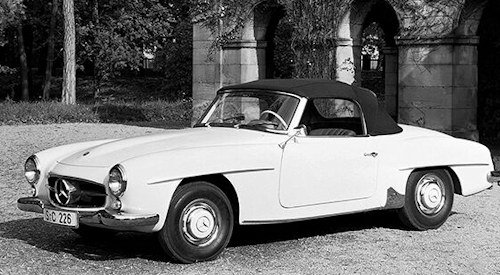
The Mercedes-Benz 190SL is a two-door grand touring convertible that was produced by Mercedes-Benz between May 1955 and February 1963.
History
The Mercedes-Benz 190 SL (W 121 B II) was offered from 1955 to 1963 as a roadster (also available with a coupé roof) the ideal basis for the conception of a real sports touring car with high suitability for everyday use should also be offered. . The 190 SL is without a doubt known for the quality of its construction and workmanship. with comfort and space allocation, With its elegant shape and the flat bonnet with the new, low and wide radiator front. The number 190 in the sales designation stands for displacements, the additional designation SL is short for "Sport Light"
Despite the extremely short development time of just five months, prototypes of the 300 SL and 190 SL were made, the New York Auto Show and the trade press. The development of the 300 SL was already well advanced, so that production could begin in August 1954. In the course of 1954, Walther Häcker's body design team carried out several changes on the New York version of the 190 SL in order to bring the vehicle closer to the shape of the 300 SL designed by Friedrich Geiger (e.g., removing the air scoop the bonnet and retouching of turn signal lights, radiator grille, bumpers, rear fender and dashboard). The first revised 190 SL was shown at the Geneva Motor Show in March 1955. Series production began two months later, where the 300 SL was also produced.
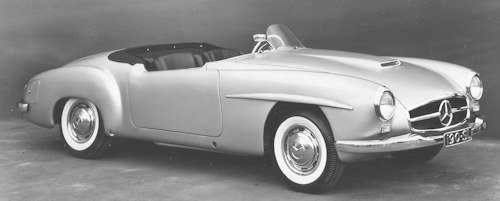
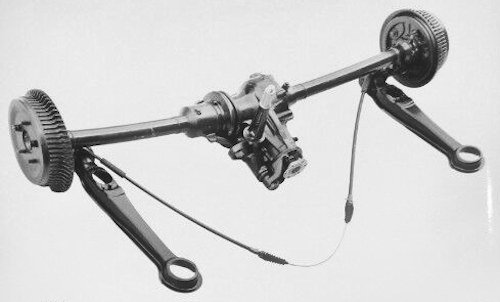
The 190SL was sold alongside the faster, more expensive Mercedes-Benz 300SL, which it closely resembled both in its styling, engineering, Technically, the 190SL did not use the 300SL's purpose-built tubular spaceframe W198 platform, but was built on a shortened and monocoque R121 platform that modified from the W121 small saloon. the Mercedes-Benz 190 SL is based on the W 121 series sedan “pontoon model”. To distinguish it from the pontoon model 190, the works code W 121 was supplemented by the suffix B II (for series II), Based on the later designation of the SL models with the abbreviation R (for roadster, from series 107), the 190 SL is sometimes also referred to as the R 121 detailing and fully independent suspension, having double wishbone suspensions at the front and swing axles at the rear.
The body of the 190 SL was aerodynamically shaped based on the model of the 300 SL gullwing. Many stylistic elements were adopted from the 300 SL, e.g., the front mask, the bumpers, the front headlights and parts of the hood. The rear lights and chassis components came from the pontoon vehicles. Bumper guards were mandatory in the USA because of the height required there, available at extra cost in Europe. The body of the 190 SL was made of sheet steel, the bonnet, trunk lid, door sill and door skin were made of aluminium. The 190 SL weighed 1180 kg (1200 kg with the hardtop on).
The co-existence of two different SL series was unique in the history of Daimler-Benz. Only since the introduction of the SLK series have there been two different roadster models, which is why the 190 SL is sometimes regarded as the predecessor of the SLK.
The 190 SL was offered in three variants:
from May 1955 Roadster with soft top -
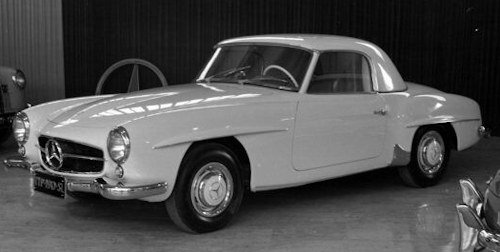
by December 1955 came the coupé with hardtop attachment without soft top compartment or also coupé with hardtop attachment and soft top The majority of the models produced were soft top roadsters with the possibility of retrofitting a suitable hardtop. With the most expensive version, the "coupé with roadster top", The 190 SL coupe version was very seldom ordered because, after the hardtop had been removed, good weather was required for open-top driving.
- from May 1955 Roadster with soft top - model code 121.042 -
- from December 1955 coupé with hardtop attachment (without soft top compartment) - model code M 121.040
- from December 1955 coupé with hardtop attachment and soft top - same model code as coupé
The majority of the models produced were roadsters. Here there was the possibility of retrofitting a suitable hardtop. With the most expensive version, the "coupé with roadster top", both roofs were available for year-round use. The 190 SL coupe version was very seldom ordered because, after the hardtop had been removed, good weather was required for open-top driving. A subsequent retrofitting of the soft top, including the locking mechanism and the top compartment, also resulted in high additional costs.
A sports version of the 190 SL was offered better driving performance should be achieved by reducing the vehicle weight. For this purpose, the bumpers and the hood could be removed. In addition, the windscreen could be replaced by a small, light plexiglass pane in the driver's seat and the doors could be exchanged for special light-metal specimens without windows. However, only 17 vehicles of this "Sport roadster" were produced (source: Motor-Klassik 2/1986), the model variant was discontinued in March 1956.
PERFORMANCE:
- max speed in 1st gear: 31.1 mph, 50 km/h
- max speed in 2nd gear: 47.2 mph, 76 km/h
- max speed in 3rd gear: 74.6 mph, 120 km/h
- max speed in 4th gear: 108.7 mph, 175 km/h
power-weight ratio: 20.1 lb/hp, 9.1 kg/hp useful 'load: 761 1b, 345 kg, max gradient in 1st gear: 50 %, speed in direct drive at 1000 rpm: 18.3 mph, 29.5 km/h
The interior of the 190 SL was luxuriously equipped. The Roadster was available with MB-Tex upholstery (artificial leather) in four colours to match the paintwork. Initially, the roadster had "bucket seats" related to those of the 300 SL, from 1956 the thicker upholstered seats of the 190 SL coupe were installed. Leather seat covers were standard in the coupé versions.
To take a third person with you, a separate transverse seat could be installed in the rear and removed again in just a few simple steps. If you didn't take a third person in the back, two full suitcases could be accommodated there. Tailor-made luggage sets for the rear and trunk were available as an extra. When the fabric top was closed, some utensils could be stored in the top compartment, and map pockets were attached to the doors. The interior floor was covered with rubber mats, later there was also an interior carpet.
Very advanced at the time was the heating control, which could be set separately for the driver and front passenger, with additional ventilation for defrosting the windows.
The dashboard is related to the 300 SL gullwing: rev counter on the left, speedometer on the right. Below that were three more instruments: oil pressure, coolant temperature and fuel gauges. Later, a hand-wound Kienzle timer was added to the lockable glove box lid. The dashboard was upholstered with artificial or genuine leather. A radio could be installed. The dimmable interior mirror and an ashtray were located on the dashboard.
The steering wheel with a diameter of 43 cm limits the field of vision for small drivers; there was no power steering. The first sun visor versions were made of metal and celluloid. In the late 1950s these were replaced by leather-covered panels; then on the passenger side with a make-up mirror.
The 190SL was powered by a new, slightly oversquare 1.9 L straight-four SOHC engine (Type M121 BII), that developed 105 PS (77 kW; 104 hp) (or 120 gross hp) that earned itself a reputation for not running that smoothly mostly due to the difficulty in properly synchronising the twin-choke dual Sole carburettors, and that, in detuned form, was later also used in the W120 180 and W121 190 models. The four-cylinder engine block of the 190SL was based on the six-cylinder engine of the 300 SL.
The 85 mm bore was transferred unchanged from the larger engine to the smaller, although the stroke for the 190 SL was reduced from 88.0 mm to 83.6 mm. The car was available either as a soft-top convertible or with removable hardtop. Optional was a third-passenger transverse seat that could even fit an adult. During its first years the 190SL was available as a sports-racing model with small Perspex windscreen and spartan one-piece leather covered bucket seats and aluminium doors, although any competition aspirations were modest. In 1959, the hardtop's rear window was enlarged.
Both the 190SL and the 300SL were replaced by the Mercedes-Benz 230SL in 1963.With 25,881 vehicles built, the touring sports car proved to be successful.
- Details
- Parent Category: M
- Category: Mercedes Benz
- Hits: 66
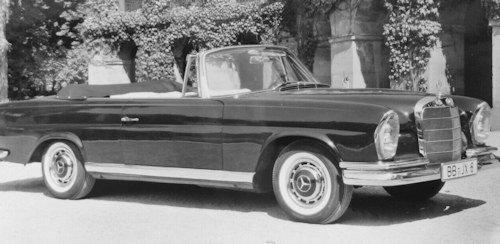
Mercedes Benz W111 W112 Coupe and Cabriolet
 |
|
|
Production period: |
1961 to 1971 |
|
Class : |
Luxury |
|
Body versions : |
coupé , convertible |
|
Engines: |
2.2–3.5 liters |
|
Length: |
192.13 in,4880 mm |
|
Width: |
72.64 in, 1485 mm |
|
Height: |
(Convertible) 56,30 in, 1430 mm (coupe) 55.91 in, 1420 mm, |
|
wheelbase : |
108.27 in, 2750 mm |
|
Dry weight : |
(Convertible) 3131 1b, 1420 kg (coupe) 2911 1b, 1320 kg |
|
Ground clearance: |
6.89 in, 175 mm |
The Mercedes Benz W111 and W112 Coupe and Cabriolet were built from 1961 to 1971.
History
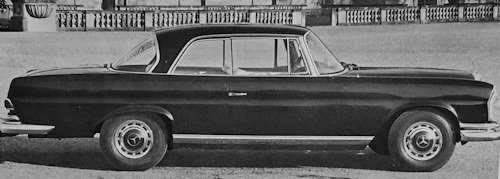
The new Mercedes-Benz 220 SEb coupe was presented at the opening of the Daimler-Benz Museum on February 24, 1961.In addition to the four-door sedans, the coupés and convertibles with flatter bodies and rounded fins that were only rudimentarily recognizable were also classified in the 111 and 112 series. The model range as 220SEC,250SEC along with the 280SEC, 280SEC 3.5L. Only the 230 S continued to be produced to 1968 as the only saloon the W 111 coupés and cabriolets remained in the range until 1971.
As the W 111, there was initially a coupe and cabriolet with the same technology as the 220 SE sedan as the 220 SEb/C. In contrast to the previous model, the coupé is based on the unabridged frame-floor system of the corresponding sedan and was therefore a fully-fledged four-seater. Stylistically, the coupe and sedan also have a great deal in common nevertheless, not a single part of the raw components of the four-door car could be used for the coupé or convertible. These C models were the last largely handcrafted Mercedes, which is why the price of the coupés and convertibles was almost twice as high as that of the sedans. Four times as many parts were handcrafted for coupés and convertibles as for sedans.
PERFORMANCE: 2.2L W 111 coupe and cabriolet
- Engine capacity: 134.25 cu in, 2195 cu cm
- Fuel consumption: 26.4 m/imp gal, 22.0 m/US gal, 10.7 1 x 100 km
- Max speed: 105.6 mph, kmh
- Max power (SAE): 134 hp at 5000 rpm
- Max torque (SAE): 152 1b ft,21 kgm at 4100 rpm
- Max number of engine rpm: 6000
- Specific power: 61.2 hP/l
- Power-weight ratio: 25.0 lb/hp,11.35 kg/hp
- Acceleration: standing 1/4-mile 18.5 sec
The 220 SEb/C was the first Mercedes series passenger car to be fitted with disc brakes on the front wheels. The original type designation "SEb/C" is unique because on the one hand it shows the difference to the predecessor model Ponton SE or SEa, on the other hand it was abandoned with the introduction of the almost identical 250 SE Coupé. Along with the 4-speed manual gearbox an automatic gear box, hydraulic torque convertor and planetary gears with 4 ratios was an option as well as a sunshine roof on the Coupe. The suspension was independent, wishbones, coil springs. Rubber bellows, anti-roll bar with telescopic dampers at the front and the rear suspension has independent, single joint low pivot, swinging half-axles, trailing radius arms, coil rubber bellows, horizontal compensating coil spring, telescopic springs with dampers.
PERFORMANCE 250 SE: 2.5L M129 Engine
- Engine Capacity 152.31 cu in, 2,496 cu cm
- Fuel Consumption 24.1 m/imp gal, 20.1 m/US gal
- Max Speed 118 mph, 190 km/h
- max power (SAE): 170 hp at 5,600 rpm
- max torque (SAE): 174 1b ft, 24 kg m at 4,500 rpm
- max engine rpm: 6,300
- specific power: 68.1 hp/l
- power-weight ratio: 19.4 lb/hp, 8.8 kg/hp
- acceleration: 0—50 mph (0—80 km/h) 7.7 sec
- speed in direct drive at 1,000 rpm: 19.9 mph, 32 km/h.
- max speeds: 31.1 mph, 50 km/h in 1st gear; 55.9 mph, 90 km/h in 2nd gear; 89.5 mph, 144 km/h in 3rd gear; 118 mph, 190 km/h in 4th gear
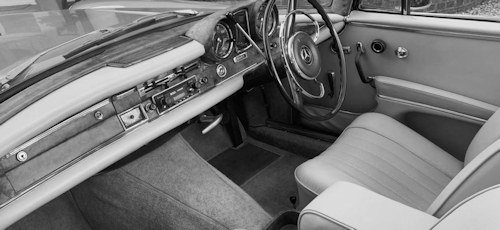
From 1965 the 250 SE Coupé models with 150 hp (110 kW) came out with the M 129 of the W 108 series. Like the three-litre models, they were fitted with 14-inch wheels and the larger disc brakes of the luxury class 108 series, now with disc brakes on the rear wheels as well. The distribution of weight at 53.5 % to front axle, and 46.5 % at rear axle.
In 1967 Mercedes brought a new 2.8 L M 130 engine with 160 hp (118 kW). As a result, the new W 111/C was now called the 280 SE Coupé. There were also small changes in the interior. The previously veneered instrument housing was covered with leather.
The W 111 received another facelift, which was also visible from the outside, from 1969 with the introduction of the 3.5 l V8 engine M 116 with 200 hp (147 kW). From November 1969, vehicles with a six-cylinder engine also had a flatter bonnet and a lower radiator grille. From then on, the models were differentiated by the (unofficial) designations "high cooler" and "flat cooler". The Cabriolet 280 SE 3.5 with the eight-cylinder engine is a coveted vehicle of this series.
300 SE Coupé and 300 SE Cabriolet
The W-112 types 300 SE Coupé and 300 SE Cabriolet, which were offered at the same time played a minor role in the sales figures. The body of the corresponding 220 SEb variant was provided with additional decorative elements and combined with the technology of the 300 SE type. Accordingly, the new exclusive models, which, like the sedan on which they are based, belong to the W 112 series, were equipped with a number of special technical features.
The basic equipment includes an M 189 light-alloy engine with a displacement of three litres, a four-speed automatic transmission, power steering, air suspension and a dual-circuit brake system with disc brakes on the front and rear wheels. The additional chrome decoration consists of a continuous chrome strip in the longitudinal bead from the headlights to the rear lights as well as decorative strips on the wheel arches and on the rocker panels. From March 1963, the 300 SE coupe, cabriolet and sedan were also available with an optional four-speed manual transmission; in this case, the list price was reduced by 1,400 marks. In January 1964 the engine output was increased to 125 kW (170 hp). A six-piston injection pump (instead of the previous two pistons with distributor pieces) made this increase in performance possible.
The air-sprung W 112 models were finally removed from the range in 1967, and after a total construction period of more than ten years, the last W 111 six-cylinder coupés and convertibles were produced in May 1971. Production of eight-cylinder coupés and convertibles also ended in July of the same year. This also ended the construction of four-seater cabriolets for the time being, because the successor W 116 was only available as a sedan. The successor to the coupe was the SLC of the 107 series.
A total of 28,918 coupés and 7,013 cabriolets were built at the Sindelfingen plant. The 220 SEb coupe achieved the highest production number within the model family with 14,173 units. Although the cabriolets only cost around ten percent more than the coupés during the construction period, they are now more than twice as expensive in a comparable condition and with a motor.
Coupe/Cabriolet range
|
Model |
Code |
years |
Engine |
Displacement |
Quantity |
|
220 SEb coupe |
111.021 |
02/1961-10/1965 |
M127V (127,984) |
2195 |
14,173 |
|
220 SEb convertible |
111.023 |
09/1961-10/1965 |
2729 |
||
|
250 SE coupe |
111.021 |
09/1965-12/1967 |
M129I (129,980) |
2496 |
5259 |
|
250 SE convertible |
111.023 |
954 |
|||
|
280 SE coupe |
111.024 |
11/1967-05/1971 |
M 130 E 28 (130.980) |
2778 |
3797 |
|
280 SE convertible |
111.025 |
1390 |
|||
|
280 SE 3.5 coupe |
111.026 |
11/1969-07/1971 |
M 116 E 35 (116.980) V8 |
3499 |
3270 |
|
280 SE 3.5 Convertible |
111.027 |
1232 |
- Details
- Parent Category: M
- Category: Mercedes Benz
- Hits: 42
Mercedes-Benz Type 130 VB W 144
 |
|
|
Years: |
1936 to 1937 |
|
Class : |
prototype |
|
Body design : |
sedan |
|
Engine: |
Gasoline : 1.3 liters (26 kW) |
|
Length: |
4100 mm |
|
Width: |
1560 mm |
|
Height: |
1545 mm |
|
Wheelbase: |
2700 mm |
|
Empty weight: |
850 kg |
The Mercedes-Benz W 144 , called Type 130 VB , was a prototype of a car with front-wheel drive, built by Daimler-Benz AG 1936-1937.
History
Hans Gustav Röhr , previously working for the Adlerwerke , designed the car based on the Adler Trumpf model .The vehicle of the compact class with 2700 mm wheelbase was intended as a two-door sedan. However, there is also a photo of a four-door sedan, in which the front doors were hinged at the front and the rear doors behind.
In total 18 test cars were built. They had a side-mounted four - cylinder boxer engine with square bore / stroke ratio(74 mm × 74 mm), giving a cubic capacity of 1272 cc. The engine developed 35 hp (26 kW) at 4300 rpm. and powered by a four-speed gearbox with overdrive (1: 0.765) and steering wheel gear on the front wheels, which were hung on wishbones and spring rods. The rear axle was designed as a pendulum axle and hung on semi-elliptic leaf springs and spring rods. All 4 wheels were hydraulically braked. The maximum speed of the vehicle was 100 km / h.All test cars were scrapped. r-Benz AG. Röhr's co-worker, senior engineer Dauben, stayed with the company for another 20 years.
- Details
- Parent Category: M
- Category: Mercedes Benz
- Hits: 23
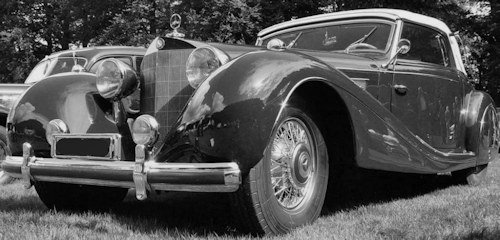
Mercedes-Benz 580K W 129
 |
|
|
Make: |
Mercedes-Benz |
|
Presentation Year: |
1939 to 1940 |
|
Class : |
sports car |
|
Body design : |
Coupe , Roadster |
|
Engine: |
Gasoline:5.8 liters (147 kW) |
|
Length: |
4480 mm |
|
Width: |
1940 mm |
|
Height: |
1520 mm |
|
Wheelbase: |
2980 mm |
|
Empty weight: |
2650 kg |
The Mercedes-Benz 580 K (W 129), was a prototype that was the successor to the 540 K type in 1939 and 1940.
History
The Mercedes-Benz 580 K design corresponded to the type 540 K. The engine capacity had grown to 5800 cc. The engine produced 96 kW (130 hp) in the suction mode and 147 kW (200 hp) with compressor. The top speed was 180 km / h.
On the short chassis, however, only a few prototypes emerged as a sports coupe and sports roadster. Due to the war, serial production no longer occurred.The two-seat special roadster of these models are among many as the most beautiful ever built cars and a icon of automotive design .
- Details
- Parent Category: M
- Category: Mercedes Benz
- Hits: 22
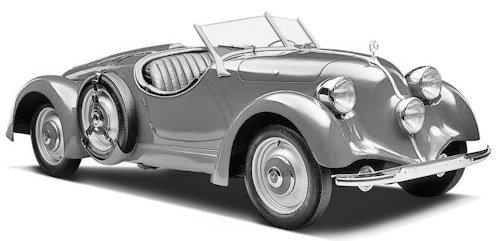
Mercedes-Benz Type 150V W 130
 |
|
|
Make: |
Mercedes-Benz |
|
Designation: |
Type 150V |
|
Production period: |
1934 to 1936 |
|
Class : |
sports car |
|
Body versions : |
Roadster ,Kübelwagen |
|
Engines: |
Gasoline : 1.5 liters (40 kW) |
|
Length: |
3945 mm |
|
Width: |
1630 mm |
|
Height: |
1350 mm |
|
Wheelbase : |
2600 mm |
|
Curb weight : |
985 kg |
The Mercedes-Benz Type 150 V (W 130) , first appeared in 1934 in parallel with the Type 150.
History
The small sports roadster conventional design had the four-cylinder in-line engine type 150 with 1498 cc, which gave an output of 55 hp (40 kW). With a unsynchronized four-speed gearbox with stick to drive the rear wheels. On all four wheels there were hydraulically operated drum brakes. The rear axle was designed as a pendulum axle with coil springs. Like its sister model with rear engine, the Roadster reached a top speed of 125 km / h.
In addition to some pre-series copies in 1934 , which were used by the factory for various road and terrain competitions, emerged a few specimens with Kübelwagenaufbau for the Wehrmacht . However, that was little interest in larger quantity of these vehicles, so that in 1936 the idea of mass production finally ceased.

