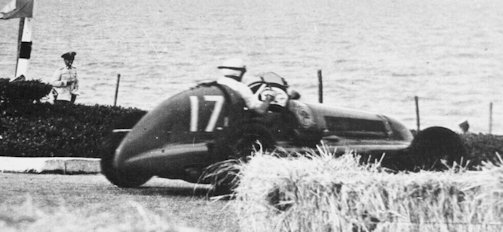
Maserati
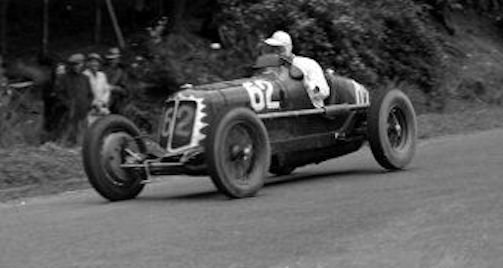
Maserati 4CM Race car
 |
|
|
Manufacturer |
Maserati |
|
Production |
From 1932 to 1938 |
|
Class |
Race Car |
|
Frame |
two side members and crosspieces in steel sections |
|
Engine |
4 cylinders in line |
|
Transmission |
4-speed gearbox plus reverse gear |
|
Length |
3680 mm (147.2 in) |
|
Width |
1480 mm (59.2 in) |
|
Height |
1350 mm (54.0 in) |
|
Weight Dry |
500 kg (1210 1b) |
The 4CM is a competition car built by Maserati from 1932 to 1938 .
History
The 4CM was produced in different series, which were distinguished by the displacement of the installed engine , which were respectively 1100, 1500, 2000 and 2500 cm³. The 1100 version was the first single-seater built by Maserati, and was assembled from 1932 to 1937 . The 1500 was built from 1934 to 1938 , 2000 in 1933 and 2500 from 1934 to 1937 .
The first 1100 cc monoposto 4-cylinder appeared in late 1931.Chassis numbers ran irregularly from 1118 to 1128 with probably no more than seven being
4CM-1100 models. The 1100 originated from the mechanics of 4CTR , suitably modified and improved. This had also installed hydraulic brakes with two pumps and two circuits, that is a better system than the solutions previously used, that is to say with steel cables . A 440 kg version was prepared , after a 470 kg intermediate, with an engine power of 145 bhp at 6500 rpm . In 1937 the last variant was built, which had the chassis and bodywork similar to the 6CM .
The 1500 was made for the interest in this class, and led to several orders also from abroad .The 2000 was manufactured in a single copy, kept at the Montague Museum in Beaulieu, in 1933. It had a 4- cylinder engine with an exceptional torque spread for most of the rotation speed and had the steering unit positioned laterally to the engine, and therefore the pilot's seat was slightly to the side.
In 1933 a 2500 cm³ engine was built alongside the 2000 from which it derived its origin. It was destined for the Grand Prix category . The engine was then coupled to a decidedly outdated chassis, with mechanically controlled brakes and a little longer than the one installed on the 2000. Also, the 2500 was a unique specimen .
The competitions
The 4CM 1100 took third place at the Nürburgring in 1932 for the 1500 category (first among the 1100 engine capacity), as well as winning other races in other competitions. He also achieved important results with Giuseppe Furmanik with the lighter variant of 470 kg and aerodynamic bodywork made by Viotti . On 3 June 1937 , on the Firenze-Mare , with this car Furmanik managed to conquer the world record on the millet launched for the category 1500, recording the speed of 237.623 km / h, previously set by the American Arthur Duray at 230.621 km / h, on 25 August 1929 .
For the 1500 the competition was stubborn, with the Delage and its 8 cylinders , and the ERA with its 6-cylinder Riley derivation . Despite this the 4CM 1500 imposed itself at the Nürburgring in 1934, when Luigi Castelbarco conquered the victory. Chassis were numbered from 1514 in August 1932 to 1559 in April 1938. About twelve cars were completed.
The first race of 2000 was in 1933 during the Coppa Ciano , and was led by Giuseppe Campari who achieved good results by exploiting its main characteristics, namely road holding and acceleration . The model was then given to Ippolito Berrone who successfully guided it in second-rate European races .
The 2500 was entrusted to Piero Taruffi , who took part in the Monaco Grand Prix retreating while occupying fourth place, best of the Maserati pilots. Afterwards the engine, after a break, was rearranged on a 4CM branch frame. In 1935 the model was retrained and led by Nino Farina . The following year a new sports version was prepared by Carlo Felice Trossi , while in 1937 the 2,500-cylinder engine made its final appearance on a 6CM chassis , driven by László Hartmann .
The body was an aluminium single-seater for the 1100, 1500 and 2000, and a two-seater for the 2500. The chassis consisted of two longitudinal members and cross-members in steel sections, with torsion bars on the front for 1100 .
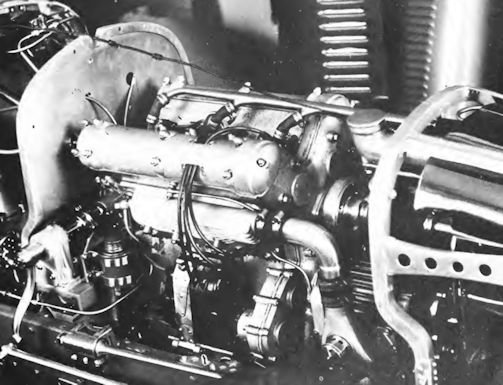
The engine was a four-cylinder in-line . The displacement was 1088.4 cm³ for the 1100 , 1495.7 cm³ for the 1500 , 1970.4 cm³ for the 2000 and 2482.6 cm³ for the 2500. The bore and stroke were respectively 65 and 82 mm for the 1100 , 69 and 100 mm for the 1500, 80 and 98 mm for the 2000 , 84 and 112 mm for the 2500 . The compression ratio was between 5: 1 and 6: 1 for the 1100 , 6: 1 for the 1500, 5.8: 1 for 2000 and for 2500. The maximum power supplied by the engine was 90-125 bhp at 5300-6000 rpm for the 1100, 130-150 bhp at 5600-6000 rpm for the 1500, 165 bhp at 5500 rpm at minute for 2000 and 195 hp at 5300 rpm for 2500.The ignition was single with Scintilla magnet . The power supply was forced with a Roots type compressor . The distribution consisted of two valves per cylinder arranged at 90 ° V, with a double overhead camshaft . The lubrication was forced with pressure and scavenge pumps. The cooling system had water circulation with centrifugal pumps .The 1100 reached a maximum speed of 146 km / h , the 1500 reached 190-230 km / h , the 2000 at 215 km / h and the 2500 at 220 km / h .
The brakes were drum-type on wheels with hydraulic control. The suspension consisted of leaf springs and friction dampers . The steering was worm and toothed sector. The transmission was formed by a change in 4 plus reverse relations .
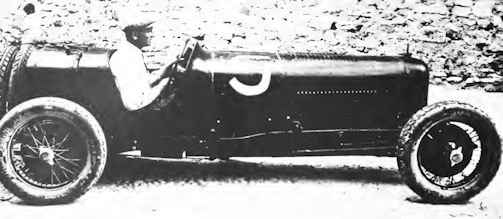
Maserati Tipo 26
 |
|
|
Builder |
Maserati |
|
Class |
Race Car |
|
Type |
Formula Grand Prix |
|
Production |
from 1926 to 1932 |
|
Motor |
1.5 Liter 8-cylinder in-line engine |
|
Length |
3670 mm |
|
Height |
1250 mm |
|
Weight |
780 kg |
The Maserati Tipo 26 was the first racing car that Officine Alfieri Maserati , founded in 1914, produced under its own name. The vehicle appeared in 1926 and was produced until 1932 in several versions in one to two dozen copies. An advanced version with a larger engine was called Tipo 26B , a roadster version with modified body Tipo 26MM .
History
Officine Maserati, founded by Alfieri Maserati, designed a racing car for Isotta Fraschini after the end of the First World War . From 1922 worked Maserati for the Turin carmaker Diatto . First, Alfieri Maserati developed a race car with 3.0 litres displacement, with which he went in 1922 at a race in Italy at the start. The following year, the Diatto Tipo 20 was born, a road vehicle that was equipped as standard with a 40-hp, 2.0-liter four-cylinder engine. Maserati derived in 1924 from a racing version called 20S, which allegedly made 70 hp. 1925 was a pure racing car, which was used only sporadically, because Diatto had now come into financial difficulties. In the early autumn of 1925 Diatto gave up its motorsport commitment completely. Alfieri Maserati took over the construction for free in September 1925 and continued the motorsport program from 1926 under his own name. He developed his last Diatto construction in some detail further and presented the otherwise unchanged Car 1926 Maserati Tipo 26 The term took on the year the presentation reference. On the technical basis of the Tipo 26 or 26B developed Maserati 1929 a racing car with 16 cylinders, which received the designation Maserati V4 .
The Tipo 26 was an open race car. This had two seats, because at that time it was still common to take a mechanic to the races. The structure was made of aluminium. It was made by the Carrozzeria Fantuzzi in Modena .The Maserati Tipo 26 corresponded technically largely to the last Diatto racing car of 1925. Some sources assume that the first copy of the Tipo 26 presented in the spring of 1926 was also physically identical to the Diatto. The Tipo 26 had a ladder frame and front and rear rigid axles . The rear axle was suspended from semi- elliptic steel leaf springs. In its original version the car was driven by a 1.5 Liter in-line eight-cylinder engine, which had two overhead camshafts and provided 115 hp. By default, a Roots compressor was installed. According to one source, the cylinder head of the Maserati was made of cast iron, while Diatto had used an aluminium cylinder head. It reached a maximum speed of 180/200 km/h.The bodywork was a two-seater in aluminium , the chassis was composed of two longitudinal members with crosspieces in steel profiles .
The engine was an in-line eight-cylinder and had a displacement of 1492.9 cm³ . The bore and stroke were 60 and 66 mm respectively . The power output varied between 120 and 128 HP at 5300/6000 rpm . The compression ratio was 5.8:1.The ignition was single with magneto . The fuelling was forced , with a Roots type compressor and two Memini brand carburettors upstream of the compressor itself (only 1 since 1927). The distribution was two valves per cylinder arranged in a 90° V, with a double overhead camshaft.
The brakes were drum brakes with hydraulic control, while the steering was worm screw. The suspension was leaf spring with friction shock absorbers . The gearbox initially had three gears, then increased to four plus reverse .
Tipo 26B
1927 appeared the Tipo 26B. This corresponded technically and externally to the previous Tipo 26, but had an enlarged to 2.0 litres capacity; the power of the engine was now 130 hp. In one case, the engine of the 26B was subsequently enlarged to 2.1 litres. Some Tipo 26 models were also retrofitted with the engine of the 26B.The maximum speed of the Tipo 26B was about 160 km / h.Approximately eleven 2-litre versions were built during 1928 and 1929. Some Tipo 26 examples were also fitted with the 2-litre engines.
Tipo 26MM
The original version of the car was intended for circuit racing which took place mostly during the day; in order to take part in the Mille Miglia , a "Sport" version of the Tipo 26 was prepared, with the modifications suitable for a race like that, which took place on roads open to traffic. In order to participate in the 1928 Mille Miglia, the second edition of the famous race, the car was equipped with side motorcycle mudguards , doors, headlights, a small windscreen and a canvas top . The truncated tail could now accommodate two spare wheels while a toolbox and battery were placed on the footrests . Bosch supplied the electrical system , which also included the starting system .
Maserati constructed two vehicles with independent body, which received the additional designation MM (for Mille Miglia ). They had curved fenders, side footboards and a removable fabric hood. Technically, they were identical to the conventional 26B.The engine had a cast iron block . The exhaust was equipped with a silencer . The wheelbase had been shortened to 2,580 mm and the weight, compared to the open-wheel version, had increased to 840 kg .Two examples were built, reserved for Carlo Tonini and Pietro Brunori, which debuted on 31 March ; the car, which also had a larger fuel tank suitable for long-distance races, finished in 23rd position .
The Maserati Tipo 26 and 26B was a free-for-sale race car, which was manufactured in small series. The exact scope of production is unclear from about 20 copies, with the Tipo 26 about nine and account for about eleven vehicles on the Tipo 26B. The exact distribution cannot be clarified because some Tipo 26 models were retrofitted with the engine of the 26B, which was partially, but not always associated with changes in the VIN. Chassis numbering commenced at number 10, and there were at least nine examples built from 1926 to 1928.chassis and engine markings were stamped with the last two digits only.
Racing
Alfieri Maserati drove 1926 from the factory numerous races with the Tipo 26. In addition, the cars were often used by private drivers.
The Maserati Tipo 26 debuted on 2 May 1926 at the Targa Florio . Driver was Alfieri Maserati, mechanic and co-driver was Guerino Bertocchi. Maserati finished ninth in the Bugatti- dominated race (out of twelve cars) and won in the 1.5-liter class. At the Italian Grand Prix in Monza appeared two Tipo 26 for Alfieri Maserati and Emilio Materassi ; both failed prematurely as a result of compressor damage. During the year, Maserati riders won several sprints and Hillclimb races .
1927 Alfieri Maserati's brother Ernesto with the new Tipo 26 at the Gran Premio di Tripoli overall third and class winner. A little later came Alfieri Maserati with the new 26B at the Targa Florio also finished third. Diego de Sterlich won several uphill races with a private Tipo 26 during the year.
1928 appeared the further developed Maserati 8C . From the factory side, Maserati started to use this vehicle, but for some years Tipo 26 and 26B were also at the start. Their best results achieved the cars at the Coppa Acerbo 1927 in Pescara and the Grand Prix of Tripoli 1929 , where they came second in each case.
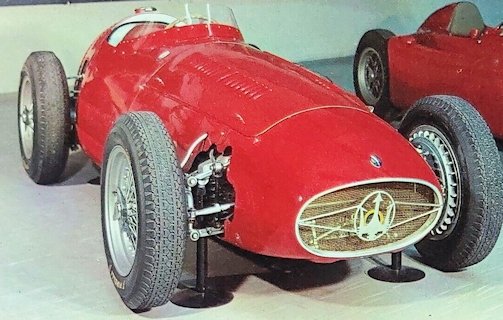
Maserati 250F T1 Grand Prix Car
 |
|
|
Builder |
Maserati |
|
Class |
Race Car |
|
Category |
Formula 1 |
|
Teams |
Officine Alfieri Maserati |
|
Designed by |
Gioachino Colombo |
|
Chassis |
Tubular |
|
Motor |
Maserati 2.5 L6 |
|
Transmission |
5-speed manual. Rear-wheel Drive |
|
Fuel |
Shell |
|
Tyres |
Pirelli |
|
Debut |
Argentine Grand Prix 1954 |
The Maserati 250F is a Formula 1 single-seater, used between 1954 and 1960. The Maserati 250F was a Formula One single-seater racing car built at Maserati from 1954 to 1958 and used in the World Championship until 1960.
History
The Maserati 250F was one of the best and most durable Formula 1 cars in Grand Prix history. The planning at Maserati originally intended to develop the car only for use by private individuals. Since these teams operated with limited financial and technical resources, the car had to be simply constructed.
Initially, the 250F was referred to as 6C2500. After the first test drives, he received the designation 250F. The number "250" stood for the cubic capacity of 2500 cc and the "F" for formula. The basis of the 250F was the Maserati A6GCM. Thus, of the 33 built specimens, five were derived from this model. The A6GCM was rebuilt to 250F. 22 pieces were planned from the start and were also manufactured, six 250F were conversions of existing cars, which were only renumbered.

The car was powered by a 6-cylinder in-line engine with dry sump lubrication initially developed by Gioachino Colombo and subsequently improved with the help of Vittorio Bellentani. It had two valves per cylinder (intake Ø 42 mm, exhaust Ø 38 mm) inclined at 77° operated via finger rockers by two overhead camshafts moved by a cascade of gears in front of the cylinder block and recalled by helical springs. The cylinder liners were 'wet' in the upper section and 'dry' in the lower section. The crankshaft was made of nitrided steel and rested on seven supports. The ignition was with double spark plugs, powered by two magnetos. Gioacchino Colombo and Alberto Massimino were responsible for the immortal 2.5-litre six-cylinder Maserati Grand Prix car which proved so widely popular in the 1950s Formula. Maserati at Modena went into virtual mass-production of these cars, over 30 being constructed, all eventually sold into private hands. Characteristically, Maserati had always supplied privateers with cars, often before their own works team vehicles were completed, and this was so with the 250F.
Introduced in 1954, the model won its first race, the Argentine Grand Prix, driven of course by the great Juan Manuel Fangio. Later that year and throughout 1955 the cars were generally outclassed by Mercedes-Benz in Grand Prix racing, but they were generally next best, and they utterly excelled in the many minor non-Championship Formula 1 events run in Europe at that time.
The 250F used a multi-tubular spaceframe chassis of the current vogue with double-wishbone and coil-spring front suspension and a De Dion rear end with transverse leaf-spring. A neat gearbox was in unit with the final-drive assembly between the rear wheels and the 84 mm x 75 mm 2.49-litre six-cylinder engine with twin overhead camshafts and three twin-choke carburettors produced around 260 bhp.
Performance:
- Power: 240 HP at 7200 rpm.
- Max power, 240 bhp at 7200 rpm rising to 270 bhp at 8000 rpm.
- Speed: 170 mph (270 kmh).
- Maximum Speed: 274km/h (170mph)
In 1956 Moss drove for Maserati, having campaigned a private 250F to such effect in 1954 that he had won his Mercedes-Benz drive for '55. Moss won at Monaco in 1956 but Fangio was too good in the Lancia-Ferrari and won the Championship. Then in 1957 Fangio rejoined Maserati—his second love after Alfa Romeo—and in a classical season won the Argentine, Monaco, French and a tremendously dramatic German Grand Prix to clinch his fifth and final World Drivers' Championship. During that year a 68.5 mm x 56mm 2449cc V 12 engine was tried in 250F chassis but follies in sports car racing cost Maserati dear and they were forced to pull in their horns for 1958. Some lightweight 'Piccolo' Maserati
250Fs were built, in one of which Fangio ran his last race—the French Grand Prix of 1958 and 250Fs in private hands raced on even into the very last 2.5-litre Grand Prix, the US event in 1960.
Vittorio Bellentani and Gioacchino Colombo agreed on the basics of the car. The six-cylinder engine was derived from the engine of the A6GCM. The cast-iron cylinder liners were placed in an aluminium engine block heated to 160 degrees in an oil bath. The compression was 12: 1. Two overhead camshafts moved two valves per cylinder. The four-speed gearbox was in the rear, to achieve an optimal weight distribution. The tubular frame carried a front axle with coil springs and lever shock absorbers. Rear, the 250F had a De Dion axle with transverse leaf springs and lever shock absorbers. The body with a cockpit, which offered the driver more space than comparable racing cars of the era delivered Fantuzzi.
Colombo was no longer able to follow the completion of the first 250F as he moved from Maserati to Bugatti to advance their Formula One project.
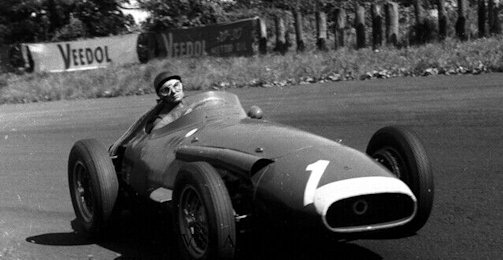
Notable 1st place Races for the Maserati 250F F1
- 1954, Argentinian Grand Prix, Juan Manuel Fangio (1st place)
- 1954, Belgium Grand Prix, Juan Manuel Fangio (1st place)
- 1956, Monaco Grand Prix, Stirling Moss (1st place)
- 1956, Monza Grand Prix, Stirling Moss (1st place)
1954
The car made his debut at the 1954 Argentine Grand Prix, winning the race with Juan Manuel Fangio, who also took the Belgian Grand Prix at the end of June, before moving to the Mercedes team. The points obtained with the two teams allowed the Italian-Argentine driver to win the World Drivers' Title. In the same year Stirling Moss drove a Maserati 250F As a private for the entire season with Juan Manuel Fangio at the wheel. Fangio, who soon left Maserati to switch to Mercedes Benz, drove the 250F as an unofficial factory car and made for a perfect maiden win. Also, at the second race in Belgium Fangio was successful. These successes led Maserati to set up an official factory team, which made it difficult for the factory to fulfil all customer orders within the agreed time. Therefore, the five A6GCM were used and converted into 250F. These cars were, mainly because of the outdated landing gear, the inferior 250F but. You could recognize the converted A6GCM to the outside of the body running tie rods., The factory team was next to Luigi Musso, Roberto Mieres and Onofre Marimón and Harry Schell.
1955
The following season, despite the move of Moss to Mercedes and designers Vittorio Bellentani and Alberto Massimino to Ferrari, the 250F had important new developments with the 5-speed gearbox and a new injection system.
Even before Mercedes-Benz tested in 1955 Maserati a Bosch injection. Although the injection was not used for the time being, the findings flowed into the injection systems, which were installed in Maserati sports cars. The transmission got a fifth gear and the outside dimensions were slightly reduced. Fantuzzi designed a new, more streamlined body, which was used in the car with the chassis number 2518. The new works driver Jean Behra finished fourth in the Italian Grand Prix. For the Mercedes-Benz race cars, however, the 250F remained without victory during the entire season.
1956
In 1956 Stirling Moss won the Monaco and Italian Grands Prix driving a private 250F. During the season, a "faired" version inspired by the Mercedes-Benz W196 "Type Monza" was tested and versions of the car were developed for the Formula 2 category. The following year Fangio achieved four successes including the epic German GP and became world champion for the fifth time. The experiments with the gasoline injection showed first fruits in 1956. A pump driven by a camshaft chain was installed in the 250F. The suspension has also been modified. The engine was rotated six degrees, allowing the prop shaft to bypass the driver's seat and lower the driver's seating position. Stirling Moss, now works driver at Maserati, won the Monaco Grand Prix and the Italian Grand Prix on Monza's high-speed track.
1957
For the 1957 season Maserati constructed a new tubular frame made of thin steel tubes. The exhaust pipes were led past the driver's windshield to the left on the left side, where they joined together to form a single pipe, which led to the rear wheels. The drum brakes were also revised. These improvements made the 250F the exceptional vehicle with which Juan Manuel Fangio clinched his fifth World Championship title. Maserati was already working on a V12 engine, which should extend the life of the 250F further, as the team management after the title win by Fangio for financial reasons, the resolution of the factory team announced.
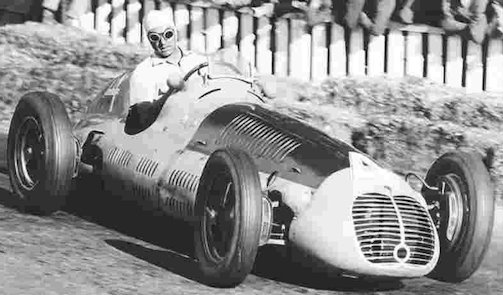
Maserati 4CLT Grand Prix Car
 |
|
|
Manufacturer |
Maserati |
|
Class |
Race Car |
|
Seats |
Single |
|
Engine |
4-cylinders Capacity 1,496 to 2000c.c. |
|
Production |
from 1947 to 1950 |
|
Length |
3850 mm |
|
Width |
1400 mm |
|
Height |
1000 mm |
The Maserati 4CLT, were single-seat competition race cars built by Maserati post war from 1947 to 1950.
History
Introduced in 1947. Basically as the Type 4CL but with a tubular chassis. Part of the tubular frame was used for the oil reservoir. Two of these cars with modified rear frame were used by Arlaldo Ruggeri and raced at various times by several drivers, including Bucci. Normal 4CLT models were driven in 1948 by Farina (winner at Geneva and Monte Carlo) and Villoresi.
In 1946 revived 4Cs were in the forefront of motor racing's reawakening, and the design quickly developed with two-stage super-charging and with a tubular chassis frame in place of the former girder type. These developed models were known first as the 4CL, then with the tubular chassis as the 4CLT At all times the independent front suspension had been by wishbones and torsion bars, with quarter-elliptic leaf springs carrying a rigid axle at the rear The project was by Ernesto Maserati, Alberto Massimino, Vittorio Bellentani and Arialdo Ruggieri.
In 1948 the 4CLT in its definitive form with coil-springs for the front suspension tucked in-board out of the airstream and operated by extension lever arms attached to the wheel-hub carriers. This 4CLT/48 model was raced by the quasi-works Scuderia Ambrosiana team and sold well to private entrants.
In their debut two 4CLT/48s were placed 1—2 at San Remo, driven by Alberto Ascari and Luigi Villoresi. The model was known as the San Remo Maserati ever after. Villoresi won four more major races that season, and was second to Vanille’s Alfa Romeo in the Italian Grand Prix, beating a new VI 2 Ferrari in the process. In the winter of 1948—49 4CLT/48s raced in the Argentine Temporada series, a virtual unknown named Juan Manuel Fangio scoring an early international success in one.
When Alfa Romeo withdrew for the 1949 season, Maserati briefly assumed their mantle before being overtaken by Ferrari's V12s. Fangio made his name in Europe with a 4CLT, while drivers like Reg Parnell, 'B. Bira' and Dr Farina all won for the trident. By 1950, however, the claimed 260 bhp of the 78mm x 78mm, 1490cc engine was achieved at the expense of oil-oozing unreliability. The old engine had reached the end of its development and although still competitive in club racing events the Maserati 'fours' were now non-entities at Grand Prix level.
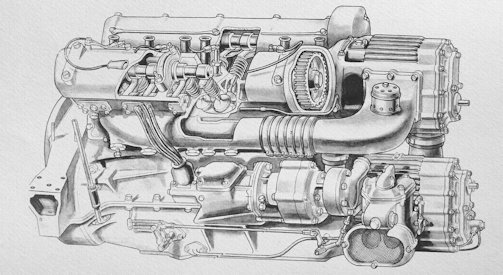
The changes to the chassis and the engine operated on the 4CL led to the development of the 4CLT, where the " T " stood for t frame loom. The increase in torsional rigidity that the tubular structure was used to counterbalance the increase in torque and power, resulting from the use of two compressors applied to the old 4-cylinder in-line engine.
The power delivered by the engine was 260 bhp, against the 220 of the 4CL. Other changes were the use of a bearing for the crankshaft, components of the forged rear suspension rather than castings, and the chassis designed to work with hydraulic shock absorbers. The displacement was 1491 cm³, and the layout of the cylinders was four in line. The change was a four-speed manual.
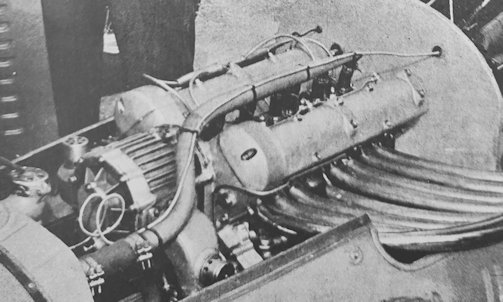
4CLT / 48 Sanremo (1948)
The 1948 model, introduced for the San Remo Grand Prix when Ascari and Villoresi finished first and second respectively. The cars next appeared at Berne (Grand Prix de l'Europe), then at Rheims (French' G.P.), Albi G.P. (when a third car was driven by Leslie Brooke), Italian Grand Prix (five cars ran—Villoresi, Ascari, Parnell, Brooke, Cortese) and Silverstone (Villoresi and Ascari, first and second respectively). Villoresi and Parnell finished first and second at Barcelona. The Engine similar to 4CL but with different camshafts, con. rods, crankshaft bearings block, etc.Two-stage supercharging as in 4CL—blowers one above the ether driven off the front of the engine.
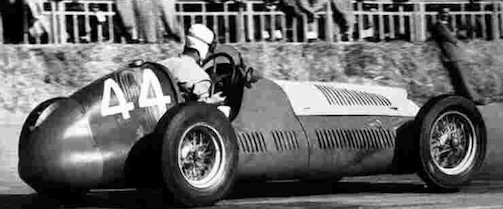
The first 4CLT variant derived its name from the name of the race where it debuted and won the first two places, more precisely at the 1948 Sanremo Grand Prix with Alberto Ascari and Luigi Villoresi. Villoresi and Reg Parnell then won five of the remaining races of the season. Other drivers who conquered important victories were Juan Manuel Fangio, Nino Farina and Prince Bira.
The main innovation was the use of a frame with circular section tubes with longitudinal and cross members, in place of profiled components. The innovation was applied with the aim of achieving a higher torsional rigidity that would have allowed a greater speed in the curve. The engine, with a displacement of 1490 cm³, finally adopted two dual-stage compressors with a Weber carburettor upstream of them, which allowed the engine to deliver 270 hp, brought to almost 330 by the studies of Professor Speluzzi of Scuderia Milano. The compression ratio was 6: 1 and the gearbox was four-speed plus reverse. The distribution was four valves per cylinder at 90 °. The brakes were drum hydraulically actuated. The suspensions were Houdaille hydraulic shock absorbers and stabilizer bar. The anterior ones were helical springs, while the rear ones with crossbow. The body was in aluminium. The maximum speed of the car was 260–270 km / h. The car remained competitive until 1950.
After the introduction of the modified 4CLT / 49 chassis the following year, with two of the remaining 4CLT / 48 Sanremo, the displacement was increased to 1720 cm³; were used in Formula Libre Temporada races in Buenos Aires. In the first year of Formula 1 (1950 season), the 4CLT / 48 Sanremo disputed the best Maserati Championship in this competition. The last variants of the 4CL that took part in the World Championship were a 4CLT / 48 modified by Arzani-Volpini, which however failed to qualify for the 1955 Italian Grand Prix A long-time affiliate of Maserati, Enrico Platé, recognized the non-competitiveness of the cars of the Casa del trident in Formula 1, and then converted the 4 CLT / 48 into the Maserati-Platé 4CLT; with the updated model, Platé decided to participate in Formula 2 races. However, this automotive series was for aspirated engines, and the first step was therefore to remove the two compressors. After this, to compensate for the loss of performance resulting from this elimination, the compression ratio was doubled and the displacement was raised to the limit for the category, more precisely 2 L. With the decrease in power caused by the revisiting of the engine, the weight was decreased, and the handling was increased by reducing the wheelbase.
4CLT / 49 (1949)
The car known as 4CLT / 49. The name of the car was not official, since the name given to it by Maserati was never known small changes to drum brakes and aerodynamic appendages to the cooling slits, together with small changes in the control panel and the repositioning of the oil sump, gave rise to. The Ascari, Villoresi, Parnell trio of drivers, joined by Juan Manuel Fangio and Toulo de Graffenried, won nine of fifteen races of the 1949 season, including the success of Graffenried at the British Grand Prix, the last before the advent of Formula 1. A copy of the 4CLT / 49 was modified by Maserati to be able to mount a more powerful engine, a V12 built by OSCA.
4CLT / 50 (1950)
In 1950 began the first World Formula 1 Championship organized by the FIA. In response to improvements to the Alfa Romeo 158, and to the already competitive Ferrari and Talbot, Maserati updated the 4CLT engine. A crankshaft consisting of multiple components, lightened and balanced connecting rods, a pair of more powerful compressors and improvements to the injection system brought the engine 's power to 280 bhp. This was assembled with the intention of reducing the weight by 10 kg. With these improvements the Maserati almost reached the performance of the Alfa Romeo. Although moderately competitive for short races, the changes made were too relevant for the car's design, which was now ten years old, so much so that in the Grand Prix it often retired due to engine failure. During the season, the victories came only in races not valid for the Formula 1 World Championship. Juan Manuel Fangio won at the Pau Grand Prix; same day Reg Parnell won the Richmond Trophy at the Goodwood Circuit, and David Hampshire won the Nottingham Trophy. Fangio also won in Formula 2 the Grand Prix Rampart to Angoulême, on a frame of 4CLT the engine of the A6 GCM. The Scuderia Milano modified 4CLT / 50 to participate in the Formula 1 World Championship in the 1950 season and in the 1951 season, but without success.
The latest victories in the races
Toulo de Graffenried won the Richmond Trophy and Nino Farina the Grand Prix of Paris in 1951, but with the transition to the Formula 2 rules from the Formula 1 World Championship, it proved that the old 4CLT chassis was too heavy and the engine had power lower than rivals. Despite being one of the biggest cars in the top-level competitions of the late thirties, the 4CL and the 4CLT quickly lost their bite when new competition cars, smaller and lighter, were born from various European workshops, which among other things were still affected by the effects of the recently ended War.
Maserati 4CL Grand Prix Car
 |
|
|
Manufacturer |
Maserati |
|
Class |
Race Car |
|
Seats |
Single |
|
Engine |
4-cylinders Capacity 1,496 c.c. |
|
Production |
from 1939 to 1948 |
|
Length |
3850 mm |
|
Width |
1400 mm |
|
Height |
1000 mm |
|
Mass |
630 k g |
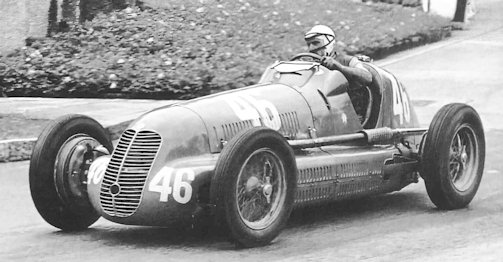
The Maserati 4CL, were single-seat competition race cars built by Maserati from 1939 to 1948 pre and post war.
History
The Maserati 4CL was often referred to as the "16-valve" Maserati, the 4CL was first built in 1939 for voiturette racing. It has a four-cylinder twin overhead camshaft engine of "square" cylinder dimensions (78 mm. bore and 78 mm. stroke), giving a capacity of 1,489 c.c. Output was claimed to be 220 b.h.p. at approximately 8,000 r.p.m.
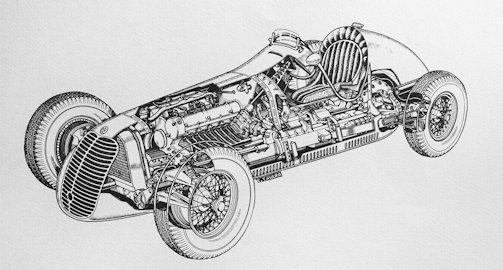
This gave the car outstanding acceleration, and although the 4CL could not beat the Type 158 Alfa Romeos, it proved the mainstay of Grand Prix racing in the early post-war years before the appearance in 1948 of a newer Maserati, the 4CLT. The 4CL single Roots-type supercharger, dry- sump lubrication, a four-speed gearbox, independent
front suspension by wishbones and torsion bars, a live rear axle sprung by quarter-elliptic springs, and hydraulic brakes.
Maserati found that 1.5-litre voiturette racing was a much more sensible proposition for a factory such as theirs during the thirties. National prestige which led Alfa Romeo once again to react to the stimulus and turn to Maserati brothers' building a new voiturette themselves. Since at the time Italians could not play in the league as the German teams.
Maserati introduced their six-cylinder 6C model for voiturette racing in 1936, replacing the formal four and eight-cylinder models. In general design it followed on from the eight-Cylinders but the twin-overhead-camshaft 1493 cc power unit was good for 155 bhp at a smooth 6200 rpm. From 1936 to 1938 the Maserati 6C was very competitive with the similarly six-cylinder ERA cars and in Italian national events and most others around Europe it numerically saturated the field. It was in response to the success and prestige achieved by these 6Cs that Alfa Romeo weighed in with their straight-eight Tipo 158 voiturette in 1938; to combat its threat the ever-cheerful and willing Maserati brothers produced in turn their 4C. The 4CL project was by Ernesto Maserati with Luigi Villoresi at the helm, using the 6C chassis to carry 1088 and 1496cc twin-overhead-camshaft engines.
The Alfetta proved to be streets ahead, and in 1939 the 4CL was released with four valves per cylinder. As the 'Sixteen-valve' Maserati this model became famous, as did its 'square' dimensions of 78mm x 78mm to give 1489 cc, and its supercharged power output of 220 bhp. However, while the Maserati won everywhere not attended by the Alfetta team, it could not combat the 158s on equal terms. But postwar, Maserati would be back, with modified versions of this late-thirties voiturette.
Performance: Some of these cars have been used with two stage supercharging, giving about 225 B.H.P.
- 210-220 b.h.p.
- Piston speed: 3,600 ft. per min. B.M.E.P.: 278 lb. per sq. in. 258 h.p. per ton (laden), 365 per ton (unladen).
The 4CL was introduced at the beginning of the 1939 season. It ran in the voiturette class of the international motoring Grand Prix. Although the competitions ended during the Second World War, the 4CL was one of the models that imposed itself on the resumption of the races in the late forties. Experiments with a two-stage volumetric compressor and a tubular frame eventually led to the introduction in 1948 of the revised model 4CLT.
In the second half of the thirties the rapid development of the competitiveness of the voiturette class, the introduction of the Alfa Romeo 158 and of the ERA models led Maserati to design a new in-line four-cylinder engine. This engine delivered 30-50 bhp more than the previous six-cylinder in line thanks to the increase in the number of valves (now four per cylinder), the use of a more powerful volumetric compressor and a small increase in the compression ratio. The displacement it was 1491 cm³. According to Maserati tradition, the engine was mounted on a chassis of a previous model, in this case of the Maserati 6CM. Although it had an almost identical wheelbase to the Maserati 6CM, the 4CL had a wider track of 5 cm, and was lowered thanks to the repositioning of the shock absorber spring connections. To wind this traditional type frame there was a low and curvilinear car body, consisting of light alloy panels and always built at Maserati. The Trident House also manufactured an aerodynamic version of the 4CL. The frame had a conventional architecture, with two box section spars running along the entire length of the car body. However, the 4CL project used much more aluminium alloy components than in the previous model. The change was a four-speed manual. The front suspensions were independent with a torsion bar. The rear ones had a crossbow and a rigid axle.
The Engine development continued in response to the introduction by Alfa Romeo of supercharged engines with a two-stage compressor. However, this led to highlighting the weakness of the chassis design. As an attempt to increase its torsional rigidity, Maserati began experimenting with tubular frames. These tests were initially applied to 4CL in 1947, and led to the introduction of 4CLT in 1948.
Johnny Wakefield won three races in 1939 at Naples, Picardy and Albi with a 4CL, and the same car was raced after the war by Reg Parnell, who won the 1947 Jersey Road Race with it. Other 4CL victories in the same period included the Nice, Marseilles, St Cloud, Albi and Penya Rhin Grands Prix of 1946, the Argentine, Pau, Frontieres, Nice, Nimes, Marne and Lausanne G.Ps. of 1947, and the Pau and Zandvoort G.Ps. of 1948. Villoresi, Chiron, Parnell, Ascari, Farina and Bira were among the famous drivers of this mode
The aerodynamic version of the 4CL won pole position at the Tripoli Grand Prix in 1939, ahead of the Mercedes W165. During the race two of the three cars taking part in the race withdrew due to engine problems, leaving the victory at Mercedes-Benz. The victory came however two Grand Prix after, more precisely to the Grand Prix of Naples with the private driver John Peter Wakefield. In the remaining races of 1939reserved for the "voiturette" category, Wakefield took two more victories, and the official car two others, before the outbreak of the Second World War interrupted international competitions. Luigi Villoresi brought the 4CL to victory in the 1940 edition of the Targa Florio. In this edition of the race there was however the limitation only to the cars coming from the Axis Powers.
At the resumption of competitions in 1946, Luigi Villoresi immediately returned to victory, winning the first race that followed the cessation of hostilities, the Nice Grand Prix. Even Tazio Nuvolari and Giorgio Pelassa won with the 4CL, but the dominator of the season was Raymond Sommer, also with a 4CL. The most successful season was the one held in 1947 where the Maserati riders won 10 races, despite the fact that the Alfa Romeo fielded the revised 158 and the new Type 308.
After the 4CL was replaced by the new 4CLT, many specimens of the older car were sold to private individuals. It was thanks to the popularity achieved by 4CL with private pilots, several of these were able to compete at a high level until the advent of the first Formula 1 championship in 1950.