
Mazda
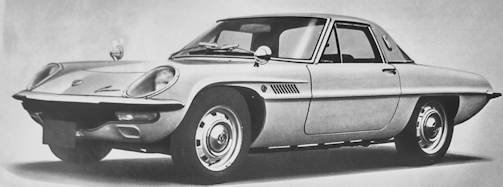
Mazda Cosmo Sports First generation
 |
|
|
country of manufacture |
Japan |
|
Production |
1967 to 1972 |
|
design manager |
Kenichi Yamamoto |
|
designer |
Heiji Kobayashi |
|
body type |
2 door coupe |
|
engine position |
front |
|
Drive system |
rear wheel drive |
|
engine |
10A type 982cc 2 rotor |
|
Maximum output |
110PS/7,000rpm (L10A) |
|
Maximum torque |
13.3 kgf m/3,500 rpm (L10A) |
|
transmission |
4-speed MT (first term)/5-speed MT (late term) |
|
Wheelbase |
2,200/2,350mm (Early/Late) |
|
full length |
162.60 in, 4,130 mm |
|
Width |
62.80 in, 1,595 mm |
|
Height |
45.85 in, 1,165 mm |
|
vehicle weight |
2,117 1b, 960 kg |
|
Produced |
1176 |
The Mazda Cosmo sport 1st Generation was a small sports car from Japan built from 1967 to 1972.
History
In 1963 at the Japan Auto Show the Cosmo Sports Prototype was also displayed. The first time the Cosmo Sport prototype was made public was in October 1963.In August 1967 under the name of Mazda 110S, this production car with a two-disc Wankel engine was also the world's first car equipped with a two-disc more practical and mass-produced rotary engine. The world's first car with the single disc Wankel engine was released by the former NSU Wankel in 1964 Cosmo Sports began selling 343 units of the L10A model by 1967.
The Cosmo project was launched in December 1962 by Mazda. Mazda completed the first two-disc engine prototype in July 1963. The first mobile prototype of the Cosmo Sport was completed in August 1963. This was presented in October 1963 at the Tokyo Motor show, under the title "Project L402A".
The prototype engine L8A had a chamber volume of 2 × 398 cm³. The L8A still uses combined side and circumferential inlets. The L8A was further developed to the L10A and the chamber volume increased to 2 × 491 cm³. The circumferential inlets were eliminated and replaced with two additional side inlets in the front and the end of the engine. This improved the torque and driveability at low speeds. By October 1964, another prototype car was officially exhibited for the first time and again in 1966.
The L10A had an engine output of 110 hp (81 kW). The advancement L10B had the same chamber volume as the L10A, by changed control times one had increased the achievement of the engine on 128 HP (94 KW). Thus, the Cosmo Sport accelerated in 8.8 s to 100 km / h and reached 200 km / h.
In April 1966, Mazda produced 80 pilot series Cosmo Sport, of which delivered 60 pieces to dealers in Japan for field testing. From the first production version with the engine L10A (May 30, 1967 to July 1968) 343 pieces were produced.
Cosmo Sports’ early model L10A was a front-engine, rear-drive car equipped with a 10A rotary engine (491 cc x 2). With a high compression ratio of 9.4 and twin plugs, it produced 110 PS / 7,000 rpm and 13.3 kgf · m / 3,500 rpm. The car only weighed 940 kg. For the suspension, independent suspension with double wishbones and coil springs at the front and independent suspension at the rear were abandoned, but a de Dion axle was suspended with leaf springs to reduce un sprung weight.
The body, was a semi- monocoque system which was specially designed for mounting the rotary engine. The steering gear uses a quick rack and pinion format. The transmission was a 4-speed full synchro, and the brakes were Dunlop type discs on the front wheels and Alfin drums on the rear wheels. In addition, the brakes are tandem master cylinders with two independent front and rear systems, providing high safety in case one of them breaks down. The rotary engine was placed as low and rearward as possible, making full use of the concept of a front-midship that later became Mazda's identity.
The battery, which is a heavy item, was placed in the trunk in the early model, and in the late model it was housed in a case with a lid that was opened and closed with a knob provided behind the passenger seat. The aluminium instrument panel combined with the full - padded dashboard is unified in matt black, and the non-reflective glass gauges (from left: clock, fuel gauge, ammeter, speedometer, tachometer, oil temperature gauge, water temperature gauge). order) are arranged in an orderly fashion. The interior is fully trimmed with black vinyl leather, including the ceiling, and black and white houndstooth patterned wool is used only in the centre of the seat in consideration of breathability.
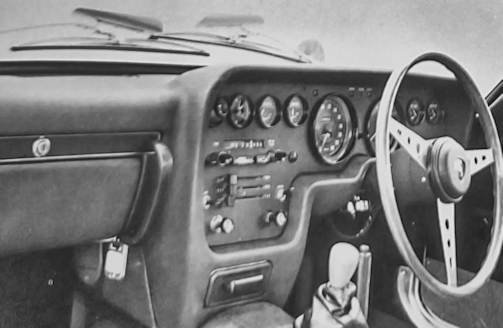
The interior design was handled by an interior team headed by Ryoichi Soma. Fitted with a three-spoke Nardi wood steering wheel that can be adjusted back and forth is standard. The floor covering is a bright red carpet, and the shift knob is in the position where the hand is naturally lowered, making it a short stroke that can be operated without moving the arm. Auto radio made by Clarion, semi- automatic antenna with a toggle switch that operates up and down, meter illumination adjustment, horn sound quality switching (for city use, high speed use), 2-speed wiper (Even if the switch is turned off during wiping, it returns to the stop position. glove box, trunk lamps were standard equipment.
The second production version with the L10B (July 13, 1968 to September 1972) was built 1176 times. Thus, a total of 1519 production vehicles (about 1599 included with pre-production vehicles) of the type Cosmo Sport were produced. The Cosmo Sport was only sold in Japan.
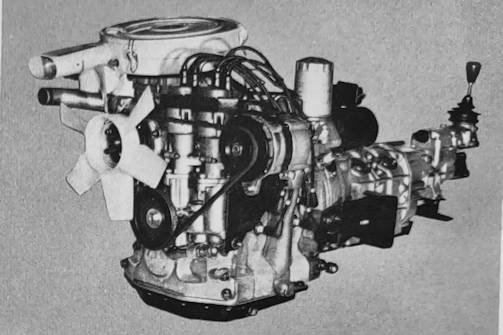
As early as July 1968, a minor change from L10A to L10B was carried out, expanding the radiator air intake, newly establishing a brake cooling port, expanding the wheelbase and tread, and increasing the transmission to 5 speeds, booster (Hydro master) to the front and rear brakes was installed. Radial tires were standardized (155HR15), and power was increased (110 PS / 13.3 kgf m to 128 PS / 14.2 kgf m) by improving intake efficiency due to port timing changes. As a result, the maximum speed increased from 185 km/h to 200 km/h, and the 0-400 m acceleration also decreased from 16.3 seconds to 15.8 seconds.
PERFORMANCE
- Engine capacity: 29.96 x 2 cu in, 491 x 2 cu cm
- Fuel consumption: 27 ml imp gal, 22.4 ml US gal
- Max speed: 124.3 mph, 200 kmlh
- Power-weight ratio: 16.5 lb/hp, 7.5 kg/hp
- Acceleration: standing 1/4 mile 15.8 sec
- Specific power: 130.5 hp/l
- Max speeds: 34.2 mph, 55 km/h in 1st gear; 55.9 mph, 90 km/h in 2nd gear; 83.9 mph, 135 km/h in 3rd gear; 115 mph, 185 km/h in 4th gear; 124.3 mph, 200 km/h in 5th gear
In addition, the four switches of the interior washer, wiper, dimmer, and turn signal are combined into one combination lever. 3-point seat belts and adjustable headrests were also equipped from the latter model. Parking (automatically turns off when the engine starts) and emergency lights were also installed.
The car was built 1519 times, excluding right-hand drive. It was a two-seater coupe; the body is in large parts and its engine made of aluminium. In 1968, it was built at a slightly lower total length with a longer wheelbase.
All generations have a coupe- type body (only the 3rd generation has a 4-door sedan), but its characteristics differ greatly depending on the generation. In addition, all but the third generation were sold with different names for each generation. Under the model’s name Cosmo until 1995 various successor models were produced.
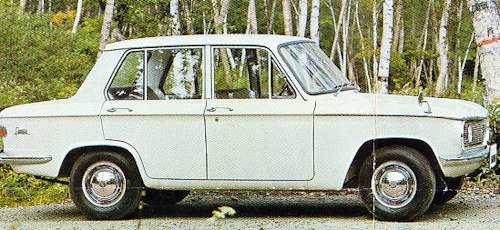
Mazda Familia 800 1000 1st Generation
 |
|
|
Production : |
1963 to 1967 |
|
Class: |
Motor Car |
|
Body versions: |
2/4 door sedan |
|
Engines: |
Gasoline: 0.8-1.0 litres (31-50 kW) |
|
Length: |
3635-3700 mm |
|
Width: |
1465 mm |
|
Height: |
1345-1390 mm |
|
Wheelbase: |
2140-2190 mm |
|
Curb weight: |
720-790 kg |
The Mazda Familia 1st Generation also as the "800" and "1000" was a car from Mazda made in Japan from 1963 to 1967.
History
The Mazda 800 was not offered in Europe. In 1965 this was only sold as the Mazda 1000 with a larger engine. Both vehicles were the first Mazda Familia in the home market.
At that time, Toyo Kogyo (Mazda), which was shifting its main products from three-wheeled vehicles to light cars and small trucks, it began development of two small cars, the Carol and the Familia. As a result of market research, Familia prioritized the development of a light van as a commercial vehicle. October 1963 - Started sales of light vans. The engine is a water-cooled straight 4 OHV 782cc engine with a larger displacement than the Carroll engine, maximum output 42PS/6,000rpm and maximum torque 6kgm/3,200rpm. It had five passenger seating and a load capacity of 400 kg when the rear seats were folded. The tailgate opened vertically and horizontally, and the upper door used a mechanism called a free stop that could be fixed at any position.
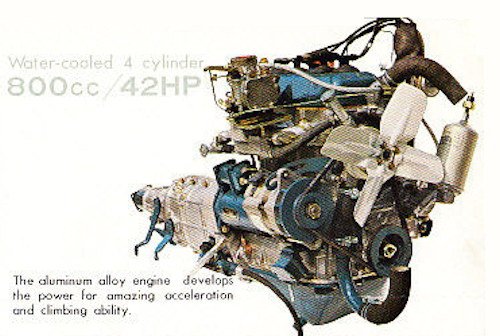
PERFORMANCE: Mazda Familia 1st Gen 800cc
- Engine capacity: 47.72 cu in, 782 cu cm
- Fuel consumption: 39.2 ml imp gal, 32.7 mlUS gal, 7.2 1 x 100 km
- Max speed: 71.4 mph, 115 km/h
- Max power (SAE): 42 hp at 6,000 rpm
- Max torque (SAE): 43 1b ft, 6 kg m at 3,200 rpm
- Max number of engine rpm: 6,000
- Specific power: 53.7 hp/l
- Power-weight ratio: 38.8 lb/hp, 17.6 kg/hp
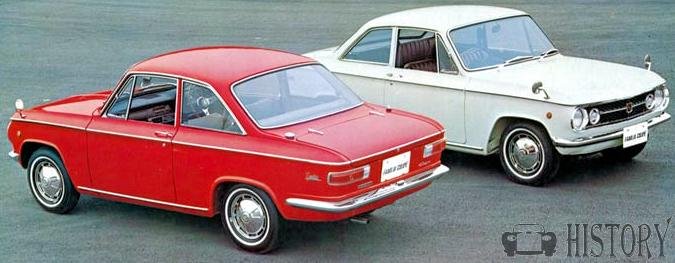
By April 1964 - "Familia Wagon 800" was added as a passenger type. A 4- door sedan, and was named "Familia Sedan 800." At this point, an all-aluminium alloy engine was installed, Furthermore, in November of the following month, a 2-door sedan model "Familia 2-door sedan 800" was added. November 1965 - Released "Family Coupe 1000" with 1.0L engine this replaced the 800 the Coupe 1000, which, in addition to a slightly different grille (black with a horizontal chrome bar), featured a 985 cc four-cylinder OHC engine with an output of 68 bhp (50 kW) at 6,500 rpm. The elegant car reached 145 km / h.
PERFORMANCE: Mazda Familia 1st Gen 1000cc
- Engine capacity: 60.10 cu in, 985 cu cm
- Fuel consumption: 32.1 m/imp gal, 26.7 m/US gal
- Max speed: 90 mph, 144.9 km/h
- Max power (SAE): 68 hp at 6,500 rpm
- Max torque (SAE): 59 1b ft, 8.1 kg m at 4,600 rpm
- Max engine rpm: 6,500
- Specific power: 69 hp/l
- Power-weight ratio: 25.6 lb/hp, 11.6 kg/hp
- Acceleration: standing 1/4 mile 20.3 sec
The sedans, coupes, and light vans were to be styled by Bertone, while the trucks were styled by Jiro Kosugi. At first the 800 (782cc engine) Then the 1.0L engine 2-door sedan added at the end of the year. The 1.0 l R4 engine. However, they limited themselves to an OHV design, which made only 58 bhp (43 kW) at 6,000 rpm. This reached a top speed of 135 km / h. In the same year, the successor was presented with the same engine, but larger body than 1000 Deluxe.
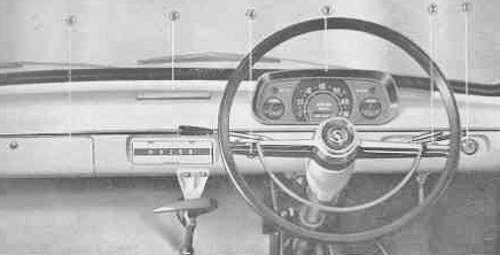
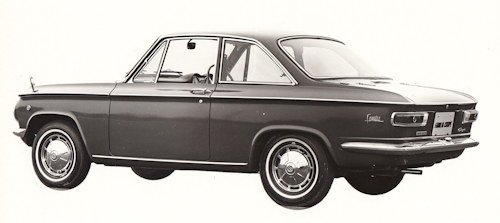
The very Basic 1.0L 2-door sedan was sold as a low-priced version so some seen as basic items were omitted such as window washer mechanism, which were not required to be installed at the time. The small car was available as a 2 or 4-door sedan and a 3-door station wagon in other markets the various types include the models as SSA as Familia 4-door ST, Familia 2-door ST, Familia 4-door /SPA Familia 1000 4 door ST, Familia 1000 2 door ST /MPA Familiar Coupe /MSAP Familia Wagon/BSAVD Familia Van /BSBVD Familia Van Auto /BPAV Familia 1000 Van/BSA55 Familia Truck and BPA55 Familia 1000 cc truck types. In total around 223,000 were built.
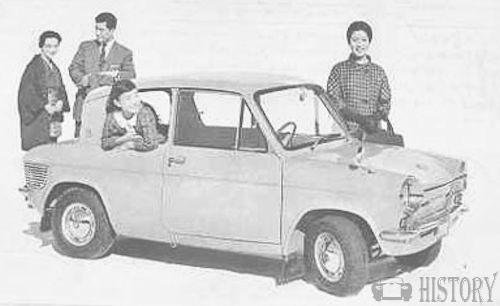
Mazda Carol 600 History
 |
|
|---|---|
| Production | 1962 to 1964 |
| body type | 4 door sedan |
| Drive system | rear engine rear drive |
| engine | 586cc in-line 4-cylinder OHV |
| Maximum output | 28PS/6,000rpm |
| Maximum torque | 4.2kgf m/4,000rpm |
| Wheelbase | 1,930mm |
| full length | 3,200mm |
| Width | 1,325mm |
| Height | 1,340mm |
| vehicle weight | 585kg |
The Mazda Carol 600 was a small car from japan built in the early 1960s for only 2 years.
History
With a larger 586 cc OHV engine, the Carol 600 made its debut in the fall of 1962. Although the prototype, the "Mazda 700," was introduced at the Tokyo Motor Show in 1961 as a 700cc sedan, the Carol was built and intended to replace it as a mainstay vehicle. It was, however, sold as a 360cc minicar. The 600 also marked Mazda's one millionth vehicle produced in 1963. It had a larger bumper and a more opulent interior and exterior than the 360, but the interior space was identical.February 1962 Production started. Initially, a 2-door was released, and in 1963, a deluxe 4-door was released, which was a big hit at first.The 600 was still as cramped as the 360 and underperformed new and established competitors, so the model was superseded after only two years by the Mazda 800 when production of the Mazda Family series began in 1964
Extra length was due to more prominent bumpers, passenger space was as restricted as in the 360. Weight ranged from 560 to 585 kg (1,235 to 1,290 lb). It was also available as a four-door sedan, ahead of the lesser Carol 360. The car was called the "600" or "P600" in export markets. At home, there was a Standard two-door, and DeLuxe two or four-door versions.

The Carol had a very strong monocoque body, a four-cylinder four-stroke engine with a five-bearing crankshaft and four-wheel independent suspension With integral type chassis, the front suspension of independent type with, twin swinging longitudinal trailing arms, rubber springs (torsion) and telescopic dampers,at the rear was also independent with swinging longitudinal trailing arms, rubber springs (torsion) and telescopic dampers., but this led to high production costs, comparably high weight, and its very comfortable ride was offset by cramped accommodation.Fitted with a transverse 4 cylinder 4 stroke 586cc water cooled engine and 1 Hitachi-Stromberg DCA 240 downdraught single barrel carburettor to a 4 speed gear box producing 28hp to the rear wheels.
PERFORMANCE: Mazda Carol 600 (1962-1964)
- Engine capacity: 35.76 cu in, 586 cu cm
- Fuel consumption: 45.5 mlimp gal, 37.9 mlUS 6.2 1 -x too km
- Max speed: 65.2 mph, 105 km/h
- Max power (SAE): 28 hp at 6,000 rpm
- Max torque (SAE): 30 1b ft, 4.2 kg m at 4,000 rpm
- Max number of engine rpm: 6,800
- Specific power: 47.8 hp/l
- Power-weight ratio: 46.1 lb/hp, 20.9 kg/hp
The Carol was an incredible success in the marketplace, capturing 67% of the Kei market in its first year. A better equipped DeLuxe version was added in May 1962, along with a changed angle of the rear window to help it stay clean.Production ended in November 1964, after the introduction of the more spacious Mazda Familia 800 sedan version. Around 8,800 Carol 600s were built.

Mazda Corporation History
Fuchu , Hiroshima , Japan

The company Mazda Motor Corporation (マツダ株式会社), is Japanese automobile manufacturer based in Fuchū since the 1930s.
History
Mazda Motor Corporation was founded in 1920 by Jujiro Matsuda as Toyo Cork Kogyō KK ( 東洋 コ ル 工業 株式会社 ) and dedicated to the refinement of cork. 1927, the company was changed in Toyo Kogyō KK. Machine parts were first manufactured in 1928, and from 1930 motorcycles were also produced. From this point on, the name "Mazda" was used.
By The mid-1930s, the development of motorized 3-wheel cars and trucks. During the Second World War, the company was involved in Japanese Armor. In 1950, Mazda resumed manufacturing small trucks with three or four wheels. Mazda played a key role after the nuclear attack on Hiroshima in 1945: the production plants and many vehicles inside survived the destruction thanks to a mountain placed in front of the explosion site, suffering very limited damage compared to the city. It is no coincidence that the plant became one of the main logistic points for the relief and subsequent reconstruction of Hiroshima.

By 1960 the first Mazda car appeared in Japan on the market the Mazda R360. In October 1960, Tsuneji Matsuda concluded a license agreement with the German company NSU for the use and further development of Wankel engines. This was approved in July 1961 by the Japanese government. From 1967 was Mazda 110 S Cosmo produced by a two-rotor Wankel engine. In April 1986, Mazda had produced 1.5 million vehicles with Wankel engine.
The Japanese company, which basically began to export its cars significantly abroad as well. Cars were equipped with both piston and rotary engines, trying to meet the needs of the world market. In 1968 Mazda began formal exports to Canada although Mazda’s had been on Canadian roads since the late 1950s. In 1970, Mazda also formally entered the US market and was immediately successful. The company quickly designed and produced the Mazda Rotary Pickup based on the more conventional piston-engine Mazda B exclusively for the North American market.

The 1973 energy crisis led US motorists to abandon Mazda's particularly fuel-intensive rotary engines. The car market was in fact evolving, with consumers particularly worried by now also about the fuel consumption of the cars they bought. Mazda found itself to be the Japanese company with the lowest productivity and Toyo Kogo found itself in 1975 on the brink. The company was saved by the intervention of Japanese banks. Following the Asian automobile financial crisis of 1997 Ford was forced to invest again in Mazda, The Ford Motor Company bought in 1979 25 percent stake in Mazda and 1996 increased its stake to 33.4 percent in 2008 but later sold 20 percent shares and in 2010 this again was reduced to 3.5 percent. Again, Ford In 2015, it sold its remaining interest and is no longer involved in the company.
In addition to the models shared with Ford, Mazda subsequently has the credit of producing the MX-5, which will become the best-selling roadster in the world, the first version of which dates back to 1989. In 1991, Mazda also achieved the breakthrough in motorsport. Mazda's first Mazda 787B, powered by a 700hp 4-wheel Wankel engine, was the first Japanese automaker to win victory in the 24 Hours of Le Mans, two laps ahead of Jaguar.
In August 2017 5% of Mazda is acquired by Toyota.
Some Mazda Models overview
- Mazda R 360 (1960-1964)
- Mazda Carol (since 1962, only in Japan)
- Mazda 800 / Mazda 1000 / Mazda 1300 (1963-1977)
- Mazda 1500 / Mazda 1800
- Mazda 121 (1988-2003)
- Mazda 323 (1977-2003)
- Mazda 616 (1970-1977)
- Mazda 626 (1979-2002)
- Mazda 818 (1973-1979)
- Mazda 929 (1973-1992)
- Mazda Xedos 6 (1992-1999)
- Mazda Xedos 9 (1993-2002)
- Mazda MX-3 (1991-1998)
- Mazda MX-6 (1987-1997)
- Mazda MPV (1988-2016, in Germany only from 1994 to 2005)
- Mazda Premacy (1999-2005)
- Mazda Tribute (2000-2008)
- Mazda Demio (1996-2003)
- Mazda B-Series (1994-2006)
- Mazda CX-7 (2006-2012)
- Mazda5 (2005-2015)
Models with Wankel engine

- Mazda 110 S Cosmo Sport (1967-1972) first wankel with two-disc engine
- Mazda R100 (1968-1975)
- Mazda R130 (1969-1972) Coupe with 13A Wankel engine
- Mazda RX-2 (1971-1974)
- Mazda RX-3 (1972-1977) versions coupe, sedan and caravan
- Mazda RX-4 (1972-1977) versions coupe, sedan and caravan
- Mazda rotary pickup (1973-1977) sold only in the US
- Mazda Parkway Rotary 26 (1974-1976) first bus with Wankel engine
- Mazda Road Pacer AP (1975-1977)
- Mazda RX-5 (1975-1981)
- Mazda Luce Legato (1977-1981) top version 929L
- Mazda Cosmo AP RX-5 (1981-1990)
- Mazda Luce (1981-1986) top version 929
- Mazda 929 Cosmo (1982-1987)
- Mazda Luce (1986-1991) top version 929
- Eunos Cosmo (1990-1995) upper classes - Coupe, first serial car with three-disc Wankel engine
- Mazda RX-7 (1978-2002) SA (FB), FC, FD series
- Mazda RX-8 (2003-2012)
Mazda B series First generation
 |
|
|
Make |
Mazda |
|
country of manufacture |
Japan ( Hiroshima City ) |
|
production |
1961 to 1965 |
|
body type |
2-door pickup truck |
|
Drive system |
rear wheel drive |
|
engine |
1.5L UA OHV inline 4 cylinder |
|
Wheelbase |
2,495 mm (BUA61) |
|
full length |
4,150 mm (BUA61) |
The B series is a pickup truck that was once manufactured and sold by Mazda the first generation from 1961 to 1965.
History
It was released in Japan as B1500 (BUA61) in August 1961. September 1962 Van goes on sale. After that, two types of double cab cars appeared.
The B1500 was sleeker and considerably more powerful than its Japanese competitors, but it was noticeably more expensive and sold poorly. This was the first model of the long-running "Proceed" series sold in Japan. This model was the only Japanese market model to be badged under the B-series name. Known overseas as the B-Series, it boasted a long track record. Since the main market was overseas, most of the produced cars are exported, and there are very few registrations in Japan.
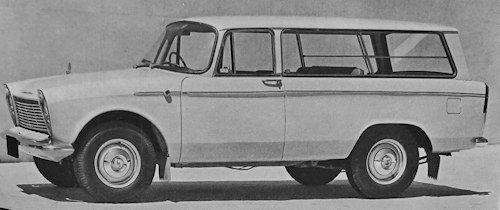
Available in various bodies with a one-ton payload. The Engine a 1,484 cc OHV water-cooled engine with cast iron head and block with wet sleeve cylinders and Carter H 30 GX downdraft carburettor which produced 44 kW (59 hp; 60 PS),
PERFORMANCE:
- Engine capacity: 90.76 cu in, 1484 cu cm
- Fuel consumption: 28.2 m imp gal, 23.5 m US gal
- Max speed: 68.3 mph, 110 km/h
- Max power (SAE): 60 hp at 4600 rpm
- Max torque (SAE): 76 1b ft, 10.5 kgm at 3000 rpm
- Specific power: 40.4 hp/l
- Power-weight ratio: 43.9 Ib/hp, 19.9 kg/hp
- Useful load: 1102 1b, 500 kg
This model also had front suspension with independent, wishbones, torsion bars, telescopic dampers, the rear suspension was rigid axle, semi-elliptic leafsprings, telescopic dampers, the distribution of weight 49 % to front axle, and 51 % at rear axle.The B1500 was later remodelled between late 1962 and September 1963; it received a new chassis code, BUB61.
There was a double-cab truck in addition to the typical two-door pickup truck body, as well as a pickup-style double-cab. The "pickup" was built on the rather passenger-oriented light van and had a completely integrated coupé utility body as opposed to the separate bed of the truck variant. The BUB61 had a larger cabin that was 80 mm (3.1 in) longer with a lengthened body and wheelbase. In place of the previous full-width grille, the BUB61's received a redesigned upside-down trapezoidal grille with thirteen bars rather than nine, turn signals on the fenders, and extra chrome trim, including a decor strip on the side. This model was a two-door, fully glazed van with a fold-down tailgate and an electrically powered window, which was rare in the Japanese market at the time.
The light van (BUAVD) was introduced in September 1962, and the two double-cab models followed shortly after. These three models were built on the shorter wheelbase chassis; when the longer chassis was introduced it was not deemed worthwhile to create new bodywork.
These models were produced for only a few months. The B1500 was sleeker and considerably more powerful than its competitors in the Japanese market, but it was also markedly more expensive and it failed to sell in the expected quantities.


