
Moskvich AZLK
- Details
- Parent Category: M
- Category: Moskvich AZLK
- Hits: 117
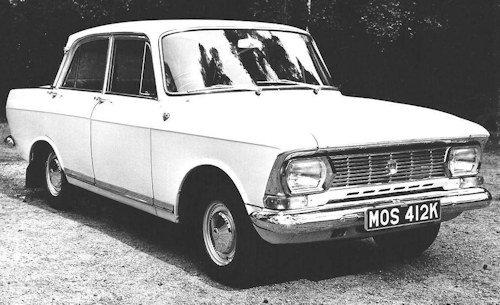
Moskvich 412-427-434
 |
|
|
Production period: |
1967 to 1976 |
|
Class: |
Motor Car |
|
Body versions: |
Saloon, station wagon, delivery van |
|
Engines: |
Gasoline engine1.5 litres |
|
Length: |
4090 mm |
|
Width: |
1550 mm |
|
Height: |
1440 mm |
|
Wheelbase: |
2400 mm |
|
Curb weight: |
1000-1045 kg |
The Moskvich-412 is a Soviet passenger car built from 1967 to 1976.
History
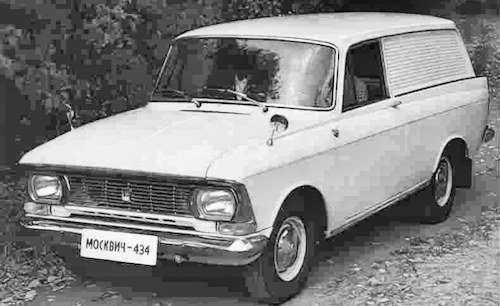
Based on the Moskvich-412 also created a version as a station wagon (as Moskwitsch -427) and a three-door van (Moskwitsch-434).
The manufacturer was the Moscow small car factory MZMA (МЗМА Russian, short for Московский завод малолитражных автомобилей,Moskovsky Zavod Malolitraschnych Awtomobilej , known by the use of the brand name Moskvich ), the 1968 car plant of Lenin's Komsomol , shortly AZLK (Russian АЗЛК, Автомобильный завод имени Ленинского комсомола, Awtomobilny zavod imeni Lenin skovo komsomola ) was renamed.
The vehicle was an evolution of the Moskwitsch-408 from 1964 and combined its robust construction with a new light-alloy engine, which provided 50% more power than the engine of its predecessor. With a close-to-production Moskwitsch-412 1974 international ADAC Rallye Tour de Europe was won, which led over 14,800 km through Europe and the Middle East. Body specification: All steel unitary construction. Opening quarterlights in front doors. Scuttle ventilator.Concealed petrol tank filler. Suspension: Front — independent with anti-roll bar and coil springs acting on unequal length wishbones. Rear-leaf spring. Telescopic shock absorbers Road wheels: 5 stud 4W steel. Tyres: 165 x 13" 4 ply.
When the new Moskvich-412 in 1967, came improvements although the manufacturer took over the previous proven body, the comfortable chassis and the ease of maintenance of its predecessor. This was no longer comparable with the Moskvich-408 thanks to its new engine the performance of the vehicle had increased by 50% from 50 hp to 75 hp (55 kW). The transmission was improved and the braking power was adapted to the new engine performance, so that the Moskwitsch-412 for the first time in the socialist car construction the car now received needed a vacuum brake booster. Later, it was also the first, provided with a safety steering column has been fitted, which collapses on impact. The light-alloy engine with the designation UZAM-412 was the most important innovation on the Moskvich-412. The first prototypes appeared in 1964, the series production began in 1967.
Designed in the mid-1960s, the Moskwitsch-412's new OHC engine was based in many ways on the M10 "New Class" engine developed by BMW in the early 1960s, which at that time contained many of the modern design features of automotive engine construction united. But there are no parts that are interchangeable with the two engines. A major difference is in the engine block, which consists of gray cast iron in the M10, and aluminium in the 412 with replaceable cylinder liners. It was still installed until the end of the 1980s in another two vehicle generations (all Moskwitsch-2140 and all 1500 cc models of the Moskvich-2141).
The engine has a displacement of 1478 cc, makes 75 hp (80 hp to SAE) and the car reaches with him a top speed of at least 140 km / h according to the factory, contemporary vehicle tests measured speeds up 150 km / h. The new engine brought the following innovations with it Light metal engine block with replaceable cylinder liners ("wet cylinder liners”) Cross-flow cylinder head made of aluminium with hemispherical combustion chambers (Hemi construction) and V-shaped valves, overhead camshaft, driven by a timing chain (OHC)
PERFORMANCE: Petrol
- engine capacity: 90.31 cu in, 1,480 cu cm
- fuel consumption: 32.1 m/imp gal, 26.7 m/US gal, 8.8 1 X 100 km
- max speed: 87 mph, 140 km/h
- max power (SAE): 80 hp at 5,800 rpm
- max torque (SAE): 85 1b ft, 11.8 kg m at 3,500 rpm
- max engine rpm: 6,500
- specific power: 54 hp/l
- power-weight ratio: 25.1 lb/hp, 11.4 kg/hp
PERFORMANCE: Diesel
max speed: 75 mph, 120 km/h
max power (SAE): 62 hp at 4,000 rpm
power-weight ratio: 35.6 lb/hp, 16 kg/hp
fuel consumption: 43.5 m/ imp gal, 36.2 m/US gal
The first plant images from 1967 show the new Moskvich-412, although already with new rectangular headlights and horizontal tail lights, this did not go at first but in series. Probably for capacity reasons, the model 412 was built at the beginning of its series production always parallel to the model 408, it did not differ in the external body shape at any time. The Moskvich-412 took over the Moskvich-408's body with single or double round headlights and vertical taillights. The externally visible differences between the two types were low very: Some models got the lettering Moskvich-412th The speedometer type 412 showed a top speed of 160 instead of 140 km / h. These early 412 models with round headlights from the years 1967 to 1969 can only rarely be found today. The main reason for this was the initially small number of units due to the parallel construction and relocation of MZMA to the new production facilities in Moscow.
The year 1969 brought the facelift for the Moskwitsch-412 (as well as for the type 408) with rectangular headlights and horizontal taillights. With the revised body came calculated crush zones and an interior without injury-prone controls to meet the new international vehicle safety standards and to remain exportable.
The name IE (Russian ИЭ) stands for "исполнение экспортное", literally translated "export execution". Later, the export models also received a safety steering column.Aswell as a 1.3-litre engine only for export, capacity 82.99 cu in, 1,360 cu cm, max speed 80.8 mph, 130km/h.Standard equipment for export : 2-speed motorised heater and demister. Radiator blind. Windscreen washers. Reversing lights. Cigar lighter. Front towing eyes. Mudflaps. Armrests on all doors. Clothes hooks and grab handles.Fully reclining front seats. Parking lights. 2-speed self-parking wipers. Twin sun visors. Fully instrumented dashboard. Comprehensive tool kit.Safety equipment: Laminated screen. Collapsible steering column. Burst-proof locks. Padded dash. Dished steering wheel. Anti-dazzle driving mirror.
The models were built until 1975/76 and then further developed to the types 2140 and 2138. Again, it stayed with the principle to use the same body for both models. Perhaps it was originally intended that the Moskvich-408 will be completely replaced by the 412 types. In fact, however, it was still built in parallel for the domestic market in the Soviet Union and low export figures, and as Moskwitsch-2138 until the 1980s. One reason for this was that the engine of the Moskvich-408, unlike that of the Moskvich-412 and the new Lada models, was also equipped with the low-octane gasoline, which was widely used in the Soviet Union.
In 1976 the Moskvich-412 was replaced by Moskvich-2140. Judging by its technical services and in exports (1975 exported AZLK in 70 countries in the world) it can be assumed that the Moskvich-412 was the most successful Moskvich. None of his predecessors and none of his successors were able to compete similarly in international comparison.
Although there was no shortage of promising prototypes (Moskwitsch Series 3-5 of 1970, Moskwitsch Series S of 1975), his successor, the Moskwitsch-2140, only made external improvements without modernizing the chassis, gearbox, body and engine.
In 1968, four Moskvich-412s took part in the 15,000 km London-Sydney Rally (London-Sydney Marathon) for the first time. Externally, the vehicles still had the "old" 408-body, inside worked already the new 1500er light metal engine. They were the only participants from socialist production and they were almost unknown exotics. The rally was murderous and about half of all started international vehicles remained on the road. But all four Moskvich came to the surprise of the international press at the goal. After this success, the export figures increased significantly. Later, these long-distance rally successes were repeated at the 1970 World Cup Rally, in which, after a legendary 25,000 km of over 100 started vehicles, only 23 arrived in Mexico City. Three of them were Moskvich-412.
From 1967, the Moskvich-412 was also manufactured in Ischmash branch in Izhevsk . The vehicles from this production were intended solely for the Soviet internal market. They differed in structure and the interior initially only in a few details of the Moscow model, but were apparently included less in the facelift, so the dashboard and radiator sections were adapted to them later. Emerged from Moskvich-412 with Kalashnikov Concern total of 2,317,439 copies, the production was in 2001 adjusted for 34 years., the models were derived from it ISCH-2715 (Pickup) and ISCH-2125(Combi with hatchback). They were built from 1972 and 1973 respectively. The ISCH-2715 produced 1,076,954 vehicles, the ISCH-2125 a total of 414,187 copies. Both models were like the Moskvich-412 produced similar long in Izhevsk.
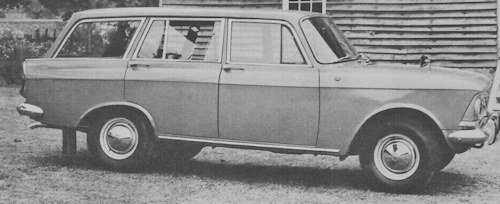
As with its predecessor, the Moskwitsch-412 also built a station wagon and a van in addition to the sedan.
production cars
- Moskvich-412 - Limousine, four-door.
- Moskwitsch-412IE - Basic model with limousine body, from 1969 also built for export.
- Moskwitsch-412Ju - Basic model with limousine body, for export to countries with tropical climate.
- Moskvich-412M - For transportation of medical personnel and material, for example to carry out home visits to patients.
- Moskvich-412P - Export version as right-hand drive.
- Moskvich-412PJu - Export version as right-hand drive, for tropical areas.
- Moskvich-412T model, specially equipped and painted as a taxi.
- Moskvich-427 - version as five-door station wagon.
- Moskwitsch-427P - Five-door station wagon for export, right -hand drive.
- Moskvich-434 - closed box van with only two doors + a hinged door at the rear. Payload 550 kg.
- Moskvich-434P - panel van in export execution as right-hand drive.
prototypes
- Moskvich-434G - Based on the chassis of the delivery van, but with pick-up body. Built in 1976, but never went into production. Ischmasch built a similar vehicle as a version of the ISCH-2715 in large numbers.
- Details
- Parent Category: M
- Category: Moskvich AZLK
- Hits: 38
Moskvich 408-426-433
 |
|
|
Sales designation: |
Москвич-408,Москвич-426,Москвич-433 |
|
Production period: |
1964 to 1975 |
|
Class: |
Motor car |
|
Body versions: |
Limousine, estaate station wagon, panel van |
|
Engines: |
Gasoline :1.36 litres(37 kW) Desiel :1760 cc Perkins diesel I4 |
|
Length: |
4090 mm |
|
Width: |
1550 mm |
|
Height: |
1440 mm |
|
Wheelbase: |
2400 mm |
|
Curb weight: |
990-1055 kg |
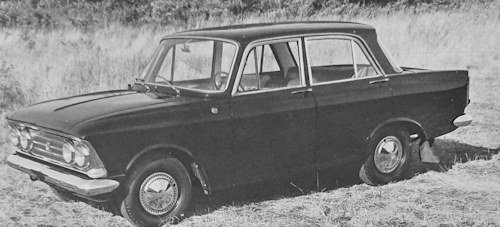
The Moskvich-408 is a passenger car of the Soviet Union built from 1964 to 1975.
History
The manufacturer Moskovsky Sawod Malolitraschnych Awtomobilej (short MZMA, from 1968 AZLK for Awtomobilny Sawod imeni Leninskovo Komsomola, known by the use of the brand name Moskvich), from 1964 to 1975 in series built the car. He is the successor of the Moskvich-403, for the MZMA already used the ground group of the Moskvich-408. From 1967 the Moskwitsch-412 was manufactured in parallel, which differed mainly by a stronger engine. Under the name Moskvich-426 (Russian Москвич-426) from 1967 a version was built as a station wagon, the Moskvich-433 is a closed box van. The latter was produced from 1966.
The development of the Moskvich-408 began in 1959. The prototypes differed externally from the later production vehicle. Compared to the predecessor Moskwitsch-403, the car received a new body with its distribution of weight: 54% front axle, 46% rear axle. The suspension has also front suspension with independent, wishbones, coil springs, anti-roll bar, telescopic dampers and the rear suspension is rigid axle, semi-elliptic leaf- springs, telescopic dampers. been redesigned. Its development was completed early, so it was already used in the Moskvich-403. The series production began in 1964.
The Moskvich-408 had some technical innovations. Brake system and engine have been revised. The bonnet will now open to the front. The vehicle received in the early years a steering wheel circuit and front a full-length bench with adjustable backrest. Later, a stick circuit was installed, accordingly, there were two separate front seats. Beginning in 1967, the vehicle was adapted to the design and engineering of the Moskvich-412. The first body in which equally both engines could be installed, was number 199706 and ran on 17 October 1967. Already on 18 May of the same year, the 1-millionth vehicle in the company's history was built, a Moskvich-408. Moskvich 4 x 4 Saloon, with 4-wheel drive, gearbox with transferbox (1.15 and 2.68 ratios), rigid axle on front and rear suspension with semi-elliptic leafsprings, overall height 66.34 in, 1,685 mm, ground clearance 8.66 in, 220 mm,dry weight 2,359 1b, 1,070 kg, power-weight ratio 39 lb/hp, 17.7 kg/hp, max speed 62.1 mph, 100 km/h.
In October 1968, the manufacturer changed the name of MZMA to AZLK. the vehicle was revised Optical 1969 at the latest let off this time-built models from the outside not from Moskvich-412 differ, only the engine of the two types was different. can be recognized by these cars to the rectangular headlights and the radiator grille with a larger rectangular structure. The production of the second series was established in December 1975 in favour of the Moskvich-2138.
The Moskvich-408 was an important export commodity. At times more than 55% of the factory's production was exported to Moscow. The vehicle not only went to socialist countries such as the GDR, but also to western countries. In Scandinavia he was sold as Moskwitsch Carat, in France and other European countries as Moskwitsch elite 1360. The name change was also made because Peugeot used a similar numbering scheme. At Scaldiain Belgium Moskvich-408 were equipped with a diesel engine. From 1967, the car was also exported to the Federal Republic of Germany and had in comparison to competing models a good standard equipment. max speeds for petrol version: 15 mph, 24.1 km/h in 1st gear; 27 mph, 43.5 km/h in 2nd gear; 49 mph, 78.9 km/h in 3rd gear; 74.5 mph, 120 km/h in 4th gear power-weight ratio: 32.9 lb/hp, 14.9 kg/hp.
Between 1966 and 1967 the Moskvich was also built in the Ischmash factory in Izhevsk. There, however, it was replaced after a year of production by the stronger Moskwitsch-412. In Bulgaria, there was also a license production in the city of Lovech between 1966 and 1975.
Model Variants
From the Moskvich-408 different versions were built, also some prototypes existed based on this vehicle.
- Moskvich-408 - Basic model with limousine body, built from 1964 to 1975.
- Moskvich-408IE - Basic model with limousine body, for export.
- Moskvich-408Ju - Basic model with limousine body, for export to countries with tropical climate.
- Moskvich-408B - Like the basic version, however, all controls have been retrofitted to suit people with physical disabilities (manual control).
- Moskvich-408M - For transportation of medical personnel and material, for example to perform home visits to patients.
- Moskvich-408P - export version as right-hand drive.
- Moskvich-408T model, specially equipped and painted as a taxi.
- Moskvich-426 - From 1967 built version as a four-door station wagon.
- Moskvich-426P - Four-door station wagon for export, right -hand drive.
- Moskvich-433 - From 1966 built version as a closed box van with only two doors.
- Moskwitsch-433P - Panel van in export execution as right-hand drive.
- Moskvich-408-Tourist - Prototype as Grand Tourismo, never built-in series. 2 + 2-seater, convertible with hardtop.

