
Mercury
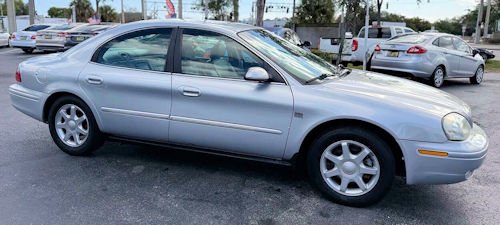
Mercury Sable 4th generation
 |
|
|
Production |
1999 to 2005 |
|
Assembly |
USA |
|
Body style |
4-door sedan, station wagon |
|
Layout |
FF layout |
|
Platform |
Ford D186 platform |
|
Related |
Ford Taurus |
|
Engine |
3.0 L Vulcan V6 |
|
Transmission |
4-speed AX4N automatic |
|
Wheelbase |
108.5 in (2,756 mm) |
|
Length |
197.8 in (5,024 mm) (station wagon) |
|
Width |
73.0 in (1,854 mm) |
|
Height |
57.8 in (1,468 mm) (station wagon) |
|
Curb weight |
3,375 lb (1,531 kg) (sedan) |
The Sable received at the end of 1999, another facelift, in which the oval design forms were weakened. With the new design, the vehicle also received a higher roof line above the rear, resulting in more headroom as well as an increased trunk volume. The interior has been completely redesigned, in a less polarizing, much more conventional design, along with revisions to suspension, instrument graphics, and interior door panels . The suspension has been softened to meet a wider, less sporty clientele. To reduce the production costs accounted for some features of the predecessor such as four-wheel disc brakes. Buyers have a choice of 5 or 6-passenger seating at no extra charge a 2-passenger rear-facing third seat is still a wagon option.
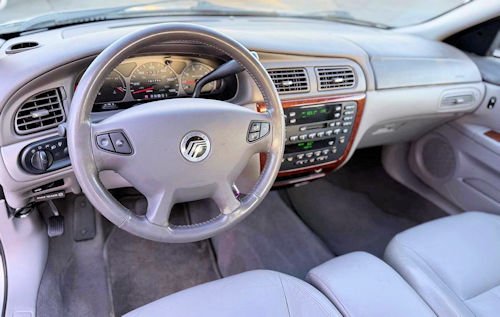
1999 changes to Ford Taurus's Mercury cousin only differs slightly in styling and available features. Sedans come in GS and LS trim; the wagon comes now only as an LS.
The base powertrain comprises an overhead-valve V-6 and automatic transmission, optional is a more-powerful double-
overhead-cam V-6 anti-lock brakes also an option .
The Sable of the year 2002 possessed in each equipment level extensively designed equipment, among other things with an audio system with CD player and an electrically adjustable driver's seat in the GS version, an electric sunroof and leather interior in the LS version. Side airbags and traction control were now available as extras for all models.
In the fall of 2003, the Sable learned minor cosmetic changes to the front end, especially in the form of a new chrome grill, and modifications in the rear area. In the interior, the instruments and the steering wheel have been redesigned.
Since the Mercury brand was no longer offered in Canada, the fourth generation of the Sable was no longer available there and was sold exclusively in the US and Mexico.
As successor of the Sable the Mercury Montego (2004) and the Mercury Milan(2005) were presented. Shortly after the introduction of the Montego the Sable was discontinued, coinciding with the Taurus station wagon. The Taurus was initially manufactured as a sedan for major customers. The last Sable left the production facility in Atlanta on April 29, 2005.
Mercury Sable Second generation
 |
|
|
Production |
1991 to 1995 |
|
Assembly |
USA |
|
Designer |
Jack Telnack |
|
Body style |
4-door sedan ,station wagon |
|
Layout |
FF layout |
|
Platform |
Ford DN5 Platform |
|
Engine |
3.0 L Vulcan V6 |
|
Transmission |
4-speed AXOD-E/AX4S automatic |
|
Wheelbase |
106 in (2,692 mm) |
|
Length |
192.2 in (4,882 mm) (sedan) |
|
Width |
71.2 in (1,808 mm) |
|
Height |
54.4 in (1,382 mm) (sedan) |
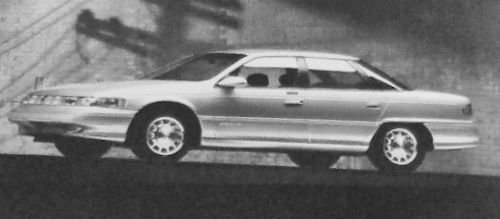
The Sable received in autumn 1991 first major body modifications. In addition to the front end and the rear, the interior was modernized, for which Ford invested $ 650 million. The new model brought it back to 103,000 units sold in 1992 despite the recent weakening sales figures of its predecessor. Although the design language remained largely unchanged, each body part except the roof was redesigned. The redesigned interior was available on request with side airbags, then a novelty in the middle class. Sable comes as a 4-door sedan and 5-door wagon in base GS and LS form.
In 1993, unpopular extras such as the InstaClear called heated windshield were no longer on offer. A passenger side airbag was from 1993 to the basic equipment, 1994, the driver's airbag revised and modified the steering wheel.The Sable's vocation has always been different from that of the Taurus. First, it didn't experience the widespread distribution of the Taurus to institutional or commercial fleets. Instead, it was purchased by executives, this car occupying a higher position in the hierarchy of models in the Ford family. Mercurys are always more luxurious than Fords, and the Sable is no exception. Higher prices therefore put it within the reach of a smaller number of buyers. It is also interesting to consider that Ford could have also insisted on counting sales of the Sable and Taurus, cars that are almost mechanically identical.
The combined version of the Sable was usually available with the same options as the sedan. The estate models had a luggage volume of a maximum of 2294 liters with folded rear seat. Was this set up (in proportion 60/40 divisible), the trunk still held 1274 liters.
A 3.0-liter V-6 is standard and a 3.8-litre V-6 is an option. Horsepower is 140 on both, but the 3.8 has 215 pounds/feet of torque to the 3.0's 160.both with 4-speed automatic is the only transmission 3.8-litre averaged just 17.3 mpg.
The wagon also had a separately hinged rear window and a roof rail, a third row of seats available on request, which was aligned against the direction of travel, a lockable compartment in the underbody and optionally an extendable picnic table. Combi models with one continuous front seat and one additional third row of seats could carry up to eight passengers. Bumpers and body cladding become body-colored by 1993, and a remote keyless entry is now available on LS version.
The last year of production of the second model generation was 1995. For this model year, the equipment line LTS was added to the offer. It featured leather seats, light-alloy wheels adopted by the Taurus LX, special plastic skins on the bodywork and a part leather interior. The LTS came standard with the three-liter Vulcan engine or, on request, the 3.8-liter Essex engine.
From the Sable of the first and second generation a total of 1,090,450 copies emerged in 10 years.
Mercury Sable 1st generation
 |
|
|
Production period: |
1986 to 1991 |
|
Body versions: |
Sedan, station wagon |
|
Engines: |
Gasoline: 2.5-3.8 Liters (65-104 kW) |
|
Length: |
4849-4874 mm |
|
Width: |
1796 mm |
|
Height: |
1377-1400 mm |
|
Wheelbase: |
2692 mm |
|
Curb weight: |
1274-1525 kg |
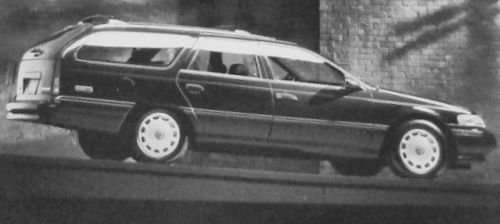
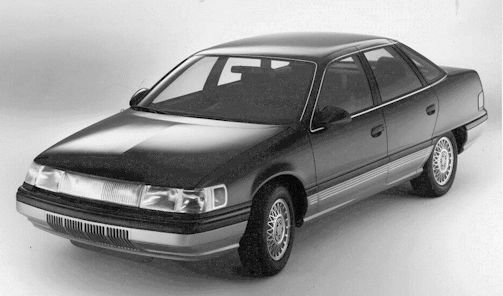
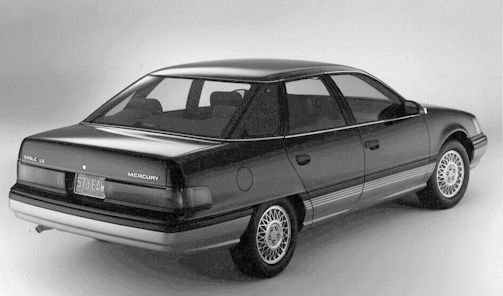
In December 1985 Mercury presented as a successor of Mercury Marquis the very modern, aerodynamically designed and futuristic Sable with front wheel drive as 4-door sedan 5-seater 5-door station wagon.
History
The Mercury Sable was a 1986 to 2009 produced car model of the US, the Ford belonging Corporation brand Mercury. The Sable was based on the largely identical Ford Taurus. In the meantime, from 2005 to 2007, it was replaced by the Mercury Montego, after a major overhaul to the model year 2008 but again sold under the name Sable.
Judging by the impressive order books for the Sable and Taurus, North Americans fell in love with them without hesitation. This was one of the great unknowns when these sedans and station wagons were launched, which had everything it took to revolutionize this market segment in America. But first, the car's shapes had to be accepted, more radical than those of the Tempo/Topaz and Cougar/T-Bird, which had done a good job of pioneering the market since 1983. Clearly, they succeeded brilliantly. For the rest, carefully designed interiors, a decent engine, and well-above-average handling, The production of the Sable was discontinued on May 21, 2009.
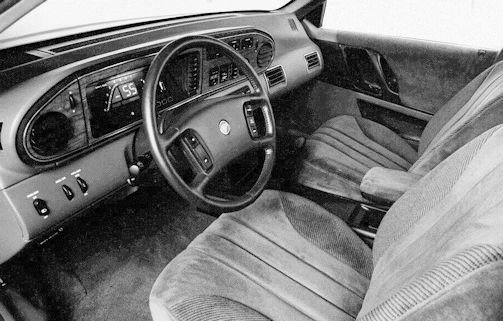
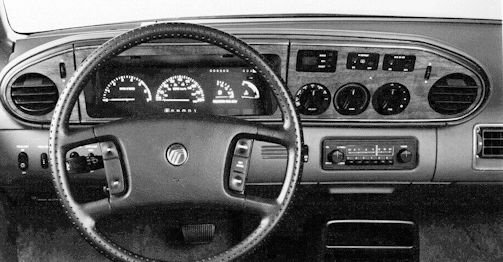
Standard drivers-side air bag and newly optional anti-lock brakes. ABS is available only on sedans, and replaces the rear drums with discs. The dashboard and instrument cluster are new, and slide-out coin and cup holder trays have been added. A tilt steering column is now standard, and a compact-disc player is a new option. Sable is a plusher version of the Ford Taurus and comes in GS and LS grades.
Power is supplied by a standard 3.0-liter V-6 or an optional 3.8-liter V-6. Ordering the 3.8 this year brings variable assist power steering. The only transmission
is a 4-speed overdrive automatic. In the first model year, customers had the choice between a 66 kW (90 hp) HSC four-cylinder in combination with a three-speed automatic or a 104 kW 3.0-liter Vulcan V6 coupled with a four-speed automatic transmission. The V6 engine proved to be the more popular and successful variant. The sales of the four-cylinder models were so disappointing that these versions were removed from the program in 1987 also updates are minimal and consist of minor details (more powerful battery, small accessories added to standard equipment, etc (the Taurus they were still available until 1991). Ford's 3.8-liter Essex V6 was added to the engine range in 1988.
Despite the identical with the Vulcan V6 power of 104 kW (141 hp), the Essex had thanks to its larger displacement, a higher torque of 291 Nm, which was especially welcome in the heavier combi variants. However, the Essex 3.8 suffered reliability problems with the cylinder head gaskets. Cooling problems also occurred.
Over the years, the Sable learned only minor modifications, mainly in the areas of equipment and design.
In the autumn of 1991, after sales had dropped to just under 90,000 copies, the second generation of Sable was introduced.
Mercury Cougar First generation
| 1967–1970 | |
|---|---|
 |
|
| Overview | |
| Model years | 1967–1970 (1969–70 are the second body shape) |
| Assembly | United States: Dearborn, Michigan |
| Body and chassis | |
| Body style | 2-door hardtop coupe 2-door convertible |
| Layout | FR layout |
| Related | Ford Mustang |
| Powertrain | |
| Engine | 289 cu in (4.7 L) Windsor V8 390 cu in (6.4 L) FE V8 302 cu in (4.9 L) Windsor V8 351 cu in (5.8 L) Windsor V8 428 cu in (7.0 L) FE V8 427 cu in (7.0 L) FE V8 |
| Dimensions | |
| Wheelbase | 111 in (2819 mm) |
The introduction of the Cougar finally gave Mercury its own pony car. Slotted between the Ford Mustang and the Ford Thunderbird, the Cougar would be the performance icon and eventually the icon for the Mercury name for several decades. The Cougar was available in two models (base and XR-7) and only came in one body style (a two-door hardtop). Engine choices ranged from the 200 hp (149 kW) 289 in
- PERFORMANCE: 289 cu in
- Engine capacity: 289 cu in, 4,735.84 cu cm
- Fuel consumption: 18.3 m/imp gal, 15.3 m/US gal, 15.4 1 X 100 km
- Max speed: 112 mph, 180.3 km/h
- Max power (SAE): 200 hp at 4,400 rpm
- Max torque (SAE): 282 1b ft, 38.9 kg m at 2,400 rpm
- Max engine rpm: 4,600
- Specific power: 42.2 hp/l
- Power-weight ratio: 15.7 lb/hp, 7.1 kg/hp
Two-barrel V8 to the 335 hp (250 kW) 390 in3 four-barrel V8. A notable performance package called the GT was available on both the base and XR-7 Cougars. This included the 390 in3 V8, as well as a performance handling package and other performance enhancements.
- Performance: 390 cu in
- Engine capacity 390 cu in, 6,390.93 cu cm
- Max power (SAE) 320 hp at 4,800 rpm
- Max torque (SAE) 427 1b ft, 58.9 kg m at 3,200 rpm
- Max speed 123 mph, 198 km/h,
- Fuel consumption 14.7 m/imp gal, 12.2 m/US gal, 19.21 x 100 km.
The 1967 Cougar, with the internal code T-7, went on sale September 30, 1966. It was based on the 1967 refaced first-generation Mustang,but with a 3-inch-longer (76 mm) wheelbase and new sheet metal. A full-width divided grille with hidden headlamps and vertical bars defined the front fascia—it was sometimes called the electric shaver grille. At the rear, a similar treatment saw the license plate surrounded on both sides with vertically slatted grillework concealing taillights (with sequential turn signals), a styling touch taken from the Thunderbird. A deliberate effort was made to give the car a more "European" flavor than the Mustang, at least to American buyers' eyes. Aside from the base model and the luxurious XR-7, only one performance package was available for either model: the sporty GT. The XR-7 model brought a simulated wood-grained dashboard with a full set of black-faced competition instruments and toggle switches, an overhead console, a T-type center automatic transmission shifter (if equipped with the optional Merc-O-Matic transmission), and leather/vinyl upholstery.

Mercury Cougar First generation XR-7
The GT package, meanwhile, supplied a much larger engine, Ford's 390-in3 (6.4 L) FE-series big block to replace the small-block 289-in3 (4.7 L) standard powerplant. Along with this came an upgraded suspension to handle the extra weight of the big engine and give better handling, more powerful brakes, better tires and a low-restriction exhaust system. Introduced with the music of Herb Alpert and the Tijuana Brass' The Work Song, the Cougar was a sales success from its introduction and helped the Lincoln-Mercury Division's 1967 sales figures substantially. The Cougar was Motor Trend magazine's Car of the Year for 1967.
The Cougar continued to be a Mustang twin for seven years, and could be optioned as a genuine muscle car. Nevertheless, it gradually tended to shift away from performance and toward luxury, evolving into something new in the market — a plush pony car. The signs were becoming clear as early as 1970, when special options styled by fashion designer Pauline Trigère appeared, a houndstooth pattern vinyl roof and matching upholstery, available together or separately. A reskinning in 1971 saw the hidden headlights vanish for good, although hidden wipers were adopted. Between 1969 and 1973, Cougar convertibles were offered.
Not much changed for the Cougar in its second year. The addition of federally mandated side marker lights and front outboard shoulder belts were among the minor changes, but the biggest changes were under the hood and in performance for the XR-7 model. A 210 hp (157 kW) 302-in3, two-barrel V8 was the base engine on all XR-7s and early standard Cougars. Three new engines were added to the option list this year: the 230 hp (172 kW) 302-in3, four-barrel V8; the 335 hp (250 kW) 428-in3, four-barrel V8; and the 390 hp (291 kW) 427-in3, four-barrel V8. In addition, the 289-in3 engine was made standard on base cars without the interior decor group midway through the model year.
PERFORMANCE: 302 cu in
- Engine capacity: 302 cu in, 4,948.87 cu cm
- Fuel consumption: 17.7 m/imp gal, 14.8 m/US gal, 15.9 1 X 100 km
- Max speed: 114 mph, 183.5 km/h
- Max power (SAE): 210 hp at 4,600 rpm
- Max torque (SAE): 300 1b ft, 41.4 kg m at 2,600 rpm
- Max engine rpm: 4,600
- Specific power: 42.4 hp/l
- power-weight ratio: 15 lb/hp, 6.8 kg/hp
There were many comfort and performance options available for the Cougar, including (at least by 1968, tilt and telescoping?)steering wheel and a power driver's seat that could be swiveled for ease of entry/egress.
Mercury was serious about the Cougar being the performance icon for the company. The XR7-G, named for Mercury road racer Dan Gurney, came with all sorts of performance add-ons, including a hood scoop, Lucas fog lamps, and hood pins. Engine selection was limited only to the 302, 390, and 428 V8. A total of 619 XR7-Gs were produced, and only 14 Gs were produced with the 428 CJ. The mid-year 7.0-L GT-E package was available on both the standard and XR-7 Cougars and came with the 427 V8. The 428 Cobra Jet Ram Air was available in limited numbers on the GT-E beginning 1 April 1968. Conservatively rated at 335 hp (250 kW), the 428 Cobra Jet could produce much more (306 kW (410 hp)) from the factory. A total of 394 GT-Es were produced, 357 with the 427 and 37 with the 428. The GT-E came with power front disc brakes as standard.
PERFORMANCE: 427 cu in
- Engine capacity: 427 cu in, 6,997.25 cu cm
- Fuel consumption: 13.1 m/imp gal, 10.9 mlUS gal, 21.6 1 X 100 km
- Max speed: 131 mph, 210.9 km/h
- Max power (SAE): 390 hp at 5,600 rpm
- Max torque (SAE): 460 1b ft, 63.5 kg m at 3,200 rpm
- Max engine rpm: 6,200
- Specific power: 55.7 hp/l
- Power-weight ratio: 9 lb/hp, 4.1 kg/hp
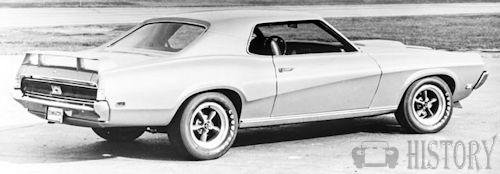
Mercury Cougar First generation XR7 Eliminator 1969
The third year of production, 1969, brought several new additions to the Cougar lineup. A convertible model was now available in either standard and XR-7 trim. These highly anticipated soft tops proved quite popular and today are considered, by many, among the most desirable of the '67-'70 production run. On the exterior, the grille switched from vertical bars to horizontal bars, and a spoiler and a Ram Air induction hood scoop were added as options. A new performance package appeared and several disappeared. The XR-7G and the 7.0-L GT-E disappeared, but the 390 and 428 V8s remained. The 290 hp (216 kW) 351 Windsor V8 was added to the engine lineup. The Eliminator performance package appeared for the first time. A 351-in3 four-barrel V8 was standard under the hood, with the 390 four-barrel V8, the 428CJ and the Boss 302 available as options. The Eliminator was the new top-of-the-line performance model of the Cougar lineup. It also featured a blacked-out grille, special side stripes, front and rear spoilers, an optional Ram Air induction system, and a more performance-tuned suspension and handling package. It also came in a variety of vibrant colors, such as White, Bright Blue Metallic, Competition Orange, and Bright Yellow. Only two Cougars came with the Boss 429 V8, making them the rarest Cougars ever built. Both were factory drag cars built for "Fast Eddie" Schartman and "Dyno" Don Nicholson.
PERFORMANCE: 351 cu in
- Engine capacity: 351 cu in, 5,751.84 cu cm
- Fuel consumption 17.1 mlimp gal, 14.2 mlus gal, 16.5 1 x 100 km
- Max speed: 117 mph, 188.4 km/h
- Max power (SAE): 250 hp at 4,600 rpm
- Max torque (SAE): 355 1b ft, 49 kg m at 2.600 rpm
- Max engine rpm: 4.600
- Specific power: 43.4 hp/l
- Power-weight ratio: 13.5 lb/hp, 6.1 kg hp

Mercury Cougar First generation convertible 1969
For 1970, the Cougar appearance was similar to the 1969 model, but numerous changes were made inside and out. It now sported a new front end which featured a pronounced center hood extension and electric shaver grille similar to the 1967 and 1968 Cougars. Federally mandated locking steering columns appeared inside, and the aforementioned new nose and taillight bezels updated the look on the outside. The 300 hp (224 kW) 351 "Cleveland" V8 was now available for the first time, though both the Cleveland and Windsor engines were available, if the buyer selected the base model two-barrel motor. The 390 FE engine was now dropped, and the Boss 302 and 428CJ soldiered on.
Total production: 1967: 150,893 1968: 113,720 1969: 100,069 1970: 72,343

Mercury Cougar First generation rear view 1967
On Her Majesty's Secret Service a Mercury Cougar XR7 driven by Contessa Teresa de Vicenzo (née: Tracy Draco, Tracy Bond) Red on Red 1969 Convertible, Driven by Tracy onto a Portuguese beach where she attempts suicide, later in a winter stock-car race on an ice-covered track to help Bond escape from Blofeld's henchmen and Irma Bund.
James bond On Her Majesty's Secret Service (1969)


